Eunuchs of history?

“I can’t stand these lustful eunuchs of history, all the seductions of an ascetic ideal; I can’t stand these blanched tombs producing life or those tired and indifferent beings who dress up in the part of wisdom and adopt an objective point of view.” Nietzche on the objectivity of historians

The Council of the American Historical Association rejected the affiliation application of Historians Against the War. HAW was informed of the rejection in a letter from AHA executive director Arnita A. Jones to Ben Alpers, who filed HAW’s request for affiliation, which read in part:

Dear Dr. Alpers:

I regret to inform you that the Council of the American Historical Association was not able to approve Historians Against the War’s application for affiliation. A majority of the members on Council were troubled by HAW’s membership criteria requiring anyone joining the organization to sign a statement opposing the war. Specifically, members believed this requirement establishes a political litmus test that conflicted with the AHA’s criteria for affiliation. (“The Association will not consider for affiliation any organization that discriminates on the basis of … ideology or political affiliation”). But more generally, a majority of the Council believed that the Association could not confer affiliate status on an organization focused on one side of a current
political debate, rather than historical study of the subject.

Given those concerns, we cannot accept your application at this time.

See a list of AHA affiliates here.

Call me Wayne. Please

Kenneth Wayne Riley has articulated well the bane (or at least an irritant) of my existence—even though it comes after my first name, my second name is still a name. Wayne.

I’m sure this is problem for all the folks who happen to go by their middle name, but it seems particularly problematic when, as an ex-pat, every form I sign requires me to list my name exactly as is appears on my passport. So it’s “Welcome Eddie” when I sign on to expedia.ca to buy airline tickets, “Hello Eddie” at the bank, etc.

Thanks to (Kenneth) Wayne Riley for sharing my pain (and articulating it so well).

The Globe and Mail
Facts & Arguments: THE ESSAY

Call me Wayne. Please
Even though it comes after my first name, my second name is still a name. Wayne. It means wagon maker

WAYNE RILEY

June 18, 2007

When I was a kid, Clint Eastwood was the Man with No Name. You would think that would be a problem, having no name, but in the Italian wild west nobody really seemed to be too hung up about it.

I am the Man With the Middle Name. I’m beginning to believe that is worse than having no name at all. It’s not that I have no identity. I just usually have the wrong identity.

My name is Kenneth Wayne Riley. I go by Wayne. You wouldn’t think that would be a problem. Even though it comes after my first name, my second name is still a name. Wayne. It means wagon maker. I looked it up.

But on certificates, notices that I’ve won a million dollars, unsolicited return-address stickers and almost anything else that has a name on it, I’m Kenneth Riley.
Print Edition – Section Front

Section L Front Enlarge Image
The Globe and Mail

In today’s world, everyone is on a first-name basis.

Over time, I’ve learned to adapt. I’ve trained myself to stand up in waiting rooms when someone calls for Kenneth.

I give money to charities asking for Kenneth’s help.

I sign for Kenneth’s parcels.

As you can see, I live under an assumed name.

Not that I’ve given up.

When I fill out a form, and they ask for my first and middle name, I always underline Wayne, sometimes twice. It never seems to help. Usually, the people who devise these forms don’t even want to know my middle name. In the line of little boxes across the top, they will ask for my first and last name and my middle initial.

I always draw a line out from the box for my middle initial and spell out Wayne. That doesn’t help either. Computers do not like people thinking outside the box.

I asked my mom once why, if she liked Wayne more than Kenneth, she didn’t simply name me Wayne Kenneth Riley.

“I just thought Kenneth Wayne sounded better,” she said.

It was much simpler as a kid. There were no computer forms to fill out, no mailing lists to be on, no telemarketers calling me at home. People either knew my name or asked me what my name was.

Sure, there were some other names along the way, like Stretch and Wiener and … well, just go to the thesaurus and look up other words for skinny. But Kenneth stayed nicely tucked in the background.

I don’t even remember exactly when Kenneth Riley came to life. It was around the time I started getting identification and credit cards. One day I looked in my wallet and realized that it belonged to a spy who didn’t like to stray too far in the alias department. There were cards for K. Wayne Riley, Kenneth W. Riley, Kenneth Riley and Wayne Riley.

And what’s with the Kenneth anyway? It’s awfully formal. If you are going to write to tell me that I’ve won an instant prize of a million dollars in a contest I didn’t even know about, hey, call me Ken.

Of course, being a little unique has its fun side, too.

I love it when my insurance agent, who has looked at my computer file while I’m in the waiting room, comes out with great familiarity, pumps my hand, and says, “Great to see you again, Kenneth.”

And this is after I’ve corrected him the past 12 years.

But one recent incident left me feeling like I had a split personality.

I have medical coverage that allows me to get a chunk of my medical expenses back when I submit a claim.

In this particular instance, when I opened what I thought would be a cheque from the insurance company, it turned out to be a note saying that my claim had been turned down.

I phoned to find out why. I gave the person at the other end of the line my coverage number and he reviewed my computer file.

“Wayne Riley doesn’t have a plan with us,” he said.

“But I’m Wayne Riley,” I said.

“The file name for this plan is Kenneth Riley,” he said.

“I’m Kenneth Riley,” I said, and quickly added, afraid that this was going to become an Abbott and Costello routine, “and Wayne Riley, too. Kenneth Wayne Riley.”

I eventually got the cheque but I know that guy on the other end of the line thought I was trying to pull a fast one.

I was talking about this stuff to a friend of mine one day and she laughed at me.

“You want me to have sympathy for you? I have five names and I go by my third. Talk to me about identity crisis.”

Another friend asked me the obvious question.

“Why prolong the headache?” he asked. Why don’t you just fill out the form as Wayne Kenneth Riley or Wayne K. Riley.

I shrugged.

“I just think it sounds better the other way.”

Wayne Riley lives in York, PEI. So does Kenneth Riley

R.I.P. Punk Planet

PP79_maxi.jpg
Yesterday the publisher of Punk Planet, a fiercely independent source of information on music, culture, and politics, announced that is it closing it’s doors.

Ironically, I had just read the latest issue and made a note about blogging on two education related articles in the current issue (PP79), looks like PP80 will the last issue after 13 years of publishing.

Independent magazines always have a rough go of it, but bad distribution deals, disappearing advertisers, and a decreasing audience of subscribers seem to have done PP in.

While not mentioned in the PP announcement, the new USPS regulations on periodicals, which were basically written by Time Warner, are having a dramatic impact on independent magazines. In its service to media conglomerates the USPS has essentially attacked threaten the dissemination of information and thus democracy.

Oh well, but PP79 is still on the newstands, check out the articles on the new SDS and on the No Child Left Behind Act.

New York City decides to pay students cash for test scores

Rather than investing money in improving the learning and teaching conditions in schools or addressing the systemic economic and social inequalities that are the root of the so-called “achievement gap” in schools, The New York Times reports today that the NYC school chancellor Joel Klein and Mayor Michael Bloomberg have decided to move forward with a pay for test score scheme in New York City Public Schools that could pay out as much as $500 a year to individual students.

The announcement came on the same day the University of California, Berkeley released a study finding that high school grades are the best predictors of academic success in college. The study by Saul Geiser and Maria Veronica Santelices notes that “high-school grades provide a fairer, more equitable, and ultimately more meaningful basis for admissions decision-making” than standardized tests like the SAT.

Geiser and Santelices found that:

  • HSGPA is consistently the strongest predictor of four-year college outcomes for all academic disciplines, campuses and freshman cohorts in the UC sample;
  • surprisingly, the predictive weight associated with HSGPA increases after the freshman year, accounting for a greater proportion of variance in cumulative fourth-year than first-year college grades; and
  • as an admissions criterion, HSGPA has less adverse impact than standardized tests on disadvantaged and underrepresented minority students.

The NYC plan is based on the work of Harvard economist Roland G. Fryer, who has been meeting with NYC school officials pushing the program. Fryer has turned is research into a new job as the NYC Department of Education’s “chief equality officer,” a member of the chancellor’s senior staff.

The pay for test scores scheme is part of a larger antipoverty incentive program that Bloomberg has instituted, which also includes other cash payments, all raised privately ($53 million), to influence behavior and reduce poverty. Those in the pilot plan can earn up to $5,000 a year by meeting criteria related to health, education, and work, including: $150 a month for keeping a full-time job; $50 a month for having health insurance. Families will also receive as much as $50 per month per child for high attendance rates in school, as well as $25 for attending parent-teacher conferences.

See Sandra Mathison’s “Bribes for Tests” for a critique of the pay for test score strategy and Alfie Kohn‘s Punished By Rewards on why carrot and stick approaches in education are wrong-headed.

What ain’t to be, just might happen…

Remember watching Porter Wagoner and Dolly Parton duets on The Porter Wagoner Show? I sure do and I tell you I’ve always wanted one of those Nudie suits.

Wagoner, now 80 years young, is known for his maudlin (and sometimes bizarre) country songs, has a new Marty Stuart-produced disc on ANTI- records and it might be considered one of those “what ain’t to be, just might happen” deals.

But, The Wagonmaster is back and following in the footsteps of country greats like Johnny Cash and Merle Haggard with the release of a late-career album that is creating a serious buzz (if not among country-radio folks).

In what might be considered a sequel to Wagoner’s song “Rubber Room” he covers the Johnny Cash tune “Committed to Parkview.”

Check out the video:

Rouge Forum Update

Dear Friends,

Apologies for the interruption in RF updates. Illness intervened.

We have some outstanding material for those with energy during what, for many, is the last week of school. Congratulations to all who persevered!

We are especially happy to report that all the Rouge Forum educators are back from Oaxaca, where they participated in massive demonstrations in the last few weeks. We are pleased that all are safe and sound and look forward to a detailed report soon.

Here is a podcast with Alfie Kohn, an interview with Michael Baker.

The AFT is backing merit pay, a bosses’ dream, around the US, and it may be that NEA is not too far behind We are all witnessing employers attaching school worker pay and benefits to test scores.

And, given the bread and butter unionism of both AFT and NEA, it is not too surprising that there has been no formal outcry, other than from the Rouge Forum, about school policies which attack kids who cannot always afford the school lunch.

Importantly, here is a request from our colleague Doug Selwyn (doug.selwyn@plattsburgh.edu), seeking information on an action-research project:

These are some of the challenging questions Doug poses to all of us:

  • What does it mean to be well educated?
  • What do you need to know and be able to do to be successful (whatever that means)?
  • How are you served by your education?
  • What do you do that helps you to be successful right now?
  • What are the characteristics of an educated person?

Rouge Forum members will be leafletting and participating in the upcoming United for Peace and Justice conference in Chicago later this month, noting that UFPJ has no strategy, no analysis of why things are as they are, and therefore winds up with a series of disjointed tactics that, unless altered, will never challenge the class tyranny that typifies every governmental relationship in the world now. UFPj appears to fear naming the world social system, capitalism, and absent that grasp, can only lead people into participating in deepening their own oppression, but confusing that participation with resistance.

At issue is to build a mass base of class conscious people willing to take real responsibility for their own histories and to make sacrifices in order to transcend the system of capital, and reach toward a world where all can care for all, where freedom and creativity can be unleashed by forces of equality and reason.

We will also be at NCSS, the first weekend of December. We will be sponsoring a booth, a pre-conference clinic (a tour of the borders of San Diego), and several workshops. And a party to boot!! Be there or be square.
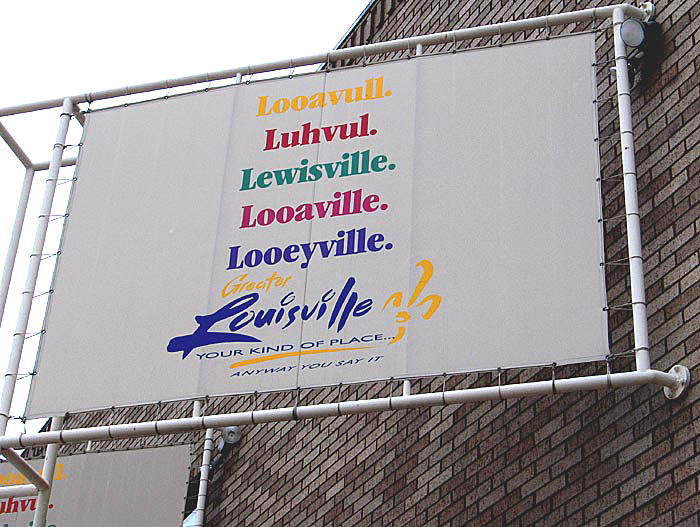
Louisville_pronunciationguide.jpg
We expect the next Rouge Forum Conference will be in Louisville, KY, in March, next year.

The struggle in Palestine sharpens every day, as does Iraq and Afghanistan. Robert Fisk who is often featured on our www.rougeforum.org site has a fine short article in the Independent.

Last, remember the Rouge Forum discussion list is open for debate. Email: Rouge-Forum-Discussion@googlegroups.com

Thanks to Judy P (very much), Carolyn, Monty, Donna, Sean A., Wayne, Sheila S., Tommie and Bob, Kelly, Doug and Connie, Betty and Don, Carol J., Phil C and Tom T, Sgt. Carrie, and Dirty Edd.

All the best,

r

Under the covers

I’ve been listening quite a bit to Patti Smith’s Twelve and Richard Thompson’s 1000 Years of Popular Music, two great cover albums, and I’ve been inspired to dig up other cover albums (Bowie’s Pin Ups; Flaco Jimenez’s Partners, Bryan Ferry’s new one, Dylanesque, tribute albums to the Kinks, Johnny Cash, etc.) and start a list of cool covers for a “mix tape.”

I’m looks for suggestions so…please share.

BTW, the Covers Project is a cool website…And Wikipedia’s article “Cover version” is also useful resource.

Here’s partial list of some cover tunes I really like (off the top of my head and in no particular order, but I did try to develop some “cover chains”):

    Patti Smith, “Gloria” (Them)
    Van Morrison, “I Can’t Stop Loving You” (Don Gibson)
    John Mellencamp, “Wild Night” (Van Morrison)
    Dwight Yoakam & Flaco Jimenez, “Carmelita” (Warren Zevon)
    Warren Zevon, “Certain Girl” (Allen Toussaint)
    W. C. Clark, “Get Out of My Life, Woman (Allen Toussaint)
    Hindu Love Gods, “Raspberry Beret” (Prince)
    Foo Fighters, “Nikki Darling” (Prince)
    Richard Thompson, “Kiss” (Prince)
    Prince, “One of Us” (Joan Osborne)
    Joan Osborne, “At Last” (Etta James)
    Etta James, “Miss You” (Rolling Stones)
    Rolling Stones, “Like A Rolling Stone” (Bob Dylan)
    Prince, “Just My Imagination” (The Temptations)
    Richard Thompson, “Friday on My Mind” (The Easybeats)
    David Bowie, “Friday on My Mind” (The Easybeats)
    Richard Thompson, “Oops, I Did It Again” (Brittney Spears)
    Richard Thompson, “Tempted” (Squeeze)
    Nickel Creek, “Spit on a Stranger” (Pavement)
    The Beatles, “Anna (Go With Him)” (Arthur Alexander)
    Arthur Alexander, “Detroit City” (Bobby Bare)
    Gram Parsons, “Streets of Baltimore” (Bobby Bare)
    Bobby Bare, “Help Me Make It Through the Night” (Kris Kristofferson)
    Kris Kristofferson, “I’ll Be Your Baby Tonight” (Bob Dylan)
    Fountains of Wayne, “Better Things” (Kinks)
    The Minus 5, “Get Back in Line” (Kinks)
    Matthew Sweet, “Big Sky” (Kinks)
    Yo La Tengo, “Fancy” (Kinks)
    R.E.M., “Superman” (Kinks)
    R.E.M., “First We Take Manhattan” (Leonard Cohen)
    Cake, “I Will Survive” (Gloria Gaynor)
    Feist, “Inside and Out” (Bee Gees)
    Robbie Fulks, “Dancing Queen” (ABBA)
    Radiohead, “Nobody Does It Better” (Carly Simon)
    Shelby Lynne, “Rainy Night in Georgia” (Tony Joe White)
    Vic Chestnutt, “The Night The Lights Went Out in Georgia” (Vicki Lawrence)
    Johnny Cash, “Hurt” (Nine Inch Nails)
    Dar Williams, “Comfortably Numb” (Pink Floyd)
    Emmylou Harris, “Wrecking Ball” (Neil Young)
    Beck & Emmylou Harris, “Sin City” (Gram Parsons/Chris Hillman)
    Dwight Yoakam & k.d. lang, “Sin City” (Gram Parsons/Chris Hillman)
    Wilco, “One Hundred Years from Now” (Gram Parsons)
    Ian Hunter, “One More Time” (Alejandro Escovedo)
    Dwight Yoakam, “I Want You To Want Me” (Cheap Trick)
    Cheap Trick, “Don’t Be Cruel” (Elvis Presley)
    Elvis Presley, “Don’t Think Twice, It’s All Right” (Bob Dylan)
    The Gords, “Gin and Juice” (Snoop Dogg)
    Goo Goo Dolls, “Give A Little Bit” (Supertramp)
    Patti Smith, “Smells Like Teen Spirit” (Nirvana)
    Def Leppard, “Waterloo Sunset” (Kinks)
    Def Leppard, “20th Century Boy” (T Rex)
    T Rex, “Summertime Blues” (Eddie Cochran)
    Nirvana, “The Man Who Sold The World” (David Bowie)
    M. Ward, “Let’s Dance (David Bowie)
    David Bowie, “I Can’t Explain” (The Who)
    Rush, “The Seeker” (The Who)
    Nada Surf, “I’m Sick of You” (Iggy Pop)
    Fountains of Wayne, “Killermont Street” (Aztec Camera)
    Aztec Camera, “Jump” (Van Halen)
    Van Halen, “You Really Got Me” (Kinks)
    The Who, “Young Man Blues” (Mose Allison)
    Rolling Stones, “Shake Your Hips” (Slim Harpo)


Covers of Dylan:

    Chris Whitley & Jeff Lang, “Changing of the Guard”
    Patti Smith, “Changing of the Guard”
    Chris Whitley & Jeff Lang, “When I Paint My Masterpiece”
    Jimi Hendrix, “All Along the Watchtower”
    Pearl Jam, “Masters of War”
    Rolling Stones, “Like A Rolling Stone”
    Rage Against the Machine, “Maggie’s Farm”
    Guns n Roses, “Knockin On Heaven’s Door”
    Warren Zevon, “Knockin On Heaven’s Door”
    Johnny Cash, “It Ain’t Me Babe”
    Ricky Nelson, “She Belongs To Me”
    Steve Earle, “My Back Pages”
    Ramones, “My Back Pages”
    Bryan Ferry, “A Hard Rain’s A-Gonna Fall”
    The White Stripes, “Love Sick”
    Neville Brothers, “With God On Our Side”
    Buddy & Julie Miller, “Wallflower”
    Nickel Creek, “House Carpenter”
    George Harrison, “If Not for You”

America’s progressive majority?

20070612_ProgressiveMajorityReport_cover_sm.jpg
pro∙gres∙sive (prə-grĕs´ĭv)
adj. 1. moving forward 2. continuing by successive steps 3. favoring better conditions, new policies, ideas, or methods
n. one who is progressive

Yes. At least that’s what an analysis of decades of public opinion polling by the Campaign for America’s Future and Media Matters for America claims.

The façade of conservative political dominance is crumbling. The disintegration runs deeper than public disaffection with the Bush administration’s catastrophic failures and is more fundamental than the political realignment of the 2006 election. The notion of America as a “conservative nation” was always more fiction than fact, but the nation’s rejection of President Bush’s brand of “you’re-on-your-own” conservatism and wedge-issue divisiveness is so broad that today the façade is simply unsustainable.

When it comes to the economy the report, The Progressive Majority: Why a Conservative America is a Myth, says that

  • 84 percent of American support to increase the minimum wage;
  • more Americans sympathize with unions than with companies in labor disputes (52 to 34 percent);
  • nearly twice as many people think the U.S. is more hurt than helped by the global economy (48 to 25 percent);
  • 69 percent of Americans believe government should care for those who can’t care for themselves;
  • twice as many people want “government to provide many more services even if it means an increase in spending” (43 percent) as want government to provide fewer services “in order to reduce spending” (20 percent);
  • majorities say the U.S. needs a bigger government “because the country’s problems are bigger” (59 percent) and a “strong government to handle complex problems” (67 percent).

On social issues too, Americans are more progressive than they are typically credited:

  • the percentage who consider abortion the “most important” issue ranks in the single digits;
  • a 56 percent majority oppose making it more difficult for a woman to get an abortion, a proportion that has hardly changed in the past 20 years;
  • only 29 percent want to see Roe v. Wade overturned;
  • 67 percent want sex education in schools to include information about contraception, not just abstinence;
  • 64 percent are willing to pay higher fuel taxes if the money were used for research into renewable energy sources;
  • 75 percent would be willing to pay more for electricity if it were generated by renewable sources like wind or energy;
  • Only oil companies, conservative politicians and a minority of Americans (41 percent) want to open the Arctic National Wildlife Refuge in Alaska to drilling.

As for the war:

  • 63 percent of Americans want to set deadlines for withdrawal;
  • four times as many Americans (48 percent to 12 percent) think the war in Iraq has made the threat of terrorism against the United States worse rather than better.

This is heartening news for progressives, but it begs the question about why Americans continued to vote in politicians (Democrat and Republican) that have not a progressive bone on in their bodies and who remain beholden in capitalist interests and the profit line.

Perhaps a combination of the following accounts provides at least a partial explanation: the folks responding to the polls have checked out of the political process and Americans are subjected to such a high level of right-wing, pro-corporate, TINA propaganda their independence of thought collapses.

Certainly schools and the mass media are culpable in significant ways for the disconnect between the “progressive majority” and the political realities of the U.S.