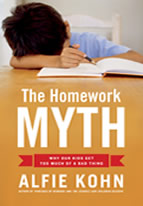
Checkout Alfie Kohn discussing the homework myth on a podcast of Michael Baker’s “Room 101” radio show.
This edition of “Room 101” was originally broadcast May 2, 2007 on KZUM 89.3FM in Lincoln, Nebraska.
Critical Theories in Education

Checkout Alfie Kohn discussing the homework myth on a podcast of Michael Baker’s “Room 101” radio show.
This edition of “Room 101” was originally broadcast May 2, 2007 on KZUM 89.3FM in Lincoln, Nebraska.
Sandra Mathison critiqued the “bribes for tests” strategies in US schools a couple of years back in Z Magazine where she wrote:
It remains common nonsense that extrinsic rewards lead to internal motivation. Indeed much research has demonstrated the deleterious effects of extrinsic rewards on motivation. Over the years, psychologists Edward Deci and Richard Ryan have repeatedly demonstrated this and recently their work points to the likelihood that using state tests for motivational purposes will likely lead to poorer education overall.
Now, unfortunately, it looks like the bribes for test strategy is gaining some serious traction in New York City as the Mayor Bloomberg and the school chancellor Joel Klein are considering a plan that would pay students cash for high scores on standardized tests.
TEACHERS CAN SAY NO TO STUDENT BATHROOM BREAKS
Two attempts this spring to limit students’ bathroom breaks have led to shame and controversy, reports G. Jeffrey MacDonald in USA TODAY.
In late April, a sixth-grader in Ohio wet his pants during a standardized test after a teacher refused to let him use the bathroom. In early May, a California eighth-grader said he urinated into a Gatorade bottle in a classroom corner because his teacher had refused to dismiss him. Such cases, though perhaps extreme, highlight a daily challenge for teachers. They must balance classroom control with a duty to accommodate the varied and hard-to-predict biological needs of their students. In seeking that balance, should they ever say no when a student asks permission to use the bathroom? That’s a matter of debate among teachers, administrators and medical professionals.
“Students make requests frequently to use the restroom when they really have intentions to do other things,” says Peter Reed, associate director of professional development services at the National Association of Secondary School Principals. “The real key is for every student to expect, when he or she is in (a teacher’s) class, that the full amount of time needs to be devoted to the learning activities for that day. You don’t have time for anything else.” But some urologists worry about the consequences of waiting too long between trips to the bathroom. ”
Responding to your body’s need to urinate or defecate is a basic human right, or even one step below that, it’s a basic animal right,” Dr. Christopher Cooper says. “I don’t think we would (restrict) animals, yet we do restrict the kids.” Complicating matters is the reality that some students avoid bathrooms because they’re dirty, smelly havens for bullies.
Via the PEN Newsletter: WHITE SUPREMACY IS NOT COLOR BLIND
A Supreme Court ruling this summer on voluntary integration plans of Louisville and Seattle schools could sound the death knell for Brown v. Board of Education, warn the editors of Rethinking Schools in their spring issue. If the U.S. Supreme Court refuses to uphold voluntary integration plans in these two cities, it would wipe out the last vestiges of the 1954 Brown decision still in place. Over the years, the court has so chipped away at Brown that it is a mere shell of a decision, honored in speeches every Martin Luther King Jr. holiday but ignored in practice 365 days of the year. While conservatives argue that race-conscious policies are no longer necessary because the United States is becoming a multiracial, multiethnic society, Theodore Shaw of the NAACP Legal Defense and Education Fund points out that “This country has always been a multiracial, multiethnic society. The problem has never been mere race consciousness. It has been white supremacy.” The editors challenge teachers to find new ways to struggle against our increasingly resegregated schools.
.onion_embed {background: rgb(256, 256, 256) !important;border: 4px solid rgb(65, 160, 65);border-width: 4px 0 1px 0;margin: 10px 30px !important;padding: 5px;overflow: hidden !important;zoom: 1;}.onion_embed img {border: 0 !important;}.onion_embed a {display: inline;}.onion_embed a.img {float: left !important;margin: 0 5px 0 0 !important;width: 66px;display: block;overflow: hidden !important;}.onion_embed a.img img {border: 1px solid #222 !important;;width: 64px;;padding: 0 !important;;}.onion_embed h2 {line-height: 2px;;clear: none;;margin: 0 !important;padding: 0 !important;}.onion_embed h3 {line-height: 16px;font: bold 16px arial, sans-serif !important;margin: 3px 0 0 0 !important;padding: 0 !important;}.onion_embed h3 a {line-height: 16px !important;;color: rgb(0, 51, 102) !important;font: bold 16px arial, sans-serif !important;text-decoration: none !important;display: inline !important;;float: none !important;;text-transform: capitalize !important;}.onion_embed h3 a:hover {text-decoration: underline !important;color: rgb(204, 51, 51) !important;}.onion_embed p {color: #000 !important;;font: normal 11px/ 11px arial, sans-serif !important;;margin: 2px 0 0 0 !important;;padding: 0 !important;}.onion_embed a {display: inline !important;;float: none !important;}
“Hell – is sitting on a hot stone reading your own scientific publications”
Erik Ursin, fish biologist
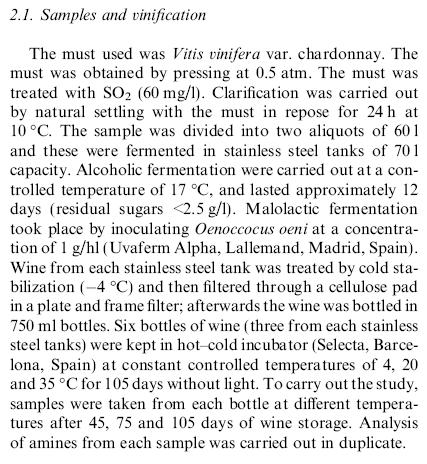
Here’s a great resource for all you aspiring scientists out there that is sure you help you along your way to gaining tenure. “How to write consistently boring scientific literature” by Kaj Sand-Jensen, an academic at the University of Copenhagen.
Sand-Jensen says that “although scientists typically insist that their research is very exciting and adventurous when they talk to laymen and prospective students, the allure of this enthusiasm is too often lost in the predictable, stilted structure and language of their scientific publications.”
In his article, published last month in the journal Oikos: Synthesising Ecology, Sand-Jensen presents a top-10 list of recommendations for how to write consistently boring scientific publications. And then discusses how scientists could make these contributions more accessible and exciting.
Here’s how to turn a gifted writer into a dull scientist (works for natural and social scientists, by the way):
1. Avoid focus
2. Avoid originality and personality
3. Write long contributions
4. Remove most implications and every speculation
5. Leave out illustrations, particularly good ones
6. Omit necessary steps of reasoning
7. Use many abbreviations and technical terms
8. Supress humor and flowery language
9. Degrade species and biology to statistical elements
10. Quote numerous papers for self-evident statements

Dear Friends,
At the Rouge Forum Conference in Detroit, we collected a sizeable amount of money to be passed along to our friends engaged in the struggle in Oaxaca. That money has now been received and hearty thanks returned. The news from Oaxaca is, in sum, the struggle continues. The debates that persist in the US (like the need for a centralized organization to confront the government, vs the desire for some personal autonomy, or the role of voting vs direct action, the nature of government as either contested terrain or a mode class rule) continue there, though under much greater pressure. Government repression stepped up, and the resistance movement has grown more sophisticated. Keep an eye on news from Oaxaca. There is a lot to learn. We hope to have a full report from our Oaxaca travelers in June.
The Rouge Forum web page is updated here.
This week, however, we want to draw attention to other work available online.
Workplace journal has a special issue on the long NYU strike which should contain lessons for all in education.
The Radical Unit for Political Economy in India did outstanding work with great insight in regard to the US oil war on Iraq, and this piece on military affairs is equally Cassandra-like.
The Power and Interest Report is carrying a challenging article on the role of Russia in the Caspian Sea region.
Our action in regard to the San Diego City Schools surge to press children and educators into support for the empire’s wars, via a series of “support the troops,” rallies, ice cream parties, and similar contests was fairly successful. We collected more than one thousand of the postcards (complete with war eagle) that were to be sent to troops, but misplaced by activist teachers, and more importantly, we sparked a national debate inside NEA and AFT locals as to just what educators should do, when put on the line ourselves.
Be sure to set aside time (and money) to come to the National Council for the Social Studies conference in San Diego in late November. We will be leading several presentations, workshops, and a clinic that features a nation/class tour of San Diego’s borders.
Thanks to Gil, Sherry W, Candace, Eva, Lila, Ann S, Michael P., Holly, Sharon A., David, Geoff, Garth, John Miller, Paul Schreer, Chuck Ream, Don A, Peter M, Carlson, TC, Amber, Doug S, and Wayne. Congratulations to Ofira’s family on the birth of a beautiful rebel girl.
Here’s the video (via Blip.tv) of the Webloggers Salon at UBC held way back in February. Thanks to Brian Lamb for putting the salon together and getting the video up.
I’ve recently podcast three episodes of Michael Baker’s “Room 101”, including an interview with Jon Albert and Matt O’Neill, the Emmy award winning producers/directors of the HBO documentary Baghdad ER and a two-part interview of Noam Chomsky in which he discusses the contradictions of education and the media as well as threats to the future of human survival.
“Room 101” podcast are available on my web site as well as directly from iTunes.
In an outrageous attack on the academic freedom of a progressive high school teacher, Michael Baker, a long-time social studies teacher at Lincoln (Nebraska) East High, was fired from his job earlier this month for showing the Emmy award winning documentary Baghdad ER.
Baker is one of fewer than 50 teachers in the state of Nebraska with National Board for Professional Teaching Standards certification. NBPTS certification is voluntary and an indication that Baker has meet the highest level of the teacher profession in the US.
Baker cannot talk freely about what happened because he reached an agreement with the school district. Part of that agreement prohibits him from saying anything “disparaging” about it, he says.
Baker hosts the radio program “Room 101,” an interview/call-in show that focuses on progressive education issues. Podcasts of “Room 101” are available here. He recently interviewed the producers and directors Baghdad ER on the show.
Baker expects to continue teaching at Southeast Community College and at the University of Nebraska, where he teaches a course on the history of American public education.
Read the Lincoln Journal Star story on Baker’s forced retirement here.
Read Matthew Rothschild’s (editor of The Progressive magazine) piece on about the firing on CommonDreams.org.