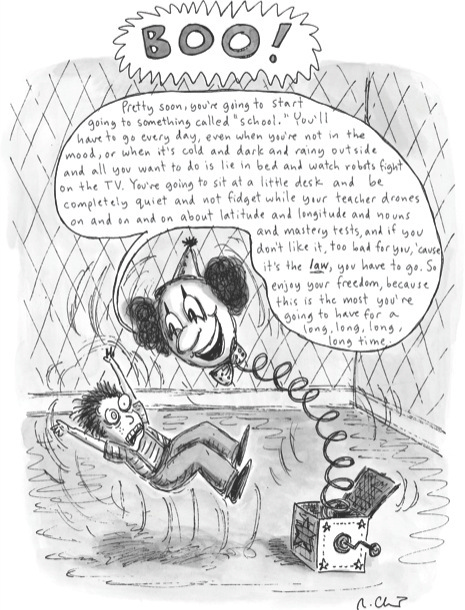
Empowering Those at the Bottom Beats Punishing Them From the Top

In a commentary for Education Week, San Diego’s school superintendent, Carl A. Cohen, presents a straight-forward, non-ideological critique of No Child Left Behind.

Key points include:

If the goal of establishing impossible targets is to exaggerate and overidentify failure in public education to provide a rationale for untested theories of reform, then the law has been a spectacular success.

I believe there is a place where no child is left behind, where all children achieve grade-level proficiency and there is no achievement gap. It is called heaven…I have a strong suspicion that it will not be achieved on earth for all of this nation’s children by the law’s target date of 2014 without divine intervention. It is even more unlikely to be achieved when this earth for many children living in our urban neighborhoods is far closer to hell. This is not a defeatist attitude or an excuse to avoid making the hard decisions necessary to address educational inequities. It is a fact. Acknowledging it and establishing ambitious, yet reasonable, targets and methods for determining progress will not diminish the desire of education leaders to improve student achievement. It will empower us.

Published Online: April 24, 2007
Published in Print: April 25, 2007

Commentary
Empowering Those at the Bottom Beats Punishing Them From the Top
An urban superintendent looks at No Child Left Behind.
By Carl A. Cohn

Some education historians argue that American cycles of school reform have been preoccupied with either the declining wit or the deteriorating character of students. This current “wit” cycle of reform, ushered in by the publication of A Nation at Risk in 1983, is now approaching a quarter-century in duration. It shows no obvious signs of winding down. Barely a day passes without another critique of public education that repackages the concerns of A Nation at Risk about the negative impact of public schools on the minds of our children.
—Jonathan Bouw

Sometimes, however, a body appears deceptively strong just before death. During my 38 years in public education, I have witnessed enough cyclical changes to suspect that the strength of this current cycle of reform has passed its peak, and that the body now suffers from a terminal illness.

This is the legacy of the No Child Left Behind Act. Beginning with the legislation’s title, federal lawmakers succeeded in codifying the good intentions and misconceptions of a generation of education reformers. For the past five years, those of us on the front lines of education have lived in a world governed by the law’s idealistic goals of achieving 100 percent proficiency for all students and eliminating the achievement gap.

As a school superintendent, I understand the symbolic power of high aspirations. I am responsible for inspiring those engaged in the difficult work of improving public education. Yet I am also keenly aware of the danger of asking educators to achieve impossible, nebulous goals. While initially inspiring, such goals eventually become debilitating.

This is where I am with No Child Left Behind: Rather than supporting my efforts to improve student achievement, the law’s unreasonable mandates and dependence on punishment are among my largest obstacles.

Since the No Child Left Behind law’s passage, educators willing to occupy this middle ground of praising its principles while pointing out its practical flaws have been guaranteed the educational equivalent of a “swiftboating.” Their motives are questioned. They are attacked as pro-union or anti-accountability and criticized for placing the needs of adults ahead of the needs of children.

Two years ago, I came out of retirement to become the superintendent of the San Diego Unified School District in California. I inherited a district in which the driving philosophy over the previous six years had, similarly, been to attack the credibility of any educator who spoke out against a top-down education reform model. These attacks allowed those in charge to portray themselves as the defenders of children, to justify any means to promote their model of improving student achievement, and to view their critics through the same apocalyptic lens of good and evil that has characterized many of our recent national debates.
If the goal of establishing impossible targets is to exaggerate and overidentify failure in public education to provide a rationale for untested theories of reform, then the law has been a spectacular success.

At any level of governance, this perspective is counterproductive. In San Diego, it produced a climate of conflict that is only now beginning to improve. On a national level, it has had a chilling effect on open discussion and prevented a genuine national debate on the goals of the No Child Left Behind legislation.

Now that I have reached my 60s, I have become far more outspoken when I encounter unreasonable targets and frustrating micromanagement from afar. As the former longtime superintendent of a district (Long Beach, Calif.) that succeeded in improving student achievement and reducing the achievement gap between minority and white students, I understand the enormity of the task and the impracticality of the progress required by this federal law.

I believe there is a place where no child is left behind, where all children achieve grade-level proficiency and there is no achievement gap. It is called heaven. As a former seminary student, I have a strong suspicion that it will not be achieved on earth for all of this nation’s children by the law’s target date of 2014 without divine intervention. It is even more unlikely to be achieved when this earth for many children living in our urban neighborhoods is far closer to hell. This is not a defeatist attitude or an excuse to avoid making the hard decisions necessary to address educational inequities. It is a fact. Acknowledging it and establishing ambitious, yet reasonable, targets and methods for determining progress will not diminish the desire of education leaders to improve student achievement. It will empower us.

If, on the other hand, the goal of establishing impossible targets is to exaggerate and overidentify failure in public education in order to provide a rationale for untested theories of reform, then the No Child Left Behind law has been a spectacular success.

If a given set of parents knew that their child would be labeled a failure for missing just one of 19 targets, they would call the system unfair. If we punished their child on the basis of such a contrived failure, it would be grounds for a lawsuit. If we then told the parents that, in the name of accountability, we were going to find that child other, better parents, I would fear for my personal safety.

Yet, the No Child Left Behind Act applies the same logic to public school systems. If one of my district’s schools misses just one of 19 federally mandated targets, I must label it a failing school. Once this school is labeled a failure, I am required to sanction it. These sanctions include offering untested private tutoring to all students, regardless of their performance or whether the services have any benefit; busing students to other schools, regardless of whether those schools are better; and closing, restructuring, or transforming the school into a charter school, regardless of whether that process will improve it.

Some states have avoided this chain of events by establishing such low standards that any school can achieve the state’s easy targets. But when a state such as California, with an accountability system that predated the No Child Left Behind law, establishes high-quality standards of performance, achieving all of No Child Left Behind’s targets on the federal government’s timeline becomes impossible. In this Alice-in-Wonderland context, enforcing the federal accountability system becomes an exercise in absurdity, where nearly all urban public schools are subjected to the same shout of “Off with his head!”

In my lifetime, I have experienced the large-scale application of so many theories of school reform. Each of these theories—from class-size reduction to whole-language reading instruction—has failed to live up to the expectations of reformers. In some cases, they have caused extensive harm. The lesson of these failures is that there are no quick fixes or perfect educational theories. School reform is a slow, steady, labor-intensive process. It is heavily dependent on harnessing the talents of individuals such as Erin Gruwell, the Long Beach teacher currently portrayed in the movie “Freedom Writers,” for transforming the lives of at-risk students, rather than punishing them for noncompliance with bureaucratic mandates and destroying their initiative.

Whether a school is public, private, or charter, ground-level solutions, such as high-quality leadership, staff collaboration, committed teachers, and clean and safe environments, have the best chance of success. These solutions are not easily quantified. They cannot be experimented on by researchers or mandated by the federal government. Their success is dependent upon empowering those at the bottom, not punishing them from the top.

Carl A. Cohn served as a teacher, counselor, central-office administrator, and superintendent before coming out of retirement in 2005 to become the superintendent of the San Diego Unified School District, California’s second-largest public school system. He had previously been the superintendent in Long Beach, California’s third-largest district, winning the Broad Prize for Urban Education and becoming the longest-serving superintendent of a large urban school district in the nation. He is portrayed in the new movie “Freedom Writers” by actor Robert Wisdom.

Vol. 26, Issue 34, Pages 32-33

More on Christofascism

Here’s an item from the The Salt Lake Tribune describing the debate at the Utah County Republican Convention on an immigration resolution asserting Satan’s role in illegal immigration and supporting the closure of U.S. borders.

The group held a 10-minute debate on the immigration issue, which district Chairman Don Larsen, author of the resolution, described as a behind-the-scenes war being waged on America by big businesses and left-wing extremists.

“They’re trying to destroy Christian America and install godless order,” Larsen said. “We need to close our national borders and protect the United States from destruction by self-invasion.”

Delegate Joe Ferguson agreed, saying undocumented immigrants will never assimilate into American culture. “The devil is involved,” Ferguson said. “Marxism is the devil and freedom is in Christ.”

Teenage shock troops of the religious right

detroit%20rally1.jpgIn Rolling Stone issue 1024 (April 19, 2007), Jeff Sharlet reports on the “teenage holy war” being waged by Ron Luce’s BattleCry, a Christofascist organization that attracts thousands to “Acquire the Fire” rallies held in stadiums in the US and has sent 53,000 teenage “missionaries” around the world to preach spiritual “purity” (e.g., chastity, sobriety) and a commitment to capitalism.

Luce rejects what he calls “cultural Christianity” and the “pigpen” of secularism.

He considers evangelical Christians as soft and bland, instead he wants “stalkers” who will bring criminal passion to the their pursuit of godliness. Luce says that he and his teenage apostles are involved in a real, not a metaphorical, war and building a “attacking church.”

Sharlet quotes him as saying “We gotta be ready to fight and not be these passive little namby-pamby, kum-ba-yah, thumb-sucking babies that call themselves Christians.”

To reach his goals, Luce entices youth to stadium-size rallies with Christian rock bands like P.O.D., Skillet, Pillar, and Casting Crowns where he tells them to make lists of secular pleasures they will sacrifice for the cause and then has kids toss their lists into a garbage truck.

The final spectacle of the Acquire the Fire events has Luce acting out the Biblical story of the Levite and his concubine , from the Book of Judges,

in which a man who, after he gives over his concubine to be gang-raped, kills the disgraced woman and cuts her into twelve pieces, then sends one to each of the tribes of Israel as a reminder of what happens to the ungodly…[Then] Luce or one of his junior pastors dissects a mannequin labeled with the sins of secularism and then—to the cheer “Cut up the concubine!”—sends his assistants into the crowd to distribute the pieces.

Messages at the rallies include claims such as obedience to God matters more than education. And that seems to be a guiding principle at BattleCry’s “Honor Academy” in Texas, where the shock troops in-training engage in “emotionally stretching opportunities of a lifetime,” and are taught media and PR skills, but the library at this “school” is never open.

But there is hope for American culture and Rolling Stone is obviously optimistic, because the article that follows the expose of Luce and BattleCry is an interview with Iggy Pop.

Happy May Day!

Dear Friends,

Happy Mayday! Here is the now classic Rouge Forum Mayday flyer, one of our most widely read pieces, online for 9 years.

This Mayday is unlikely to match the massive outpouring we saw last year. That’s because many of the corporate supporters of last year’s marches have withdrawn their backing. No loss. Tens of thousands of youth and workers will be on the streets, striking against anti-working class immigration laws, for dignity at work and freedom from police raids in the communities and in homes. Last year’s general strike on Mayday was the biggest such action in the US, ever.

In many cases, as in California, the Mayday school walkouts will disrupt testing week. Good! Shut down the racist tests, get the kids on the streets where they will learn, on Mayday, far more than they will in any test station.

We are happy to report that after nearly one hundred Rouge Forum members deluged Earthlink with email, our web site re-lit, almost by magic. After six weeks of battles with the service provider, it’s clear the member response was decisive in moving Earthlink management to act, and act right. We are now up at www.richgibson.com.

The Rouge Forum No Blood For Oil site is up and running, fully restored.

Note in particular articles addressing the fact that the US has no plan to leave Iraq. Why Was There No Exit Plan?, from the San Francisco Chronicle .

Intensifying imperial rivalry is indicated in the massive build-up of China’s Navy.

And the Putin move to suspend Russia’s participation in a symbolic arms pact is here.

This is a fascinating piece on the New York City Teacher’s Union by Sean Ahern.

Thanks to Wayne Ross for posting key material on his site while we were shut down. One of several significant things on Wayne’s site is a link to podcasts from Michael Baker’s Room 101, an interview program out of Nebraska NPR featuring Susan Ohanian, Wayne, Chomsky, and others.

Thanks also to the San Francisco Gray Panthers for posting material to their site, as in this discussion on testing and social change.

Thanks as well to Sean, Perry, Doug, Mary and Paul, Ssg Lloyd, Eliz O, Candace D, Betty Shelly, Donnie, TC, Evan, and all those activists who wrote Earthlink and got their minds right.

best r

“Room 101” podcasts

KZUM.png
“Room 101” is hosted by Michael Baker on KZUM 89.3FM in Lincoln, Nebraska and features interviews and talk about issues of education and schooling.

I’m now podcasting “Room 101” from my web site. Check it out! You can listen to the shows (and subscribe to the podcasts) at my site. The podcasts are also available for free from the iTunes store.

Two podcasts are now available and I will be adding more in the days and weeks to come.

Rich Gibson, San Diego State University professor and co-founder of the Rouge Forum, talks with Michael about the schools-to-war pipeline and how the US imperialist project is reflected in the No Child Left Behind Act.

Peter McLaren, UCLA’s “most dangerous professor”, discusses the right-wing agenda for schools; his recent exchanges with Bill Ayers; and the growing efforts to dismantle the No Child Left Behind Act.

Upcoming podcasts will have interviews with Noam Chomsky, Nancy Patterson, Prentice Chandler, activist students from Lincoln, Nebraska and more…

Gibson: “I put the question to all other reformers: Toward What End?”

sfgp.jpgSan Francisco Gray Pathers Blog: “I put the question to all other reformers: Toward What End?”

I put the question to all other reformers: Toward What End?

The following was was written by Rich Gibson, who teaches at San Diego State and is part of the anti-high stakes testing movement in public education. This post was to an on-line discussion about raising consciousness and getting teachers and parents organized, but it applies to much of our work.

“It is good to see people beginning to lay out positions prior to the Fresno gathering, meaning we are taking this moment seriously.

So, let us stake out areas of agreement and disagreement and see where we may, or may not, coalesce.

At the outset, I want to restate my respect for anyone engaged in resistance to the regimentation of schools via regulated curricula and high stakes exams, in beating back the military, and especially those who want to overcome the system of capital that lies behind all that. Disagreement is not disrespect and, so far, many of us have found that friendship over the long haul arches over our differences.

That said, I disagree with those who want to disconnect capitalism, imperialism, war, and the trends in school that capital creates, like the Big Tests and the military recruiters.

I disagree with those who see this US government as anything but a weapon for the rich, and executive committee for the wealthy. Urging people into electoral work, into the courts, etc. merely lends credence and support for a state, a government, that is flatly on the other side, the enemy of the mass of people including most students.

That teachers are largely unaware of the nature of government speaks to their own mis-education, especially in colleges of education, but also to the limited privileges teachers have, like health benefits.

I am interested in building a mass base of class conscious people (who, for example, recognize that the working class and the owning class have only contradiction in common), people within a caring community, people who are willing to take serious risks and at the same time are willing to see that discipline and organization are necessary to reach into a world where we can live reasonably creative, more or less equitable, free lives. I want people to become less alienated, more responsible for our own histories, if not our birthrights. I want to get rid of capitalism. That is a pedagogical and practical project.

I put the question to all other reformers: Toward What End? If that question is unanswered, then all that happens is more of the same, perhaps in new forms, running on capital’s many treadmills: nationalism, hierarchy, mysticism, racism, sexism, irrationalism, more wars, etc.

Opposition to curricula regimentation, high-stakes exams, child abuse, can only be carried through if it is connected to the source of those problems, to capital and its need for a docile, uninformed, work force and witless military. Winning gentler Big Tests and more “progressive,” scripted curricula, without building a base of people opposing capital itself, is not winning. Even abolishing the No Child Left Behind (which is not going to happen) without an educational project that takes on capitalism is a hollow victory.

I see work in schools and in the military as central to that work for peace and justice in the de-industrialized US. There are other key places, like the immigrant worker rights movement, but schools and the military are important because they are anchors to daily life.

Any plan of action, tactics, needs to be rooted in a careful examination of our current situation, both in general (an international war of the rich on the poor intensifying, and within that imperialist wars), and in specifics (in San Diego, for example, the heavy presence of the military, the connections of all schooling to the military industry, and the racist border, etc, or In Detroit the racist collapse of the entire city). The general cannot be split apart from its particularities; they interact.

Of course, there are some answers in history to our current situation, but those answers are very limited, and are especially useful only in our criticism of past movements. Our situation is quite different from what people have faced in the past. We are in the midst of a technologically powerful empire that is not about to give up its domain with a whimper.

This is not the British Empire (which went out with fewer bangs but plenty of massacres in Africa) that had the US to hide behind and manipulate. It is not Germany in the thirties when people could look to the USSR or the US. It is not Japan in the thirties when people could look to the Chinese Red Army. It is not the US mired in Vietnam in the sixties; the Iraqis are not the sane peasant nationalists of Vietnam. Rome did not have the Bomb.

While there are some similarities to our context in the past, we are mainly in a unique, and very difficult, position. The emergence of fascism in the US as a popular movement is quite real (80 million Christian fundamentalists, a historically illiterate population, a culture industry thriving on the “300,” misogyny, racism, the celebration of violence, coupled with nationalism and the direct rule of the rich).

The civil rights movement and the freedom schools of the 50’s and 60’s are good examples of both what can be done, and what should not be done. After all, the civil rights movement, as Bob Moses honestly portrays in Radical Equations, was easily diverted from a mass movement for jobs, against racism, to a voting rights project directed by foundation grants. While it would not be hard to find a dozen movements that turned out to be what they claimed to set out to oppose, surely the US civil rights movement would be one of them. All those movements, from the Soviets to the civil rights movement, lost sight of the project of going beyond, transcending, the inequality and exploitation that capital requires. Why do that again?

ACORN today is little more than a Rockefeller Foundation diversion–hardly an exemplary movement.

Myles Horton was, I think, more honest. I suspect he would argue that we must connect the particularities of people’s lives today with the larger realities, like war and the emergence of fascism. Or perhaps not. It is hard to tell, Myles Horton was a reformer, above all, but he was not blind to his surroundings, and he was usually surrounded by Marxists of one kind or another. What are the social conditions that might change Myles from a reformer to one who wants to transcend the system of capital? Well, maybe the reality of the brink of WWIII, financial collapse, the eradication of civil liberties, the clear exposure of all governments as corrupt, violent, unable to serve the need of masses of people, and impervious to reformist change.

Jean Anyon’s work has been pivotal in understanding education policy. Her comment that “doing school reform without doing social and economic reform in communities is like washing the air on one side of a screen door,” stands as a lighthouse for beginning any discussion about education reform. Her political economy of the Newark schools was path-breaking. But her hopeless thought in “Ghetto Schooling,” that the only way out of the schools/community crisis is for the rich to give up their money makes no sense—as it is the result of a failure to really critique capitalism and its transformation. The rich are not going to give up their money, and they are far less positioned to do that than they were in the 1960’s, when the US was still an ascendant capitalist nation. Now the US is in rapid decline, badly positioned against imperialist rivals like China.

What is possible in Newark and Detroit and elsewhere is that people are positioned so they must fight to live, as in the California Grocery Strike, in the Detroit teachers’ wildcats, the student walkouts against this war, and the massive Mayday strike last year.

At issue is whether people will be able to make sense of the fights they must make, or will they make the same errors and lose, again? That is a question of education and organization.

Organizing 101 is not merely listening to people and synthesizing their problems as social, not merely individual, problems; but also having a sense of where you want to go, and being able and unafraid to communicate that. A good part of the reluctance to talk about capitalism is the fear that people will either not understand, or be scared off by it, that they have to be walked through to the reality of capital on baby steps.

That’s not true in my experience. This process of one-step-at-a-time teaching and learning surely seems odd when it comes from people steeped in Whole Language, ie, a desire to withhold the real Whole (capitalism) from people in order to walk them through a process (sound out the parts of the social system but never view the whole of it) which it is assumed they cannot understand in discussions or in reading.

The idea of hiding one’s politics (if that is the case, and if it is not, then just what are one’s politics?) is commonplace on the left. To make a small leap, it winds up with the people who need to know about left politics not knowing, and the people who do not need to know, like the cops, knowing all about it. Such was the CPUSA, the SWP, and many others.

I agree with Kathy Emery (whose book with Susan Ohanian says nearly all that needs to be said about capitalism and education) in that we need to build close personal ties with people, real principled friendships, especially anti-racist friendships, and that the Education Roundtable petition is a good starting point for organizing. It can, as we have seen, expose the absolutely corrupt leadership of the NEA and AFT, for example.

The petition does not, however, ask people to take control over their own lives, to be truly class conscious. Instead, it asks others (corrupt politicians on the Gates’ payroll for example) to act for us and, at the end of the day, that will not happen. Nor is it an especially good idea to have an mass of education school grads writing the national curriculum, especially not when more than 90 percent of them are white and middle class. There is not going to be a good national curriculum until there is sufficient strife to cause an elite retreat, as in the sixties when the curriculum got briefly interesting. In the absence of a social movement, of organization: nothing. Power only bends to power.

The US ruling class is not going to be voted out of the Iraq oil fields and it is not going to be petitioned out of the school mind-fields, the pipelines for wars, militarism, and voluntary nationalist servitude.

It is possible that civil strife will hasten the retreat of the empire, in schools and out. Surely the invasion of Detroit by the 82nd Airbourne, recalled from Vietnam in 1967 to fight Americans, would be a good historical example. Thousands of jobs, indeed tens of thousands of jobs, were won as a result of that uprising.

Even so, however, this situation today is much different, the empire’s rulers much more desperate and even more ruthless because of that. Witness what was done to New Orleans when racism merely connected to nature. Imagine what would happen if Detroit went up again. It might. For black people in the US, the situation is already nearly intolerable. What will educators do?

There are debates about how organizing is done. One can seek the lowest common denominator of complaints that an organizer finds in a community, build a centrist base around that, and see where it goes. This, however, abandons a broader outlook and typically winds up with, at best, very short term effects, a la Alinsky.

The better way to organize is to organize the left, find the more antiracist, more militant, more internationalist, more dedicated people, organize them and have this left move the center.

Boycotts of the tests and driving military recruiters off campuses–all that has already happened without sophisticated structures and lines of communications—though surely it would be better if those elements were in place, and if we could successfully link the boycotts to freedom schooling on or off campuses.

Test boycotts, or driving military recruiters off campuses, do not happen because they are simply announced, but are the product of many factors, including working with parents and students over time, walking door to door in communities, building reputations, taking smaller actions like demanding toilet paper and books in Detroit or exposing the recruiters’ lies in San Diego. But any action at some point requires some one to get it going, and far too few teachers have been willing to gird up the courage to halt what is obviously child abuse.

Teachers do not have to be missionaries for capitalism, and schools its churches. School workers have far more freedom than most other workers. Self-censorship, however, remains powerful in schools where freedom is typically overwhelmed by (often unwarranted) fear; a real inversion of any educational effort.

Teachers now participate in the oppression of kids, and themselves, as we see wages and benefits attached to test scores—as we predicted a decade ago. Part of the reason for that is that thinking teachers have few people to talk to, are isolated, and they know they do not have the power to defend putting real critical thinking into classroom reality. Isolation and fear can be answered by organization.

The Rouge Forum is the only organization in the US that has not only linked capitalism, war, and schooling, but has also led conferences that include school workers, profs, k-12 nd university students, parents, community and cultural activists, and rank and file labor leaders—and led test boycotts, massive walkouts against the war, helped organize demonstrations against the wars and racism. Take a look at the recent Rouge Forum conference in Detroit http://www.rohan.sdsu.edu/%7Ergibson/rouge_forum/EducationActionPostConference.htm.

There are many voices inside the Rouge Forum: Democrats, anarchists, libertarians, marxists, Greens, four troops in Iraq, profs in the UK and South Africa, teachers in the Caribbean, students from the US now in Oaxaca, unaligned students and teachers, etc.

The leadership of the Rouge Forum is shifting to younger people and a more open, transparent, structure is under discussion.

We have organized people across the divisive boundaries of union membership, race, age, occupation, and nation. We created a community where educators can meet with others who share similar, intelligent, views—and where passionate debate is mediated by friendship.

We have conducted action-research about the US unions, especially the school unions, and demonstrated how the organizations are structurally incapable of meeting the crisis at hand (dividing people more than uniting them), why it is their leadership is completely corrupt (bribed by the high salaries, more than $450,000, that imperialism offers them in exchange for promoting the nationalist idea that school workers, politicians, and the US Chamber of Commerce have common interests), and most importantly, we helped people work inside the unions, and out, for justice and peace.

We have led strikes in schools and supported strikers (like the California Grocery strikers) outside schools. We recognize that without the working class, a schools-based movement cannot sustain itself. But students can surely initiate resistance, as can school workers, especially when hope is eradicated from schooling: France, 1968.

With an “injury to one only goes before an injury to all,” outlook, we have learned how to defend our friends (as the unions surely will not) on the job and off. Our collective, online and in person, has helped school workers keep their ideals and still teach.

We already have a more than a decade of experience of how that can be done. We have also offered self-criticism about where we went wrong. We have joined a variety of community groups in coalitions against the war and in developing real, practical, strategic plans. http://www-rohan.sdsu.edu/~rgibson/strategicplanningSD.htm

We have attempted to link test boycotts with freedom schooling, with only a little success.

We’ve had fun, using guerrilla theater to disrupt the workings of the Testistos, organized regular social gatherings around films and books, promoted artists and musicians in the movement.

We have researched the tests, the scripted curricula, and published extensively in books, the popular press, and academic journals. Our web page gets 32,000 “hits” a month and serves as a useful research tool (www.rougeforum.org).

We have supported Substance News, edited by George Schmidt, as a central voice for education and community activists, a voice of our own. We can never rely on the good graces of the corporate press.

We continue to work in many community based groups. Many if not most of us recognize that coalitions that seek to combat a ruthless enemy that has a centralized command system can be shattered like glass under pressure and will not prevail; nor do we support the identity-politics movements that reduce social movements to the lowest denominators of human life, divided along lines of nation, sex/gender, etc. We recognize the need to fight racism and to demolish the divisions among us, before they are used to demolish us.

We struggled to combat the individualism and careerism that is endemic in the academy and among middle class school workers, resulting in a fear of organization and, hence, more powerlessness.

The founders of the Rouge Forum have demonstrated in practice that we are not out to be somebody, to become icons, but rather we have sacrificed to collectively do something important. We recognize that organizing is always humbling.

There is room in the Rouge Forum for nearly any educator, student, community or cultural activist, and parent who wants to find a place where they can exert the creativity they cannot exercise in other parts of life, and where what we do actually counts.

You are welcome to join us. Just email rgibson@pipeline.com

Should the US choose to attack Iran, and many indications are there that say the ruling class will as they must have that oil and regional control (http://www.umich.edu/~twod/writing/z_iran_28apr06c-wkg.pdf ) , then our situation will probably change dramatically, with an even more rapid attack on civil liberties coupled with sharpened economic assaults on life in schools and at work, that is, a draft becomes more likely, freedoms to teach or organize on campuses will diminish, wages and health benefits come under attack, as the war costs come home. That could lead to a profound economic crisis, or not, and it could also rachet up propaganda for a fascist mass movement.

Such is our current situation.

There is a story about a frog in a well who became an expert on what it believed was all of the sky. Our current context demands an organization that can see a larger sky than the one viewed from the bottom of a well.

All the best, r “

‘Devastating’ Bill Moyers Probe of Press and Iraq Coming This Week

Editor & Publisher: ‘Devastating’ Bill Moyers Probe of Press and Iraq Coming This Week

By Greg Mitchell

Published: April 21, 2007 9:00 PM ET

NEW YORK (Commentary) The most powerful indictment of the news media for falling down in its duties in the run-up to the war in Iraq will appear next Wednesday, a 90-minute PBS broadcast called “Buying the War,” which marks the return of “Bill Moyers Journal.” E&P was sent a preview DVD and a draft transcript for the program this week.

While much of the evidence of the media’s role as cheerleaders for the war presented here is not new, it is skillfully assembled, with many fresh quotes from interviews (with the likes of Tim Russert and Walter Pincus) along with numerous embarrassing examples of past statements by journalists and pundits that proved grossly misleading or wrong. Several prominent media figures, prodded by Moyers, admit the media failed miserably, though few take personal responsibility.

The war continues today, now in its fifth year, with the death toll for Americans and Iraqis rising again — yet Moyers points out, “the press has yet to come to terms with its role in enabling the Bush Administration to go to war on false pretenses.”

Among the few heroes of this devastating film are reporters with the Knight Ridder/McClatchy bureau in D.C. Tragically late, Walter Isaacson, who headed CNN, observes, “The people at Knight Ridder were calling the colonels and the lieutenants and the people in the CIA and finding out, you know, that the intelligence is not very good. We should’ve all been doing that.”

At the close, Moyers mentions some of the chief proponents of the war who refused to speak to him for this program, including Thomas Friedman, Bill Kristol, Roger Ailes, Charles Krauthammer, Judith Miller, and William Safire.

But Dan Rather, the former CBS anchor, admits, “I don’t think there is any excuse for, you know, my performance and the performance of the press in general in the roll up to the war&hellipWe didn’t dig enough. And we shouldn’t have been fooled in this way.” Bob Simon, who had strong doubts about evidence for war, was asked by Moyers if he pushed any of the top brass at CBS to “dig deeper,” and he replies, “No, in all honesty, with a thousand mea culpas&hellip.nope, I don’t think we followed up on this.”

Instead he covered the marketing of the war in a “softer” way, explaining to Moyers: “I think we all felt from the beginning that to deal with a subject as explosive as this, we should keep it, in a way, almost light – if that doesn’t seem ridiculous.”

Moyers replies: “Going to war, almost light.”

Walter Isaacson is pushed hard by Moyers and finally admits, “We didn’t question our sources enough.” But why? Isaacson notes there was “almost a patriotism police” after 9/11 and when the network showed civilian casualties it would get phone calls from advertisers and the administration and “big people in corporations were calling up and saying, ‘You’re being anti-American here.'”

Moyers then mentions that Isaacson had sent a memo to staff, leaked to the Washington Post, in which he declared, “It seems perverse to focus too much on the casualties or hardship in Afghanistan” and ordered them to balance any such images with reminders of 9/11. Moyers also asserts that editors at the Panama City (Fla.) News-Herald received an order from above, “Do not use photos on Page 1A showing civilian casualties. Our sister paper has done so and received hundreds and hundreds of threatening emails.”

Walter Pincus of the Washington Post explains that even at his paper reporters “do worry about sort of getting out ahead of something.” But Moyers gives credit to Charles J. Hanley of The Associated Press for trying, in vain, to draw more attention to United Nations inspectors failing to find WMD in early 2003.

The disgraceful press reaction to Colin Powell’s presentation at the United Nations seems like something out of Monty Python, with one key British report cited by Powell being nothing more than a student’s thesis, downloaded from the Web — with the student later threatening to charge U.S. officials with “plagiarism.”

Phil Donahue recalls that he was told he could not feature war dissenters alone on his MSNBC talk show and always had to have “two conservatives for every liberal.” Moyers resurrects a leaked NBC memo about Donahue’s firing that claimed he “presents a difficult public face for NBC in a time of war. At the same time our competitors are waving the flag at every opportunity.”

Moyers also throws some stats around: In the year before the invasion William Safire (who predicted a “quick war” with Iraqis cheering their liberators) wrote “a total of 27 opinion pieces fanning the sparks of war.” The Washington Post carried at least 140 front-page stories in that same period making the administration’s case for attack. In the six months leading to the invasion the Post would “editorialize in favor of the war at least 27 times.”

Of the 414 Iraq stories broadcast on NBC, ABC and CBS nightly news in the six months before the war, almost all could be traced back to sources solely in the White House, Pentagon or State Dept., Moyers tells Russert, who offers no coherent reply.

The program closes on a sad note, with Moyers pointing out that “so many of the advocates and apologists for the war are still flourishing in the media.” He then runs a pre-war clip of President Bush declaring, “We cannot wait for the final proof: the smoking gun that could come in the form of a mushroom cloud.” Then he explains: “The man who came up with it was Michael Gerson, President Bush’s top speechwriter.

“He has left the White House and has been hired by the Washington Post as a columnist.”

***
Greg Mitchell’s most recent column on Iraq: “Sorry We Shot Your Kid, But Here’s $500”

Rouge Forum Update: Happy May Day!

Dear Friends,

We support the many school walkouts that will take place on May 1, the international workers holiday. All school workers should back the students with the courage to take direct action. We also support the immigrant-workers rights movement that seeks, once again, to demonstrate its potential on this great day.

In that vein, here is a link prepared by the Lawyers Guild on the rights of students, especially as related to walkouts.
Go to www.schoolwalkouts.info

And here is a fine, old, piece by Alexander Trachtenberg on Mayday

Long time Rouge Forum readers will note that we are not linking to our own traditional Mayday flyer, nor have we sent out a Rouge Forum update for two weeks.

That is because our service provider, Earthlink, has had our web site shut down, illegally, since April 1. We have paid all our bills but Earthlink simply refuses to restore the web site.

At least two officials at Earthlink seem to have responsibility for this, a Mr Lunsford at , lunsford.support@corp.earthlink.net , and Bil Quince, Mr Lunsford’s underling at bquince@corp.earthlink.net

Maybe if, say, ten percent of the 4400 people on our email list send them a note, they will wake up and act right. All you need to do is say, “Turn on Richard Gibson’s (rgibson@pipeline.com) web site NOW.”

Thanks to Gil, Tommie, Bill B, Amber, Wayne, Susan H and O, Connie Lane, Doug, Marsha, Sally, Sandy, Nancy, and Nancy P.

We hope to be restored to life, fully, next week.

All the best, r