Chalmers Johnson: Chronicling America’s Imperial Folly
Submitted by BuzzFlash on Tue, 03/13/2007 – 6:53am. Interviews
A BUZZFLASH INTERVIEW
I believe that we’re close to a tipping point right now. What happened to the Soviet Union between 1989 and 1991 could easily be happening to us for essentially the same reasons. Imperial overreach, inability to reform, rigid economic ideology. … The world’s balance of power didn’t change one iota on September 11, 2001. The only way we could lose the power and influence we had at that time was through our own actions, and that’s what we did.
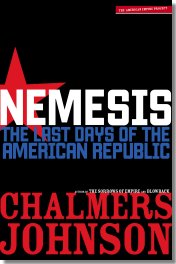
— Chalmers Johnson, author of Nemesis: The Last Days of the American Republic
Has our “leadership” traded democracy for empire? Have their over-bloated egos convinced them that they are the world’s newly crowned colonial kings? Author Chalmers Johnson is certainly not given to wearing rose-colored glasses. As he concludes in his newest book, Nemesis: “… my country is launched on a dangerous path that it must abandon or else face the consequences.” Chalmers’ well-argued, persuasive dose of doom saying draws on the economic, military, and political lessons of the past, which may be just what’s needed to wake up Americans in time to change course. He talked with BuzzFlash about his hopes and fears for contemporary America.
* * *
BuzzFlash: You’ve written a three-part series of books on the United States as an empire. The first was called Blowback. The second is The Sorrows of the Empire. And, now, Nemesis, The Last Days of the American Republic. That’s kind of a doomsday declension there.
Chalmers Johnson: I guess you could say that. It’s inadvertent. I didn’t set out to write three volumes. I don’t know whether Gibbons set out to write The Decline and the Fall of the Roman Empire. But one led to the other.
The first was written well before 9/11, and it was concerned with what I perceived to be the American public’s lack of understanding that most of the foreign policy problems of the 21st century were going to be things left over from the Cold War. Above all, I argue that our numerous clandestine activities, some of which are almost totally disreputable, will come back to haunt us.
The second book followed on the first, in that it was a broad analysis of what I called our military-based empire, an empire of 737 American military bases in over 130 countries around the world. That number is the official Pentagon count. They are genuine military bases. They’re very extensive. They are not, as some defenders of the Pentagon like to say, just Marine guards. We haven’t got 700 embassies around the world. The Sorrows of Empire was written as we were preparing for our invasion of Iraq, and it was published virtually on the day that we invaded
BuzzFlash: And now Nemesis is your cataclysmic conclusion. Not long ago, it was considered sort of radical to say that America is a neo-colonial empire. But you embrace that concept in many ways.
Chalmers Johnson: Right.
BuzzFlash: The perspective in much of the neo-con writing, in The Weekly Standard, for instance, is that America is an empire. It’s a superpower. It can take whatever it wants. Basically, the rule of thumb becomes, if you challenge the U.S. assertion of military control and dominance, you’re an enemy of the United States. You don’t have to threaten the United States, but merely oppose the imposition of the military authority.
Chalmers Johnson: Quite true. The roots of this military empire go back, of course, to World War II, which is when we conquered Germany, Japan, Italy, places of that sort, and did not withdraw after the war was over. We’ve been in Okinawa, for example, ever since 1945. The people there have been fighting against us ever since 1945, in three major revolts — they hate it.
But the critical point comes with the collapse of the Soviet Union. Paul Wolfowitz, who was then in the Department of Defense working for Dick Cheney in the first Bush administration, wrote that our policy now is to prevent any nation, or combination of nations, from ever having the kind of power that could challenge us in any way militarily.
This is when we really invite “Nemesis,” the goddess of retribution, vengeance, and hubris, into our midst by proclaiming that we “won” the Cold War. It’s not at all clear that we’ve won the Cold War. Probably, we and the U.S.S.R. lost it, but they lost it first and harder because they were always poorer than we were. The assumption was that we were now the global superpower; we were the lone superpower; we were a new Rome. We could do anything we wanted to. We could dominate the world through military force.
This is as clear a statement of imperial intent as I think one could imagine, and it is what leads to such radical ideas as war as a choice, preventive war, wars such as that in Iraq, which was essentially to expand the empire by providing a new stable base for us in the Middle East, having lost Iran in 1979, and having so antagonized the Saudis that they were no longer allowing us to use our bases there the way we like.
So, yes, I think the word imperialism is appropriate here, but not in the sense of colonization of the world. I’m meaning imperialism in the sense of, for example, the Soviet empire in Eastern Europe throughout the Cold War after World War II. That is, we dominate places militarily, we insist on local satellite-type governments that are subservient to us, that follow our orders and report to us when we ask them to. Yet we have troops based in their territories. They are part of our global longevity.
BuzzFlash: We’ve heard both Bush and Cheney repeat their mantra that the troops won’t come home until our mission is accomplished, until we achieve victory. It’s somewhat fascinating, in a very tragic sort of way, to try to figure out what the heck these guys are talking about. We have seen from both of them so many different missions publicly stated. First it was weapons of mass destruction. Then it was regime change. When we changed the regime and found out there were no weapons of mass destruction, we suddenly developed new missions.
Chalmers Johnson: Right.
BuzzFlash: Now it’s not clear what the mission is. Bush just says let’s complete the mission. We speculated on BuzzFlash that this is sort of a policy of white man’s rule, coming from the days of the Confederacy, where, if you were a white male, you were entitled to run a plantation, or whip your slave. You were the head of the household, no matter what.
Chalmers Johnson: I wouldn’t put it in racist terms, but you’re quite right. The political philosopher Hannah Arendt argued that at the root of all imperialism, there has to be a racist view.
BuzzFlash: When Bush says we have to accomplish the mission, or Cheney says we have to achieve victory, the question hangs out there as to what our mission is now? And what could possibly be victory in these circumstances? To them, mission or victory mainly means that we are perceived as winning and Iraq remains under our control.
Chalmers Johnson: I believe that’s absolutely true. It’s one of the reasons why we didn’t have a withdrawal strategy from Iraq — we didn’t intend to leave. Several people who retired from the Pentagon in protest at the start of the war — I’m thinking of Lieutenant Colonel Frank Hoffman particularly — have testified that the purpose of the invasion was to establish a new, stable pillar of power for the United States in the Middle East. We had lost our main two bases of power in the region — Iran, which we lost in 1979 because of the revolution against the Shah, whom we ourselves placed in power — and then Saudi Arabia, because of the serious blunder made after the first Gulf War — the placing of American Air Force and ground troops in Saudi Arabia after 1991. That was unnecessary. It’s stupid. We do not have an obligation to defend the government of Saudi Arabia. It was deeply resented by any number of sincere Saudi patriots, including former asset and colleague, Osama bin Laden. Their reaction was that the regime that is charged with the defense of the two most sacred sites of Islam — Mecca and Medina — should not rely upon foreign infidels who know next to nothing about our religion and our background.
The result was that, over the 1990s and going into the 2000s, the Saudis began to restrict the uses we had of Prince Sultan Air Base at Riyadh. They became so restricted that, finally, in the invasion of Iraq in 2003, we moved our main headquarters to Qatar and conducted the war from there. This left us, however, with only the numerous small bases we have in the Persian Gulf. But these are in rather fragile countries.
Iraq was the place of choice, to these characters, who knew virtually nothing about the Middle East. Spoke not a word of Arabic or knew even the history of it. Iraq was the one they picked out because it’s the second largest source of oil on earth, and it looked like an easy conquest.
We now know that the President himself didn’t understand the difference between Shia and Sunni Islam — that he did not appreciate that Saddam Hussein’s regime was a minority Sunni dictatorship over the majority Shia population. That once you brought about regime change there, the inevitable result would be unleashing the Shia population, who had previously been suppressed, to run their country, and that they would align themselves with the largest Shia power of all, a Shia superpower, namely, Iran, right next door, where most of their leaders had spent the period of the Saddam Hussein dictatorship.
That’s essentially what’s happened. It’s hard to imagine how this served our interests, given the deep hostility between Iran and the United States ever since we started interfering in that country back in 1953. It is hard to imagine how this served the interests of Israel, in that it gave Shia support there. Support from Iran now spreads throughout the Middle East to Hezbollah, Hamas, and other organizations. And it leads to a contradiction in terms of what we’re doing there. At times, we seem to be trying to restore Sunni rule, so that we can bring about some peace. On the other hand, we have no choice but to support the majority power because of our propaganda about supporting democracy at the point of an assault rifle.
BuzzFlash: In Nemesis you draw comparisons to the Roman empire. As you point out, with the collapse of the Soviet Union, we became the most powerful nation, at least in our self-perception. But in terms of our economy, we are at the mercy of all the countries that are keeping our economy afloat through loans. Militarily, we have the most powerful weapons, but this seems to have done nothing for us in Iraq.
Chalmers Johnson: Nothing at all. In fact, sticking to Iraq just for a moment, one of the most absurd things is the fact that we have a defense budget that’s larger than all other defense budgets on earth. This army of 150,000 troops that we’ve sent to Iraq — a country with the GDP of Louisiana, I’d say — they’ve been stopped by 20,000 insurgents. This is a scandal and a discrediting of the military, the Pentagon, and the strategies we’ve pursued.
But the broad argument that I’m trying to make in Nemesis is that history tells us there’s no more unstable, critical configuration than the combination of domestic democracy and foreign empire. You can be one or the other. You can be a democratic country, as we have claimed in the past to be, based on our Constitution. Or you can be an empire. But you can’t be both.
The classic example is the Roman republic, on which our country was, in many respects, modeled. They decided, largely through the influence of militarism, to retain their empire. Having decided to retain it, they then lost their democracy due to military intervention in politics after the assassination of Julius Caesar and the coming to power of military dictators. They were termed Roman emperors, but they were essentially military dictators.
There is an alternative model that I advocate in the book. It’s not as clear-cut an example, but it is certainly one that’s relevant, and that is Great Britain after World War II. After the spectacular war against Nazism, it was brought home to the British that if they were going to retain the jewel in the crown of their empire, namely India, with its huge, vast population, it could do so. It could keep people under its control through military force. They’d used that often enough in India, as it was.
In light of the Nazi experience, though, it now seemed almost impossible to go in that direction. Britain realized that to retain its empire, it would have to become a tyranny domestically. It chose, in my view, to give up its empire. It didn’t do it beautifully, and we see imperialistic atavisms all the time, Tony Blair being the best example. But it chose to give up its empire in order to retain its democracy.
The causative issue is militarism. Imperialism, by definition, requires military force. It requires huge standing armies. It requires a large military-industrial complex. It requires the willingness to use force regularly. Imperialism is a pure form of tyranny. It never rules through consent, any more than we do in Iraq today.
The power of the military establishment is what threatens the separation of powers on which our Constitution is based. The Constitution, the chief bulwark against tyranny and dictatorship, separates the executive and legislative and judicial branches. It does not concentrate power in the executive branch, or concentrate money there, or secrecy.
The two most famous warnings in the history of our country address militarism — namely George Washington’s farewell address, read at the opening of every session of Congress, and Eisenhower’s speech. Washington spoke of the greatest enemy of liberty as being standing armies. He said they were the particular enemy of republican liberties. He was not opposed to defending the country; he was talking about standing armies, as distinct from armies raised to defend the country in a time of national emergency. It was standing armies, Washington argued, that overbalance the separation of powers, that serve the presidency and destroy federalism.
The next great warning, which was even more striking, were the words of Dwight Eisenhower in 1961. He spoke of the military-industrial complex and its unwarranted, unchecked, unsupervised power and the enormous damage it was doing. This is what I’m talking about in Nemesis, and why I use this, as you put it, very apocalyptic subtitle.
But I do mean it. I believe that we’re close to a tipping point right now. What happened to the Soviet Union between 1989 and 1991 could easily be happening to us for essentially the same reasons. Imperial overreach, inability to reform, rigid economic ideology. And we have, as you know, also very serious economic dependencies on the rest of the world now. We are a wholly indebted country. We’re not paying for the things we’re doing. The sort of news we saw in recent days in the Stock Exchange is entirely predictable.
BuzzFlash: Is the Middle East intervention — Iraq, and the desire to nuke Iran — is this empire building in the guise of fighting terrorism?
Chalmers Johnson: Yes.
BuzzFlash: If there weren’t terrorists, Bush and Cheney would have had to invent them?
Chalmers Johnson: Absolutely. There’s just no doubt about it. In fact, we have to say that in any historical perspective, that the response of Bush-Cheney to 9/11 was a catastrophe of misjudgment and almost surely based on interests entirely separate from the terrorist attacks. We enhanced Osama bin Laden’s power by declaring war on terrorism, escalating his position. The world’s balance of power didn’t change one iota on September 11th, 2001. The only way we could lose the power and influence we had at that time was through our own actions, and that’s what we did.
Instead of calling it a war on terrorism, we should have called it a national emergency. We should have gone after the terrorists as criminals, as organized crime, because of their attacks on innocent civilians. Tracked them down — we have the capacity to do that — arrested them, extradited them back to the United States, tried them in our courts, and executed them. Had we done that, we would have retained the support of virtually the entire rest of the world, including the Islamic world, as the victims on 9/11.
But we did the opposite. We simply went crazy, and we also refused to acknowledge that the retaliation that came on 9/11 was blow-back. We were partly responsible for what happened, since the people who attacked us were our former allies in the largest single clandestine operation we ever carried out, including Armenians sending into battle of the Mujahideen against the Russians in Afghanistan. Certainly, Osama bin Laden was not unfamiliar to our Central Intelligence Agency. They had been working with him for quite a long time.
It’s in that sense that I think it was a catastrophic error. But the truth is, in retrospect, it doesn’t look like an error at all. They saw it as an opportunity — as a golden opportunity to carry out these sort of mad and speculative schemes that they had been working on throughout the 1990s, dreaming that we were this new Rome that could do anything it wants to.
BuzzFlash: What will collapse first in America, according to your scenario, in the last days of the American republic?
Chalmers Johnson: I’m not Cassandra. I can’t make a prediction. If I would look at the historical examples, I would say we could expect that a bloated, overgrown military soon would become unaffordable. It would move in and take over. I don’t really expect that to happen, though I certainly should warn you that General Tommy Franks had said publicly in print that in case of another attack like 9/11, he saw no alternative but for the military to assume command of the country.
That would be the Roman answer — having built this huge militaristic world, and becoming increasingly economically dependent on the military-industrial complex domestically. We don’t actually manufacture that much in this country, anymore, except for weapons and munitions. That’s a possibility, that the military does ultimately take over, just as in the Roman republic, with that reliance on standing armies instead of legions raised from common citizens because of threats to the country. Ultimately, ambitious generals, often from the establishment, chose to take over. All they asked for was dictatorship for life, by God, and that’s what they got.
It isn’t inconceivable that one could have a renaissance in popular opinion. And that is needed. We need to rebuild the Constitutional system to overcome that most peculiar of anomalies. We know about the imperial presidency. We know about Dick Cheney’s ambitions. It’s one thing after another. So why is the Congress simply abdicating its role as the main point of oversight, the main source of authority?
I live in the 50th District of California, where Duke Cunningham was sentenced to federal prison for eight and a half years for being the biggest single bribe taker in the history of the U.S. Congress. It’s significant, of course, that the people bribing him were defense contractors. It was a case of us getting crummy weapons, in order simply to line their own pockets.
There’s far too much of that. Not enough has been done about it. We have procedures in this country for dealing with unsatisfactory political leaders, for removing the incompetent from office. It’s called impeachment. Last November, the American public brought the opposition party into power in Congress, and immediately the leaders of the opposition party said impeachment is off the table. Well, if impeachment is off the table, then it may well be that Constitutional democracy is off the table, too.
If you had asked me what I think actually will happen — and again, I cannot foresee the future — the economic news encourages me in this thought. I believe we will stagger along under the façade of constitutional government until we’re overtaken by bankruptcy. Bankruptcy will not mean the literal end of the United States, any more than it did for Germany in 1923, or China in 1948, or Argentina just a few years ago, for 2001 and 2002.
But it would mean a catastrophic shake up of the society, which could conceivably usher in revolution, given the interests that would be damaged in this. It would mean virtually the disappearance of all American influence in international affairs. The rest of the world would be greatly affected, but it would begin to overcome it. We probably would not.
That’s what I think is the most likely development, given the profligacy of our government in spending money that it doesn’t have, in borrowing it from the Chinese and the Japanese, and the defense budgets that are simply serving the interest of the military-industrial complex.
BuzzFlash: Polling has shown that most Americans want some sort of withdrawal from Iraq based on timetables. They want this war over. The Democratic electoral victory was perceived to be a victory to close down the Iraq war. The majority of Iraqis support attacks on American soldiers. Why is Bush talking about trying to save Iraq from the terrorists, if 62% support attacks on American soldiers?
Chalmers Johnson: That’s exactly the point, I think. He’s not making sense. They’re putting out hot air, a smoke screen, visions, such things as the longing for democracy, as if American G.I.s are going to bring democracy to anybody. They’re disguising their real intent. We see it in their almost total inability ever to say that they do not intend to keep permanent bases, when you’ve seen the largest military bases, air bases with huge double runways, strategically located around the country. Never once do they say, that’s not our intent. And the Air Force occasionally let slip that we expect to be there for at least a couple more decades.
But the American establishment, which certainly includes the Congressional and judicial establishment, has accepted the idea that we are the lone superpower, that we can do anything we want to. Although we’ve always been a superpower since World War II — we’ve easily been the world’s largest nation — we didn’t behave in that stupid manner. That’s in part why I entitled my book Nemesis. She is the punisher of hubris and arrogance.
The public is on the receiving end, in terms of the declining jobs, the lower quality of life in America, and supplying the troops for the wars of choice that Bush and Condoleezza Rice have invented — the public is beginning to get the idea. They understand it in a natural way.
That is one reason the military so much prefers the volunteer army, since 1973, as distinct from conscription. Conscription does mean a citizen army. You know why you’re there. When I was in the Navy in the Korean War, it was an obligation of citizenship, it was not as it is today. Service today in our armed forces is a career choice, a decision about how to make your living. That alters things a great deal.
It makes it easier for the officers. Everybody who was ever in the armed forces knows that, with a citizen army, the people are very sensitive to whether the officers are lying, or whether they know what they’re doing, whether the strategy makes any sense or not. There’s a degree of fairness at work. The Vietnam war was certainly a working-class war. The total number of Yale graduates killed in Vietnam was one, and that is a fact.
So, yes, you could conceivably imagine a renaissance of public demand to take back the Congress, reconstitute it, reform it. Kick out the elites that serve vested interests. They’re in both parties.
But I don’t really expect that to happen. I think it’s almost impossible to imagine mobilizing that kind of public, given the conglomerate control of the media in America, basically for purposes of advertising revenue.
At the same time, I am very much aware that the Internet is a new source of information. It’s radically active. There are lots of people using it. And the public is alive. I’ve now published three books, this inadvertent trilogy. I notice a much more positive response to this last book, Nemesis, than to the first two, when you go into public to talk about it at the bookstore or at a university, or at a Democratic club. The people are worried to death about the way the country is going, the way it’s governed, and above all, what they see as having happened. The political system has failed. We allowed it — we lost oversight. If the price of liberty is eternal vigilance, we have been anything but vigilant.
That’s what Eisenhower warned us against. It’s now here on our doorstep. We’re close to the tipping point. And I don’t really expect it to be reversed. But at the same time, that’s precisely why you and I are talking to each other. We still do believe that there’s a possibility of mobilizing inattentive citizens to reclaim the Congress and clean it up.
BuzzFlash: You mentioned earlier that the CIA at one time cooperated with the mujahideen, and particularly Osama bin Laden.
Chalmers Johnson: Right.
BuzzFlash: He was, in essence, an intelligence and military asset for the United States in its effort to wound the Soviets in Afghanistan.
Chalmers Johnson: Right.
BuzzFlash: The effort was successful, in large part, because of a guerilla operation in which foreign fighters, including Osama bin Laden, who is from Saudi Arabia, fought on behalf of a Muslim nation against what was considered an imperial invader from the north — Russia. And Russia finally withdrew.
Chalmers Johnson: Right. What happened in Afghanistan contributed ultimately to the collapse and dissolution of the Soviet Union.
BuzzFlash: Exactly. It was one of the major dominos leading to the collapse of the Soviet Union as an empire. And it was imperial hubris which caused them to think they could subdue Afghanistan.
Chalmers Johnson: Right.
BuzzFlash: Now my question is this: Is Iraq America’s Afghanistan?
Chalmers Johnson: It is perfectly possible that it will prove to be. Let me, just for once, give the Pentagon credit instead of criticizing it. I’ve always preferred their phrase “asymmetric warfare” for terrorism. Terrorism is a wrong word. It’s a pejorative term. It’s used to attack other people. We don’t recognize the amount of terrorism we ourselves perpetuate, particularly from the air. But asymmetric warfare means the warfare of the poor, of the people who must rely upon ambushes and traps, and knowing their own country. That’s what the Soviet Union ran into.
The fact that we are again repeating that — you simply have to wonder whatever happened to Tony Blair? Is he an educated Englishman or not? Doesn’t he know what happened to England in Afghanistan in the 19th Century, where the Afghans wiped them out? They would leave one single Englishman and send him back to the Khyber Pass to inform the army in India what had happened. We’re back there again, and there’s no doubt that we’re going to be facing something very much like what the Soviet Union faced, in this coming summer.
It’s absurd to listen to our people talk about how they had won the Afghan war. Basically what they did was to re-ignite the civil war by aiding the most corrupt figures in the country, namely the Northern Alliance of warlords, and provide them with airpower. It was anything but a victory, and I would hate to invest much in the Karzai regime for longevity.
So, yes, it is perfectly possible that we have come up against our genuine nemesis in the Middle East. We have created an economy totally dependent on oil. There’s our insane belief that we can dominate the world through superior task forces, cruise missiles, and things of this sort. And we still claim that this is democracy.
The very idea — we’ve seen the pictures of Americans kicking down the door of a private home, rushing in, usually walking all over Arabic rugs in their dirty boots, and pointing assault rifles at cowering women and children, carrying a few men off with their arms tied behind their back and hoods over their heads. Then we claim that this is bringing democracy to Iraq? We shouldn’t be surprised that many Iraqis say it’s okay to kill Americans.
That’s what’s going on in Iraq. We know we’re going to lose it, just as we did in Vietnam. At least the public is sensing that, once again raising the hopes that democracy is not an insane form of government. The public may not be as well-informed as it ought to be, but it seems to be better informed than the elites in Washington, D.C.
BuzzFlash: Thank you very much. Congratulations, it’s a great trilogy.
Chalmers Johnson: Thank you.
BuzzFlash Interview conducted by Mark Karlin.