Report from The Rouge Forum “Their Wars Left Behind” Conference

The Rouge Forum web page is updated with initial reports, including great video, from our “Their Wars Left Behind: Education for Action” conference last week in lovely downtown Detroit (where, on Tuesday, Comerica Bank, official name of what was once Tiger Stadium, announced the company was leaving the city).

View photos from the conference here.

Here is a link to some wonderful work from presenters and participants, including song and dance:

At least three things came from the conference.

1. People made lasting friendships, built close personal ties within a community that demonstrated its solidarity in unusual conference fashion—nearly everyone ate together, enjoyed some great films, and made it beyond a Detroit blizzard. Real friendship is radical activity in the USA today.

2. The presentation and keynoters were outstanding, offering new ways to understand and transform the world in schools and out, as you can see from the videos and papers now online.

3. We initiated a transformation of our organization so that new people will be able to come into the Rouge Forum, quickly see where they might best exhibit their talents, and help press forward the project toward equality, democracy, and justice. The minutes from the Sunday organizational meeting will be up this coming week, available for comment on the Rouge Forum discussion list linked here.

In brief, we underlined that justice does indeed demand organization. No other education based group in the US has done what the Rouge Forum has done, or could do with your help.

Thanks to all those who gave generously of time and money, especially Greg Queen and Katy Landless, Amber Goslee, Bill Boyer, Rich Gibson, Faith Wilson, George Schmidt (remember to subscribe to Substance News!), Patrick Shannon, Susan Ohanian, Susan Harman, David Strom, Connie and Doug Lane, M.L, Liebler, Fran Shor, Michael Peterson, Nancy Patterson, Scott Craig, Steve Fleury, Eugenio Basualdo, Joseph Cronin, Steve Strauss, Tim Cashman, Eric Ferris, Ed Sanders, Adam Renner, Gina Stiens, Carolyn Stirling, Peter Werbe, Dave Hill, Richard Kamler, Al Franklin, Mindy Nathan, Sean Ahern, Lloyd Conway, Don Perl, Kristi Roberston, Judy Depew, and Paul Gilmore.

Thanks too to the labor leaders like Al Cholger and Tommie Suber who traveled far to participate, and the Downer Five’s Elizabeth Jaeger, and California Resisters’ Susan Harman, and to the high-school students who did such a fine job taking leadership.

The Rich and the Rest of Us

The income/wealth gaps between the rich and everyone else continues to grow. A recent report from the Canadian Centre for Policy Alternatives shows that Canada’s income gap between the rich and poor is growing, largely because the lion’s share of Canada’s economic growth is going to the richest 10% of families. It’s not going to the majority, the 80% of families earning under a $100,000.

The study, The Rich and the Rest of Us: The Changing Face of Canada’s Growing Gap, looks at the earnings and after-tax incomes of Canadian families raising children under 18, comparing families in the late 1970s and those in the early 2000s. The study finds:

* Canada’s income gap is growing: In 2004, the richest 10% of families earned 82 times more than the poorest 10% – almost triple the ratio of 1976, when they earned 31 times more. In after-tax terms the gap is at a 30-year high.

* Bottom half shut out: Between 1976-79 the bottom half earned 27% of total earnings. Between 2001-04 that dropped to 20.5%, though they worked more. Up to 80% of families lost ground or stayed put compared to the previous generation, in both earnings and after-tax terms. The poorest saw real incomes drop.

* Work is not enough: All but the richest 10% of families are working more weeks and hours in the paid workforce (200 hours more on average since 1996) yet only the richest 10% saw a significant increase in their earnings – 30%.

In the February 2007 issue of Z Magazine, Jack Rasmus describes how in the USA there is a $1 trillion income shift from the working classes to the rick every year.

The most telling statistic of what it all means comes from the U.S. Department of Commerce. It states that wages and salaries as of April 2006 constituted only 45.3 percent of GDP, a decline from 50.0 percent in 2001 and 53.6 percent in 1970. Furthermore, as the U.S. government estimates, “each percentage point now equals about $132 billion.” In other words, the roughly 8.3 percent drop in labor’s share by 2005 represents an annual shift in relative income today of about $1.09 trillion. That’s $1.09 trillion that now occurs every year—and it is rising.

That $1.09 trillion shift is equivalent to every one of 108 million non-supervisory workers in the U.S. today writing out a check each year, every year, for $12,100 and signing it over to the 24 million upper-class households—about 40 percent of which would go to the wealthiest 1.4 million families.

High-Stakes Testing is Putting the Nation At Risk

Here’s an Education Week commentary on the deleterious effects of the No Child Left Behind legislation by David Berliner and Sharon L. Nichols, which is based on their new book Collateral Damage: How High-Stakes Testing Corrupts America’s Schools, published by Harvard Education Press.

Education Week
Published: March 12, 2007

Commentary
High-Stakes Testing is Putting the Nation At Risk
By David C. Berliner & Sharon L. Nichols

In his 2007 State of the Union address, President Bush claimed success for the federal No Child Left Behind Act. “Students are performing better in reading and math, and minority students are closing the achievement gap,” he said, calling on Congress to reauthorize this “good law.” Apparently, the president sees in No Child Left Behind what he sees in Iraq: evidence that his programs are working. But, as with Iraq, a substantial body of evidence challenges his claim.

We believe that this federal law, now in its sixth year, puts American public school students in serious jeopardy. Extensive reviews of empirical and theoretical work, along with conversations with hundreds of educators across the country, have convinced us that if Congress does not act in this session to fundamentally transform the law’s accountability provision, young people and their educators will suffer serious and long-term consequences. If the title were not already taken, our thoughts on this subject could be headlined “A Nation at Risk.”

We note in passing that only people who have no contact with children could write legislation demanding that every child reach a high level of performance in three subjects, thereby denying that individual differences exist. Only those same people could also believe that all children would reach high levels of proficiency at precisely the same rate of speed.

Validity problems in the testing of English-language learners and special education students also abound, but we limit our concerns in this essay to the No Child Left Behind law’s reliance on high-stakes testing. The stakes are high when students’ standardized-test performance results in grade retention or failure to graduate from high school. The stakes are high when teachers and administrators can lose their jobs or, conversely, receive large bonuses for student scores, or when humiliation or praise for teachers and schools occurs in the press as a result of test scores. This federal law requires such high-stakes testing in all states.

More than 30 years ago, the eminent social scientist Donald T. Campbell warned about the perils of measuring effectiveness via a single, highly consequential indicator: “The more any quantitative social indicator is used for social decisionmaking,” he said, “the more subject it will be to corruption pressures and the more apt it will be to distort and corrupt the social processes it is intended to monitor.” High-stakes testing is exactly the kind of process Campbell worried about, since important judgments about student, teacher, and school effectiveness often are based on a single test score. This exaggerated reliance on scores for making judgments creates conditions that promote corruption and distortion. In fact, the overvaluation of this single indicator of school success often compromises the validity of the test scores themselves. Thus, the scores we end up praising and condemning in the press and our legislatures are actually untrustworthy, perhaps even worthless.
The scores we end up praising and condemning in the press and our legislatures are actually untrustworthy, perhaps even worthless.

Campbell’s law is ubiquitous, and shows up in many human endeavors. Businesses, for example, regularly become corrupt as particular indicators are deemed important in judging success or failure. If stock prices are the indicator of a company’s success, for example, then companies like Enron, Qwest, Adelphia, and WorldCom manipulate that indicator to make sure they look good. Lives and companies are destroyed as a result. That particular indicator of business success became untrustworthy as both it and the people who worked with it were corrupted.

Similarly, when the number of criminal cases closed is the indicator chosen to judge the success of a police department, two things generally happen: More trials are brought against people who may be innocent or, with a promise of lighter sentences, deals are made with accused criminals to get them to confess to crimes they didn’t commit.

When the indicators of success and failure in a profession take on too much value, they invariably are corrupted. Those of us in the academic world know that when researchers are judged primarily by their publication records, they have occasionally fabricated or manipulated data. This is just another instance of Campbell’s law in action.

We have documented hundreds of examples of the ways in which high-stakes testing corrupts American education in a new book, Collateral Damage. Using Campbell’s law as a framework, we found examples of administrators and teachers who have cheated on standardized tests. Educators, acting just like other humans do, manipulate the indicators used to judge their success or failure when their reputations, employment, or significant salary bonuses are related to those indicators.
The law makes all who engage in compliance activities traitors to their own profession. It forces education professionals to ignore the testing standards that they have worked so hard to develop.

We found examples of administrators who would falsify school test data or force low-scoring students out of school in their quest to avoid public humiliation. We documented the distortion of instructional values when teachers focused on “bubble” kids—those on the cusp of passing the test—at the expense of the education of very low or very high scorers. We found instances where callous disregard for student welfare had replaced compassion and humanity, as when special education students were forced to take a test they had failed five times, or when a student who had recently suffered a death in the family was forced to take the test anyway.

Because so much depends on how students perform on tests, it should not be surprising that, as one Florida superintendent noted, “When a low-performing child walks into a classroom, instead of being seen as a challenge, or an opportunity for improvement, for the first time since I’ve been in education, teachers are seeing [that child] as a liability.” Shouldn’t we be concerned about a law that turns too many of the country’s most morally admired citizens into morally compromised individuals?

We also documented the narrowing of the curriculum to just what is tested, and found a huge increase in time spent in test preparation instead of genuine instruction. We found teachers concerned about their loss of morale, the undercutting of their professionalism, and the problem of disillusionment among their students. Teachers and administrators told us repeatedly how they were not against accountability, but that they were being held responsible for their students’ performance regardless of other factors that may affect it. Dentists aren’t held responsible for cavities and physicians for the onset of diabetes when youngsters don’t brush their teeth, or eat too much junk food, they argue.

Teachers know they stand a better chance of being successful where neighborhoods and families are healthy and communicate a sense of efficacy, where incomes are both steady and adequate, and where health-care and child-care programs exist. So the best of them soon move to schools with easier-to-teach students. This is no way to close the achievement gap.

Dozens of assessment experts have argued eloquently and vehemently that the high-stakes tests accompanying the implementation of the No Child Left Behind Act are psychometrically inadequate for the decisions that must be made about students, teachers, and schools. Furthermore, the testing standards of the American Educational Research Association are being violated in numerous ways by the use of high-stakes tests to comply with the law. The law, therefore, makes all who engage in compliance activities traitors to their own profession. It forces education professionals to ignore the testing standards that they have worked so hard to develop. We wonder, would the federal government treat members of the American Medical Association or the National Academy of Sciences with such disdain?

In reauthorization hearings for the law, members of Congress should abandon high-stakes testing and replace it with an accountability system that is more reasonable and fair.

What might such a system look like?

A move to more “formative” assessments and an abandonment of our heavy commitment to “summative” assessments would be welcome. Assessment for learning, as opposed to assessment of learning, has produced some impressive gains in student achievement in other countries, and ought to be tried here. Likewise, the use of an inspectorate—an agency that sends expert observers into schools—has proved itself useful in other countries, and could also help improve schools in the United States.

End-of-course exams designed by teachers, as some states are now offering, increase teachers’ commitment to the testing program and, if the teachers get to score the tests, can also be a great professional-development opportunity. There are other alternatives to high-stakes testing, as well.

Our research informs us that high-stakes testing is hurting students, teachers, and schools. It is putting the nation at risk. By restricting the education of our young people and substituting for it training for performing well on high-stakes examinations, we are turning America into a nation of test-takers, abandoning our heritage as a nation of thinkers, dreamers, and doers.

David C. Berliner is the Regents’ professor of education at Arizona State University, in Tempe, and a past president of the American Educational Research Association. Sharon L. Nichols is an assistant professor of educational psychology at the University of Texas at San Antonio. They are the co-authors of Collateral Damage: How High-Stakes Testing Corrupts America’s Schools, published this month by Harvard Education Press.

Vol. 26, Issue 27, Pages 36,48

© 2007 Editorial Projects in Education

Florida Neo-Nazi rally was organized by FBI informant

Here’s yet another example of why the government should be trusted (as if we needed more)…direct ties between the FBI and Nazis.

Neo-Nazi rally was organized by FBI informant

Henry Pierson Curtis
Sentinel Staff Writer

February 15, 2007

A paid FBI informant was the man behind a neo-Nazi march through the streets of Parramore that stirred up anxiety in Orlando’s black community and fears of racial unrest that triggered a major police mobilization.

That revelation came Wednesday in an unrelated federal court hearing and has prompted outrage from black leaders, some of whom demanded an investigation into whether the February 2006 march was, itself, an event staged by law-enforcement agencies.

The FBI would not comment on what it knew about the involvement of its informant, 39-year-old David Gletty of Orlando, in the neo-Nazi event. In court Wednesday, an FBI agent said the bureau has paid its informant at least $20,000 during the past two years.

“Wow,” Gletty said when reached by phone late Wednesday. “It is what it is. You were there in court. I can’t really go into any detail now.”

Orlando City Councilwoman Daisy Lynum, whose district includes the march route west of Interstate 4, said she wants to know who was behind the march, the neo-Nazis or the FBI and other law-enforcement agencies.

“If it was staged, I would feel very uncomfortable and would ask for a full-scale investigation,” Lynum said. “To come into a predominantly black community which could have resulted in great harm to the black community? I would hate to be part of a game. It’s a mockery to the community for someone else to be playing a game with the community.”

Others applauded the FBI’s infiltration of the neo-Nazis.

“It’s one of the largest extremist groups in the country, and Gletty was one of the most visible individuals in the National Socialist Movement,” said Andy Rosenkranz, state regional director for the Anti-Defamation League. “Generally, the FBI and the JTTF (Joint Terrorism Task Force) in Florida does an excellent job.”

Rally puts city in spotlight

Orlando drew national attention when the city granted a permit to Gletty so a minimum of 100 white supremacists and National Socialist Movement members could march Feb. 25 through the historically black Parramore neighborhood.

Wearing swastikas and holding signs declaring “White Pride,” the 22 neo-Nazis who turned out were protected from 500 counterprotesters by about 300 police officers.

Gletty’s secret life became public Wednesday in a federal court hearing resulting from the arrest last week of two suspected white supremacists on charges of conspiracy to distribute crack cocaine.

Last Thursday, the FBI arrested Tom Martin, 23, and John Rock, 35, after Gletty wore a wire to a meeting and agreed to help them rob a drug dealer in Casselberry, according to testimony.

Rock told Gletty in a tape-recorded conversation that he and Martin had robbed seven drug dealers by posing as law-enforcement officers, according to testimony. Martin and Rock remain held without bail in the Seminole County Jail.

Slip-up lets name out of bag

Throughout most of the hearing, Gletty was referred to as “Mr. X” or “CW” (cooperating witness). His identity was revealed when Assistant Federal Public Defender Peter W. Kenny repeatedly slipped up and mentioned Gletty’s full name.

FBI agent Kevin Farrington and a federal prosecutor were clearly uncomfortable with the disclosure of the informant’s name in open court.

Questioned about Gletty’s role in the march, Farrington testified that “he participated in it. He did not organize it. . . . [That’s] pretty good firsthand information, sir.”

The city parade permit, however, lists Gletty as the “on scene event manager.”

And pictures of Gletty addressing marchers sporting swastika armbands for the Orlando rally appear on a neo-Nazi Web site. Captions from other photos on the site mock the counterdemonstrators and the police presence.

On another Web site, Gletty details his role in organizing the Orlando event and hosting a victory party afterward.

“On 1/17/06 I got the permits and started the ball rolling,” he writes. “On 2/25/06 at 3 pm on saturday [sic] in downtown Orlando My crew and I got it done.”

In another part of the posting, he writes: “Since I was the permit holder I was the person to deal with the police and had over-all authority of the event.”

No word from FBI

FBI officials did not return calls asking for specifics about the agency’s relationship with Gletty. A tree-trimmer in Orlando, he withdrew from the National Socialist Movement last fall to pursue other projects, Farrington testified.

Orlando police Deputy Chief Pete Gauntlett, who supervised the march preparations, would not say what the FBI told police about Gletty and other marchers.

“We let them express their free speech and let them do what they’re allowed to do, but we wanted to have control,” Gauntlett said.

Bill White, a former spokesman for the National Socialist Movement who participated in the rally and now runs another neo-Nazi group, said he was surprised to hear of Gletty’s involvement with the FBI. He said Gletty did a lot for the cause.

A neo-Nazi offers his take

“If he was being sponsored by the FBI, then American National Socialism has a lot to thank the FBI for,” White said in an e-mail.

Lynum said that if the FBI was behind the march, she would like the agency to reimburse the city for the tens of thousands it spent to send officers — including SWAT-team and mounted-unit members — to police the march.

Adora Obi Nweze, president of the State Conference NAACP in Miami, said she was disturbed an informant set up the march and was working for the FBI.

“That’s very troubling that somebody like that would be an informant for the FBI,” she said. “You never know what they are capable of. No question, it bothers me.”

But Alzo Reddick, a former state legislator who grew up in segregated Orlando, lived through KKK marches and later taught black history, said he was proud of the way the police and the community responded. He was a member of the “Be Cool” movement organized to calm the community before the march.

“I think law enforcement has to walk in some murky places to be where the bad guys are,” Reddick said. “Was the FBI informant an activist or a participant? Was he the agent provocateur from the get-go? Sure, that would be part of what I’d like to know.”

Rene Stutzman, Jim Leusner and Willoughby Mariano of the Sentinel staff contributed to this report. Henry Pierson Curtis can be reached at hcurtis@orlandosentinel.com or 407-420-5257. Others applauded the FBI’s infiltration of the neo-Nazis.

“It’s one of the largest extremist groups in the country, and Gletty was one of the most visible individuals in the National Socialist Movement,” said Andy Rosenkranz, state regional director for the Anti-Defamation League. “Generally, the FBI and the JTTF (Joint Terrorism Task Force) in Florida does an excellent job.”

Rally puts city in spotlight

Orlando drew national attention when the city granted a permit to Gletty so a minimum of 100 white supremacists and National Socialist Movement members could march Feb. 25 through the historically black Parramore neighborhood.

Wearing swastikas and holding signs declaring “White Pride,” the 22 neo-Nazis who turned out were protected from 500 counterprotesters by about 300 police officers.

Gletty’s secret life became public Wednesday in a federal court hearing resulting from the arrest last week of two suspected white supremacists on charges of conspiracy to distribute crack cocaine.

Last Thursday, the FBI arrested Tom Martin, 23, and John Rock, 35, after Gletty wore a wire to a meeting and agreed to help them rob a drug dealer in Casselberry, according to testimony.

Rock told Gletty in a tape-recorded conversation that he and Martin had robbed seven drug dealers by posing as law-enforcement officers, according to testimony. Martin and Rock remain held without bail in the Seminole County Jail.

Slip-up lets name out of bag

Throughout most of the hearing, Gletty was referred to as “Mr. X” or “CW” (cooperating witness). His identity was revealed when Assistant Federal Public Defender Peter W. Kenny repeatedly slipped up and mentioned Gletty’s full name.

FBI agent Kevin Farrington and a federal prosecutor were clearly uncomfortable with the disclosure of the informant’s name in open court.

Questioned about Gletty’s role in the march, Farrington testified that “he participated in it. He did not organize it. . . . [That’s] pretty good firsthand information, sir.”

The city parade permit, however, lists Gletty as the “on scene event manager.”

And pictures of Gletty addressing marchers sporting swastika armbands for the Orlando rally appear on a neo-Nazi Web site. Captions from other photos on the site mock the counterdemonstrators and the police presence.

On another Web site, Gletty details his role in organizing the Orlando event and hosting a victory party afterward.

“On 1/17/06 I got the permits and started the ball rolling,” he writes. “On 2/25/06 at 3 pm on saturday [sic] in downtown Orlando My crew and I got it done.”

In another part of the posting, he writes: “Since I was the permit holder I was the person to deal with the police and had over-all authority of the event.”

No word from FBI

FBI officials did not return calls asking for specifics about the agency’s relationship with Gletty. A tree-trimmer in Orlando, he withdrew from the National Socialist Movement last fall to pursue other projects, Farrington testified.

Orlando police Deputy Chief Pete Gauntlett, who supervised the march preparations, would not say what the FBI told police about Gletty and other marchers.

“We let them express their free speech and let them do what they’re allowed to do, but we wanted to have control,” Gauntlett said.

Bill White, a former spokesman for the National Socialist Movement who participated in the rally and now runs another neo-Nazi group, said he was surprised to hear of Gletty’s involvement with the FBI. He said Gletty did a lot for the cause.

A neo-Nazi offers his take

“If he was being sponsored by the FBI, then American National Socialism has a lot to thank the FBI for,” White said in an e-mail.

Lynum said that if the FBI was behind the march, she would like the agency to reimburse the city for the tens of thousands it spent to send officers — including SWAT-team and mounted-unit members — to police the march.

Adora Obi Nweze, president of the State Conference NAACP in Miami, said she was disturbed an informant set up the march and was working for the FBI.

“That’s very troubling that somebody like that would be an informant for the FBI,” she said. “You never know what they are capable of. No question, it bothers me.”

But Alzo Reddick, a former state legislator who grew up in segregated Orlando, lived through KKK marches and later taught black history, said he was proud of the way the police and the community responded. He was a member of the “Be Cool” movement organized to calm the community before the march.

“I think law enforcement has to walk in some murky places to be where the bad guys are,” Reddick said. “Was the FBI informant an activist or a participant? Was he the agent provocateur from the get-go? Sure, that would be part of what I’d like to know.”

Rene Stutzman, Jim Leusner and Willoughby Mariano of the Sentinel staff contributed to this report. Henry Pierson Curtis can be reached at hcurtis@orlandosentinel.com or 407-420-5257.
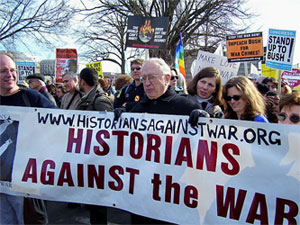
Historians and the war in Iraq

jan07dc.jpg
Here’s a letter from two leaders of Historians Against the War, which appeared in the The Chronicle of Higher Education:

From the issue dated February 23, 2007
LETTERS TO THE EDITOR
Historians Against the War

To the Editor:

We wish to amplify your article that described the resolution on civil liberties in wartime adopted at the American Historical Association’s annual meeting in January (“Historians’ Annual Meeting: Controversy and a Glut of Jobs,” The Chronicle, January 19).

The resolution strongly condemns the exclusion of foreign scholars, the reclassification of previously unclassified documents, the obstruction of access to prewar intelligence, and other intrusions on free inquiry. It links these intrusions to the Bush administration’s conduct of the war in Iraq, and it calls upon members of the organization “to do whatever they can to bring the Iraq war to a speedy conclusion.”

After passage by an overwhelming vote at the business meeting, the resolution was accepted by the AHA’s council and is being sent to the general membership for ratification in an electronic ballot to be completed by March 1. We are pleased to note that the resolution has quickly garnered significant support. More than 100 historians have signed on, including two former presidents of the AHA, John Coatsworth and Eric Foner; a former president of the Organization of American Historians, David Montgomery; and numerous other leaders of the profession, such as Michael Adas, Robert Griffith, Tony Judt, Jackson Lears, Staughton Lynd, Francis Oakley, Joan Scott, Martin Sherwin, Dale Van Kley, and Marilyn Young, to name a few.

Supporters recognize that recent violations of civil liberty are inextricably linked to the war in Iraq… Since 2001 these attacks have been conducted in the name of national security, under the banner of a “war on terror” whose supposed front line is in Iraq. In calling for a “speedy conclusion” to the war, the resolution seeks to remove the major factor behind these attacks.

Mindful of the need to maintain tax-exempt status, the resolution seeks to immunize the organization against legal challenges by calling on members to act, rather than having the AHA lobby for the antiwar resolutions that we hope Congress will adopt.

In answer to complaints about politicization, we would point out that to act against the war is to answer repeated calls from the AHA itself to take a public stand in defense of the values of the profession. These include passage of a “free speech” resolution in January 2004, the statement on professional standards, and the adoption of “Guiding Principles on Taking a Public Stance” in January 2007. …

Historians of this era have begun to make amends for some of our professional forebears. In addition to the so-called court historians of the cold war and Vietnam, too many historians in the early 20th century — including such luminaries as J. Franklin Jameson and Carl Becker — contributed their talents to the superpatriotic excesses of the First World War, which led to the shameful silencing of antiwar critics.

We prefer to be remembered by posterity not as Americans who put service to power above the search for truth, but rather as citizen-scholars who took a public stand to oppose the misdeeds of the powerful that violated the ethical standards of scholarly inquiry.

Alan Dawley
Professor of History
College of New Jersey
Ewing, N.J.

Shanti Singham
Professor of History
Williams College
Williamstown, Mass.

Saving Rock And Roll

.onion_embed {background: rgb(256, 256, 256) !important;border: 4px solid rgb(65, 160, 65);border-width: 4px 0 1px 0;margin: 10px 30px !important;padding: 5px;overflow: hidden !important;zoom: 1;}.onion_embed img {border: 0 !important;}.onion_embed a {display: inline;}.onion_embed a.img {float: left !important;margin: 0 5px 0 0 !important;width: 66px;display: block;overflow: hidden !important;}.onion_embed a.img img {border: 1px solid #222 !important;;width: 64px;;padding: 0 !important;;}.onion_embed h2 {line-height: 2px;;clear: none;;margin: 0 !important;padding: 0 !important;}.onion_embed h3 {line-height: 16px;font: bold 16px arial, sans-serif !important;margin: 3px 0 0 0 !important;padding: 0 !important;}.onion_embed h3 a {line-height: 16px !important;;color: rgb(0, 51, 102) !important;font: bold 16px arial, sans-serif !important;text-decoration: none !important;display: inline !important;;float: none !important;;text-transform: capitalize !important;}.onion_embed h3 a:hover {text-decoration: underline !important;color: rgb(204, 51, 51) !important;}.onion_embed p {color: #000 !important;;font: normal 11px/ 11px arial, sans-serif !important;;margin: 2px 0 0 0 !important;;padding: 0 !important;}.onion_embed a {display: inline !important;;float: none !important;}

GWYNEDD, WALES—Recent developments in the music world, such as the popularity of the Dixie Chicks and Sufjan Stevens, have created a “perfect storm of lameness.”

GIs Petition Congress To End Iraq War

An Appeal for Redress from the War in Iraq

Many active duty, reserve, and guard service members are concerned about the war in Iraq and support the withdrawal of U.S. troops. The Appeal for Redress provides a way in which individual service members can appeal to their Congressional Representative and US Senators to urge an end to the U.S. military occupation. The first Appeal signatures messages will be were delivered to members of Congress on January 16, to coincide with at the time of the Martin Luther King, Jr. Day in January 2007.

The wording of the Appeal for Redress is short and simple. It is patriotic and respectful in tone.

As a patriotic American proud to serve the nation in uniform, I respectfully urge my political leaders in Congress to support the prompt withdrawal of all American military forces and bases from Iraq . Staying in Iraq will not work and is not worth the price. It is time for U.S. troops to come home.

For CBS News story click here

(CBS) Americans in the military have been asked to make extraordinary sacrifices in recent years, particularly in Iraq, where the casualties are mounting, the tours are being extended, and some of them have had enough.

Correspondent Lara Logan heard dissension in the ranks from a large group of service members who are fed up and have decided to go public. They’re not going AWOL, they’re not disobeying orders or even refusing to fight in Iraq. But they are doing something unthinkable to many in uniform: bypassing the chain of command to denounce a war they’re in the middle of fighting.

Bringing peace to suffering humanity

The Monthly Review often runs small “fillers” at the end its articles. Sometimes these are quotes from previously published articles, but the one that recently caught my attention is from David Starr Jordan‘s book Imperial Democracy, published in 1899—it certainly has relevance for today:

This, according to John Morley, is England’s experience in bringing peace to suffering humanity in the tropics: “First you push into territories where you have no business to be, and where you had promised not to go; secondly, your intrusion provokes resentment and, in the wild countries, resentment means resistance; thirdly, you instantly cry out that the people are rebellious and that their act is rebellion (this in spite of your own assurance that you have no intention of setting up a permanent sovereignty over them); fourthly, you send a force to stamp out the rebellion; and fifthly, having spread bloodshed, confusion and anarchy, you declare, with hands uplifted to the heavens, that moral reasons force you to stay, for if you were to leave, this territory would be left in a condition which no civilized power could contemplate with equanimity or with composure. These are the five stages in the Forward Rake’s progress.

Our public schools should value diversity, not simply conformity

In her column in yesterday’s edition of The Province, Christy Clark argued that as far as schools go “inclusion” doesn’t work for everyone, so we ought to try segregated schools for aboriginal students, children with autism, “gifted” children etc.

The column—which lauds the idea of segregated “model” schools proposed by BC Minister of Education Shirley Bond—suggests that the only way diverse needs of students can be met is through creation of separate schools. Along the way Clark repeats dubious claims regarding the evidence on the effectiveness of gender segregated schools as well as twisting the concept of “diversity” into “parental choice” (in support of privatized alternatives) as opposed to the basis for public schools that that have the ways and means to adapt instruction to serve the full spectrum of student needs.

Here’s the column:
Our public schools should value diversity, not simply conformity

Here’s the letter I sent The Province.

Our public schools should value diversity, not simply conformity
Christy Clark
The Province

Sunday, February 25, 2007

The people who make a virtue of ignoring the differences between us are at it again. This time, they’re attacking the provincial government’s plan to create “model schools.”

Model schools are the latest plan to give parents more choices. Education Minister Shirley Bond says she will build provincial schools — not ones run by school boards — that will cater to specific needs.

She imagines a school for children with autism. She’s also suggested an aboriginal school.

The idea has some fans. It also has some powerful opponents. The New Democrats and their allies in the BCTF were first out of the gate.

They argue that a school for autistic children will turn back the clock 20 years — back to the days when they were forced into segregated classrooms.

Segregation was rotten policy — they’re right about that, at least. It was a terrible loss for both special-needs students and the “typical” ones. It stigmatized one group, and it stole from the rest opportunities to learn that people who are disabled are as complex and interesting as anyone else.

Segregation didn’t work as a general rule. But rules have exceptions, and inclusion hasn’t worked for everyone.

Some children simply cannot meet their potential in a regular classroom, no matter how many resources are devoted to the task. Some cannot learn in the noisy commotion of the average school. Their brains aren’t wired that way. Insisting that every child should be forced into a similar school cruelly shortchanges hundreds of them — and not just those with special needs.

There are other groups who could benefit from special schools. Bond has talked about aboriginals, but she could go much further.

She could create a school for “gifted” children — ones who are incredibly bright, but who tend to drop out or do badly because their wiring is different, too.

She could consider single- sex schools.

There is a growing body of evidence that boys’ and girls’ heads are hardwired differently. The areas used for spatial relations and geometry develop in boys’ brains before the areas for language.

In girls, it’s the opposite. Boys respond better to sequential direction. Girls need visuals and time to ask questions. Girls even hear better — something that also influences the classroom dynamic.

It is true that a limited range of choice does exist within the public system. But the array choice pales in comparison with what the private system has to offer.

Across the province, parents are voting with their feet.

They’re paying to send their kids to private schools. Those long waiting lists make it crystal-clear that many parents can’t find what their kids need in a public system that seems to value conformity over diversity.

It’s a shame that the critics of choice have stymied change for so long. It’s heartening that the province might now be willing to make change, despite them.

— christyclark@shaw.ca
© The Vancouver Province 2007

Copyright © 2007 CanWest Interactive, a division of CanWest MediaWorks Publications, Inc.. All rights reserved.