Rouge Forum “Their Wars Left Behind” Conference

Dear friends,

Our Rouge Forum “Their Wars Left Behind” Conference, this coming weekend, March 1 to 4, may be the first of its kind in North America. We will unite students, K-12 educators, cultural activists, poets, playwrights, labor activists, in an action-oriented discussion about what to do in schools inside a nation promising perpetual war on the world. The Rouge Forum is the only education-based group in the US that has had the limited courage it takes to make the obvious connections of: Endless War=Rising Inequality=The Regimentation of Schools=Racist High-stakes Standardized Tests.

Check the schedule linked here and come on down to Detroit to participate in understanding, and changing, the world. What you do counts, more than ever before. No one will be turned away for fees.

We will have to leave it to Patrick Shannon, historian of progressive education in the US, as to whether or not our claim of “first time ever,” is true, but it is clear the stakes could not be higher, higher even than a SAT score. What we are addressing now, in every classroom and in every community, is a matter of life and death. Social studies, for example, is no longer about citizenship. It is about killing people.

Among our presenters are Susan Ohanian, author of Why is Corporate America Bashing Our Schools? and long-time Detroit radio host, Peter Werbe, who will take up the question of the eradication of history in schools, something that would underpin Chalmers Johnson’s claim that, “Americans can no longer connect cause and effect so they wonder, ‘Why do they hate us?'”

So, while this conference will extend the Rouge Forum traditions of friendship, inclusion, and good cheer, it also takes place during yet another pivotal moment in world history: the very real possibility of a US attack on Iran which could easily be the next step toward World War III.

Such an attack will mean harsh repression in the US in order to contain the campuses as well as the poor and working people who will be asked to pay the price of the empire’s wars for oil and social control. Predictably, a key element of both a US assault on Iran, and repression at home, will be racism. One of our tasks will be to put the battle for internationalism, against racism, in the forefront of educational action.

We will show, and discuss, the film, “Sir No Sir,” about the GI led anti-war movement during the wars on Vietnam, and “Grain of Sand,” about the educator led uprising in Oaxaca, Mexico. Our entire agenda is right to the point at hand.

As always, the participants will set the agenda and tone of this Rouge Forum. However, it is clear we need to take up organizational questions (like having a more easily understood leadership group so anyone could look and see where they might display their creativity best), and communications questions (like shall we continue to publish the Rouge Forum News online as well as focus on Substance News’ vital contributions in hard copy?), or matters of outreach (like what shall our role be in professional groups?) and strategic questions (like the one we have taken up for years: how to build a caring community within the RF while, at the same time, we face a ruthless and highly organized opposition?), and perhaps the key question: what do we want people to know, and how do we think they might best learn it?

That implies the big question to each of us: What shall we do? How can we, for example, link direct action vs high-stakes testing with the wars—and freedom schooling?

This weekend in Detroit each of us will have a chance to make a real difference. Please join us, spread the word, and bring friends.

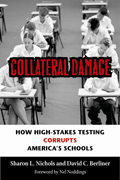
New book: Collateral Damage: How High-Stakes Testing Corrupts America’s Schools

collateral-damage.gif
Sharon L. Nichols and David Berliner have a new book coming out from Harvard Education Press: Collateral Damage: How High-Stakes Testing Corrupts America’s Schools

Here’s the blurb from HEP:

For more than a decade, the debate over high-stakes testing has dominated the field of education. This passionate and provocative book provides a fresh perspective on the issue and powerful ammunition for opponents of high-stakes tests.

Drawing on their extensive research, Nichols and Berliner document and categorize the ways that high-stakes testing threatens the purposes and ideals of the American education system. Their analysis is grounded in the application of Campbell’s Law, which posits that the greater the social consequences associated with a quantitative indicator (such as test scores), the more likely it is that the indicator itself will become corrupted—and the more likely it is that the use of the indicator will corrupt the social processes it was intended to monitor.

Nichols and Berliner illustrate both aspects of this “corruption,” showing how the pressures of high-stakes testing erode the validity of test scores and distort the integrity of the education system. Their analysis provides a coherent and comprehensive intellectual framework for the wide-ranging arguments against high-stakes testing, while putting a compelling human face on the data marshalled in support of those arguments.

Here’s an excerpt from the introduction: “A Short History of High-Stakes Testing”

Watch Yourself

thumb.jpegMatt Hern—who runs The Purple Thistle Centre, an alternative youth center in East Vancouver—has a new book titled Watch Yourself: Why Safer Isn’t Always Better (to be released in March by New Star Books).

Here’s the blurb from New Star:

From warnings on coffee cups to colour-coded terrorist gauges to ubiquitous security cameras, our culture is obsessed with safety.

Some of this is driven by lawyers and insurance, and some by over-zealous public officials, but much is indicative of a cultural conversation that has lost its bearings. The result is not just a neurotically restrictive society, but one which actively undermines individual and community self-reliance. More importantly, we are creating a world of officious administration, management by statistics, absurd regulations, rampaging lawsuits, and hygenically cleansed public spaces. We are trying to render the human and natural worlds predictable and calculated. In doing so, we are trampling common discourse about politics and ethics.

Hern asserts that safer just isn’t always better. Throughout Watch Yourself, he emphasizes the need to rethink our approach to risk, reconsider our fixation with safety, and reassert individual decision-making.

Check out Matt’s other books too:
Field Day: Getting Society Out of School and Deschooling Our Lives

The Purple Thistle does fantastic work and until recently has relied solely on grant support for their operations. The Thistle is now trying to develop a base of individual supporters. I urge you to check out what they’re doing and support the great work the center is doing on Vancouver’s eastside.

Eliminate No Child Left Behind

Eliminate No Child Left Behind is new web site by the Kings/Tulare UniServ Unit of the California Teachers Association (NEA) with information and resources for organizing to eliminate the NCLB, and the destructive effects it is having on teaching and learning in US schools.

Backers include the Educators’ Rountable, Susan Ohanian.org, and The Rouge Forum.

NCLB should be eliminated because it:

1. Is not scientifically based.

2. Is test driven education and it is not meeting the individual needs of students.

3. Violates the US Constitution.

4. Supports complicity of corporate interests rather than democracy based on public concerns.

5. Fosters coercion over cooperation with regards to federal funding for public education.

6. Does not follow the U.S. Government’s own data on learning. We must take action now!

Study: USA, UK worst places to be a kid

Here’s a report that has received major attention world-wide but has been ignored, for the most part, by the US media.

A United Nations (UNICEF) study reports that children in the richest countries are not necessarily the best-off.

The Czech Republic, for example, ranked above countries with a higher per capita income, such as Austria, France, the United States and Britain, in part because of a more equitable distribution of wealth and higher relative investment in education and public health.

Some of the wealthier countries’ lower rankings were a result of less spending on social programs and “dog-eat-dog” competition in jobs that led to adults spending less time with their children and heightened alienation among peers,

The U.S. and Britain landed at the bottom of a U.N. ranking of the quality of life for children in developed countries.

Top 5 Countries in Child Well-being (Average ranking position of child well-being in developed countries)
Netherlands 4.2
Sweden 5.0
Denmark 7.2
Finland 7.5
Spain 8.0

Bottom 5 Countries in Child Well-being
Portugal 13.7
Austria 13.8
Hungary 14.5
United States 18.0
Britain 18.2
Source: UNICEF

Here’s the story from the Los Angeles Times:
U.S., Britain fare poorly in children survey
UNICEF ranks the well-being of youngsters in 21 developed countries

By Maggie Farley
Times Staff Writer

February 15, 2007

UNITED NATIONS — The United States and Britain ranked as the worst places to be a child, according to a UNICEF study of more than 20 developed nations released Wednesday. The Netherlands was the best, it says, followed by Sweden and Denmark.

UNICEF’s Innocenti Research Center in Italy ranked the countries in six categories: material well-being, health, education, relationships, behaviors and risks, and young people’s own sense of happiness. The finding that children in the richest countries are not necessarily the best-off surprised many, said the director of the study, Marta Santos Pais. The Czech Republic, for example, ranked above countries with a higher per capita income, such as Austria, France, the United States and Britain, in part because of a more equitable distribution of wealth and higher relative investment in education and public health.

Some of the wealthier countries’ lower rankings were a result of less spending on social programs and “dog-eat-dog” competition in jobs that led to adults spending less time with their children and heightened alienation among peers, one of the report’s authors, Jonathan Bradshaw, said at a televised news conference in London.

“The findings that we got today are a consequence of long-term underinvestment in children,” said Bradshaw, who is also professor of social policy at York University in England.

The highest ranking for the United States was in education, where it placed 12th among the 21 countries. But the U.S. and Britain landed in the lowest third in five of the six categories.

The U.S. was at the bottom of the list in health and safety, mostly because of high rates of child mortality and accidental deaths. It was next to last in family and peer relationships and risk-taking behavior. The U.S. has the highest proportion of children living in single-family homes, which the study defined as an indicator for increased risk of poverty and poor health, though it “may seem unfair and insensitive,” it says. The U.S., which ranked 17th in the percentage of children who live in relative poverty, was also close to last when it comes to children eating and talking frequently with their families.

Britain had the highest rate of children involved in activities that endangered their welfare: 31% of those studied said they had been drunk at least twice by the age of 15 (compared with 11.6% for the United States), and 38% had had sexual intercourse by that age (statistics unavailable for the U.S.). Canada had the highest rate of children who had smoked marijuana by age 15 — 40.4% (compared with 31.4% in the U.S.). Japan ranked the worst on “subjective well-being,” with 30% of children agreeing with the statement “I am lonely” — three times higher than the next-highest-scoring country.

Children in the Netherlands, Spain and Greece said they were the happiest, and those in Spain, Portugal and the Netherlands spent the most time with their families and friends.

Because of a lack of comparable data, the study did not address children’s exposure to domestic violence, both as victims and as witnesses, and children’s mental and emotional health.

The report acknowledges that some of the assessment scales have “weak spots.”

The study, for example, measured relative affluence by asking whether a family owned a vehicle, a computer, whether children had their own bedroom, and how often the family traveled on holidays. Some answers might depend on the quality of public transit and real estate prices, making the average child in New York’s affluent areas seem equal to one in a less-developed country because of the constraints of city living.

The authors wrote that as the first attempt at a multidimensional overview of children’s well-being in developed countries, the survey was “a work in progress in need of improved definitions and better data.”

But they said it was nonetheless a first step in providing benchmarks for comparing countries and highlighting poor performance in otherwise rich nations.

“All countries have weaknesses to be addressed,” said Santos Pais, the study’s director.

Copyright 2007 Los Angeles Times |
Author of a Controversial Paper on the Medical Benefits of Prayer Is Accused of Plagiarizing

The Chronicle: Author of a Controversial Paper on the Medical Benefits of Prayer Is Accused of Plagiarizing

A controversial study that claimed to demonstrate the efficacy of prayer in medicine has suffered yet another blow to its credibility, as one of its authors now stands accused of plagiarism in another published paper.

Doctors were flummoxed in 2001, when Columbia University researchers published a study in The Journal of Reproductive Medicine that found that strangers’ prayers could double the chances that a woman would get pregnant using in-vitro fertilization. In the years that followed, however, the lead author removed his name from the paper, saying that he had not contributed to the study, and a second author went to jail on unrelated fraud charges.

Meanwhile, many scientists and doctors have written to the journal criticizing the study, and at least one doctor has published papers debunking its findings.

Now the third author of the controversial paper, Kwang Y. Cha, has been accused of plagiarizing a paper published in the journal Fertility and Sterility in December 2005. Alan DeCherney, editor of Fertility and Sterility and director of the reproductive biology and medicine branch at the National Institute of Child Health and Human Development, said on Monday that it was clear to him that Dr. Cha, who has since left Columbia, plagiarized the work of a South Korean doctoral student for a paper he published on detecting women who are at risk of premature menopause.

Jeong Hwan Kim, then a student at Korea University, in Seoul, had published the same paper in a South Korean journal in January 2004, according to Sunday’s Los Angeles Times. Mr. Kim brought the matter to the attention of Fertility and Sterility in the spring of 2006, Dr. DeCherney said. In an interview on Monday, he said he had spent the intervening time confirming the accusations.

Dr. DeCherney said he would recommend that the journal’s oversight committee publish a statement saying that the paper was plagiarized and bar Dr. Cha, who appeared as the lead author on the paper, and the five other listed authors from publishing in the journal for three years. The publication committee of the American Society of Reproductive Medicine, which oversees the journal, is expected to decide on the issue in April.

Dr. Cha, a businessman whose company owns fertility clinics in Los Angeles and Seoul, could not be reached for comment on Monday. He also did not return calls from the Los Angeles Times, according to that newspaper’s report.

Dr. DeCherney said that he had compiled a list of other papers Dr. Cha has published in Fertility and Sterility, and that he would review the list if other complaints arose. As for the validity of the 2001 paper on the efficacy of prayer, Dr. DeCherney said his journal had declined to publish the findings in the first place.

“It’s baloney,” he said. “That’s not in question.”

Editors at The Journal of Reproductive Medicine, which is affiliated with several organizations including the Martin L. Stone Obstetrical and Gynecological Society of the New York Medical College, did not return calls for comment on Monday. Lawrence D. Devoe, the journal’s editor in chief, said in 2004 that the journal was further scrutinizing the paper (The Chronicle, December 2, 2004).

But Bruce L. Flamm, a researcher who has worked for years to debunk the 2001 paper, said the plagiarism accusations against Dr. Cha should leave the Journal of Reproductive Medicine with no choice but to retract it.

“I’m convinced that paper is fraudulent,” said Dr. Flamm, a clinical professor of obstetrics and gynecology at the University of California at Irvine. “And over the years, everything that has happened has confirmed that opinion, not moved me away from it.”

Markets, schools, and test scores in B.C.

Neoliberalism—which functions “an ideological cover for the promotion of capitalist interests”—is certainly alive and well in British Columbia. The provincial government is the beau ideal of the business-government philosophy that serves the interests of capital rather than people.

This is evident in the privatization of public services such as BC Ferries, BC Rail, and the “liberalization” of education.

For example,

  • the Ministry of Education has encouraged under-funded schools in BC to form for-profit companies to market BC’s Dogwood Program (the equivalent of a high school diploma) in Asia where there is demand for it. There are now nine off-shore schools officially certified by the BC Ministry of Education.
  • despite billions of dollars of in budget surpluses, the Liberal Party BC government has cut the real levels of funding per student for public schools—which has produced deteriorating teaching and learning conditions, closed schools, cuts to the number of teacher-librarians—and increased university tuition (after campaign promises to cut tuition by 5%), etc.

And now, as the Ministry of Education increasingly emphasizes tests scores it’s on the the same path that lead the United States to the No Child Left Behind Act and the resultant pedagogy of oppression.

The same neoliberal worldview that makes NCLB seem like a good thing, is at work in BC and is manifest most explicitly in the work of the Fraser Institute. The Fraser Institute’s rankings of provincial schools based on scores from the Foundations Skills Assessment (a mandatory provincial test), mimics the simplistic approach to judging school quality that has swept the US in the wake of NCLB.

The Fraser Institute rankings have enjoyed strong, uncritical support from the major media in the province (e.g., The Vancouver Sun, The Province, and Global TV, all part of CanWest Global Communications, Inc.), so, it’s refreshing to see The Georgia Straight highlight Paul Shaker’s recent critique of the Fraser Institute’s report cards.

Of the Fraser Institute’s approach to ranking schools Shaker said, “The gloss or the veneer of science is put on these claims, but real science isn’t there.”

The remarks were made as part of a debate between Shaker, Dean of the Simon Fraser University Faculty of Education, and Peter Cowley director of school performance studies at the Fraser Institute, which was hosted by British Columbia Association for Supervision and Curriculum Development.

Cowley responded by asking, “How do we know if we’re improving without measurement?” … the proverbial you-can-fatten-a-pig-by-weighing-it logic.

In the debate, Shaker pointed out that there’s much more to school evaluation that comparing test scores…video of the debate will be uploaded to the SFU web site soon.

Arizona proposes legislation to prohibit politcal activity of teachers and professors

In yet another sign of the emerging fascism in the USA an Arizona Senate committee approved a bill that would punish college professors for endorsing, supporting or opposing political candidates, legislation, and litigation in any court; for advocating “one side of a social, political, or cultural issue that is a matter of partisan controversy” or hindering military recruiting on campus or endorsing the activities of those who do.

This is one of the most outrageous attacks on academic freedom and freedom of speech to come down the pike in a long time. So outrageous that even David Horowitz, the force behind the anti-liberal Academic Bill of Rights, says the legislation goes too far.

Read more here: Inside Higher Ed: $500 Fines for Political Profs

Rouge Forum Update

atwcov.jpgDear Friends,

The Rouge Forum Conference, March 1-4 in lovely downtown Detroit, will be unlike any other conference this year. We will connect the real links between the empire’s wars, schools, regimented curricula, high stakes testing, segregation and inequality with action-oriented participatory workshops led by some of the most prominent thinkers and activists anywhere. We will draw participants from three continents, five nations. The updated schedule is linked here.
Please circulate widely.

One conference presenter would like to share a room in the Ferry Street Inn, near Wayne State’s campus. Potential roomies please contact me.

Here is a most informative link by Lloyd Conway about why he was prepared to go to Iraq.

Chalmers Johnson speaks about Nemesis.

Several school systems have adopted Joel Andreas’ fine Addicted to War book. Yours could too. Andreas also published The Incredible Rocky, a history of the Rockefeller family.