Cutting the Schools-to-War Pipeline

Here’s a piece Rich Gibson and I wrote for Counterpunch (published February 2, 2007).

No Child Left Behind and the Imperial Project
Cutting the Schools-to-War Pipeline

Any nation promising perpetual war on the world is likely to make peculiar demands on its schools and impositions on its teachers and youth.

While it may seem a sideshow to war and exploitation, the sharp pressure from the Bush administration and its liberal allies to re-authorize the No Child Left Behind Act (NCLB) is, in fact, a vital part of the imperial project.The NCLB is the result of nearly three decades of elites’ struggles to recapture control over education in the US, lost during the Vietnam era when campuses and high-schools broke into open rebellion and, as a collateral result, critical pedagogy, whole language reading programs, inter-active, investigatory teaching gained a foothold; some kids learned they could understand and act on the world-not good in a world where the Masters need the Slaves to deny their own domination.

In de-industrialized America, the centripetal organizing point of most peoples’ lives is no longer a factory or the union movement, but rather school. So, securing every aspect of schooling is essential to elites.

Twinned with the NCLB, now comes the equally bi-partisan New Commission on the American Workforce report, “Tough Choices for Tough Times”. Tough-Tough was authored by such educational experts as the director of the militarized Lockheed-Martin, and university presidents whose incomes are frequently dependant on grants from the military, earmarked for “research.” Tough-Tough calls for national curriculum standards as a means of recapturing the witless patriotism necessary to get people to work, and eagerly fight and die, for what is abundantly easy to see are the interests of their own rulers. To resist NCLB at its choke points is to cut the human pipeline for the promise of perpetual war. Teachers and all school workers are uniquely positioned to do that.

Washington Post reporter Mike Grunwald outlines three claims made by NCLB supporters: (1) to focus on low-performing kids and schools; (2) to strengthen the federal role in schools via curricula standards and high-stakes tests; and (3) to use “scientific methods” to evaluate the techniques and products of educational work, that is, to apply the apparently timeless scheme of F. W. Taylor’s scientific management time and motion studies to evaluate teaching methods and measure the knowledge pumped into kids through intensified surveillance and high-stakes standardized testing. Only the first part, has been trumpeted to the public, though education workers are keenly aware of parts two and three.

The primary thesis proclaimed by NCLB supporters is that every child deserves a good education as a leg up in the US meritocracy. The reality is that doing school reform without doing economic and social reform in communities is, as our colleague Professor Jean Anyon says, “like washing the air on one side of a screen door–it won’t work.” Anyon’s comment is so abundantly clear that it seems only the hopelessly obtuse or flatly dishonest would miss the point, but even though five years of NCLB practice proves it out, unless there is significant resistance from parents, kids, and school workers, what many have learned is a project that turns kids into commodities or customers and educators into production workers.

Most mainstream liberals support NCLB by cheerleading, especially from Senator Edward Kennedy and California Representative George Miller who dismisses critics by simply not meeting with them. Liberal critics of NCLB ingenuously seek to re-load curricula regimentation and high-stakes testing for their own narrow ends, tweaking the law by, for example, demanding full funding (teacher unions) and modest accommodations for scoring problems (most professional associations).

However, key initial proponents of the NCLB project, including curricula regulation and high-stakes exams, make an interesting list, including the Business Roundtable, the U.S. Chambers of Commerce, and the leadership of the two huge (combined about 4 million members) teacher unions, the National Education Association and the American Federation of Teachers, who joined together to take out full page ads in the New York Times to demand it.

NCLB and its key components (like textbooks, test production, and test tutoring) are more than profitable for some of its backers. According to the American Association of Publishers sales of standardized tests tripled to nearly $600 million since the introduction of NCLB. The testing industry oligarchy of CTB-McGraw Hill, Harcourt, and Houghton Mifflin control 80 percent of the total market, which is valued at over $7 billion.

Under NCLB, each state must ensure that all schools and districts make “Adequate Yearly Progress,” as measured by math and reading scores. (It should be noted that AYP is fraught with insurmountable technical and political flaws.) If a school fails to improve test scores within three years, a portion of its federal funding is diverted to “parental choice” tutoring programs, which not only weakens the school’s ability to improve, but more importantly diverts public money to for-profit education outfits like Educate Inc. owner of Sylvan Learning Centers whose revenues have grew from $180 to $250 million between 2001-2003 and whose profits shot up 250% in 2003.

Schools are, after all, huge markets-as a for-profit venture public education represents a market worth over $600 billion dollars. However, only a grasp of the nature of US unionism today, corporate unionism that sees a unity of purpose between labor, government, and business “in the national interest,” explains support from union leaders, whose high salaries are drawn directly from the imperial well.

Schools serve to train the next generation of workers, from pre-prison schooling in some urban and rural areas, to pre-military schooling, to pre-middle class teacher training, to pre-med or pre-law, to the private school systems of the rich; schooling is divided along razor sharp lines. Schools do skills training, and depending on where a child is, some limited intellectual training. In public schools, the key issues of life: work, production and reproduction, rational knowledge, and freedom, are virtually illegal.

It is illegal in California, for example, to teach positive things about the communist movement, and hence nearly impossible to teach about unionism. It is illegal to teach about the joys of sexual pleasure. Rather, discussions about sex must be padded with plenty of fear, and promises of abstinence. It is not possible for most educators to merely say that all gods are myths, and the suspension of critique that is faith is a dangerous move. And, in regard to freedom, anyone who visits a school will quickly see that it is a sheer abstraction in schools, as the entire system of surveillance (both physical and intellectual) is designed to eradicate it.

Nevertheless, it is true that schools fashion hope, real or false, and that society’s whose hope through school is erased are commonly steeped in rebellion, as in France, 1968. Redesigning what hope is, and tamping down expectations of school workers, parents, and kids, is part of the NCLB project.

There has been resistance to high-stakes testing. George Schmidt, editor of the Chicago educator newspaper Substance (http://www.substancenews.com), was fired from a 28 teaching year career for publishing the Chicago CASE test after it was given in 1999. His dismissal upheld by the courts. The Rouge Forum, an organization of about 4,000 school workers, parents, students, community people, has led successful test boycotts and school walkouts in Michigan, New York, and California. There has, however, been little continuity in this work, perhaps reflecting the problems of a poorly funded volunteer group. Rouge Forum leaders have stuck by their insistence that there is a direct line from the systems of capital to imperialist war to the regulation of what people need to know, how they come to know it, and the warped systems of surveillance that inevitably are anti-working class, racist, high-stakes tests.

In January 2007, renowned education author Susan Ohanian initiated an online petition calling for the abolition of the NCLB online, through The Educator Roundtable. Her effort was immediately attacked by the leadership of the National Education Association with a letter urging their members not to sign the petition. NEA now calls for some limited reform of NCLB, and demands the imperial bribe: full-funding. NEA plans to spend $1 million lobbying to get it.

Other complaints about NCLB have been more off target. The Palm Beach Post of January 11, proclaimed, “The bedrock fantasy is that every child in America will be able to read and do math on grade level by 2014. Everyone knows that can’t happen.”

Setting aside the problem of what “grade level” is, a fully literate population is quite possible with a door to door community based program coupled with a project of social change, as the Cuban literacy success amply demonstrates.
In any case, most of the opposition to NCLB accepts the claim that it is: (1) designed to serve all the children of the nation and that the (2) public schools, our schools, must be reformed. We call both pretenses into question. The bi-partisan, united-as-a class, efforts to demolish the welfare system and the social safety net, to deny poor children health care, food, and safe places to live, to close libraries, and used their state power to assist the storm, Katrina, in making a natural disaster a racist assault, should be sufficient to offset the good motives implied by claim one.

In regard to claim two, we are skeptical about the truly public nature of a national school system that is absolutely segregated by class and race, where the teaching force itself is an apartheid body (about 85 percent white teaching minority/majority kids), where different content is taught to different students based on their birthright, and where test results are as predictable as income levels within zip codes. These may well be their schools, serving the needs of capital, just as the Ford plant is not ours, but Ford’s, is also in question, though both at Ford, and in schools, there is always resistance, as regimented labor and intellectual work both suck. Ford, however, produces machines, and schools produce hope.

Other resisters seek to participate in the NCLB process on the grounds that, “If you are not in the room, your voice won’t be heard.” That sums up the position of liberal historian Gary Nash, the key author of the National History Standards, who wrote them in part because he was concerned that if he did not do it, then the neo-conservatives would. Nash hoped no high-stakes exam would be attached. His standards, which excluded Marxist and feminist interpretations at the outset, were then voted down by a Rush Limbaugh-inspired congress. He re-wrote them and, in our eyes, became what he set out to oppose, his history standards as partisan as could be. And now, as with the Michigan MEAP (long administered by Standard and Poor’s) a watered down version of Nash’s standards serves as the state’s exam.

Support for the high-stakes exams which, in every instance, were born from curricula regulations, make appeals like this: “The rationale for standardized testing has always been a matter of common sense: In order to measure how each student is doing academically, there has to be a standard of measure.” That remains the publicity claim of the conservative Mackinac Center in Michigan, an appeal to simple reason.

We want to focus on high-stakes examinations as a key choke point in public schools and to suggest that, while petitioning to abolish the NCLB and the tests along with it is a fine first step, only direct action in the form of boycotts, matched by outside freedom schooling, can possibly overcome the destruction of reason the tests truly represent, creating a class of counter-curious kids, their level of projected subservience varying with their inheritance. It is equally true that trying to vote troops out of Iraq may be a fine thing, but the direct action of troop refusals, mass disobedience, and throwing military recruiters off campuses, is likely to be the only powerful form of war resistance­creating the kind of self-conscious movement that can be sustained through all the promised imperial adventures.

High stakes testing has its roots in the early twentieth century work of Lewis Terman and Robert Yerkes who promoted the IQ test to prove the genetic advantages of races they had already identified as superior, demonstrating the use of bogus science to determine who should be an officer in a segregated military. Their work in the American Eugenics Society (AES) aimed at identifying degenerate races, in order to purify the gene pool. Their work was used to sterilize thousands of women, against their will. During their Nuremburg trials, Nazis routinely pointed to the AES as an inspiration.

Carl Brigham worked with Yerkes. He’s the key founder of the widely used SAT. Today, the conservative favorite, Charles Murray, co-author of the racist The Bell Curve, which was used as the intellectual basis to demolish the welfare system, published a series of articles in the January 2007 Wall Street Journal suggesting that IQ tests should be used to track youth into specific schools, as “To have an IQ of 100 means that a tough high-school course pushes you about as far as your academic talents will take you.”

NCLB simply puts Murray into the daily life of schools. However, the geneticist effort is deepened by the Taylorist, “scientific management,” aspects of high-stakes tests which not only place educators and students under the constant supervision of those who seek to deem some inferior, but it also meets the key goal of replacing the mind of the worker, in this case a teacher, with the mind of the boss, through strict curricula regulations, eradicating a vital lynchpin of learning anything: freedom.

Here is what we think is a reasonable litany of objections to the NCLB, its national curriculum, and the attached noose, high stakes exams.

High-stakes standardized tests, an international phenomenon, represent a powerful intrusion into classrooms, often taking up as much as 40% of classroom time in preparation, practice testing, and administration;

The tests are flawed in technical adequacy. They invoke a fallible single standard and a single measure, a practice specifically condemned by the Standards on Educational and Psychological Testing;

The tests are implemented and used to make high stakes decisions before sufficient validation evidence is obtained and before defensible technical documentation is issued for public scrutiny;

The tests are employed without credible independent meta-evaluation;

The tests are flawed in accuracy of scoring and reporting, for example in New York in 2000 when thousands of students were unnecessarily ordered to summer school on the grounds of incorrect test results;

The tests pretend that one standard fits all, when one standard does not fit all;

These tests measure, for the most part, parental income and race, and are therefore instruments that build racism and anti-working class sentiment against the interest of most teachers and their students;

These tests deepen the segregation of children within and between school systems, a move that is not in the interests of most people throughout the world;

Inner-city families and poor families are promised tests as an avenue to escape the ghetto and poverty, when the tests are designed to fail their children, boosting dropouts, leaving more children trapped in the ghetto and poverty, deepening inequality and all forms of injustice;

The tests set up a false employer-employees relationship between teachers and students which damages honest exchanges in the classroom;

The tests create an atmosphere that pits students against students and teachers against teachers and school systems against school systems in a mad scramble for financial rewards, and to avoid financial retribution;

The tests have been used to unjustly fire and discipline educators throughout the country;

The exams represent an assault on academic freedom by forcing their way into the classroom in an attempt to regulate knowledge, what is known and how people come to know it;

The tests foment an atmosphere of greed, fear, and hysteria, none of which contributes to learning;

The tests destroy inclusion and inquiry-based education;

The high-stakes test pretend to neutrality but are deeply partisan in content, reflecting the needs of elites in a world becoming more inequitable, less democratic, promising the youth of the world perpetual war;

The tests become commodities for opportunists whose interests are profits, not the best interests of children.

We support the rising tide of education worker resistance to the high-stakes exams, as well as student and educator boycotts. We are sharply opposed to those false-flag reformers who seek to do anything but abolish the NCLB, its tests, and its developing national curriculum.

Liberal reformers on this bent simply lend credence to a government that stands fully exposed as a weapon of violence for the rich, they disconnect the clear class and race domination in not-so public schooling from the empire’s wars, and they mislead people into believing the dishonest motives of prime NCLB proponents. Above all, through their clear opposition to direct action versus the big tests, as in NEA’s attack on Ohanian, they simultaneously seek to destroy the leadership of a movement that could actually succeed, and they once again try to teach people that others, usually elites, will solve our problems, a vile diversion from the fact that no one is going to save us but the united action of us.

Parents and students have a legal right to opt out of the exams, which are little more than child abuse made respectable. That the school worker force is aware of the abusive nature of this testing, seeing second-graders in tears as a matter of routine, cleaning vomit off test booklets, etc., speaks to the levels of opportunism, fear, and racism in the work force.

Nevertheless, many courageous school workers continue to speak out, to call for action, and in some cases to play a leadership role.

Practice suggests that boycotts initiate first in wealthy areas, then when people in poor and working class neighborhoods see that succeed, they follow suit. The wealthy, after all, have the power and outlook to shut down the tests from the outset, and they know regimented curricula simply makes their kids stupid, wastes their time. Peers in private schools never have to take a silly MEAP. Test boycotts in wealthy areas of Michigan and California, for example, have been going on for years.

Poor and working class parents and students, however, need to learn, probably from teachers, that the tests are not designed to make education equitable, but to track them into meaningless jobs, or the military­fighting and dying against what they are never taught are truly the enemies of their enemies. In addition, they need to learn that their power supersedes boycotts in rich areas, in that it can truly bring the testing to an end and even serve as a foundation for much broader social change for equality and democracy.

Ending imperialism is a pedagogical project, involving a mass change of mind that overcomes most, if not all, of the defects built into every birthright of capital. The linkage of education and social action that could come from anti-test boycotts could be part of that change of consciousness so urgently needed now.

We are not barbarians seeking to bring down education itself. We recognize the need to link freedom schooling with test boycotts. Freedom schooling could, for example, be conducted in homes, community centers, or churches, for older students addressing the question of why things are as they are, through community power analyses, while youngsters could be treated to the forbidden delights of recess, free play, storytelling, and playmaking.

We hope to contribute to the movement to take direct action against the Big Tests. Some beacons of education publications, like Substance News in Chicago, and organizations like the Rouge Forum, leading a March 1 2007 conference in Detroit, deserve support.

Rich Gibson is a professor emeritus at San Diego State University. E. Wayne Ross is professor at University of British Columbia. They are co-editors of Neoliberalism and Education Reform to be published by Hampton Press in 2007.
Rouge Forum March Conference & Update

Dear Friends,

Our conference bringing together some of the most prominent thinkers and activists in the anti-war, whole schooling, inclusive education, and critical pedagogy movements in North America is set for March 1 to 4. Please note that we need your help in preparing for the conference, especially by circulating the conference agenda to friends and colleagues, and by thinking carefully about just what our social situation is, and what you hope to do about it. Justice demands organization–and you. Nobody will save us but us.

The Rouge Forum No Blood For Oil page is fully updated. It is a remarkable collection of key articles related to the empire’s wars, since 2001, of good use to educators and students.

Take note of the Rouge Forum flyer on John Yoo, author of the Bush “Torture Memos,” as well as the effort to illegally wiretap US citizens. The flyer is being well received as John Yoo, fascist, tracks his excuses around California.

Note, too, this article by Pulitzer Prize winning reporters on SAIC, which demonstrates a key thesis put forward by some Rouge Forum members: the government is a weapon, and executive committee, of the rich. Ask, “what would this mean for government schools?”

Chalmers Johnson’s new book, “Nemesis,” is out now, and highly recommended. Here is a link to a piece Johnson wrote for Tomdispatch
.

This link demonstrates the kind of strategic planning we are trying to do in San Diego, with our peace and justice group, which includes a relatively small but active number of educators and students.

I am wondering if other groups are trying to do this kind of work. One thing the local San Diego coalition has achieved is a remarkable drop in high school military recruitment, with a persistent campaign to counter recruiters’ lies, to drive them off high school campuses, and to deny the military warm bodies eager to go off to fight what are really the enemies of their enemies.

Counterpunch recently carried an article, “Cut the Schools-To-War Pipeline” linked here.

best r

Accountabalism

From the February issue of Harvard Business Review…the imagery of “accountabalism” works perfectly as a description of what has happened as a result of public schools “reform” in North America:

The Folly of Accountabalism
By David Weinberger

Accountability has gone horribly wrong. It has become “accountabalism,” the practice of eating sacrificial victims in an attempt to magically ward off evil. The emphasis on accountability was an understandable response to some god-awful bookkeeping-based scandals. But the notion would never have evolved from a buzzword into the focus of voluminous legislation if we hadn’t also been lured by the myth of precision: Because accountability suggests that there is a right and a wrong answer to every question, it flourishes where we can measure results exactly. It spread to schools—where it is eating our young—as a result of our recent irrational exuberance about testing, which forces education to become something that can be measured precisely. When such disincentives as the threat of having to wear an orange jumpsuit for eight to ten years didn’t stop the Enron nightmare and other bad things from happening, accountabalism whispered two seductive lies to us: Systems go wrong because of individuals; and the right set of controls will enable us to prevent individuals from creating disasters. Accountabalism is a type of superstitious thinking that allows us to live in a state of denial about just how little control we individuals have over our environment.

Accountabalism manifests itself in a set of related beliefs and practices: It looks at complex systems that have gone wrong for complex reasons and decides the problem can be solved at the next level of detail. Another set of work procedures is written, and yet more forms are printed up. But businesses are not mechanical, so we can’t fine-tune them by making every process a well-regulated routine. Accountabalism turns these complex systems into merely complicated systems, sacrificing innovation and adaptability. How can a company be agile if every change or deviation requires a new set of forms?

Accountabalism assumes perfection—if anything goes wrong, it’s a sign that the system is broken. That’s not true even of mechanical systems: Entropy, friction, and manufacturing tolerances ensure that no machine works perfectly. Social systems are incapable of anything close to perfection, so if something goes wrong in one, that need not mean the system is broken. If an employee cheats on expenses by filling in taxi receipts for himself, the organization doesn’t have to “fix” the expense-reporting system by requiring that everyone travel with a notary public.

Accountabalism is blind to human nature. For example, it assumes that if we know we’re being watched, we won’t do wrong—which seriously underestimates the twistiness of human minds and motivations. We are capable of astounding degrees of self-delusion regarding the likelihood of our being caught. Further, by overly formalizing processes, accountabalism refuses to acknowledge that people work and think differently. It eliminates the human variations that move institutions forward and provide a check on the monoculture that accounts for most disastrous decisions. It also makes work no fun.

Accountabalism bureaucratizes and atomizes responsibility. While claiming to increase individual responsibility, it drives out human judgment. When a sign-off is required for every step in the work flow, those closest to a process lack the leeway to optimize or rectify it. Similarly, by assuming that an individual’s laxness caused a given problem—if so-and-so hadn’t been asleep at the switch or hadn’t gotten greedy or hadn’t assumed that somebody else would clean up the mess, none of this would have happened—accountabalism can miss systemic causes of failure, even, ironically, as it responds to the problem by increasing the system’s reach.

Accountabalism tries to squeeze centuries of thought about how to entice people toward good behavior and dissuade them from bad into simple rules by which individuals can be measured and disciplined. It would react to a car crash by putting stop signs at every corner. Bureaucratizing morality or mechanizing a complex organization gives us the sense that we can exert close control. But grown-ups prefer clarity and realism to happy superstition.

David Weinberger (self@evident.com), a marketing consultant and a coauthor
of The Cluetrain Manifesto: The End of Business as Usual (Perseus, 2000), is also
a research fellow at Harvard Law School’s Berkman Center for Internet & Society
in Cambridge, Massachusetts. His book Everything Is Miscellaneous will be
published in May by Times Books.

Rouge Forum “Their Wars Left Behind” Conference Schedule

This promises to be a great conference. We have a terrific group made up of some of the most prominent people in the anti-war, inclusive education, and anti-high stakes test movement in North America. In addition, we combine young, middle, and old, people from three continents, k12 educators, profs, students, and community workers.

The Rouge Forum, as you know, is the only organization in the US that has consistently connected the role of capital, race, and social class with imperialism and the resultant demands to regulate what kids know, and how they come to know it, in schools. We have combined research with action.

Our hope is that this interactive, action-oriented conference will not only offer scintillating presentations, but also bring together good minds in order to deepen our collective activity, as an organization. We have set aside a good deal of time to meet people informally. Sunday is a full day of conversations about what is to be done.

We ask that you circulate the full conference schedule to as many people as you can, personally urging them to attend. That kind of one-to-one work is what builds movements.

More information is available at RougeForum.org. Contact rougeforum@pipeline.com or rgibson2@pipeline.com with questions or for additional information.

All the best, r

Our schedule:

The Rouge Forum presents

Their Wars Left Behind: Education for Action

(National Conference on How to Be Anti-War & Pro-Learning)

THURSDAY, MARCH 1 – SUNDAY, MARCH 4, 2007


Wayne State University, Manoogian Hall (map)

NW corner of Warren & Third Street, Detroit

Thursday Night (3-1-07)

8:00-Bill Boyer and his infamous Ground Zen at the Zeitgeist. Discussion to follow.


Friday (3-2-07)

9:00-9:30…….…
Meet and Greet

9:30- 10:30….….
Susan Ohanian—Author Why Is Corporate America Bashing Our Schools? and co-author What Happened to Recess and Why Are Our Children Struggling in Kindergarten? (Room 91)

10:45-12:00……..
Steve Fleury and Eugenio Basualdo Toward Liberalizing Vocational Education; Joseph Cronin, The Knowledge Based Economy, Educational Debt, and Class Reproduction (Room 43)

Susan Newel- FAME: Finding Alternative to Military Enlistment; Nancy Patterson, Free Speech in the Balance (Room 54)

Scott Craig FLEX Education, (Room 91)

12:00-1:30……… Lunch

1:30-2:45……….
Elizabeth Jaegar, The Downer 5; Susan Harman, (Room 43)

Steve Strauss, Global Transformation of Public Education under Neoliberal Influence ; Tim Cashman, The United States and Its Wars; Mexican Teachers’ Perspective (Room 54)

Rich Gibson Why Have Schools ; Eric Ferris, Social Class: America’s Well Kept Dirty Little Secret (Room 91)

3:00-3:30…….…
George Schmidt, Editor of Substance (Room 91)

3:30-4:00……….
M.L. Liebler Poetry and Music (Room 91)

8:00-Bill Boyer and his infamous Ground Zen at the Zeitgeist. Discussion to follow.

Saturday (3-3-07)

9:00-9:30…….…
Meet and Greet

9:30-10:30……..
Patrick Shannon (Room 91)

10:45-12:00…….
Fran Shor Bush League Spectacles (Room 43)

Adam Renner The Achievement Gap in Mathematics; Carolyn Stirling, Burqas, Bombs and Bleeding Hearts: The Role(s) of Antiracist/Culturally Inclusive Education (Room 54)

Peter Werbe (Room 91)

12:00-1:30……… Lunch

1:30-2:45……….
Dave Hill, Class, Capital and Education in this Neoliberal NeoConservative Period ; Faith Wilson , Downsized Discourse: Classroom Management, Corporate Talk, and the Shaping of Correct Workplace Attitudes (Room 43)

Michael Peterson; Wayne Ross (Room 54)

Nancye McCrary; Richard Kamler Artist as Citizen in Contemporary Society (Room 91)

3:00-3:30…….…
Rich Gibson (Room 91)

3:30-4:00…….…
Alan Franklin, Music (Room 91)

8:00-Bill Boyer and his infamous Ground Zen at the Zeitgeist. Discussion to follow.

Sunday (3-4-07)
What to do? Organizing and proposals for action. (Room to be determined)

Schedule subject to change. See RougeForum.org for any changes.

Richard Thompson’s new song about the war in Iraq

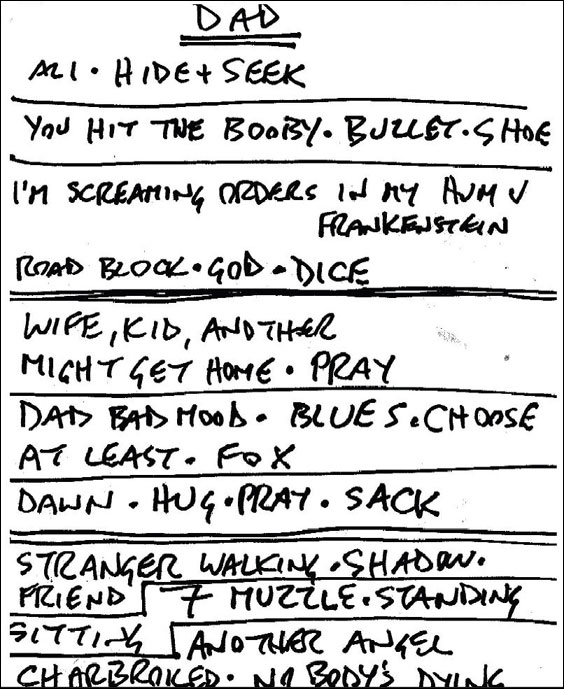
Thompson-Cheatsheetg-1.jpg
Via the Rock and Rap listserv:

The Raw Story: Legendary folk guitarist Richard Thompson records anti-war song from viewpoint of ‘grunt’

article excerpt:

“Lately at concerts he’s been singing a song in protest against the Iraq war titled ‘Dad’s Gonna Kill Me,'” Goldstein writes. “‘Dad,’ Thompson explains to audiences, is grunt-speak for ‘Baghdad,’ much as ”Nam’ once meant ‘Vietnam'”

‘Dad’s in a bad mood,
‘Dad’s got the blues;
It’s someone else’s mess that I didn’t choose;
At least we’re winning on the Fox evening news;
‘Dad’s Gonna Kill Me.

When performing the song in public, Thompson, 57, has used a cheat sheet to head off senior moments. Check it out at in Slate: Richard Thompson’s cheat sheet to his new Iraq protest song

Listen to mp3 of “‘Dad’s Gonna Kill Me” here.

“Dad’s Gonna Kill Me” will be on his next CD, “Sweet Warrior,” slated for release in May.

In my ear (January)

keenebros.jpg
Heavy rotation for January:
Tom Waits Orphans
Vince Gill These Days
Keene Brothers Blues and Boogie Shoes
Sloan Never Hear the End of It
Nighmares on Wax In a Space Outta Sound
Todd Snider: That Was Me and The Devil You Know
Tommy Guerrero
Wayne’s Favorites of 2006 (Vols 1-2)

Hey I realize I’m no Nick Hornby, but I thought I might try my hand at chronicling my musical purchases and listening habits over the course of 2007. And no, the purchases and the listening don’t always coincide as you’ll see sometimes it takes me a while to get around to “seriously” listening to some of those cds.

My listening year official starts on Boxing Day. And this past December 26 I was standing in line with the teaming hordes at Best Buy when I spotted Tom Waits‘ highly acclaimed new album Orphans. (I was at Best Buy purchasing a $100 HDMI cable since Sony is too cheap to include the proper cable connection so C could have the hi def experience on the PS3 that Santa dropped off, but that’s another story.) Anyway, I bought Tom’s new one, which was released in late November, and sure enough it’s 5 star masterpiece.

Orphans is a three disc “box” but it’s an unusual “retrospective” in that it is not a mere compliation of previously released tracks. Waits does versions of his songs that were originally recorded by other artists (I really like “Fannin Street” which his buddy John Hammond recorded first), plus he does “covers” of songs by Kurt Weill/Bertolt Brecht, Leadbelly, The Ramones…you get the idea. “Brawlers” (Disc One) is full of bluesy rockers. “Bawlers” (Disc Two) is a tour de force of styles (ballads, waltzes, etc). And “Bastards” (Disc Three) is packed with the weird and wonderful (experimental music and spoken word pieces like Tom reading encyclopedia entries about the strange behavior of certain insects).

The other “universally acclaimed” box set released in the last few months of 2006 is Vince Gill’s four disc collection of new music, These Days, which was my first purchase in January. I’ve not been listening to much “mainstream” country the past few years, but then again, Vince is no longer mainstream country. These Days covers a different style on each disc (rock, country, ballads, acoustic/bluegrass). There is know doubt Gill’s a talented writer, amazing player and pleasing singer. These Days is worthy of all the praise, but when you have 43 new tunes there are is bound to be some clunkers, but there are only a couple of those (most notably the duet with Diana Krall). I find myself listening to all four discs quite a bit.

Two other new purchases this month:

Sloan is a a first rate Canadian power pop group who has taken a tip from Robert Pollard and produced a 30 track disc with a majority of the tunes checking in under 3 minutes. Their Beatlesque stylings have produced loads of success in Canada (the group was formed in the early 1990s in Halifax), but they remain pretty much below the radar in the US of A—that’s too bad for the Yanks because their missing out on some sublime pop. In their review of Never Hear the End of It, folks at All Music Guide envoke the b-side of Abbey Road, The White Album and Todd Rundgren’s A Wizard, A True Star—not bad company!

Speaking of Bob Pollard, my final purchase of January was #42 in prolific Pollard’s Fading Captain Series: The Keene Brothers’ Blues and Boogie Shoes, an album that had I listened to it in 2006 would have definitely been in my Top 10, alongside Pollard’s solo disc Normal Happiness. Guitar slinger Tommy Keene (Velvet Crush and Paul Westerberg) joined Pollard’s From a Compound Eye touring band and they began writing songs. Blues and Boogie Shoes is the result and it’s better than the first couple of Pollard’s official solo records, which is saying a lot! AMG says: “Blues and Boogie Shoes is the first (and hopefully not the last) album from the Keene Brothers, and while it’s a more modest affair it sounds significantly stronger and more satisfying than Pollard’s much-vaunted “official solo debut” and fuses muscular rock guitar with glorious pop hooks as well as anything GbV ever released. With Keene in charge of the instrumental side of the program, the guitars both chime and crunch while the drums bash away in glorious fury — Keene’s musical vision is certainly simpatico with Pollard’s, but he offers enough fresh melodic twists to give the songs new blood that serves them well, and his guitar work is consistently excellent without a hint of needless flash.”

All out on Saturday! Rouge Forum Update

RF4.jpg
Dear Friends,

The promise for perpetual war is quite real. The US cannot leave the Gulf Region, nor the Caucasus, as it cannot abandon the oil, cannot relinquish regional control. Yet the US military cannot defeat the residents of the regions, and cannot understand why. But the US is there to rob the regions of their natural resources, and their labor, and everyone there knows it, if most US citizens do not. So, that fighting will continue. And it will deepen as imperial rivals like the Russians, China, Japan, and Europe witness the weakness of US military and economic might.

The only thing Bush is telling the truth about is that the US ruling classes cannot lose, cannot retreat, in the oil regions. But they cannot win either, so they hope to send working class men and women to fight and die, not fighting against their enemies, but fighting the enemies of their greatest enemies.

The battle over oil is the most serious of battles, as oil independence in the US is simply not possible, and all military machines run on oil.

As the wars progress, we have long argued that fascism will emerge in the US, as it is. Two recent articles, one from the radical press, and one from a prominent Princeton professor, buttress that insight. Here is a link from Richard Falk, Princeton, “Will the Empire Be Fascist?”
and Greg Meyerson, here.

What can educators, students, and parents do in the face of these multiple crises? We can educate and organize to try to build a mass base of class conscious, ethical, resistance, in schools and out. Schools are a key choke point of US society, as elites insistence on NCLB demonstrates. Combined with the military, it is possible that youth in schools and in uniform, could take the lead in mobilizing anti-fascist resistance.

One aspect of that resistance is to build for the mass actions this coming Saturday, demanding that the US GET OUT of IRAQ NOW.

We should demonstrate, not so much to “show ourselves” to politicians, but as a test of our movement, a test of ourselves, our own courage and consciousness, our ability to bring others, to build close personal friendships, and to struggle with one another over our differing analyses of power and change in our communities–so we come away smarter.

We will not change the mind of the executive committee of the rich that is the US government today. But we will learn how far we have come in the process of defeating all of them, and their plan to extinguish hope and reason in the world.

The next step of that process is the Rouge Forum Conference, March 1 to 4, in lovely downtown Detroit, Wayne State University. The full schedule will be released by the conference committee this coming Sunday but, as this is mainly a participatory conference, plan to bring yourself and friends now.

People are already on the move, as people struggle to survive. Street kids recently invaded the World Social Forum and took the food they needed.

And, while school workers remain the most highly unionized people in the US, the percentage of the work force in unions dropped below 12 percent, one-third of the membership peak, perhaps indicating the irrelevance of US union leadership, despite their six figure salaries.

Apologies, again, to AOL users who find many of their Rouge Forum email updates blocked. We have worked with AOL on this problem for one year now, as have many similar list leaders. AOL refuses to assist, and remains, according to Consumer Reports, the worst server in the northern hemisphere. AOL is not only uncooperative and incompetent, their owners were among the first to turn over their members email to the government, on a simple request, when other providers, like Earthlink, refused. We urge you to leave AOL. After all, they do not want you as customers, as they themselves have said. There are many free alternatives, like Sharpreader.

In the meantime, we are troubled we are still blocked by AOL, and seeking hints on how to circumvent them.

Don’t forget, ALL OUT ON SATURDAY. US OUT OF IRAQ. You are welcome to download free posters and flyers from www.rougeforum.org.

Bracey’s Rotten Apples in Education Awards: 2006 Edition

ROTTEN APPLES IN EDUCATION: 2006 EDITION

Education researcher Gerald W. Bracey has done it again. This much-respected education outsider has released his annual list of “Rotten Apples” that points fingers at foolishness and malice and bad science in the education world. 2006 winners include: Secretary of Education Margaret Spellings for her belief in the absolutely purity of NCLB; Neil Bush and Barbara Bush for questionable business practices related to an educational software company; George Will and other advocates of the 65 Percent Solution; Thomas Friedman, journalist and author of “The World Is Flat”; ABC-TV’s John Stossel for his alarmist reporting; and a few select others.