Via Carlo Fanelli:
Editor, Alternate Routes: A Journal of Critical Social Research
Critical Theories in Education
Via Carlo Fanelli:
[Click to enlarge images]
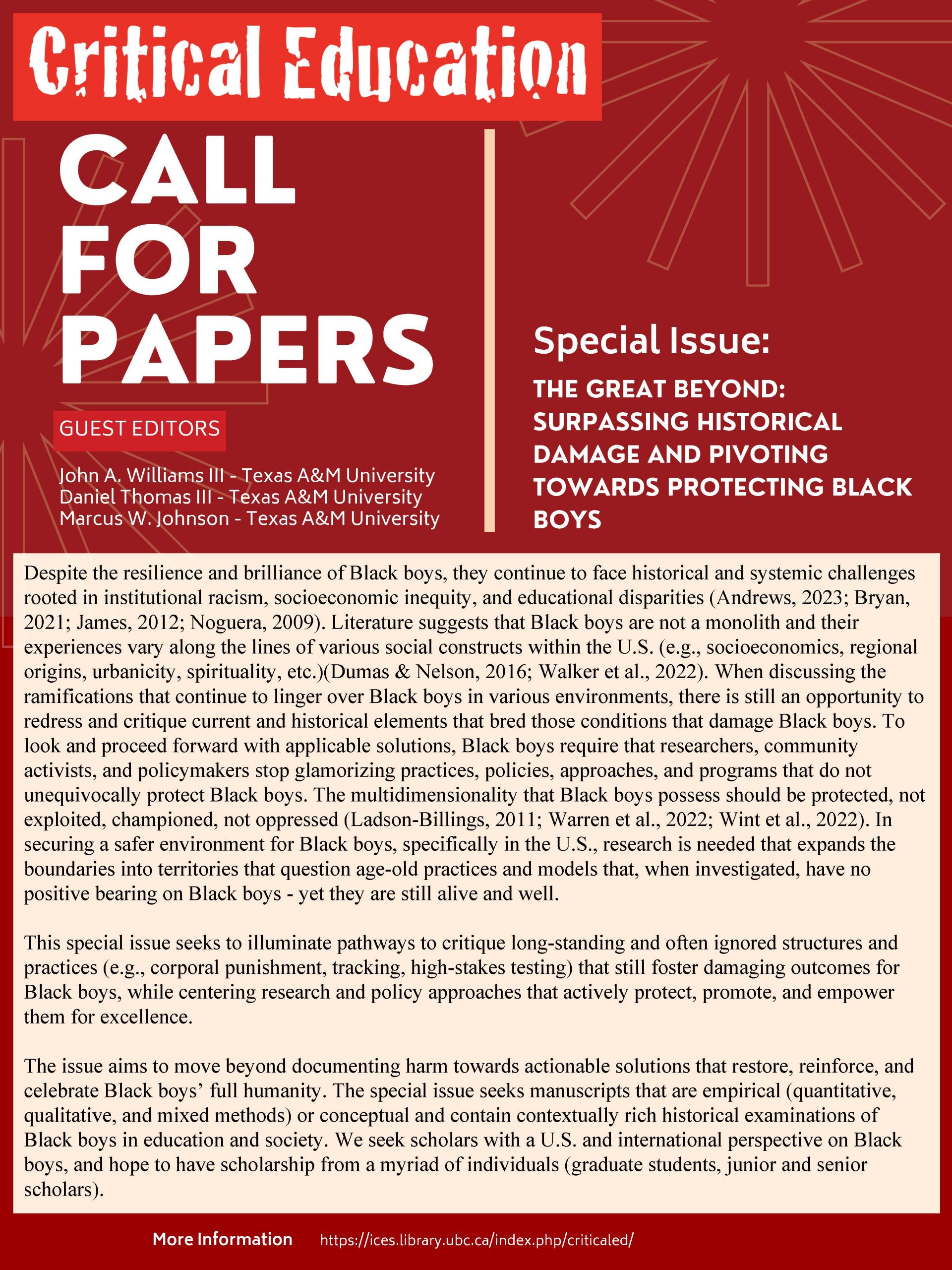
Guest Editors:
John A. Williams III – Texas A&M University
Daniel Thomas III – Texas A&M University
Marcus W. Johnson – Texas A&M University
Despite the resilience and brilliance of Black boys, they continue to face historical and systemic challenges rooted in institutional racism, socioeconomic inequity, and educational disparities (Andrews, 2023; Bryan, 2021; James, 2012; Noguera, 2009). Literature suggests that Black boys are not a monolith and their experiences vary along the lines of various social constructs within the U.S. (e.g., socioeconomics, regional origins, urbanicity, spirituality, etc.) (Dumas & Nelson, 2016; Walker et al., 2022). When discussing the ramifications that continue to linger over Black boys in various environments, there is still an opportunity to redress and critique current and historical elements that bred those conditions that damage Black boys. To look and proceed forward with applicable solutions, Black boys require that researchers, community activists, and policymakers stop glamorizing practices, policies, approaches, and programs that do not unequivocally protect Black boys. The multidimensionality that Black boys possess should be protected, not exploited, championed, not oppressed (Ladson-Billings, 2011; Warren et al., 2022; Wint et al., 2022). In securing a safer environment for Black boys, specifically in the U.S., research is needed that expands the boundaries into territories that question age-old practices and models that, when investigated, have no positive bearing on Black boys – yet they are still alive and well.
This special issue seeks to illuminate pathways to critique long-standing and often ignored structures and practices (e.g., corporal punishment, tracking, high-stakes testing) that still foster damaging outcomes for Black boys, while centering research and policy approaches that actively protect, promote, and empower them for excellence.
The issue aims to move beyond documenting harm towards actionable solutions that restore, reinforce, and celebrate Black boys’ full humanity. The special issue seeks manuscripts that are empirical (quantitative, qualitative, and mixed methods) or conceptual and contain contextually rich historical examinations of Black boys in education and society. We seek scholars with a U.S. and international perspective on Black boys and hope to have scholarship from a myriad of individuals (graduate students, junior and senior scholars).
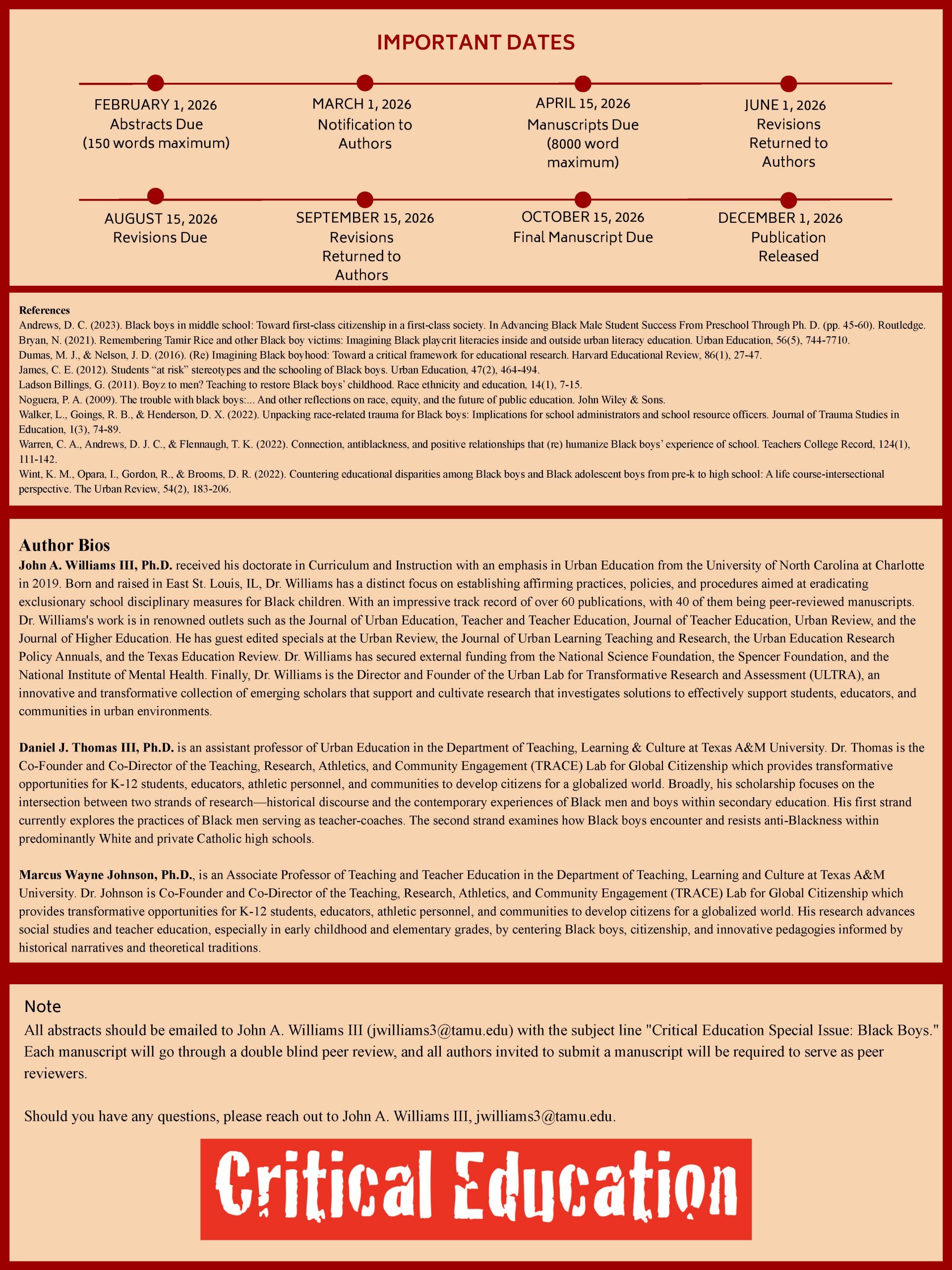
All abstracts should be emailed to John A. Williams III (jwilliams3@tamu.edu) with the subject line “Critical Education Special Issue: Black Boys.” Abstracts due: February 1, 2016.
Each manuscript will go through a double blind peer review, and all authors invited to submit a manuscript will be required to serve as peer reviewers.
Should you have any questions, please reach out to John A. Williams III, jwilliams3@tamu.edu.
References
Andrews, D. C. (2023). Black boys in middle school: Toward first-class citizenship in a first-class society. In Advancing Black Male Student Success from Preschool Through Ph.D. (pp. 45-60). Routledge.
Bryan, N. (2021). Remembering Tamir Rice and other Black boy victims: Imagining Black playcrit literacies inside and outside urban literacy education. Urban Education, 56(5), 744-7710.
Dumas, M. J., & Nelson, J. D. (2016). (Re) Imagining Black boyhood: Toward a critical framework for educational research. Harvard Educational Review, 86(1), 27-47.
James, C. E. (2012). Students “at risk” stereotypes and the schooling of Black boys. Urban Education, 47(2), 464-494.
Ladson Billings, G. (2011). Boyz to men? Teaching to restore Black boys’ childhood. Race ethnicity and education, 14(1), 7-15.
Noguera, P. A. (2009). The trouble with black boys:… And other reflections on race, equity, and the future of public education. John Wiley & Sons.
Walker, L., Goings, R. B., & Henderson, D. X. (2022). Unpacking race-related trauma for Black boys: Implications for school administrators and school resource officers. Journal of Trauma Studies in Education, 1(3), 74-89.
Warren, C. A., Andrews, D. J. C., & Flennaugh, T. K. (2022). Connection, antiblackness, and positive relationships that (re) humanize Black boys’ experience of school. Teachers College Record, 124(1),111-142.
Wint, K. M., Opara, I., Gordon, R., & Brooms, D. R. (2022). Countering educational disparities among Black boys and Black adolescent boys from pre-k to high school: A life course-intersectional perspective. The Urban Review, 54(2), 183-206.
https://ices.library.ubc.ca/index.php/criticaled/announcement/view/182282
Alternate Routes: A Journal of Critical Social Research, in collaboration with the Feltrinelli Foundation, invites submissions of critical papers and panel proposals for its upcoming conference and journal issue: Capitalism, Crisis, and Global Reordering.Organizing Committee: Carlo Fanelli, York University; Salvatore Prinzi, National Research Council; Spartaco Puttini, Feltrinelli Foundation; Heather Whiteside, University of Waterloo
When: June 23-24, 2026 Where: Feltrinelli Foundation, Viale Pasubio 5, Milan, Italy
We are living through a time of profound transformation—an era in which the only constant is change and instability. From economic malaise and international uncertainty to political unpredictability, war, genocide, and hunger, volatility now shapes all spheres of social life. As Marx and Engels long ago observed, “All fixed, fast-frozen relations… are swept away, all new-formed ones become antiquated before they can ossify.” Today, the logic of capital continues to unravel the social fabric, remaking the world at an ever-increasing pace.
>
Industrial production is being reshaped by artificial intelligence and automation, demanding new raw materials and reorganized global value chains. Free trade orthodoxy is eroding, giving way to a resurgence of tariffs, protectionism, and nationalist economic policy. The geopolitical landscape is shifting rapidly, marked by trade wars, real wars, and a renewed scramble for space— territorial and in orbit. These upheavals are accelerating climate change, fuelling displacements, and sparking new forms of popular resistance – struggles not only for justice but for the survival of all life systems on earth.
UNIVERSIDAD DISTRITAL FRANCISCO JOSÉ DE CALDAS
XXI SYMPOSIUM ON RESEARCH IN APPLIED LINGUISTICS &
III INTERNATIONAL SYMPOSIUM ON LITERACIES AND DISCOURSE STUDIES
1ST CALL FOR PAPERS
This academic event is committed to the interdisciplinary promotion and support of research on literacies and discourse studies to push further the boundaries of applied linguistics. Papers drawing on research experiences around topics such as literacies, multilingualism(s) and discourse studies are welcome. Some key areas within these broad topics which contributors could explore include, but are not limited to:
|
LITERACIES |
MULTILINGUALISM(S) |
DISCOURSE STUDIES |
|
Early literacy |
Language planning & policy |
Classroom discourse(s) |
|
Digital literacy |
Languages in contact |
Political discourse(s) |
|
Multimodality |
Minority languages |
Media discourse(s) |
|
Bilingualism/Biliteracies |
Community-based pedagogies in multilingual contexts |
Narratives |
KEY NOTE SPEAKERS
Professor
Margaret Hawkins, PhD
University of Wisconsin – USA
Professor
Gary Barkhuizen, PhD
The University of Auckland – New Zealand
Alvaro Quintero, PhD Candidate
Universidad Distrital Francisco José de Caldas – Colombia
Download Call for Papers and Submission form here: CALL FOR PAPERS – 2015
American Educational Research Association
2012 Annual Meeting – Vancouver, British Columbia, Canada
Friday, April 13 – Tuesday, April 17, 2012**
***Marxian Analysis of Society, School and Education SIG***
***CALL FOR PAPERS*** [pdf]
*Why Marxism? Whose Marxism? Let’s Begin from the Beginning.*
*Rethink Class, Race and Gender Inequalities and Education*
The current global momentum is a profound paradox. On one hand, our era has
been witnessing huge and dramatic transformations propelled by the biotech
movement including genetic and biotechnological discoveries, as well
as, theelectronic revolution of communications and informationboth of
which have had a huge impact on the way knowledge has been produced
and reproduced. Despite such progress, on the other hand, global societies
have been experiencing, among other things, the shocking exacerbation (and
in some cases the return) of horrendous social evils, namely, the return of
slavery, legitimization of human genocide, new pandemics, the return of high
vulnerability to old sicknesses that seemed to have been eradicated and now
appear to be linked to new pandemics like HIV/AIDS, and naturalization of
war, the domestication of revolting social inequalities (cf. Sousa Santos,
2005), the need of a more predatory capitalism to sustain neoliberal
capitalism, the emergence of a new economy propelled by the need to fight
terror(ism) (cf. Giroux, 2011). Despite the fact that we never had a society
that produced as much knowledge as today’s society, the fact is such
production not only has been incapable of building a fairer and just
society, but also as it has just served to increase and multiply social
inequality. Such shocking paradoxes bring to the fore the vitality of
(neo)Marxist analyses, as the ‘most rigorous, comprehensive critique of
capitalism ever to be launched’ (Eagleton, 2011). The 2012 Marxian Analysis
of Society, School and Education SIG program asks scholars and educators
around the globe, profoundly committed with the struggle for social and
cognitive justice, to rethinking not only class, race, and gender
inequalities and education, but also if the reinvigoration of the
(neo)Marxist analyses and contributions to society and education implies the
need to ‘begin from the beginning’ (Zizek, 2009). We asked scholars to
critically address questions such as why (neo)Marxism and whose (neo)Marxism
is a key to rethink and understand the current global disruption of
capitalism and its implications of the daily live of teachers and students.
Rouge Forum News, Issue 14: Call for papers
The Rouge Forum News is an outlet for working papers, critical analysis, and grassroots news. Issue 14 of the RF News will be dedicated to papers delivered at the Rouge Forum Conference at Eastern Michigan University in Ypsilanti, MI.
Conference presenters, if you would like your paper to be considered for Issue 14, please send your essay to Adam Renner at arenner@bellarmine.edu by June 15, 2009.
Rouge Forum News, Issue 15: Call for papers
The Rouge Forum News is an outlet for working papers, critical analysis, and grassroots news. Issue 15 will be dedicated to our persistence in providing links between runaway capital, the rabid and rapid standardization of curriculum, the co-optation of our unions, the militarization of our youth, and the creep of irrationalism in our schools.
We are interested in work from academics, parents, teachers, and students: teachers at all levels, students in ANY grade, parents of children of any age.
Something small, something big, something serious. It is the stories we get from people like you that make the RF News what it is. If you have a story to share, but would like to protect your identity, use a pen name. Pen names are ALWAYS welcome!
We NEED Art! Songs! Poems! Editorial cartoons! Links to online videos or other material!
We are looking for narratives, as well as research, and the interplay between research and practice which focuses on the economy, curriculum, unions, etc. If you have a story to tell, some research to share, a book to review, we’d love to see it (and share it).
We publish material from k-12 students, parents, teachers, academics, and community people struggling for equality and democracy in schools—writing (intended to inform/educate, or stories from your classroom, etc.), art, cartoons, photos, poetry. You can submit material for the RF News via email (text attachment, if possible) to Adam Renner at arenner@bellarmine.edu. PLEASE SUBMIT BY AUGUST 15, 2009.
See Issue 13 of the Rouge Forum News. All past issues at available here.