Educators and researchers have long considered the benefits of students actively engaging in the classroom and how this can lead to gains in student learning. One way to achieve such engagement is by effectively incorporating all-class response or a student response system (SRS) as a part of your classroom assessment (and teaching) approaches.
Be sure to keep in mind that the efficacy of any student response system depends on the quality of the questions and how you use the system. You will learn, as part of your course work, how to develop effective questions (including multiple choice). This work will be helpful in selecting an SRS and constructing a poll or quiz for formative or summative assessment. Using an effective discussion strategy will increase the value of an SRS.
All class response (vs. hands up/volunteers), including the use of a digital student response system (SRS) can lead to greater student engagement. Martyn’s 2007 article in Educause describes how the efficacy of assessments and increases in student learning are achieved when an SRS is coupled with socio-constructivist methods. The use of these systems along with student discussion, peer teaching and pair share can also lead to greater student satisfaction and engagement. All class response is in keeping with a large body of research supporting more inclusive approaches to assessment (Nagro et al, 2016)
Providing time for your students to share their questions and understandings is key to ensuring that learning is happening in your classroom. All-Class Response is one ‘type’ of strategy that can support engaging more, or hopefully all, learners and inviting (or even requiring) participation. Some of these strategies and tools can even support anonymity which may encourage students who are more reluctant to share orally. In some cases, responses of the group can be projected so that students are able to access the responses of others as they formulate their own thoughts.

All-Class Response and Student Response Systems (SRS)
High Tech
- Mentimeter – polling software that allows for various types of response and graphical representations (plot graphs, bar graph, word cloud, tiled short answer response)
- Poll Everywhere – students answer poll questions using browser, mobile app or text response
- Socrative – create a class account to track responses, students answer using browser or mobile app
- Answer Garden – instantly generates a word cloud of responses, no account needed
- Kahoot – gameify learning in your classroom with ‘Kahoots’
- Flip Grid – creating and sharing videos in a Microsoft learning tools environment (NB: many coast metro school districts use FlipGrid and other MSoft tools because of their Canadian data housing). It can also be used free as a stand alone tool.
Here’s a Student Response System Comparison Chart for an at a glance view of each of the above systems.
Low Tech
-
- Plickers – all you need are free printable scan cards, a teacher account and one mobile device to record and track responses.
- iClickers – a set of iclickers for Mac and PC are available on loan in the UBC Neville Scarfe Education Library.
No Tech – a small selection of strategies
- Thumbs up, down, sideways
- Red card/Green card – I had a laminated set so students could flip the cards (cards can mean yes/no, stop/go, or A/B or…?
- Letter or number cards (each student has a set)
- Mini Individual White Boards – to record and show responses
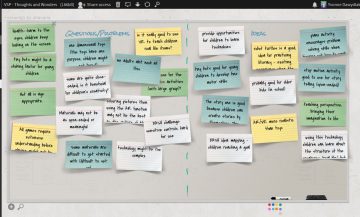
- Sticky Notes – have students share their idea, question, word, wonder and place on the board, around the room, on charts. Sort and classify and organize to work with the ideas.
- Placemat Activities: Large format paper on a desk (can be separated into grids or more free form depending on your purpose) allows a group of 3 or 4 students to share ideas at the same time. These could also be concept maps/Mind maps for even more critical thinking!
- Write around the room: students pick a spot on the whiteboard and record responses. This could be combined with a small group discussion and one or two students then go to the board to record… space dependent though I know teachers who also use their windows and put chart paper up…
It is important to note that while these no tech approaches do not provide the anonymity that digital tools can afford, they can provide authentic opportunities for formative assessment and student voice. To leverage the ‘visibility’ of responses, a teacher might have students turn and look at the responses of others, have discussion about varied responses and even change their response.
Content co-creation and brainstorming:
Allow your students to co-create their understandings, share their ideas and questions can lead to deep learning. Here are just a few suggestions:
- Padlet – this multi-modal response digital wall is great for brainstorming, checks for understanding and formative assessment (and now includes ability to add audio and drawing in addition to text, hyperlinks, video, images)
- Concept mapping is a powerful tool for illustrating complex links between ideas (be they images or text). Many softwares allow for hyperlinking and embedding images and video. Mindmup is a browser based application that allows co-creation of a concept map across time and space (NB: co-creation seems to now be a paid level of access – I’m trying to find another option… Schools/Districts using Google Classroom will have co-creation access).
Some Considerations when employing Digital Tech:
- BYOD and Access – bring your own device – Are there policies in place in my jurisdiction, school, district or are there rules in my classroom to consider? What about students who do not have access to a device? When pairing or grouping students and expecting one device in a group, do you know if the student who owns that device is willing to share it OR are there devices in the school you can borrow? What impact does it have on students when they do not have the same access as others?
- FIPPA – Freedom of Information and Privacy Protection act – Students data should not be shared on non-Canadian housed servers… Am I protecting students data privacy? Do I have necessary permissions or consent? Am I engaging my students in critical digital literacy discussion around privacy & safety in a broader sense? School Districts will have policies in place that meet the informed consent requirements of FIPPA. Be aware of local policies. (See this helpful guide from BCTF to support teachers and parents)
Additional Resources & Strategies:
Chapter 4 of Leahy and Williams’, Embedding Formative Assessment, makes a case for ‘all student response’ and limiting teacher questions to only those that propel learning. This book is a valuable addition to any teacher’s library and clearly links theory with practical strategies and relevant advice. (UBC Library has a copy)
BackChannel Chat:
By allowing students to voice their ideas or ask questions during a lecture or class work period using electronic tools such as those built into most learning management systems and widely available free online, you are providing opportunities for students to ask just-in time questions, share thoughts and connect with one another; potentially increasing student engagement and learning. These potential benefits come with ‘management’ needs and requires the development of a set of expectations in the classroom that student can follow. This can take time, usually involves some trial and error but is a risk that may be worth taking when one considers the increase in student agency that can result from the moderate risk. The notion that engaging the ‘backchannel’ during lectures and classes can add a more active component to what are sometimes more passive forms of teaching is taking hold with the growth in BYOD (bring your own device) in secondary and post-secondary classrooms.
High Tech
- Mentimeter is one ‘tool’ example. Many other SRS’s can be used in the same way.
- Teams and Google Classroom have their own backchannels and response systems either built in or that can be integrated depending on District permissions and access.
Low/No Tech
- Question box – allow students to note questions on a slip of paper and pop into a question box. I’ve also had students flag a page in their notebook prior to handing in with a sticky note.
Random Selection
This isn’t strictly speaking an all-class response strategy but may encourage participation. In some instances, it may be acceptable to have an understanding in the class or in a particular lesson that you may randomly call on students to respond to questions, to share ideas or their wonders. When using this strategy, it is important to ensure you are equitable and that you are considerate of your learners… if the questions is very high level and/or will likely NOT return an appropriate or correct response, then probably best to avoid this approach. If the question is accessible and you give prior warning and you are confident all learners will have the ability to at least make good attempts, then these approaches might be employed:
High Tech:
- Random Name Generator – there are several available online including some developed for interactive whiteboards/Smartboards. Ensure you do not include full names or other identifying info and always check out privacy policies. I’ve played with this one (developed by a Principal in the UK) https://www.transum.org/software/RandomStudents/
Low/No Tech:
- Popsicle Stick names, Playing Cards, Bingo card, etc – Teacher draws a name at random and student responds
- The teacher might encourage more responses by providing students with tokens and asking that they try to ‘use’ a token during each class discussion… this can also help limit the ‘over-responders’ who sometimes don’t leave space for others (i.e. they can only ‘spend’ up to X tokens each discussion…)
The value of anonymous responses…
We know that adolescent learners appreciate, or some would even say require, the opportunity to participate anonymously. Due to their sometimes heavy reliance on peer approval, students at this age can be reluctant to share their views orally. For this reason, employing an SRS can give voice to quieter learners and generate more honest responses. Of course, anonymity comes with risks so be sure to consider the following:
- How are responses published, shared or viewed?
- Can I moderate responses? (i.e. can I see them and approve them before they are ‘live’ to the students)
- Can students change their responses or provide multiple responses?
- Can I archive or track student responses in some way? (do I need to?)
- How will I respond if a student posts an inappropriate response?
- How can I create a class climate the promotes risk taking and accountability?
- consider small group response vs. individual response – students discuss their ideas and, using one device for the group, record their response… this can lessen the potential for inappropriate responses especially where the teacher is actively engaged in/with the class by circulating and checking in.
Closing Notes:
Remember that creating a positive classroom climate and cultivating a place of respect and value takes intention, time and patience on the part of the teacher.
Any tool or strategy may take practice. Give yourself (and your students) the benefit of trying something more than once. If it’s a tool, try allowing time to ‘play’ with it in a low stakes way so that students can learn the affordances.
References
Low-tech classroom response systems(Clickers). (n.d.). New York Tech. Retrieved October 26, 2023, from https://www.nyit.edu/ctl/blog/low-tech_classroom_response_systems
Nagro, S. A., Hooks, S. D., Fraser, D. W., & Cornelius, K. E. (2016). Whole-group response strategies to promote student engagement in inclusive classrooms. TEACHING Exceptional Children, 48(5), 243–249. https://doi.org/10.1177/0040059916640749