Tag Archives: math

Learning about and through Food: podcast resource post

Food is an interdisciplinary concept that intertwines through a wide range of subjects: home economics, science, math, arts, and many more.

In Episode 5 of our recently launched Thinking outside the Sandbox podcast, Dr. Kerry Renwick, Dr. Susan Gerofsky, and Dr. Lorrie Miller share their ideas and experiences with respect to food and the development of interdisciplinary learning experiences.

Below are a few resources that might be used to support each of the main points discussed in this episode:

1. Home Economics and Interdisciplinarity

Dr. Kerry Renwick shares how the concept of food could be intertwined with biology, chemistry, as well as issues of race and class.

The topic of food could be used as an entry point to discuss many topics and disciplines. Various interdisciplinary food-related activities and lesson plans are available at Teach BC:

  • Our Animal Neighbours; this unit identifies how animals were and continue to be relied upon and an important part of the lives of First Peoples; furs and skins for clothing and shelter, meat for food, bone, and antler for tools and weapons, etc.
  • Forced from home; this unit explores refugees’ experience with finding food
  • Mock Advertisement: Sustainable Community Lesson Plan; introduces marketing and advertising tactics aimed at children and youth, including those involving food and supplements.

Other resources are available at Teach BC that teach about food in relation to other cultures and geographic regions.

2. Learning from and in School Gardens

Dr. Susan Gerofsky spoke of her experience of the UBC Orchard Gardens where teachers could experiment with teaching outdoors. Check the UBC Orchard garden blog for more ideas on teaching, learning, and growing in the outdoor classroom.

  • Growing your own food helps you eat fresh fruits and vegetables, helps you choose which fertilizers and pesticides come in contact with your food, and control when to harvest your food, thus having more nutrients in your garden-grown vegetables, as highlighted in this Harvard Health Letter.
  • Engage your students with gardening their food in the school garden, or in one of the nearby community gardens.
  • Encourage your students to learn about gardening through the various activities and lesson plans provided by Kids Gardening.
  • Another interesting interdisciplinary idea in relation to gardens would be to encourage students to share their inspirations and reflections through writing poems. Explore this learning experience with the garden as a co-teacher where teacher candidates wrote their poems from the garden.

3. Food Literacy

Dr. Kerry Renwick elaborated on “food literacy” highlighting topics as food choice and responsibility when buying food, as well as seasonality and harvesting options/decisions.

Food literacy is knowledge, attitudes, and skills about food. This includes understanding the connections between food, health, and wellbeing; knowing how to select nutritious foods; and understanding what constitutes a healthy diet, as explained by Healthy Schools BC.

4. Engaging with Aboriginal Knowledge and Understanding

Dr. Kerry Renwick spoke of the importance of incorporating Aboriginal ways of learning about food specifically on sustainable ways of dealing with food.

FNESC  (First Nations Education Steering Committee) provides various resources that highlight food in relation to First Nations Knowledge.

    • Science: Traditional Aboriginal cultures used natural resources for transportation, shelter, and food gathering.
    • Social Studies: Aboriginal peoples developed distinct foods, medicines, and clothing.
  • For Grades 5-9, there is a teacher resource guide titled  “Science First Peoples”, which highlights First Peoples’ connection to the land for food. Examples include:
    • Science grade 5: How does Traditional Knowledge about body systems help First Peoples prepare and store food for the winter?
    • Science grade 6: How does Traditional Knowledge about life cycles help First Peoples harvest food in their territories?
    • Science grade 7: How did/do First Peoples use their knowledge of organisms’ survival needs- including food-to modify the environment for harvesting? (e.g. clam gardens, controlled burning, herring roe harvesting ), as well as other resources and activities.

5. Creative ways for sustainable engagement with food consumption

Dr. Lorrie Miller spoke of creative ways to make use of food scraps, one of which is food dyes.

  • More ideas on creating natural dyes from food waste could be found here.
  • Review these tips on how to compost kitchen scraps.
  • Check this teacher’s guide by the Alameda County Waste Management Authority & Source Reduction and Recycling Board, San Leandro, California, for activities on how to bring compost into the classroom as a valuable teaching tool.
  • Inspiration on ways of growing vegetables from kitchen food scraps is available in this blogpost by the UBC Orchard Garden.

Guest Post: Nashwa Khedr, EDCP graduate student, project assistant 2020

Leave a Comment

Filed under Active Learning, AppliedDesignSkillsTechnologies, Physical and Health Education, Planning, Podcasts, Resources

Intertwining Art: PodCast Resource Post

When used meaningfully, Art can be Education’s best ally! Whether it be witnessing or creating it, Art gives students and teachers the opportunity to engage with something new.

In the attempt to approach, explore, and practice new pieces of knowledge, Art serves as the forum to make connections through multiple angles. By allowing the space to search through diverse points, Art provides the freedom to bring students into unique and intimate relationships with their answers (Greene, 2001).

Think about it! The more ways to engage with the learning materials, the better chance ALL student have at finding something that speaks to them; therefore, the more likely they will be of making connections relevant to them and their previous knowledge.

Here at Scarfe Sandbox we are firm believers in interdisciplinary learning experiences for students. So the Scarfe Sandbox 2020 team set out to interview UBC professors from the Faculty of Education, and create Thinking Outside the Sandbox! A podcast sharing knowledge on Interdisciplinary learning in teacher education. For inspiration on intertwining Art into your lesson plan we encourage you to check out episode 3: “Art & Interdisciplinary Learning and Teaching” which featuring Dr. Sandrine Han. Dr. Shannon Leddy, and Dr. Marina Milner-Bolotin.

In addition to the podcast episode to help you begin thinking about the ‘A’ in STEAM, below are some examples showing a few approaches to planning meaningful Art-based lessons to engage students with Big Ideas, Content, and Curricular Competencies across three different subjects of the BC curriculum. All of these examples were presented to TC´s at an “Intertwining Art into Unit planning” workshop in early 2020 by Belen (post-author, pod cast host & graduate student in Arts Education)

Intertwining Art and English Language

A great way of intertwining Art and English Language is creating a museum or art gallery inside your classroom!

By encouraging both teachers and students to think of art pieces, museums, and artists as living and dynamic, Art turns into a space and medium to explore, express, and document new pieces of knowledge. Engaging students with unique ways of expression allows for the exchange of stories and new perspectives.

Perks: It can remain as a short lesson plan but has the potential to become a cross disciplinary unit plan, using museum and gallery spaces as a theme to the project.

Provided in the link, you can find slides from our Art-based unit planning workshop, offering a wider insight on the potential to this Art-based unit plan and an overview on how Big Ideas, Content, and Curricular Competencies from the English Language Arts 1 are covered in the BC curriculum: Meaningful Art-based lesson plan for Language Arts 1

Intertwining Art at a Secondary level

For all you secondary teachers we  have some great resources to accompany our episode on creating interdisciplinary units plans that intertwine Art, we invite you to read our post on Interdisciplinary Unit Planning: Secondary Art, Sci, SS,  in which you can find a lesson-plan to engage students with the Bentwood box, constructed by Coast Salish artist Luke Marston,  carved from red cedar to represent First Nations, Inuit and Metis cultures. All while exploring (remotely) the Museum CMHR, through their app.

Intertwining Art and Mathematics

Engagement with Art can activate students’ imagination to conceive possibility and other choices of life, such as ways of interpreting and displaying different forms of data.

Analyzing art composition can be a wonderful way to introduce fractions, decimals, percentages, and even ratios. While the creation of art pieces becomes a great medium to practice with, it can also be a form of assessment.

Provided in the link, you can find slides from our Art-based unit planning workshop, offering a wider insight on the potential to teaching fractions in an Art-based approach, plus the overview on how Big Ideas, Content, and Curricular Competencies from the Mathematics 4 are covered in the BC curriculum: Meaningful Art-based lesson plan for Math 4

Intertwining Art and Science

Manually sculpting, carving, and using the potter´s wheel are magical. With the appropriate use of wording, children will experience what it means to cool, steer, mix, heat, dilute, and dry matter. Plus it can even be done in 1 or 2 classes!

Provided in the link, you can find slides from our Art-based unit planning workshop, offering a wider insight on the potential to teaching fractions in an Art-based approach, plus the overview on how Big Ideas, Content, and Curricular Competencies from the Science 2 are covered in the BC curriculum: Meaningful Art-based lesson plan for Science 2

Guest Post contributed by Belen Guilleman, a grad student in Arts Education

References:
Greene, M. (2001). Variations on a Blue Guitar: The Lincoln Center Institute Lectures on Aesthetic Education. New York: Teachers College Press.

Leave a Comment

Filed under Blog Posts, Math, Podcasts, Science, The Arts

Tailoring Your Lessons For Passionate Learning


“The goals of passion-driven education is to preserve and perpetuate the senses of awe and excitement all young children inherently have, fuelling a lifelong love of learning.”

Connor Boyack in his book Passion-Driven Education (p. 128)


Children are naturally curious! Alternatively, the world is full of learning opportunities and puzzles to be solved (Griffith, 1998). This means that children usually have personal interests that they are exploring and questions that they are inquiring about.

Children might lose their curiosity as they grow if they are not provided with stimulating opportunities to explore their passions and interests. While some known figures (Bill Gates, Steven Jobs, Oprah Winfrey, Mark Zuckerberg) have pursued their passion in their personal time, others (Walt Disney and Henry Ford) left the modern education systems to focus on their passions (Boyack, 2016). Albert Einstein says “It is a miracle that curiosity survives formal education.”


Does one’s passion need to be pursued beyond school time?


Pursuing one’s passion does not need to be separate from the school learning program. A child’s interest is not a useless distraction, as explained by Boyack (2016). In fact, Boyack explains that “a successful method of education must incorporate a child’s interests” (2016, p. 124).

The BC curriculum allows for a large extent of flexibility when it comes to planning a lesson or a unit. Based on the big ideas, content and curricular competencies, teachers could creatively craft their lessons based on the students’ interests allowing for a more personalised learning experience.

Additionally, with more time spent at home amidst remote learning, students have more time to experiment and explore topics of their own interest in their personal space and time.

Also, more age-mixing occurs at home with people of a broader age spectrum (siblings, parents, relatives and acquaintances) thus learning within the zone of proximal development occurs as students interact with individuals that have knowledge and skills beyond themselves.

Connor Boyack explains in his book Passion Driven Education: How to Use Your Child Interests to Ignite a Life Long Love of Learning how he managed to foster his son’s passion for Angry Birds by relating different subject areas to it.

He also provides several examples in his book of how a child’s interest could be tackled through various subjects, allowing the student to learn about it interdisciplinarily. Two examples are described below:

1. Animals
A passion for animals could be stimulated through:

  • History: list of extinct species and the cause of their demise, study the predator/prey relationship to discuss the dominance of weak nations by powerful nations
  • Languages: write a journal of family pet (behaviors, habits, physical activities), volunteer at the zoo and write a blog, write a story of world dominated by animals
  • Science: explore binomial nomenclature, dissect a frog, explore how animals adapt to the environment
  • Math: calculate statistics of population of animals in different countries, estimate counting animals in a video or real life
  • Art & Creativity: create animal sock puppets, woodwork to build a birdhouse, design obstacles for a family pet

2.Cooking:
A passion for cooking could be stimulated through:

  • History: explore how diets have changed over time, how people harvested & preserved food in the past, and how pilgrims cooked while on the move, review wars by studying diets of soldiers
  • Languages: read and write; recipe cards, blogs, shopping list, food journals with daily intakes
  • Math: utilize units of measure, calculate the cost of meal, cut food into various shapes (geometry), plan for a week’s food and calculate the money
  • Science: study the effect of temperature and humidity on food, study chemical reactions that affect food, study recent inventions used to increase shelf life of food, introduce kingdoms of life
  • Art/creativity: possible activities include best dessert decoration, most colourful salad, fancy meal invitation, painting using juices.


What might teachers do in the classroom?


Class activities and projects could be based on students’ interests (e.g., horses, cooking, animals, car, cartoon characters) or a contextually- relevant social problem.

Let’s imagine a student or a group of Grade 4 students interested in ‘gardening’. How could we possibly integrate their interest in several subjects allowing them to pursue their passions in depth within the realm of school curriculum?

First, explore the curriculum for that grade. Use this interesting search tool to view the big ideas, content and core competencies for subjects of interest in the BC curriculum.

Looking at the subjects (social studies, math and science) with ‘gardening’ in mind, several opportunities for fostering this passion emerge!

Social studies: in relation to the history of the local community and of local First Peoples communities, students could explore how farming and gardening have changed over time and how food and medicine gardening continues to be a culturally relevant practice.

Mathematics: students could explore their backyard garden or visit a nearby garden, and count different species of trees, compare fractions, and hypothesise the number of a certain species in the larger park (maybe through counting species in a smaller group then estimating that figure through multiplying and dividing, exploring the perimeter of regular and irregular shapes, exploring polygons, exploring increasing and decreasing  patterns pf flowers or trees.

Science: students could explore how plants respond to light, touch, water and gravity; or local changes caused by Earth’s axis, rotation and orbit, specifically how plants respond to the seasons (e.g., dropping leaves).


Similarly, if another student is interested in ‘cooking’, possible suggestions for these subjects include:

Social Studies: students could explore the history and changes in meal preps in local communities and local First Peoples communities, and to what extent the change in meals has been impacted by colonisation of First Peoples societies.

Mathematics: students could calculate recipes for hypothetical large dinner preparations, could design patterns in meals, calculate the probability of a certain pizza ingredient/vegetable not being present in a slice, or explore perimeter of irregular shapes such as bagels or pretzels.

Science: students could explore the forms of energy involved throughout cooking (thermal, chemical…), energy transformation that occurs through cooking, effects of temperature on particle movement, the importance of senses and responses in the kitchen, phases of matter included in the kitchen, and the effect of temperature on particle movement

An example of how an interdisciplinary unit for secondary school students could be prepared is available here.

Guest Post: Nashwa Khedr, EDCP graduate student, project assistant 2020


References

Boyack , Connor. (2016) Passion Driven Education: How to Use Your Child Interests to Ignite a Life Long Love of Learning. Libertas Press.

Griffith, M. (1998). The Unschooling Handbook: How to use the whole world as your child’s classroom. Crown Publishing Group.

Rosen, M. (2014). Good Ideas: How to be Your Child’s (and Your Own) Best Teacher. John Murray (Publishers).


Leave a Comment

Filed under Active Learning, Blog Posts, Planning, Remote teaching & learning

Asking and Promoting Effective Questions

“Questioning is one of the thinking processing skills which is structurally embedded in the thinking operation of critical thinking, creative thinking, and problem-solving”
(Cuccio‐Schirripa & Steiner, 2000, p. 210).


Young children as natural inquirers

Young children ask an estimated 10,000 questions per year before they begin formal schooling (Harris, 2012). Preschoolers increasingly use questions to seek information. These questioning skills develop rapidly during infancy and the elementary school years. Elementary school students develop the ability to ask precise questions to receive accurate information (Ronfard, et al., 2017).


Who asks the most questions in the classroom?

Despite young children’s natural inclination to ask questions, previous research shows that children rarely ask questions at school compared to teachers who usually ask predominantly rote memory questions, at rates of 1–3 questions per minute (Gall, 1971; Susskind, 1969; Susskind,1979; Ronfard, et al., 2017).


Why might some students refrain from questioning?

Research shows that questioning drops in school and classroom environments compared to home when teachers take an authoritarian stance, or when students’ questions are regarded as ‘stupid’, as providing an ‘impolite challenge’ or as adding to current stress (Ronfard, et al. 2017).

It is important for teachers to develop students’ curiosity not only by asking questions but also by encouraging students to develop their own questions, thus owning their learning process.

Students’ ability to ask good questions has multifold benefits according to Chin & Osborne (2008).

For students:

  • Allows them to direct their own learning
  • Fosters discussion
  • Helps with self-evaluation
  • Arouses their curiosity thus increasing motivation and interest in a topic

For teachers:

  • Helps them diagnose students’ understanding, thus acting as formative assessment
  • Evaluates higher-order thinking skills
  • Allows for further inquiry into the topic
  • Invites critical reflection on classroom practices


Recommendations:

Below are several recommendations for asking effective questions in various subjects, as well as encouraging your students to come up with their own questions!


Create A ‘Cognitive Disequilibrium’

To stimulate students’ question-asking and spark students’ curiosity, teachers might set up some kind of ‘cognitive disequilibrium’ in the classroom, through confronting students with gaps of knowledge, obstacles to goals, unusual events, projecting contrasts, and decisions that require choosing between alternatives (Chin & Osborne, 2008).

Stimulate Curiosity Through Observation

Providing stimulating prompts for observation is an effective way to stimulate curiosity. One example is provided by Tammy, an upper elementary school teacher, is encouraging students to observe, then investigate observations through writing questions, and classifying them to searchable and investigative questions. Teachers can then build lessons based on students’ interests.

In Social Studies

The Critical Thinking Skills Cheatsheet (provided by the Global Digital Citizen Foundation) offers questions to promote critical thinking on any given topic, especially when students are to explore or discuss new information.

In Novels

Questions could be used to promote critical thinking and deeper understanding when reading novels. Through suggesting choices about different possible scenarios as well as using close-ended and open-ended questions, students are encouraged to think, allowing the advance of cognitive and emotional processing. Elaboration using the story of “Goldilocks and the Three Bears” could be found here.

In Mathematics

Questions could be used not only as a prompt to start exploration but also throughout the work to stimulate thinking, encourage students to reflect on their work, make connections, and help them share their representations.

Consider the following prompts provided by the Ontario Ministry of Education in their  special edition (#21) of the  Capacity Building Series on asking effective questions, which help students:

  • Share their presentations

(How have you shown your thinking- e.g., picture, model, number, sentence? )

  • Reflect on their work

(What questions arose as you worked?)

  • Make connections

(When do you see this math at home?)

  • Share feelings, attitudes and beliefs about mathematics

(How do you feel about mathematics?)

  • Retell

(How did you solve the problem? What did you learn today? What were the steps involved?)

  • Predict, invent or problem solve

(How are adding and multiplying the same? What would happen if ..?)

More examples of questions could be found in the previously mentioned document.

In Science

In attempt to make individuals critical consumers of scientific knowledge, the ability to ask good thinking questions is an important component of scientific literacy (Chin & Osborne, 2008).

In science education, strategies to enhance students’ question-asking as recommended by Chin & Osborne (2008) are:

Teacher modelling and use of appropriate stimuli, questions prompts, and taxonomies

  • Teach student categories of question types that differ in the nature of higher-order thinking skills
  • Provide sample self-questions that focus on specific cognitive processes (e.g., comparing, analysing, predicting, hypothesising, explaining)

Structuring tasks through use of physical support, time and targeted activities

  • Encourage students to record their questions in a learning journal, allowing them to think about gaps in their knowledge and allowing the instructor to modify instruction to address students’ needs.
  • Establish a problem corner where students can supply problems of the week (Jelly, 1985)
  • Allow shy students to take the time to craft their questions through email or discussion forums
  • Encourage students to write questions to be used in the evaluation (Eisner, 1965; Zoller, 1994)

 Providing social support

  • Provide a warm classroom climate with low criticism
  • Provide praise to those who invent questions, avoid repression
  • Encourage students to ask questions that help them find relationship and coherence in search of understanding


How to encourage students to come up with their own questions?

According to The Right Question Institute, the skill of Question Formulation has several benefits:

  • providing learners the cognitive skills to solve real-world problems
  • shifting the view of ignorance from a weakness to an opportunity
  • aiding in arriving at better questions
  • increasing engagement
  • adding joy in learning and researching

 Dan Rothstein and Luz Santana of the Right Question Institute developed 6 steps in the Question Formulation Technique (QFT) for educators to help students formulate their own questions.

Step 1: Present with a question focus (QFocus) that is not in the form of a question (a prompt which could be an image, primary source, etc.)

Step 2: Encourage students to pose questions about question focus while following the four rules

  1. Ask as many questions as you can.
  2. Do not stop to judge, discuss, or answer questions.
  3. Write down every question exactly as stated.
  4. Change any statement into a question.

Step 3: Identify different types of questions (open-ended or closed-ended), transform questions to the other type, and add to the list.

Step 4: Students prioritise questions

Step 5: Educator and students discuss next steps

Step 6: Students reflect on the process of asking questions, and move into next steps

For more elaboration, you could read this article on QFT by Dan Rothstein and Luz Santana.

Always remember that children are young inquirers and their ability to develop precise questioning skills strengthens with age, given the supportive environment- so let’s create that!

Guest Post: Nashwa Khedr, EDCP graduate student, project assistant 2020

References:

Chin, C & Osborne, J (2008). Students’ questions: a potential resource for teaching and learning science, Studies in Science Education, 44(1), pp. 1-39, DOI: 10.1080/03057260701828101

Cuccio-Schirripa, S., & Steiner, H.E. (2000). Enhancement and analysis of science question level for middle school students. Journal of Research in Science Teaching, 37, 210–224.

Gall, M. (1971.) The use of questions in teaching. Review of Educational Research, 40, pp. 707-721.

Harris, P. L. (2012). Trusting What You’re Told: How Children Learn from Others. Cambridge, Mass.: The Belknap Press of Harvard University Press.

Minigan, A. P., Westbrook, S. Rothstein, D, and Santana, L. (2017). Stimulating and Sustaining Inquiry with Students’ Questions. Social Education 81(5), National Council for the Social Studies. pp. 268-272

Ronfard, S., Zambrana, I. M., Hermansen, T. K. & Kelemen, D. (2017). Question-asking in childhood: A review of the literature and a framework for understanding its development. Developmental Review, https://doi.org/10.1016/j.dr.2018.05.002

Susskind, E. (1969). Questioning and curiosity in the elementary school classroom. Unpublished doctoral dissertation. Yale University.

Susskind, E. (1979). Encouraging teachers to encourage children’s curiosity a pivotal competence. Journal of Clinical Child Psychology, 8(2).

Ontario Ministry of Education (July 2011). Asking Effective Questions. Capacity Building Series. Special Edition no. 21 Retrieved from http://www.edu.gov.on.ca/eng/literacynumeracy/inspire/research/cbs_askingeffectivequestions.pdf


Leave a Comment

Filed under Active Learning, Blog Posts, Not Subject Specific, Remote teaching & learning

Math outside the classroom

The National Council of Teachers of Math (NCTM) “is an international association advocating for high-quality mathematics teaching and learning for each and every student.” They are currently offering free memberships and providing access to research based resources including articles, learning plans and more.

Given our current situation, teachers may find that parents and students are overwhelmed and unable to grapple with content or concepts that are new or too challenging. Consider using this time for review and application of previously covered concepts before moving on to new material. Perhaps this is a good time to provide some choice to your students around applying prior learning through an at home project, provocation, problem solving or problem based learning?

eagle image showing 2 meters apart distance

  • Math Resources:
    • K-7: Janice Novakowski, ‪@jnovakowski38‬ on Twitter, (Richmond SD38 numeracy helping teacher and local math guru!) has started a collection of resources to support teaching in our current COVID context for K-2, 3-5, 6-7. For all ages, consider downloading and sharing, perhaps along with a prompt or provocation, one of her play outdoors posters (one example pictured here).
    • For weekly Math tasks/plans for home learning, visit the Continuity of Learning pages from SD38 (another shout out to Janice Novakowski and her fab math colleagues!) The K-9 learning plans “include five tasks for each week connected to one foundational math concept and big idea with connections to BC curricular content and competencies. They are intended to be shared with families as one choice for their week’s learning opportunities in mathematics.”
    • Meghan Zeni (@roomtoplay on Twitter) is one of my go to sources for elementary aged outdoor learning activities including Math ideas like this patterns in nature post
    • K-12: Illuminations – National Council of Teachers of Math website with Lessons and interactive simulations for online math learning
    • K-9 and beyond: Marilyn Burns Math Blog. On her blog, and @mburnsmath, Marilyn has been sharing regular posts with engaging and simple math activities that can be done at home using materials many families will have on hand. There are many games with NO digital tech required and several that incorporate digi tech. A favourite no tech game my own elementary aged students loved to play is Race to 100. Where appropriate, a teacher (or child) might make these higher tech and interactive by playing games together in a synchronous web space or video recording and sharing a game (much like many kids enjoy doing with their video games). Some students might enjoy sharing their math-edventures via flipgrid video, text chat or what about a live game on a digital whiteboard (such as awww)
    • IXL Math is a skillbuilder website for grades 1 – 12 that includes diagnostic quizzes for various concepts and will provide students with ‘appropriate leveled’ practice activities (mobile or web browser). NB: 30 day free trial, not canadian housed so be sure to check with your school/district for permissions and access. Teacher Eric Neumeyer shares ‘how to use IXL videos’ on his class blog to support students (and parents and teachers) learning to use this free online digital resource. Of further interest is Eric’s approach to COVID learning with his students: optional can do activities along with must do/essential learning activities. While his full lessons and activities are shared on his private google classroom with his students, you can see what he is sharing and assigning to his students on his blog. You’ll notice that he shares brief ‘explainer videos’ so that students can read and also ‘view’ what they need to (or can) do.
    • At home project idea for any age (given some support) COOKING! Need I say more? The math and science learning in this life-long activity cannot be overstated: Sharing cooking experiences (trials and errors); halving or doubling recipes; sharing favourite recipes; sharing photos and reflections on ‘top chef’ or ‘fridge-challenges'(i.e. make something with X number of random ingredients from your fridge – no going to the store!); investigating food as cultural and intercultural experience. The SD36 (Surrey) District Aboriginal Learning’s Idea of the Day Blog often shares math ideas and recently shared a bannock recipe. Check out @teachertong on Twitter and the THESA (Home Ec Specialists Assoc) website for home learning ideas for Middle and Secondary learners including this adaptable « choice board » of foods learning experiences – parents will appreciate the « clean the microwave » option!.
    • No post that références learning outside would be complete without a shout out and link to Gillian Judson’s Walking Curriculum – including, but not limited to, math ideas. A truly interdisciplinary, imaginative approach! (a post devoted to this resource here) @perfinker on Twitter.

    Working with older students and want to look at data? This article « The Math Behind Social Distancing » on Global News includes some excellent info graphics With clear explanations of the math behind the data.

    Don’t have dice to play with? Try making your own! (thanks to one of Janice’s ‘Math at Home’ youtube videos)

Leave a Comment

Filed under Blog Posts, Math, Physical and Health Education, Remote teaching & learning

Tinkercad

TinkerCad logo


According to its website, “Tinkercad is a free online collection of software tools” for what is known as 3D CAD (three-dimensional computer aided design) as well as coding, circuitry, and 3D printing. With a variety of target audiences, including students, parents, and teachers, as well as hobbyists and general enthusiasts, Tinkercad provides users with web-based access from any on-line device, and their designs can be published and shared thanks to a Creative Commons license.

Tinkercad was launched in 2011 and is currently owned by American software giant, Autodesk. Its objective, according to founder Kai Backman, is to help “make 3-D design in general, and the design of physical items in particular, accessible to hundreds of millions of people.” By combining creative thinking and collaboration with computer aided design, Tinkercad introduces students to such pursuits as architecture, engineering, and even animation.

Tinkercad designs can also be taken further by integrating them with Merge Cube or CoSpaces. These integrations allow for models and designs to be viewed in AR and VR spaces. Link to Merge Cube website with instructions for importing Tinkercad designs into Object Viewers.

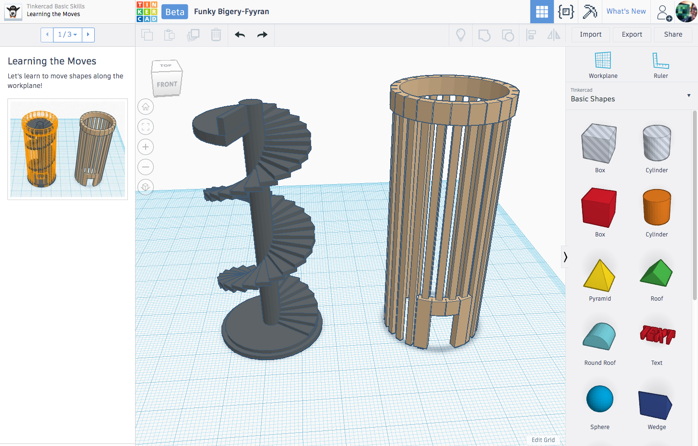
Click above to view an example of Tinkercad project in progress


3D design software provides another medium for your students to utilize their applied design thinking skills. The beauty of Tinkercad over other 3D design tools lies in its accessibility. Catered to the beginner designer, Tinkercad makes the design process user friendly by employing drag & drop mechanisms and snapping grids. The application is also free to use and browser-based, allowing any computer to run the application without downloads. (You can even use it on your tablet!)

Objects designed in Tinkercad can also be shared with other peers, and exported to be printed on a 3D printer!

    1. Visit http://tinkercad.com/
    2. Sign up for a free account

(please keep in mind that Tinkercad data is not Canadian housed so teachers may choose to sign up for themselves but would need to confirm permissions with their schools/district before asking students to sign up. Teachers can create classes, share designs and challenges with their students. If teachers add students using a nickname, students can login using a join code and there is no need for them to provide their email or other personal information!

  1. Begin either by Creating a New Design or visiting the Gallery to browse other designs
  2. Drag and drop shapes and objects from your tool bar onto your grid – by default, objects snap to sit on the ‘surface’ of the plane.
  3. Edit your shapes and objects by selecting on the transformative modifiers located around the object
  4. Rotate your viewing angle by clicking on the left side cube and moving it around.
  5. Share or Export your creation with the buttons located in the top-right corner
  6. To go further… After you design your project in Tinkercad, you can upload the object on Merge cube! It will give an opportunity to your students evaluate, improve, and play with their work in their own hands!
  7. Visit the Thingiverse https://www.thingiverse.com/ for a variety of templates, lessons for projects across the curriculum.

A few Tips:

  • If you want to stack objects on top of each other, first place the object on the ‘plane/paper’ and then move it up using the triangle tool at the top.
  • You can view the height of each object by selecting the object.
  • Use the Cube in the top left corner of your screen to view Front, Back, Top, Bottom… Be sure you are building ON the plane (not below it!)


If want a step-by-step of some of the Tinkercard tools, the Master of Educational Technology prepared a small demonstration of what you can do:


Leave a Comment

Filed under AppliedDesignSkillsTechnologies, Engineering, Math, Resources, Science, Technology, The Arts

Ressources pour vous aider à enseigner la science, l’éducation physique et les maths

Il s’agit ici de quelques ressources pour vous aider à enseigner la science, l’éducation physique et les maths.


L’apprentissage d’une langue est un processus sans fin pour les étudiants et les enseignant.e.s.

De plus, au Canada, un pays bilingue, les étudiants ont la chance d’apprendre le français et l’anglais à l’école publique. En tant qu’enseignant.e c’est important d’être au courant avec le vocabulaire utilisé dans la salle de classe. Après une discussion avec des enseignant.e.s et des candidat.e.s dans la faculté d’éducation, notre équipe a remarqué qu’ils.elles ont encore des difficultés à trouver des ressources pour soutenir l’apprentissage du vocabulaire sur divers sujets. Par conséquent, on a commencé la recherche pour vous aider ! Ci-dessous on a divisé les ressources par sujet.


La science

Ce document présente les termes de vocabulaire d’une façon très organisée et efficace; il se catégorise premièrement par sujet, et puis par la nature du terme (nom, adjectif, verbe). La liste, quoique pas exhaustive, fournit beaucoup de termes qu’on utilise en cours de science.


L’éducation physique

Dans ce document, le gouvernement du Québec présente de termes commun, des théories et des stratagèmes d’enseignement. 


Les maths

Ce site commence avec une explication sur les « maths comme langue ». C’est-à-dire, que dans les maths, il s’agit des termes et d’une façon de parler assez différents qu’on utilise d’habitude. Ensuite il nous fournit les douze termes les plus fréquents en maths. Les explications de ces termes sont claires et vraiment utiles.

Ce site offre un lexique mathématique en PDF (et dont on peut faire des recherches pour des termes spécifiques). Ce n’est pas du tout exhaustif, mais néanmoins utile pour les termes qui s’y trouvent.

Finalement, ce site fournit un lexique très détaillé dont on peut faire des recherches pour des termes spécifiques sur plusieurs sujets mathématiques. Il inclut beaucoup de termes qui traitent plusieurs sujets mathématiques.


3 Comments

Filed under Blog Posts, en francais, Physical and Health Education, Resources