California Court Protects a Professor’s Right to Criticize Research

The Chronicle: California Court Protects a Professor’s Right to Criticize Research

How far can one scientist go in criticizing the work of another before committing libel? A California judge decided this week that, at least in the bizarre case of a controversial study involving prayer, words like “fraud,” “guilty,” and “plagiarism” are fair game in the scientific literature.

“We’re breathing a sigh of relief,” said Bruce L. Flamm, who wrote those critical words about the study. The resolution to the case was a victory for academic freedom, said Dr. Flamm, a volunteer clinical professor of obstetrics and gynecology at the University of California at Irvine and a physician with Kaiser Permanente.

But he also said the lawsuit brought against him last year would have a chilling effect on scholarly discourse. “I’ve spoken to colleagues who find the lawsuit to be absolutely frightening,” he said.

The case centers on a 2001 study published in The Journal of Reproductive Medicine. The paper purported to show that prayer by anonymous people in North America and Australia could double the chances of success for South Korean women undergoing fertilization procedures, who were unaware of the prayers. The authors of that paper were Kwang Y. Cha, a prominent fertility specialist in South Korea and California; Rogerio A. Lobo, a professor of obstetrics and gynecology at Columbia University Medical Center; and Daniel Wirth, a lawyer who studies the paranormal.

Panel Finds That West Virginia U. Erred in Awarding M.B.A. to Governor’s Daughter

Pittsburgh Post-Gazette: Panel: Bresch didn’t earn M.B.A.

A five-member panel has concluded unanimously that Mylan Inc. executive Heather Bresch, daughter of West Virginia Gov. Joe Manchin, did not earn an M.B.A. degree from West Virginia University and that administrators acted improperly in granting her the degree retroactively in October, according to a person familiar with the report.

New York: Federal judge dismisses mail and wire fraud charges against SUNY Prof

The Buffalo News: Federal judge dismisses mail and wire fraud charges against Kurtz
UB professor was accused of illegally obtaining biological materials

Agents from the FBI Hazardous Materials Response Unit collect biological evidence from a house on College Street and Maryland in Allentown belonging to UB professor Steve Kurtz in May 2004. A federal judge dismissed an indictment against Kurtz today.

A federal judge today dismissed criminal indictments against Steven Kurtz, the University at Buffalo professor accused of mail and wire fraud when he obtained biological materials he intended to use in his artwork.

California: Nearly 2,000 protest college spending cuts

San Francisco Chronicle: Nearly 2,000 protest college spending cuts

Students frustrated by the skyrocketing costs of going to college staged noisy demonstrations up and down the state Monday and said they were just warming up for protests against the governor’s proposed $1 billion cut to higher education.

Universities’ Intellectual Property Stance Criticized

Inside Higher Ed: Universities’ Intellectual Property Stance Criticized

Getting medicines to people who need them in developing countries is a top goal of public health experts worldwide, many of whom note that people are dying all the time of diseases for which treatments exist. Universities, whose scientists’ research is crucial to many of those drugs and which enjoy a share of royalties on some of those drugs, are finding themselves drawn into a debate that has as much to do with the economics of the pharmaceutical industry as anything that takes place in a laboratory.

UK: Strike hits 2,500 schools so far

BBC: Strike hits 2,500 schools so farhttp://news.bbc.co.uk/2/hi/uk_news/education/7359702.stm

It looks unlikely that half of schools will be disrupted by the strike

Parents are being warned about the impact of this week’s teachers’ strike – with over 2,500 schools so far set to be fully or partially closed.

Local authorities in England and Wales are gathering information – with 68 local authorities revealing their closure plans for the one-day strike.

Does Academic Freedom Give a Professor the Final Say on Grades?

The Chronicle: CASE IN POINT: STRONACH V. VIRGINIA STATE U. (2008)
Does Academic Freedom Give a Professor the Final Say on Grades?

Commentary

Does Academic Freedom Give a Professor the Final Say on Grades?

By LAWRENCE WHITE

Carey E. Stronach, for more than 40 years a tenured professor of physics at Virginia State University, assigned an undergraduate a final grade of D after the student had failed three classroom quizzes. The student claimed to have received A’s on two of the quizzes. He submitted faxed copies of his score sheets to Stronach, who concluded that the student had doctored his scores. The student appealed to the chairman of the physics department, who sided with the student and changed his final course grade to an A.

New York: Bloomberg for President – Of University?

The New York Sun: Bloomberg for President – Of University?

Even though Mayor Bloomberg has put to rest speculation that he would run for president this year, he could find himself answering to “President Bloomberg” just the same.

Michigan: Students protest plan for armed security at Calvin

Grand Rapids Press: Students protest plan for armed security at Calvin

GRAND RAPIDS — More than 60 Calvin College students marched on campus Thursday, protesting the Faculty Senate’s decision to allow the school’s safety supervisors to carry handguns on campus.

Outsourcing at UC Davis

Inside Higher Ed: The University of California at Davis last week announced a new approach to the outsourcing of its food service operations — a source of controversy and protests on the campus. Under the new policy, Sodexo will continue manage the food operations. But about 175 to 200 non-managerial employees and several hundred student employees will over time become University of California employees, rather than Sodexo employees. Critics at Davis and elsewhere have said that outsourcing has the impact of denying those who work on campus the benefits and job protections offered to campus employees.

A Test the Education Department Doesn’t Love

Inside Higher Ed: A Test the Education Department Doesn’t Love

In many quarters within American higher education, Education Secretary Margaret Spellings is viewed (unfairly, she and her supporters would argue) as an almost single-minded advocate for more, and more standardized, measurement of how well college students are educated. The position of Spellings’s Education Department on testing has made her unpopular with many college leaders and faculty members in the United States.

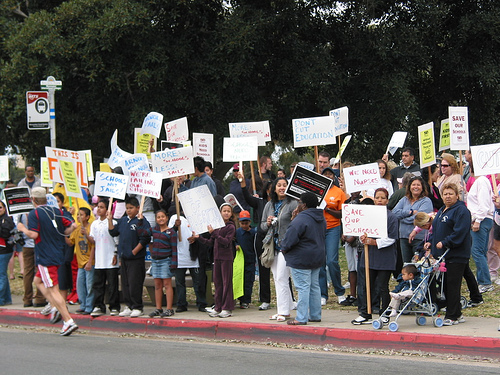
San Diego teachers march against budget cuts and layoffs

2426295632_554e734131.jpg

Here are likes to some photos and a very short video clip from this morning’s march by San Diego teachers against public school budget cuts. The march was organized by teachers at Hoover High School protesting the teacher layoffs. The union supported the march, but was too busy to organize one themselves so the teachers just went ahead and did it. An estimated 800 people marched.

http://www.flickr.com/photos/25821635@N04/sets/72157604628132757/

http://video.google.com/videoplay?docid=4077811264784298929&hl=en

Pope Benedict Thanks Educators and Addresses Academic Freedom in Talk at Catholic U.

The Chronicle: Pope Benedict Thanks Educators and Addresses Academic Freedom in Talk at Catholic U.

In a warmly received address to Roman Catholic educators, including 200 college presidents, on Thursday, Pope Benedict XVI expressed “profound gratitude” for the educators’ “selfless contributions,” which “serve both your country and the church.”

Colorado: CCHE allows controversial institution to open doors in Colorado

Silver & Gold: CCHE allows controversial institution to open doors in Colorado

A bill making its way through the House this month may put in place more oversight of private, for-profit higher education institutions in Colorado. But it will not give the Colorado Commission on Higher Education (CCHE) oversight of an institution whose predecessor was closed down in Hawaii and was referred to as a “degree mill.”

Last week, the CCHE authorized the American University for Humanities (AUfH) to offer degrees in Colorado. AUfH plans to begin enrolling students this fall and will offer undergraduate degrees in liberal arts, business administration, information technology, political science, psychology, “forensic psychology and criminal justice” and “psychology in business,” according to AUfH documents.

New Tactic on TA Unions

Inside Higher Ed: New Tactic on TA Unions

Two key Congressional Democrats on Thursday proposed legislation that would allow teaching assistants at private universities to unionize. While many public universities recognize TA unions (which are regulated in the public sector by state laws), private universities’ labor disputes are judged by the National Labor Relations Board, which in 2004 ruled that graduate students are primarily students, and not employees, so TA’s are not entitled to unionize. The legislation announced by Sen. Edward M. Kennedy and Rep. George Miller, the respective chairs of the Senate and House education committees, would reverse the 2004 ruling by the NLRB. In a statement, Senator Kennedy said: “Teaching and research assistants are in classrooms every day, educating students in colleges and universities across the country. This bill restores the bargaining rights unfairly denied by the NLRB to these hard-working graduate students.” It is unclear what will happen to the bill; President Bush’s appointees to the NLRB have been skeptical of TA unions, as have leaders of private universities. If a law did overturn the 2004 ruling, the impact could be significant. Prior to that ruling, New York University teaching assistants unionized, although after the ruling, the university declined to continue union recognition when its contract expired, and a union strike over the issue fizzled without winning another contract. Several organizing drives of TA’s at private universities that were active prior to the 2004 ruling have been muted since the combination of the decision and the defeat of the NYU strike.

U. of Chicago law school blocks Internet access in classrooms

Inside Higher Ed: Hey, You! Pay Attention!

The students sit in class, tapping away at their laptops as the boring old law professor mechanically plods through his lecture. Except one. Instead of hunching over a portable computer or a notebook, he’s playing solitaire with a deck of cards on his desk. The professor halts his droning. “What are you doing?” he demands. The student shrugs. “My laptop is broken,” he says.

AAUP Re-Elects Cary Nelson as President

The Chronicle News Blog: AAUP Re-Elects Cary Nelson as President

Members of the American Association of University Professors have given Cary Nelson a second two-year term as president. Mr. Nelson is a professor of English at the University of Illinois at Urbana-Champaign.

Since he took office, in 2006, Mr. Nelson has tried to increase the association’s flagging membership rolls with a national campaign. He has also begun a twice-monthly online newsletter to AAUP members and issued statements on politics in the classroom and academic freedom.

Mr. Nelson was challenged for the presidency by Thomas E. Guild, a visiting professor in the business school at Oklahoma City University. Mr. Guild’s campaign Web site said the AAUP was facing a financial crisis — running a deficit and liquidating investments to meet its staff payroll. He garnered 41 percent of the vote. Only 6,156 of the 40,000 AAUP members eligible to vote cast ballots.

The members also voted in a slate of officers to the National Council, which is the AAUP’s governing body. Results are available on the AAUP’s Web site. —Robin Wilson

What Is to Be Done (About Tenure)?

The Chronicle Review: What Is to Be Done (About Tenure)?

In a previous post, I advocated either the abolition or the radical modification of tenure. I argued that tenure in its current form terrorizes junior faculty and renders them (to greatly varying degrees, of course) timid and impotent. It permits — even encourages — tenured faculty to act like bullies.

Online College Faces Criticism for Renting Out Space on ‘.edu’ Domain

The Chronicle: Online College Faces Criticism for Renting Out Space on ‘.edu’ Domain

Web addresses ending in .edu are usually reserved for accredited colleges and universities, but an online college in Missouri has started renting out blog space on its .edu domain to just about anyone willing to pay $50 a month. And the practice has quickly raised objections from college officials worried that such rentals undermine the .edu designation.

Texas Tech Faculty Members Challenge Report’s View of Their Teaching Time

The Chronicle: Texas Tech Faculty Members Challenge Report’s View of Their Teaching Time

A controversial growth plan at Texas Tech University took center stage on Wednesday as faculty members challenged a report, commissioned by the chancellor, that concluded that one of the reasons tuition was rising was that faculty members weren’t spending enough time in the classroom.