
Support Resisting Teacher in Tükiye!
“Under the leadership of the Private Sector Teachers’ Union, teachers working in private educational institutions and our teachers who have been victims of the interview system have been resisting in Ankara since June 14 to secure the restoration of their revoked rights, to defend their professional dignity, and to attain a humane life.
Our teachers, whose appointment rights—hard-won through great effort—have been usurped by the interview system, preventing them from practicing their profession; who have been condemned to work for minimum wage in private educational institutions; whose labor has been devalued; and who have been pushed into precarity through fixed-term contracts—are now being subjected to assault, dragged on the ground, and taken into custody with reverse handcuffs when they try to voice their demands in front of the Ministry of National Education and the Grand National Assembly of Turkey in order to break free from this spiral of exploitation.
We reject the violence and oppression inflicted upon education workers who seek to raise their voices by exercising their democratic rights in the face of the deep precarity and rights violations they are subjected to!
The working conditions imposed on teachers are a direct consequence of the rapid marketization of all levels of education—including universities—in Türkiye, whereby education has been stripped of its status as a public right and transformed into a commodity to be bought and sold on the market. In 2002, there were 1,887 private schools across Türkiye; by 2026, this number has reached 14,700, while the share of private schools within the total number of schools has risen from 4% to 20%. While the owners of private educational institutions have grown wealthy through VAT exemptions, customs duty exemptions, land allocation, tax reductions, employer insurance premium supports, and interest or profit-share subsidies, education workers have been condemned to unemployment, precarity, poverty, and a futureless existence.
The problems faced by teachers in private educational institutions are not limited to wages alone. Education workers are employed for ten months of the year through fixed-term contracts, spending the remaining two months without pay or insurance, while being deprived of severance pay rights and living under the constant threat of dismissal year after year. Their trade union rights are effectively obstructed by the ‘umbrella’ structure of Collective Agreement Branch No. 10, which encompasses disparate and unrelated fields of work under ‘Trade, Office, Education and Fine Arts.’
Today, the teachers in Ankara—who have resorted to hunger strike as a last resort to make their voices heard—are striving to keep the teaching profession alive, to remind society of what belongs to the public, and to make possible an equal and free education and science. For this reason, this resistance must be not only the resistance of interview-victim teachers and private-sector teachers, but of all of us. As the academics and researchers whose signatures appear below, we adopt our teachers’ demands as our own and address the government:
- The ‘Base Salary’ law, repealed in 2014, must be re-enacted!
- The interview system in appointments must be abolished, and the 1,611 teachers who have been victims of the interview system must be appointed!
- The employment of teachers in private educational institutions on fixed-term contracts must be ended!
- Collective Agreement Branch No. 10 must be reorganized according to professions, and the structural barriers to trade union rights must be removed!
We salute our comrades in struggle who are now on the seventh day of their hunger strike in Ankara, and we call upon all academics and independent researchers to expand solidarity.
Long live the united struggle of education and science workers!



#UBC time to lay down the mace in graduation and governance #ubcnews #bced #highered
*Apologies to the medievalists again. Customized below is our semi-annual appeal to UBC managers to Lay Down the Mace:
As we count down to and roll through graduation, can we please remove the mace from convocation and governance at the University of British Columbia? The mace had its day in the first 100 years of this esteemed University but that day has gone.
Dalhousie University is currently embroiled in controversy over its mace, decorated as it is to demonstrate racial supremacy (“the rose, thistle, fieur-de-lys, and shamrock, depicting the major racial groups of our country”). Indigenous peoples and advocates have said enough already.
Some traditions just aren’t worth maintaining…
At the Nexo Knights’ Graduation Day,
Jestro grabbed a sword, a mace, and a spear and began to juggle them… The unimpressed crowd started to boo… Sweat broke out on his forehead…. He let go of the mace, and it flew across the arena. The crowd gasped and ducked… Then … bam! It hit the power grid on the arena wall. The area lights flickered, then turned off. Soon the power outage surged throughout the city.
Yes, this really did happen in a Lego story! And in England, Bradford College faculty members called the admin’s decision to spend £24,000 on a new mace for graduation ceremonies a “crass bit of judgement.”
At UBC, things were questionable again this past year. With an opportunity to follow faculty and staff members’ and students’ proposal to divest from fossil fuel investments, in mid February UBC chose to continue to be a part of the problem of climate change instead of the solution. Still heavily invested. And after chalking up a $22m budget surplus, in April & May UBC jumped the line at Wholefoods to draw $7,230 in grocery bag donations. On 24 April an Open Letter signed by 110 faculty members was submitted to the UBC Chancellor Reappointment Committee questioning the process.
The days of the mace in Convocation and governance are of the past and that part of the past is no longer worth reenacting.
It’s difficult to know where this University now stands or what it stands for.
It is time to retire the mace, symbol of aggression, authority, and war. It’s time to march to graduation ceremonies in late May and November with open and empty hands as symbolic of peace and reconciliation of controversies and roles of the President’s Office.
UBC’s mace is a relic but a relic of what? The mace is symbolic speech but what is it saying about us now?
From ancient times, this club, this weapon of assault and offence, the mace was gradually adorned until the late twelfth century when it doubled as a symbol of civil office. Queen Elizabeth I granted her royal mace to Oxford in 1589. From military and civil power derives academic authority. The rest is history and it is not all good.
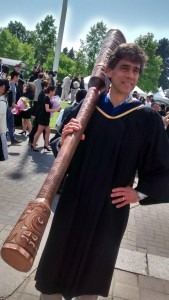
Dr. Thomas Lemieux, School of Economics, with UBC’s Mace at the May 2015 Convocation.
It is time to retire the macebearer, whose importance is inflated every year by the image’s presence on UBC’s graduation pages leading to Convocation. In pragmatic terms, if the mace falls into the hands of the wrong macebearer or manager at this point, someone’s liable to get clocked with it.
Is UBC’s mace still a respectable appendage to Convocation?
Remember, since that fateful November day in 1997, just five months into Martha Piper’s Presidency, when student activists put their bodies and minds on the line at the APEC protest, Tuum Est adorns both the can of mace sprayed in their eyes and the ceremonial mace that the President’s Office is eager to carry across campus every November and May.
Is it not time to retire the mace?
Comments Off on #UBC time to lay down the mace in graduation and governance #ubcnews #bced #highered
Posted in Academic freedom, Academic Labor, Accountability, BC Education, Budgets, Commentary, Critical University Studies, Faculty, Governance, Maces, Shared governance, Students, Working conditions
Tagged Academic freedom, Faculty, Global Warming, Governance, Protests, Students, University presidents, Working conditions