Several Hundred Students Strike at UMass-Amherst to Protest Fees and Voice Concerns

The Chronicle: Several Hundred Students Strike at UMass-Amherst to Protest Fees and Voice Concerns

Students at the University of Massachusetts at Amherst began a two-day strike on Thursday to protest what they see as administrators’ indifference to their concerns.

Undergraduates and graduate students planned the strike together. They stated four demands: a drop in student fees, more attention to diversity, the withdrawal of police officers from dormitories, and more student say in the use of campus space.

Quebec: Dawson students stage strike

The Gazette (Montreal): Dawson students stage strike

By the books, it was an ordinary day at Dawson College – if it weren’t for the clutch of picketers on the doorstep shouting “Free Education Now,” security guards keeping watch for interlopers, or the faculty members who cancelled classes or simply refused to cross the line.

Students at Dawson College kicked off an impromptu three-day strike yesterday, joining more than 40,000 university and CEGEP students from across the province who are boycotting classes to protest Quebec’s decision to boost tuition fees by $500 over the next five years.

Students mass in Montreal against tuition hikes

CBC: Students mass in Montreal against tuition hikes

About 1,000 students rallied in the rain Thursday in downtown Montreal to protest against Quebec’s decision to lift a long-standing freeze on tuition fees.

The protest capped three days of student strikes in Quebec.

College and university students walked out of classes this week to fight a $50 per semester tuition increase that came into effect this fall.

Asking for Input — Deliberately

Inside Higher Ed: Asking for Input — Deliberately

Among the 50 or so participants, some clearly came into Carnegie Mellon University’s deliberative poll on same-sex marriage Wednesday with a “gut feeling —- a perspective that they weren’t able to articulate a clear rationale for,” says Michael Bridges, associate director of educational support at the Eberly Center for Teaching Excellence and an adjunct professor of psychology at Carnegie Mellon.

The Conservative Pipeline Problem

Inside Higher Ed: The Conservative Pipeline Problem

Colleges have been increasingly competing to offer “family friendly” policies — in the hopes of attracting the best academic talent from a pool of Ph.D.’s that includes both more women than ever before as well as many men who take parenting responsibilities seriously. A new study suggests that such policies may be important for another group that believes its needs aren’t fully addressed in academe: conservatives.

The study — “Left Pipeline: Why Conservatives Don’t Get Doctorates” — argues that the much debated minority status for conservatives in higher education may be the result of differing priorities of graduating college seniors of different political persuasions. The study presents evidence that conservatives are significantly more likely than liberals — at the point when college students decide whether to apply to graduate school — to value raising a family and having money. In contrast, liberals at that point in their lives are significantly more likely to value writing original works.

U. of Michigan Pledges $30-Million for New Hires

The Chronicle News Blog: U. of Michigan Pledges $30-Million for New Hires

The University of Michigan at Ann Arbor plans to spend $30-million over the next five years on hiring 100 new tenure-track faculty members to lead interdisciplinary research and teaching in areas such as energy and environmental sustainability.

on distributed presence (and blogrolls)

From Creativity/Machine: on distributed presence (and blogrolls)

One of the things I find most interesting about the current proliferation and extensive uptake of various ’social media’ technologies, from RSS readers, to del.icio.us, facebook and twitter as well as weblogs themselves, is the decentralising effect that these technologies are having the ‘online presence’ of individuals, at the same time as these technologies are being adopted at scale. Put simply, there are more of us online, in more places. But is more really more?

British Prime Minister Says ‘Extremism’ on Campuses Remains a Top Concern

The Chronicle News Blog: British Prime Minister Says ‘Extremism’ on Campuses Remains a Top Concern

In a statement before Britain’s House of Commons today, Prime Minister Gordon Brown outlined measures designed, he said, “both to root out terrorism and to strengthen the resilience of communities to resist extreme influence.”

Concern has grown in Britain over the extent to which universities might be breeding grounds for extremist activity and recruiting. The prime minister’s speech cited the role of universities several times. The coming Counter Terrorism Bill will include “updated advice for universities on how to deal with extremism on the campus,” Mr. Brown said, adding that “the secretary for skills and the higher-education minister will invite universities to lead a debate on how we maintain academic freedom whilst ensuring that extremists can never stifle debate or impose their views.”

President of Columbia Is Criticized

The New York Time: President of Columbia Is Criticized

Lee C. Bollinger, the president of Columbia University, was confronted yesterday by discontented professors who gathered more than 100 faculty signatures for a document criticizing his leadership.

Their “statement of concern,” read to him at a faculty meeting, outlined a grab bag of charges, some relating to governance of the university and some concerning Middle East issues that have repeatedly troubled the campus, in particular his challenging introductory remarks when the Iranian president, Mahmoud Ahmadinejad, visited this fall.

Texas: UT panel recommends higher tuition

Austin American Statesman: UT panel recommends higher tuition

Officials say tuition increase is needed because of inadequate legislative appropriations.
Listen to this article or download audio file.

Dallas Morning News: UT-Austin proposes raising tuition by up to 22 percent over two years

Tuition and fees at the University of Texas at Austin could increase at least 13 percent over the next two years, adding hundreds of dollars to students’ bills, if a proposal submitted Tuesday is adopted.

California: UC weighs raises of 33% for all 10 chancellors

Sacramento Bee: UC weighs raises of 33% for all 10 chancellors

University of California regents are weighing a proposal to increase their top executives’ pay by an average of 33 percent over the next four years, beginning with salary hikes this year of between 13 and 17 percent.

The plan, which will be discussed in a closed committee meeting today, is drawing fire from critics who question the propriety of such increases in a tight budget year for the state.

College presidents cash in

Pittsburgh Post-Gazette: College presidents cash in on competition for talent

Think the highest paid college president in Pennsylvania wears a Nittany Lions cap, squeezes into a Panthers sweat shirt or enjoys a personal parking spot at the state’s only Ivy League school?

College presidents work in halls of higher earning

The Philadelphia Inquirer: College presidents work in halls of higher earning

Anyone thinking about a career change might want to consider university president, as salaries are rising rapidly at public and private institutions, according to a survey released today.

The region’s earning champ was James P. Gallagher, who stepped down from 3,200-student Philadelphia University in August with $2.6 million, the second-highest wage at a private university in the nation in 2005-06, the most recent year available.

That whopper of a payoff included $2.2 million in deferred compensation that accrued over five years, said Elizabeth Gemmill, chairman of the board of trustees.

Increased Compensation Puts More College Presidents in the Million-Dollar Club

prez190.jpgThe New York Times: Increased Compensation Puts More College Presidents in the Million-Dollar Club

Soaring compensation of university presidents, once limited to a few wealthy institutions, is becoming increasingly common, with the number of million-dollar pay packages at private institutions nearly doubling last year, and compensation at many public universities not far behind.

Presidents at 12 private universities received more than $1 million in the 2005-6 school year, the most recent period for which data on private institutions is available, up from seven a year earlier, according to an annual survey of presidential pay to be released today by The Chronicle of Higher Education. The number of private college presidents earning more than $500,000 reached 81, up from 70 a year earlier and just three a decade ago.

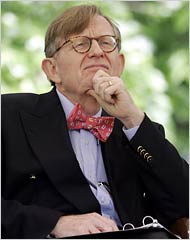
The survey also found that the number of public university presidents making $700,000 or more rose to eight in 2006-7, the reporting period for public institutions. Only two public university presidents made $700,000 in the previous period. The survey did not include E. Gordon Gee, who took over at Ohio State University earlier this year and whose $1 million pay package, before bonuses, is probably the highest of any public institution.

Make universities accountable for what matters

Houston Chronicle: Make universities accountable for what matters

Put higher education on the spot to show how well our students learn

By CHARLES MILLER and KEVIN CAREY

It’s an article of faith that free markets have given America the greatest higher education system in the world. Unlike K-12 schools, colleges and universities have to compete for students and resources. As a result, the thinking goes, we’re blessed with vibrant institutions that operate relatively free of government control and provide a crucial advantage in the global contest for economic supremacy.

Unfortunately, this is wrong on all counts. When it comes to their most important mission — helping students learn— American colleges and universities are badly underperforming and overpriced. That’s because they don’t operate in anything like a true free market. And the solution to this problem isn’t less government involvement, but a stronger role of a different kind.

Can colleges pass the test?

Baltimore Sun: Can colleges pass the test?
Standardized exams seek to track learning during students’ careers

College students in Maryland and across the country might soon be taking standardized tests to determine how much they’ve learned on campus – part of a national effort to hold universities accountable for student achievement.

An association representing more than 200 large public universities is expected to vote today to recommend that its member colleges adopt standardized tests and within four years begin to publish the results. A group representing another 400 colleges will take a similar vote this month.

A Campaign of Many Grievances

Inside Higher Ed: A Campaign of Many Grievances

The petition lists no grievances. It hasn’t been posted publicly. Almost half the school’s tenured faculty signed it, and it has one demand: the removal of the dean.

But if a sizable contingent backed the campaign, they seemingly did so for their own reasons. Beyond the united front of a single document lay festering resentments, damaged egos and genuine fear — enough fear that not even tenured professors were willing to speak for attribution. At Washington University in St. Louis, the effort to unseat Dean Mary Sansalone may have stalled, but it revealed discontent within the School of Engineering that some attributed to a lack of faculty input during strategic planning processes, others called sexism and supporters characterized as knee-jerk resistance to necessary change.

‘Scholarship in the Digital Age’

Inside Higher Ed: ‘Scholarship in the Digital Age’

It’s hard to meet academics these days whose work hasn’t been changed by the Internet. But even if everyone knows that the world of scholarship has changed, it’s not always clear just how or the way those evolutions fit into the broad history of scholarship. Christine L. Borgman sets out to do just that in Scholarship in the Digital Age: Information, Infrastructure and the Internet, just published by MIT Press. Borgman, a presidential chair in information studies at the University of California at Los Angeles, responded to e-mail questions about her book.

Reconsidering Retiree Health Benefits

Inside Higher Ed: Reconsidering Retiree Health Benefits

At a time when many colleges are concerned about the cost of paying for their employees’ post-retirement health care, Dartmouth College is floating a plan that would scale back existing coverage for some employees and eventually cut it altogether for others.

Professors and Politics (Again)

Inside Higher Ed: Professors and Politics (Again)

A month after the release of a study hailed by many as a definitive examination of faculty members’ political views, a slew of new research on the topic — some of it updated versions of previous research — will be released today finding (not surprisingly) that professors lean to the left.

Today’s research will be released as part of a day-long conference, “Reforming the Politically Correct University,” being held at the American Enterprise Institute. Two of the papers were released in advance and (judging from paper titles) they appear consistent with the theme of the conference that ideological diversity is in short supply in academe. The papers argue that the political imbalance in humanities and social sciences departments is large, growing and inappropriate. And one paper charges that “groupthink” is at work in ways that limit the opportunities for those who don’t share the leftist views of many other professors.