UC Irvine gave donor a say in dean selection

Los Angeles Times: UC Irvine gave Bren a say in dean selection

UC Irvine gave Orange County billionaire Donald Bren the right to be consulted in the selection of a dean for its new law school in return for his $20-million donation, according to documents released to The Times on Thursday.

Survey Finds Today’s Students Are More Civically Engaged but Are Ambivalent About Politics

Inside Higher Ed: Millennials, Unspun
http://www.insidehighered.com/news/2007/11/08/civic

The report, from the Center for Information and Research on Civic Learning and Engagement (CIRCLE), which studies civic engagement among young people, suggests that students are tired of partisanship and “spin,” are wary of the political process in general and tend to distrust the overwhelming array of media sources that vie for their attention.

The Chronicle of Higher Education
Today’s Students Are More Civically Engaged but Are Ambivalent About Politics, Report Finds
http://chronicle.com/daily/2007/11/635n.htm

Young people entering college today— most of whom are part of the so-called Millennial Generation born after 1985— are neither cynical nor highly individualistic, according to a new report released on Wednesday. Compared to their predecessors, Generation X, the Millennials are more likely to volunteer and be involved in social issues, researchers found.

The report, “Millennials Talk Politics: A Study of College Student Political Engagement,” is based on a study conducted by the Center for Information & Research on Civic Learning & Engagement, in collaboration with the Charles F. Kettering Foundation. The study examined the barriers to political engagement that young people face.

The authors of the report conducted focus groups with nearly 400 students on a dozen four-year campuses, including Bowdoin College, Kansas State University, and the University of New Mexico. They also conducted a written survey and drew on a national telephone survey.

Northwestern sets up in Qatar

Inside Higher Ed: Northwestern University has become the latest American institution to set up shop in Qatar’s Education City. Northwestern will offer undergraduate degrees in communication and journalism, starting in the fall of 2008.

CSU students not ready to make nice – and they don’t have to

San Francisco Chronicle: CSU students not ready to make nice – and they don’t have to

The 417,000 students at California State University’s 28 campuses are expected to be civil to one another, the university says in its policy manual.

It sounds innocuous – but a federal magistrate says it’s an unconstitutional restriction on speech when the policy is used to investigate or discipline students, such as the College Republicans whose members stomped on two flags bearing the name of Allah during an anti-terrorism rally at San Francisco State last year.

“It might be fine for the university to say, ‘Hey, we hope you folks are civil to one another,’ ” U.S. Magistrate Wayne Brazil said last week at a hearing in his Oakland courtroom. “But it’s not fine for the university to say, ‘If you’re not civil, whatever that means, we’re going to punish you.’ “

Anthropology Association Formally Disapproves of Military Program

The Chronicle News Blog: Anthropology Association Formally Disapproves of Military Program

The executive board of the American Anthropological Association has released a statement that “expresses its disapproval” of a year-old U.S. Army program known as the Human Terrain System, which sends anthropologists and other social scientists to advise military units in Afghanistan and Iraq.

Britain Begins New Security Checks for Some Foreign Students

The Chronicle News Blog: Britain Begins New Security Checks for Some Foreign Students

Under a new screening program that went into effect in Britain last week, graduate students from outside the European Union and the European Economic Area must obtain a special security clearance before applying for a visa if their field of study falls within one of the 41 disciplines that the government has deemed “sensitive subjects.” Those include science, engineering, or technology-related disciplines, such as aerospace engineering, metallurgy, veterinary sciences, and agriculture.

You’re Not Fooling Anyone

The Chronicle: You’re Not Fooling Anyone

Holden Caulfield used to hunt phonies a few blocks from here, but times have changed. Now the phonies — or people who think they are, anyway — hunt themselves.

Case in point: On a recent evening, Columbia University held a well-attended workshop for young academics who feel like frauds.

These were duly vetted, highly successful scholars who nonetheless live in creeping fear of being found out. Exposed. Sent packing.

If that sounds familiar, you may have the impostor syndrome. In psychological terms, that’s a cognitive distortion that prevents a person from internalizing any sense of accomplishment.

Deal to Save Antioch College Hits Snags, as Some Donors Balk

The Chronicle: Deal to Save Antioch College Hits Snags, as Some Donors Balk

Some of the key players crucial to the plan to keep Antioch College from closing in June— alumni who have pledged millions to the cause— are balking at the deal that their association’s leaders reached with the college’s governing board late last week.

The donors say the agreement announced with great fanfare on Saturday does not give the historic liberal-arts college in Yellow Springs, Ohio, adequate independence within the overall structure of Antioch University, of which it is part. Such independence was a condition of their giving the money, they say. The college is the only residential campus within the university, whose five other campuses specialize in adult education.

UK universities rise up rankings

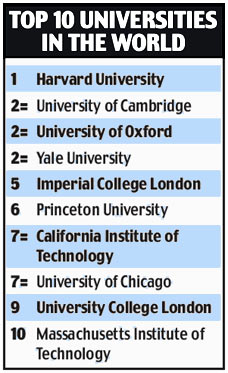
TopTenUni_228x373.jpgDaily Mail: Oxbridge closing on Harvard as world’s top university

Oxford and Cambridge tie for second place in global university rankings published today.

America’s Harvard remains the top-ranked institution, though its lead was slashed.

Britain now has four universities in the Top Ten and 32 in the top 200 – our best showing since the tables began four years ago.

BBC: UK universities rise up rankings

Britain’s performance in a league table of the world’s top universities has improved, but the US still dominates.

Four of the top 10 are British and the rest American. Harvard is top and Yale, Oxford and Cambridge joint second.

University College London breaks into the top 10 for the first time and Imperial College London rises to fifth.

Gunfire Erupts at Venezuela University

examiner.com: Gunfire Erupts at Venezuela University

Masked gunmen opened fire on students returning from a march in which tens of thousands of Venezuelans denounced President Hugo Chavez’s attempts to expand his power through constitutional changes.

Officials said at least eight people were injured Wednesday, including one by gunfire, at the Central University of Venezuela, or UCV – the country’s largest university.

Universities need to embrace global strategies

Richmond Times-Dispatch: Universities need to embrace global strategies

American universities need to adopt a world outlook to thrive, VCU President Eugene P. Trani says.

In the new millennium, a convergence of unprecedented dynamics has catapulted international expertise from the status of merely important to unquestionably vital.

“You’ve got to have a global strategy in the 21st century,” Trani told the World Affairs Council of Greater Richmond yesterday.

Maryland: Payroll Failure At BCCC Leaves Many Teachers Without Pay For 10 Weeks

City Paper: Lessons in Frustration

Payroll Failure At BCCC Leaves Many Teachers Without Pay For 10 Weeks

For ace student and part-time fashion design teacher Meredith Page, Baltimore City Community College seemed like a great opportunity to teach and encourage young women less fortunate than herself.

But after going 10 weeks recently without a contract or pay, Page says she’s fed up after just a year and a half on the job.

“This is the third semester in a row I haven’t been paid on time,” she says. “There’s a different excuse every week. I have a mortgage and bills to pay. The school doesn’t care.”

French students protest reforms

The Boston Globe: French students protest reforms

PARIS –French university students angry over a law making their schools more market-friendly have shut down classes at several campuses across France and are mobilizing to join nationwide protests later this month over President Nicolas Sarkozy’s reforms.

Cal State Faulted on Executive Pay

Inside Higher Ed: he California state auditor on Tuesday released a report calling for the California State University to tighten control over executive compensation. The system lacks effective monitoring procedures and a clearly justified methodology for determining some salaries, adding that some employees had received “questionable compensation.” The system issued a statement noting that the audit did not identify violations of policy. However, the system also pledged to try to carry out the recommendations of the audit.

A Friendly Reminder (on P2P)

Inside Higher Ed: A Friendly Reminder

Could students possibly be making themselves vulnerable to lawsuits from the recording industry — without knowing it?

The University of Michigan thinks they might. And just to be sure, it rolled out a service last week that automatically informs students living in residence halls if they’re uploading files via peer-to-peer technology. The service, called BAYU (for Be Aware You’re Uploading), is being described by officials as an educational tool that keeps students aware of their online activity.

‘Fundamentally Inconsistent’ With University Values

Inside Higher Ed: ‘Fundamentally Inconsistent’ With University Values

Organizers of the Academy on Capitalism and Limited Government Fund hoped to turn their new program at the University of Illinois at Urbana-Champaign into a Hoover Institution of the Midwest, a model for getting more free market ideals and ideological diversity into major research universities.

But when a faculty committee was able to get all the details of the agreement that created the new center, it found provisions that were “fundamentally inconsistent” with university values that are designed to ensure a diversity of views. Specifically, the panel found that portions of the agreement would have restricted funds to research designed to reflect certain points of view, and that donors were given control over matters traditionally left to academics.

The Partisan Battle Over Academic Freedom

The Chronicle:

CRITICAL MASS
The Partisan Battle Over Academic Freedom

Citing a pattern of outside interest groups aggressively seeking to impose their influence on recent collegiate hiring and tenure decisions, five prominent professors have formed the Ad Hoc Committee to Defend the University. They are circulating an online petition that takes explicit aim at “groups portraying themselves as defenders of Israel,” which, the committee alleges, are disseminating “unfounded insinuations and allegations … of anti-Semitism” and pressuring university administrations by threatening to withhold donations. “The future of higher education in America, its role in our country’s democracy, and its contribution to world affairs is at stake,” the petition concludes. Within one week of appearing on the Web, the appeal had garnered nearly 300 signatures from academics across the country. But in terms of online buzz, most of the reaction was provided by critics who dismissed the committee’s petition as adding to the problem. One more example of how partisan the issue of academic freedom has recently become:

The petition: In recent years, universities across the country have been targeted by outside groups seeking to influence what is taught and who can teach. To achieve their political agendas, these groups have defamed scholars, pressured administrators, and tried to bypass or subvert established procedures of academic governance. As a consequence, faculty have been denied jobs or tenure, and scholars have been denied public platforms from which to share their viewpoints. This violates an important principle of scholarship, the free exchange of ideas, subjecting them to ideological and political tests. These attacks threaten academic freedom and the core mission of institutions of higher education in a democratic society. (Ad Hoc Committee to Defend the University)

“The New York Sun” Editorial Board: Defend the university from what? According to the petition, the threat from which the university — actually, not only the university, but, the petition claims, “the future of democratic society” — requires a defense consists of “groups portraying themselves as defenders of Israel.” The petition portrays these groups not as like Senator McCarthy’s anti-Communism, but worse.

The double standards show what the Ad Hoc Committee — led by, among others, a former provost of Columbia University — really has in mind. The professors say they are in favor of “the free exchange of ideas” and against “ideological and political tests,” but among the signers of the petition are two scholars, Everett Mendelsohn and J. Lorand Matory of Harvard University, who led the fight to oust Harvard’s president, Lawrence Summers, for his sins of speaking out in favor of America and Israel. They say they are against “outside groups seeking to influence what is taught,” but they raise not a peep against the tens of millions of dollars pouring into American universities from Saudi princes and Persian Gulf governments that are hostile to Israel. The only “outside groups” the Ad Hoc Committee is worked up about are those friendly to Israel. Those groups include alumni, parents, students, trustees, and professors, so it is hard for us to see the logic to denying them a voice in what happens on campus. What was that about the “free exchange of ideas,” again? (The New York Sun)

Harvey Silvergate, Foundation for Individual Rights in Education: The Committee, led Joan Wallach Scott, a history professor at Princeton, has already voiced its opinion on quite a few academic-freedom controversies, and, so far, they’ve always come out pretty much on the right side, in my view. When St. Thomas University canceled a speech by critic of Israel and Nobel laureate Archbishop Desmond Tutu, members of the Committee rallied behind the censored clergyman. And when the pro-Israel group StandWithUs convinced the University of Michigan press to stop publishing a book called Overcoming Zionism, the Committee helped convince Michigan to change its mind, arguing persuasively against these “efforts to broaden definitions of anti-Semitism to include scholarship and teaching that is critical of U.S. foreign policy in the Middle East and of Israel.”

So what’s the problem, then? As you can see, all of these controversies involve censorship of anti-Israel speakers. In order for me to take this group seriously, it first needs to defend the academic freedom of someone whose speech doesn’t fit neatly into the limited range of politically acceptable (or, as some prefer to say, politically correct) viewpoints prevalent on most campuses. The Committee stood behind Tutu, a liberal darling, but where was it when the Regents of the University of California nixed a speaking invitation to former Harvard University president and secretary of the treasury Lawrence Summers because of complaints from a handful of leftist postmodernist professors? (The Free for All, The Phoenix)

Chris Goff, AFT Higher Education: While the petition places a particular focus on the ideological campaigns against scholars who study the Middle East (and not without good reason), we should stress that the worthwhile ideals advocated by the statement’s authors apply to all scholars, regardless of their theoretical, methodological, or political stances. Seeking to curtail a researcher’s academic freedom — wherever the attack originates from on the ideological perspective — is never acceptable. (Free Exchange on Campus)

Anne D. Neal, American Council of Trustees and Alumni: The Com-mittee’s often hysterical rhetoric is amenable to analysis, and tells us a lot about what is motivating those who espouse it. The fact that so many academics continue to refuse to respond to reasonable calls for accountability underscores the depth of the problem and the urgent need to expose their self-serving arguments. (Phi Beta Cons, National Review Online)

Erin O’Connor, University of Pennsylvania: In exchange for exceptional autonomy, academics are charged with teaching and researching in a manner that is consistent with the disinterested pursuit of truth. They are also charged with maintaining a responsible system of self-governance that guarantees the integrity of the curriculum as well as decisions about hiring and promotion. They have failed, repeatedly and publicly, to keep their end of the bargain implicit in academic freedom. (ACTA Online)

SOURCES CITED IN THIS COLUMN

ACTA Online

Ad Hoc Committee to Defend the University

Free Exchange on Campus

The Free for All, The Phoenix

The New York Sun

Phi Beta Cons, National Review Online

http://chronicle.com

Section: The Chronicle Review
Volume 54, Issue 11, Page B4

France: University students angry over reforms disrupt classes

International Herald Tribune: University students angry over reforms disrupt classes

French university students angry over a law making their schools more market-friendly have shut down classes at several campuses across France and are mobilizing to join nationwide protests later this month over President Nicolas Sarkozy’s reforms.

For the past week, students have disrupted classes, at least sporadically, at about 10 campuses, from Montpellier and Toulouse in the south to Rennes in the west and the Tolbiac campus of the University of Paris, according to the Education Ministry.

The reforms, passed by lawmakers in August, will make all state-run French universities independent within five years, granting them the right to control their own budgets, raise tuition and accept private donations. Proponents believe the law will make French graduates more competitive in the global marketplace by improving facilities and reducing university dropout rates.

Israel: For education’s sake

Haaretz Editorial: For education’s sake

The teachers who have been demonstrating for more than three weeks at major intersections throughout the country in order to protest the education situation have recently encountered something new: Parents, high-school students, university students and many others have been joining them to show solidarity.

Bulgarian teachers end 6-week strike

UPI: Bulgarian teachers end 6-week strike

A union leader said teachers in Bulgaria’s state-run schools ended a six-week strike Monday after reaching a compromise that includes a 46 percent pay raise.

Teachers’ union leader Krum Krumov said the government of Prime Minister Sergei Stanishev couldn’t agree on a 100-percent salary hike demanded by striking teachers as that much money wouldn’t be available in the state budget next year, the Bulgarian News Network reported Monday.

Krumov said the teachers accepted the 46 percent monthly salary hike that should be reached by mid-2008.