Categories
Research Themed Sessions

Who knows what, when? Current and desired capacities for online journal statistics gathering and dissemination: The Session Blog

Friday, July 10, 2009 @ 9:30
SFU Harbour Centre (Earl & Jennie Lohn Rm 7000)

Presenters:

Andrea Kosavic (Digital Initiatives Librarian at York University)

James MacGregor (PKP Associate)

Session Overview

Session Abstract

James MacGregor and Andrea Kosavic outline their efforts to provide a suitable recommendation to Synergies Canada on what they should provide in terms of statistics and to whom based on a survey of current and desired practices in online journals. Kosavic explained that her interest in participating in this study stemmed from having multiple statistics requests at once at York and being overwhelmed by the lack of a streamlined method of reporting this information.

Commentary

In trying to establish a recommendation to Synergies Canada regarding what statistics should be collected and shared, Kosavic and MacGregor proceeded to:

1) establish what is currently supported or lacking.
2) survey journals and repository holders to see what they actually need.
3) draw up recommendations.
Using Open Journal Systems (“OJS”) and Erudit Consortium as targets for recommendations, the following was initially noted:

–    they do not share common statistics collection;
–    both can capture the number of items viewed per month (with the help of external software);
–    other statistics are difficult to capture; and
–    both have reporting functionalities.

Key questions were asked of respondents in order to frame findings with 75% of respondents claimed that their current statistics collecting solution was not satisfactory.

Key findings include:

–    51% of OJS users utilize the built in reporting tool.
–    30% of respondents use 2 or more tools.
–    Identifiying the number of “unique visitors” was deemed the most important statistic.
–    Web pages accessed and page clicks were identified as the most collected statistics.
–    RSS feed information was identified as the least collected statistic.
–    Statistic collection ranged from monthly to quarterly to yearly with no significant majority.

In regards to the sharing of statistical information, the survey indicates that a significant gap exists between who journals are currently sharing statistics with and who they anticipate sharing statistics with.

Kosavic and MacGregor learned that there appeared to be no ideal statistical management system. The speakers were asked by someone in the audience about whether or not it will be possible to tell whether or not an end user is actually reading an article and if so, how much and what is being cited (if anything). MacGregor explained that this statistic was not collected and that there is currently no way to track this information; another member of the audience compared it to trying to be able to track how much of a book a library patron read. Ultimately this would be ideal to be able to track but unrealistic in the near future. It was also noted that referrer statistics were not included in the survey, that is, information related to how viewers came to find a journal site/article.

Recommendations for statistical gathering and disseminating:

–    should standardize on 3rd party reporting across all nodes;
–    use SUSHI protocol to collect statistics;
–    implement COUNTER protocol to collect statistics;
–    extend COUNTER to cover other Synergies items.

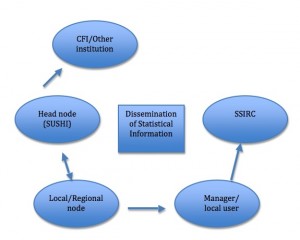
At different points in the presentation, MacGregor showed a different visual representation based on his gradually refining understanding of current and desired capabilities and the flow of statistical dissemination. This was helpful in demonstrating that initially there were many complicated methods of statistic collection and possibilities but eventually, with greater understanding, MacGregor was able to illustrate an easy to understanding model for statistic management.
statistics

(Figure 1.0 – Final visual representation representing a steamlined view of the dissemination of statistical information)

Stakeholders, statistics desired and relevant protocols have been identified and the final report is in the process of being completed.

Related Links

Synergies Canada

Erudit Publishing Consortium

OJS – Journal List

Categories
Editor-Themed Sessions

Open access journals copyright policies: an analysis of the information available to prospective authors: The Session Blog

Thursday, July 9, 2009 @ 11:30
SFU Harbour Centre (Earl & Jennie Lohn Rm 7000)

Presenter:

couture

(Source)

Marc Couture (Science & Technology professor at Tele-université: Université du Quebec à Montréal’s distance education component)

Session Overview

Session Abstract

Marc Couture presents his research findings about the availability of copyright policies on open access journals. He addresses the assumptions about copyright, the statistics related to his study and recommends a framework for publishers to use with respect to making copyright decisions that take into account the best interests of both the author and publisher.

Commentary

Couture urges authors to become aware of the copyright policies associated with the journals they are interested being published in. He establishes some basic assumptions he operates on about copyright prior to his research including: copyright is important to authors, the deal between the author and publisher involved in publishing an article must be legally and ethically fair and that the interests of the journal, the author and the end-user (the reader of the article) must be equally taken into account.

Research

The guiding question for Couture’s research was “where can information on copyright be found on open access journals websites?” Specifically, Couture was looking to see if a prospective author can infer from the website who will keep copyright, what rights the author will retain and what permissions will be given to end-users. 300 journals (representing 251 publishers) from the DOAJ list were randomly selected and scoured for any form of copyright that could include statements, Creative Commons (“CC”) licenses, transfer/license forms etc. Key results indicate that copyright information was not easy to find – 9% of journals did not have copyright information and 63% of journals had copyright information buried on an “other page” (ie. not a home page or specific copyright page). Additionally, copyright policy was not consistent across journals; something that prospective authors need to be acutely aware of.

Couture points to the relevant issue of semantics in relation to copyright statements. He identifies key words found in copyright statements ranging from ambiguous terms, such as “make available” and “copy” to more precise terms, such as “photocopy” and “display publicly”. “Use” is the umbrella term that envelops all terms and copyright statements that rely on “use” to direct the reader are clearly poorly defined. An example from a copyright statement is given:

“the full text of articles can only be used for personal or educational purposes?”

The uncertainty that lies within the statement is demonstrated in attempting to answer two questions

–    Can a teacher post the article on his website?
–    Can an engineer working in a company distribute printed copies of the article to her team member?

In addition to the ambiguity of specific words, Couture points out that too many words is no better than too few words.  Another factor that requires clarification is whether or not everything that is not explicitly forbidden is permitted. Couture poses this question as an example to publishers that if their exact intentions are not stated, prospective authors and end users might derive incorrect assumptions about copyright.

Proposal

As a result of his research, Couture wanted to create a proposal that would define the outline of a software tool which could help a journal by generating, through a series of inputs, a clear and unambiguous statement indicating copyright policy that could be add to a website.  The key, he says, is generating simple text that is aimed at authors and end users. This is a work in progress and Couture would like to see the publisher approach the grid from the viewpoint of “what do I want as a publisher?” rather than “what do I want to forbid the author from doing?”.

The exact content of copyright policies are investigated and Couture notes that about half of the journals require a transfer of ownership from the author to the publisher. This leads to Couture’s secondary motive – establishing the divide that exists between the desires of authors with regards to copyright and the reality of publishing. Couture would like to see what he refers to as “fair practices” whereby there is no transfer of copyright, no more rights than required are granted to the publisher and broad end user permissions are in place (in the form of CC licenses).

Couture’s presentation makes it clear that the copyright policies of open access journals lack a common sense of purpose or consistency and that publishers should make copyright clarification a priority.

Related Links

Article – “The facts about Open Access”

Directory of open access journals

Related Reading

Hoorn, E., & van der Graaf, M. (2005). Towards good practices of copyright in Open Access Journals. A study among authors of articles in Open Access journals. Pleiade Management & Consultancy.

Categories
Library-Themed Sessions

Legal Deposit at Library and Archives Canada and development of a Trusted Digital Repository: The Session Blog

Thursday, July 9, 2009 @9:30
SFU Harbour Centre (Sauder Industries Rm 2270)

Presenters:

Pam Armstrong (Manager of the Digital Preservation Office at Library and Archives Canada and Business Lead of the LAC Trusted Digital Repository Project)

Susan Haigh (Manager of the Digital Office of Published Heritage at Library and Archives Canada)

Session Overview

Session Abstract

Pam Armstrong and Susan Haigh succinctly present the aims of and current progress of Library and Archives Canada’s Trusted Digital Repository and Legal Deposit.

Commentary

Pam Armstrong reviewed the Library and Archives Canada (“LAC”) Trusted Digital Repository (“TDR”) project currently underway. Two key aspects of the project were identified as the building component (of the necessary infrastructure) and the business component (the workflow and efficiencies associated with it). Current projects with the TDR include creating a digital format registry, establishing threat risk assessment, establishing effective communications strategies and establishing a storage policy for data. Armstrong points to collaboration as the key to facing the challenges of preserving the digital heritage of Canadians which, given the amount of collaborators involved, is crucial in ensuring the integrity of preservation. Additionally, Armstrong suggests that the TDR brings a corporate approach to digital preservation due to the requirement of having content providers register online. The logistics of the TDR are displayed in a framework illustrating the structured flow of data. Data goes through a quarantine zone then to a virtual loading dock (where it is, among other things, scanned for viruses, decrypted and validated) then to staff processing (where metadata is enhanced) then in to a metadata management system and finally to an access zone. Ultimately, it appears that the TDR will not only organize and preserve data but it will also make it more accessible to Canadians through the world wide web.

Susan Haigh reviewed the mandates of the Library and Archives Canada Act and broke down the logistics of the Virtual Loading Dock (“VLD”) that exists within the Legal Deposit side of the electronic collections. Haigh highlighted the LAC mandate as the preservation of documentary heritage of Canadians through acquisition and preservation of publications at any cost. She identifies the VLD as an effective tool to do so that requires publishers to adhere to a law obliging them to deposit two copies of a publication and its contents in cryptic form along with any metadata in the VLD. This puts the onus of responsibility on the publisher, though Haigh forwards this with “theoretically” indicating that it is not yet as streamlined as it could be.  Simply put, the VLD is part of a drive to build an accessible and comprehensible electronic collection. As a result of this collaborative effort since 1994, there are over 60,000 titles (monographs, serials and websites) and over 150,000 journal issues housed in the Legal Deposit. Open source software is called up in LAC projects including Heritrix, an open source archival software, which is used to acquire domains associated with the federal, provincial and territorial governments as well as Olympic Games domains.

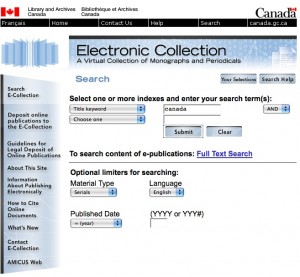
Front page of LAC's Electronic Collection (public access)
Front page of LAC’s Electronic Collection

(Source)

The VLD was conceived as a pilot project in an effort to make the electronic collections at LAC more efficient. This software-based approach had several aims including to test methodologies and to learn technical and operational details about the workflow related to the intake of electronic materials of various types. As is the nature of a pilot project, LAC learned many lessons about the VLD that will ensure adjustments will be made in the future to make archival of materials even more efficient. Lessons learned include the need for distinct ISBN’s for digital editions, the need to have the bugs worked out of JHOVE with respect to large PDF files and a need to tweak the functionality for publisher registration. Haigh indicated that this first release of the VLD was very useful in raising an understanding of the importance of functionality for metadata capture by making sure it is efficient and clear to publishers.

Moving to the future, LAC will begin to test serials as well as all transfer methods associated with the Legal Deposit. Additionally, LAC will explore two important questions related to preservation:

1.    How do we capture Canadian OJS journals for legal deposit and preservation purposes?
2.    How can LAC and the Can OJS community collaborate?

As for access, it is clear that the goal of the TDR is to provide access but I would be interested to see statistics regarding who is actually accessing the materials from the LAC (ie. mostly the academic community or individuals for personal purposes). In keeping within the confines of copyright, Armstrong notes that rights associated with content as dictated by the publisher will be reflected in terms of access.

Related Links

Library and Archives Canada – Official Site

Library and Archives Canada Act

Library and Archives Canada – Trusted Digital Repository Project

Library and Archives Canada – Legal Deposit

Library and Archives Canada – Electronic Collection

Article – “Attributes of a Trusted Digital Repository: Meeting the Needs of Research Resources”

Spam prevention powered by Akismet