This year marks the bicentennial of Darwin’s birthday, and the sesquicentennial of the publication of “The Origin of Species”. 2009 also marks the 20th anniversary of the invention of the Web by Tim Berners-Lee. These momentous occasions provide a fitting opportunity to reflect on how the conception of scholarly communication and scientific discoveries have evolved from the time of Darwin to the present. Using the publication of “The Origin” and the subsequent acceptance of the theory of evolution as a case study, we look at how new knowledge was formalized from the vast amount of data collected by Darwin, his prodigious private correspondence and personal notebooks, into the public record in the form of books, journal articles, and public lectures. I argue that just as evolution provides an overarching and coherent framework for organizing and making sense of biological diversity, the Web and open access are providing unprecedented opportunities for the framing and reframing of scholarly inquires, and calling into question the nature of authority in the knowledge production process. I will provide examples to show that just as species are mutable, so too are knowledge domains, authority, and disciplinary boundaries in the open and generative web environment.
A vast amount of scholarly journals are edited in the countries of Latin America and the Iberian Peninsula, altogether providing a rich picture of the scientific production in these countries. However, these journals have traditionally not been part of the international mainstream. Different solutions have been sought to increase their access and visibility, using both existing information systems and developing new systems tailored to the needs of the region.
A detailed analysis is made of the presence of Ibero-American journals in the international information scene, and of the efforts to increase their visibility by editors and publishing institutions. Further, an account is presented of the major online information systems developed in the region. The main features of these systems are discussed (including search facilities and free access to journal contents), and how they have influenced editorial practices throughout the region.
Some conclusions are drawn on the challenges that Ibero-American journals face as they seek to strengthen their presence in the international scene.
Click the link below to load the video archive of the plenary session.
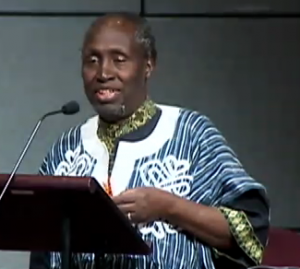
The contours of the geography of science and scholarship have been changing and the change is likely to be even more pronounced in the years to come. The dominance of the advanced countries of the West is eroding and the erstwhile colonies are no longer content to remain hunting grounds for safari science. Some of them are unwilling to play second fiddle to science in the advanced countries any longer and want to be equal partners.
The need for science to be performed everywhere and take roots in all countries is now well recognized.
The toll-access journal system that was set up some 350 years ago and which has served well till a few decades ago evolved, for historical reasons, largely to serve the needs of North-North knowledge exchange and have failed to take cognizance of the aspirations of the South. In addition, the spiraling costs of journal subscriptions have effectively locked researchers from the South out of access to new knowledge and the much-needed international dialogue, thus making the notion of universality of knowledge and science a distant ideal and not a practicable goal.
Even advocates of open access do not fully recognize how important it is today for scientists in the North to learn about developments in the South. The value of South-to-North flow of knowledge was well demonstrated by what happened during medical disasters such as avian flu and swine flu when speedy exchange of not only research results but also research data enabled dealing with the disasters quickly.
Open access to knowledge is not merely important in science but also in development. Organizations such as IDRC and to some extent DFID support open access to all the reports from development projects they support.
If OA is so very important to the South, why is the progress slow? While computers, internet access and bandwidths continue to pose problem in a number of southern countries, in general the situation is improving. The more importan factor is scientists’ apathy. Scientists in the South, by and large, do not exercise their rights to the full; often they give away on a platter copyright to their research papers to journal publishers. The publishers themselves indulge in practices that would entice publishing scientists and librarians to act in ways that would benefit the publishers. Funding agencies and goverments of southern countries are not as proactive as they should be.
Focused advocacy on the advantages of the public commons approach can bring about some revolutionary changes. Such advocacy should be aimed at all levels of stakeholders. Some examples of what is being done in India will be presented.
Click the link below to load the video archive of the plenary session.
This paper introduces a new journal Scholarly and Research Communication. It does so against a background of the desire to maximize the dissemination and impact of research, a goal that complements public investment in research. The paper reviews developments in commercial publishing with special emphasis on the emerging legal relationships between publishers authors and users. Second, it provide an overview of developments in non-commercial scholarly publishing – where things now stand. Third, it identifies what I see as a needed rationalization of functions. Fourth, it introduces to you Scholarly and Research Communication as a venue for research and technical inquiry.
Click the link below to load the video archive of the plenary session.
Information technology is increasingly making the notion of a global village and shared global culture a reality. At the same time, the domination of the world by a few languages, mostly western, has meant the exclusion of large number of languages from a global conversation. Publishing which has always been so central in national conversations and cultures can play a similar role in global conversation among cultures big and small. This means utilizing the possibilities opened by new technologies to bring knowledge and scholarship in marginalized languages out of the shadows so that they can contribute to the common light of global knowledge.
Click the link below to load the video archive of the plenary session.
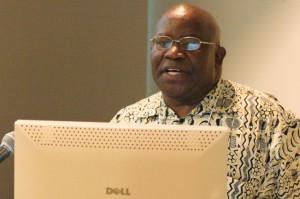
Ezra Ondari-Okemwa, Senior Lecturer and Head, Department of Library and Information Sciences, University of Fort Hare, South Africa.
Session Overview
Photo: J. Miller - PKP Conference
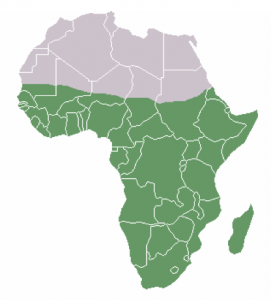
Dr. Ondari-Okemwa introduced his talk by explaining that his research specifically focused upon the sub-Saharan region of Africa during its most productive period in terms of knowledge production, 1996-2007. The level of scholarly publication in sub-Saharan Africa is of critical importance, as this activity enables scholars to share what they know with their peers within the region. Such activity, researchers in sub-Saharan Africa can create new knowledge rather than only relying on scholarly research that emanates from the developed world.
A map showing the boundaries of sub-Saharan Africa – South of the Sahara Desert
Ondari-Okemwa’s called into question the accuracy of indicators of scholarly publication from sources such as Thomson Reuters as its data focuses predominantly upon publications from North America, Europe as well as publications in the English language. He also identified that knowledge production was not uniform and took at least two dominant modes, only one of which benefited from the funding sources typically available to African researchers. The first mode of knowledge production is a linear one, one that is almost exclusively academic, investigator focused and discipline based. This mode of knowledge production leans heavily on scholarly publication. The second mode, one that started to emerge in the mid-twentieth century is far more context and problem-focused, with an interdisciplinary and reflexive orientation. This mode leans more towards the types of knowledge production we see in emerging interdisciplinary academic disciplines such as Developmental Studies, Knowledge Management and Gender Studies. This latter mode, seems particularly under-represented in the data on sub-Saharan African scholarly production, in part because funding sources are less likely to be found for such research in the social sciences than, in say, Medicine or Science. As such, the majority of the scholarly publications that were published during the time-period of the study (1996-2007) show a strong emphasis on science-based disciplines. Other disciplines were not widely represented.
Ondari-Okemwa also spoke to the potential benefits of Open Access and electronic journals in the context of scholarly activities in sub-Saharan Africa, specifically, and in Africa in general. Without question, the availability of such resources has had a positive impact on the research connections between the leading institutions. Such resources can be readily and exhaustively searched, readers can quickly move from citations to the cited works themselves with a single click, and the full range of bibliographic references are easily available and retrievable. However, a general state of technological deprivation in sub-Saharan Africa excludes most scholars from contributing to knowledge production in the region.
Ondari-Okemwa identified several key hurdles to scholarly publishing and knowledge production in Sub-Saharan Africa:
There is little or no use of locally produced knowledge
Invisibility of scholarly publications emanating from sub-Saharan Africa
Technological hurdles such as poor Internet connectivity and low teledensity
According to Ondari-Okemwa, governments in sub-Saharan Africa need to address issues such as low and eroding salaries, social unrest and political conflicts including war, to address the reasons why so many people leave the region. In concluding, Ondari-Okemwa acknowledged the many strategic challenges facing most institutions of research and learning in sub-Saharan Africa, but felt strongly that steps needed to be taken to ensure higher rates of production of knowledge. These local scholars must play a role in this as they are best-placed to produce such knowledge about the region.
Question period
During the question period, several issues raised by the audience focused upon infrastructure challenges within African universities and the pressure upon scholars within those institutions to conduct their research in areas of interest to the developed world. Many in the room made reference back to the hurdles to scholarly publishing earlier mentioned by Ondari-Okemwa and to the fact that connectivity is a critically important factor that is limiting the possibilities for universities throughout Africa to engage more fully in research activities. With respect to funding for research, one audience member questioned whether or not the World Bank model of development really calls for the production of new knowledge from African countries. More often, it seems to narrowly task universities to reproduce existing research and to focus instead on increasing numbers of graduates in areas that align with its definitions of economic growth in the region. Ondari-Okemwa acknowledged that universities were increasingly being asked by government to shift to the mass production of graduates. The universities are caught up in a struggle with increasing enrolments without a concomitant increase in funding sources, and this results in fewer opportunities for scholars to focus on research activities.
Another issue that came up during the question period concerned the invisibility of many African scholarly journals. There are hundreds of journals that are not online and not visible being hidden within institutions and only available to a limited number of scholars and readers. Ondari-Okemwa responded by saying that it will be difficult to change this situation, though initiatives like African Journals Online is helping to make African journals more visible.
Launched in May, 2008, The Open Humanities Press (OHP) is a scholar -led open access publishing initiative that currently publishes 10 journals. Central to OHP’s vision are goals articulated by the Budapest Open Access declaration (2002) to remove barriers to scholarly literature, accelerate research, enrich education and share the learning of the rich world with the poor.
Session Overview
Photo: J. Miller - PKP Conference
Barbara Cohen started the session with what she called “Open Access 101”, a quick survey of some basic principles and recent initiatives focused on ideas of giving free and open access to peer-reviewed scholarly literature on the Internet. This background is important context to consider in relation to the principles and goals driving The Open Humanities Press (OHP), an open access publishing house that launched in 2008 with 7 journals (now 10). Central to OHP’s vision are goals articulated by the Budapest Open Access declaration (2002) to remove barriers to scholarly literature, accelerate research, enrich education and share the learning of the rich world with the poor. Cohen went on to note that despite the fact that most scholars prefer to read electronic copies of articles, the Internet is still perceived by many Humanties scholars as being an unsuitable publishing medium for serious humanities research. In a 2008 talk at Irvine, Sigi Jӧttkandt, one of the co-founders of the OHP, characterized this perception where the Internet was seen as “a sort of open free-for-all of publishing” medium in stark contrast to trusted, peer-reviewed paper-based scholarly journals. The OHP was envisioned as a means to overcome this perception by bringing high-quality editorial standards and design processes to the field of Humanities scholarly publishing on the Internet. It was essential for the founders of the OHP that scholars felt that its journals would be good places to publish. The founders of the OHP feel that their stragegy of developing an open access publishing house has been a good way to gain the trust of the scholarly community in the humanities.
Cohen described OHP’s key goals as: advocating Open Access in the Humanities; fostering a community of prestigious Humanities scholars; promoting intellectual diversity, and exploring new forms of scholarly collaboration. A strong peer review model was seen to be key to the success of the OHP in developing a level of creditability and trust amongst Humanist scholars, and to that end, the OHP has gathered a prestigious, rotating editorial board, as well as a strong steering group, all without any operating budget. The OHP also has worked to bring open access content to its readers in journals that share high production values and effective leveraging of new technologies such as PKP’s Open Journals System and, in the future PKP’s Open Manuscript Press software.
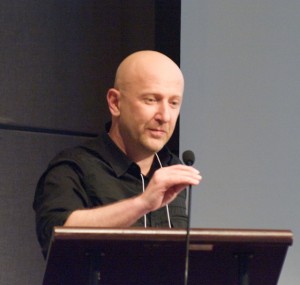
Gary Hall
Photo: J. Miller - PKP Conference
The second speaker, Gary Hall, picked up the importance of open access initiatives with books and monographs. Such initiatives were particularly significant in the Humanities because scholars in these disciplines place such emphasis on books over journal articles. Hall discussed several book projects that are underway with The OHP, describing these efforts as focused upon a new cultural studies project, liquid books with a fluid structure up to the challenge of exploring the potential shape of the book to come. The first of these books has been published as New Cultural Studies: The Liquid Theory Reader. Hall was particularly interested in the potential of experimental projects that would allow scholars to challenge traditional concepts of the codex by expanding to include the range of materials/media found within printed books: excerpts, snippets of media, clips from multimodal texts. Such an exploration is an important response to the emerging landscape for digital texts, a landscape influenced by the proliferation of books scanned by Google and reading devices from ipods to Kindles.
Hall also indicated his interest in creative ways to employ open access and open editing strategies in liquid books that were free for anyone to read, write, remix, and reinvent to produce alternate parallel versions of books. Such acts of distributed writing and editing within liquid texts would, Hall hoped, raise critical challenges to traditional notions of authorship, intellectual property, authority, etc. This potential dismantling of the authority of the text was a particular challenge for open access initiatives, as they ran the risk of reinscribing and reproducing traditional approaches and limits of current knowledge production, this time in an electronic space. Drawing upon Derrida, Foucault and Barthes, Hall offered that open access could bring interrogations of academic authorship so as to loosen up these notions, making them less fixed and rigid (more jello-like). By recognizing some wobbles in the smooth surface of academic publishing, scholars would be in a good position to delineate and respond to shifts in power and authority increasingly evident in decentralized forms of writing such as MyTimes (a cross between the associated press and an RSS reader), Wikipedia (a networked, distributed and very liquid work), and other such fluid sites for knowledge production. Such a redistribution and decentring of traditional authority could help scholars to avoid replicating the current centre/periphery dynamics of knowledge production and dissemination, an imbalance that sees 90% of the world’s scientific research being published by just 15 countries.
Question Period
During the question period, one member of the audience identified a contradictory tension that seemed evident in the presentations offered in the session. On the one hand, the speakers stressed a need to establish the credibility of academic publishing. On the other hand, it was clear that there was also a keen interest in exploring the boundaries of new media (and traditional academic practice) so as to destabilize the model of academic publishing alongside the decentring of other concepts like authority (authorship), and the very form of scholarly writing be it journal articles or monographs. Keeping these things in balance is quite a challenge, especially when many scholars are as intent on building credibility in these new forms of academic scholarship at the same time as others are intent on destabilizing the very units and processes that have long characterized academic discourse. This somewhat anxious tension seems to describe aptly the stance of Humanist scholars exploring new cultural studies.
This is a blog for the PKP Scholarly Publishing Conference 2009 in Vancouver, Canada. A group of graduate students in LLED565D: Developments in Access to Knowledge and Scholarly Communication are live-blogging the conference. Postings on the conference sessions will be up on this blog right after each session ends. At a later time, we will be editing our posts as necessary.