College and University Faculty Assembly of National Council for the Social Studies Votes to Oppose Resolution Against Iraq War

NCSS/CUFA VOTES To Oppose Resolution Against Iraq War

On November 29, 2007, the assembled members of the College and University Faculty Association of the National Council for the Social Studies voted to reject a motion raised by members of the Rouge Forum opposing the Iraq invasion and war. The vote was 58 “No” to 46 “Yes” with 17 abstentions. As we go press, the final tally had not been reconfirmed by Cufa officials. This was a very small turnout for a Cufa meeting but the vote was a hand count and the ultimate result cannot be disputed.

This is the motion CUFA members, who had earlier heard former Supreme Court Justice Sandra Day Oconnor say the US, “is moving toward fascism,” rejected:


Whereas the Iraq invasion and reason have nothing in common and,

Whereas the Iraq war has invaded our education system with military recruiters who defy reason with unkept promises and who unfairly take advantage of economically deprived and oppressed students, and,

Whereas the invasion has intensified the regimentation of curricula and,

Whereas the invasion escalated the use of high-stakes testing as a weapon which sorts youth along lines of race and class, having little to do with intellectual achievement, serving as a pipeline to what is in fact a war for empire,

Wheras the war is an extension of the international war of the rich on the poor, destroying all semblance of democracy in its wake,

Be it resolved that CUFA notify NCSS, the President of the US, Congress, and the press that we think the US should get out of Iraq now.

Among those voting against this motion were social studies luminaries like Linda Levstik, Walter Parker, David Hicks, and Jeff Passe.

CUFA is the university faculty wing of the National Council of Social Studies. As noted above, CUFA members had, earlier in the day, heard Sandra Day Oconnor, former Supreme Court Justice, say, “Fascism is rising in the USA.” Then, in the CUFA meeting, prior to the vote on the war, members voted in favor of a motion urging NCATE retain the term “social justice,” in their by-laws.

There was no debate on the Iraq resolution, as has been the case in nearly every similar motion brought by the Rouge Forum to CUFA. Debate inside this group of PhD’s who choose to stand aside like mandarins as their claims to democratic education evaporate around them, is quite rare. In one session four years ago, a CUFA chair person urged that debate on an antiwar motion be cut off before it began on the grounds that snacks were already being served in another room.

In the past, CUFA voted to oppose the war or its conduct. It may be that the smaller numbers at the NCSS convention shifted this vote. The loss of attendance could be due to cuts in social studies education where there are few, if any, state tests. The NCSS response? Demand a Social Studies test–that will invariably hide the terms ” capitalism,” and “imperialism,” and measure, not knowledge, but subservience and parental income. In any case, several NCSS members reported that their travel funding was cut because of the low status of social studies but they came anyway. It’s no stretcher to guess that costs kept many people away.

CUFA and NCSS believe they are the bulwarks of education for democratic citizenship in the US. Contrary to that belief is the fact that top CUFA members, including leading multiculturalist professors, voted against a Rouge Forum motion favoring affirmative action in 2003, on the grounds that such action might cost profesors money from their pay.

Last year, CUFA was addressed by the founder of a million dollar institute, and tenured professor, who spoke for an hour, claiming that the reason people in what he called the Third World suffer from the conditions of their daily lives is because they are not sufficiently “cosmopolitan.” Only Rouge Forum members were laughing.

At the NCSS conference in San Diego this year, no session would have mentioned the war in Iraq if they session had not been proposed and organized by Rouge Forum members. This, in a conference which listed 80 pages of sessions.

Many CUFA and NCSS members, especially grad students and younger teachers unaccustomed to NCSS’ undemocratic and reactionary ways, expressed dismay that such an august group could be such an autocratic muddle. But in the course of the conference, nearly 100 new people joined the Rouge Forum, enjoyed long discussions at our booth and social activities.

If is is the case that fascism now emerges around us, and I think it does, the educational work and direct action, of groups like the Rouge Forum would seem to be vital. Justice demands organization. Absent the Rouge Forum at NCSS: Nothing.

Thanks go to many, many Rouge Forum activists who made a great weekend possible. Amber, Beau and Noi, Wayne, Greg and Katie, Tommie, Steve and Perry, Marc, AK, Steve, Chris (write that letter), Cynthia M (great salad! and thanks for your patience) Sandy, Sally, Molly, Sean, Bill B and the Blanks, Bob A., Susan, Cheir, Ken, Kimi, Matt and all who are not forgotten.

Clever fundraising appeal number two: NCSS cost a lot of money. The low attendance hurt our ability to sell material and recoup our costs: about $2700.00. If you can spare any cash at all, please send some. Or, visit the Rouge Forum web page (www.rougeforum.org) and get some of those terrific good-for-the-rest-of -your-life anti-war posters for holiday presents. And, we have Rouge Forum tshirts on sale as well. Ten bucks plus postages. Images online soon.

All the best, r

Rouge Forum at NCSS and More

Dear Friends,

As a reminder:

The Rouge Forum will be hosting a booth, a party, and several sessions at the upcoming National Council for the Social Studies Conference in San Diego, this weekend. Here are three presentations that might interest you.

*FRIDAY (8:30 – 10AM) International Assembly: Is It Possible or Desirable to Teach for Democracy Today?

*FRIDAY (5 – 6 PM) World History SD Convention Center 30B
Overcoming High-Stakes Tests: Keeping Our Ideals and Still Teaching

*SATURDAY (2:45-3:45) Experienced k12 Teachers at SD Convention Center 30D
How We Keep Our Ideals and Teach:Progressive Teachers in the Classroom.

Come visit and go on the record abot NCLB and the wars for our video at our booth.

The party is Saturday night. Please rsvp if you wish to attend.

It is easy to witness the madness of our times, the spectacles that lure more than a million people a week to attend NFL gams, Judge Judy tormenting volunteer fools, Reality TV becoming “Not Reality But Actuality TV,” (formerly Court TV) the glaring contradiction of the moment as in 800,000 millionaires in New York City matched by one person in six in the same city going to bed hungry, wars around the world going unreported—and to miss the fact that people do resist.

The Paris uprisings of late run parallel with, and intersect each other. Students protesting the French government’s moves to create a two-tier privatized education system (a la the UC and CSU systems in California) initiated the battles, quickly joined by striking workers. Now the same police that attacked the students are attacking immigrant communities, and being met with a ferocious counterattack. http://www.nytimes.com/2007/11/29/world/europe/29france.html?hp

In Russia, workers demanding wage increases and a six hour day have seized a Ford plant outside St. Petersburg (Leningrad).

In schools, educators around the country seek to drive military recruiters off their campuses and to halt the high-stakes exams that strangle freedom and learning. Ethical school workers have nearly reached the limit of their tolerance. Our task is to make sense of resistance that must occur.

On December 8, at Fresno State there will be a meeting of education activists trying to organize testing boycotts. Watch the coming updates for time and place. Our task is to connect reason to power, to try to build a mass based class conscious movement of people prepared to take the risks and make the sacrifices necessary to fashion and sustain an equitable world== toward the consciousness of freedom; the same project of centuries that our great-grandparents took on, that we should pass on to the kids. You are welcome to join us in Fresno.

Meanwhile, the California Teachers Association (NEA) and the California Federation of Teacher (AFT) battle each other to the tune of hundreds of thousands of lobbying dollars. CTA opposes CFT’s proposition 92 which would reduce costs at community colleges and guarantee some cc funding. This cannot be a new low in unionism as the UAW’s recent contract still holds that rank, but it is a highlight in demonstrating that US union executives have nothing but opportunism as a guide. CFA fears that funding community colleges might cut into their k12 teacher pay while CFT’s membership is heavily in the cc’s. To their credit, the United Teachers of L.A. rejected CTA-NEA’s position.
http://www.prop92yes.com/

Our friends in the AFT-D.C. local asked to spread the word about where their dues went, via the criminal AFT president Barbara Bullock. http://www.washingtonpost.com/wp-dyn/content/article/2007/11/04/AR2007110401865.html

Justice in schools and communities demands new kinds of organizations.

Remember the Rouge Forum conference March 14-16 in Louisville. This is the call for papers: www.rougeforumconference.org

best, r

Billionaires Up, America Down

MindtheGap.jpg
In 1982, when the Forbes 400 had just 13 billionaires (there were 482 last year), the highest paid CEO made $108 million and the average full-time worker made $34,199, adjusted for inflation in $2006. Last year, the highest paid hedge fund manager hauled in $1.7 billion, the highest paid CEO made $647 million, and the average worker made $34,861, with vanishing health and pension coverage.

ZNet Commentary
Billionaires Up, America Down
November 19, 2007
By Holly Sklar

When it comes to producing billionaires, America is doing great.

Until 2005, multimillionaires could still make the Forbes list of the 400 richest Americans. In 2006, the Forbes 400 went billionaires only.

This year, you’d need a Forbes 482 to fit all the billionaires.

A billion dollars is a lot of dough. Queen Elizabeth II, British monarch for five decades, would have to add $400 million to her $600 million fortune to reach $1 billion. And she’d need another $300 million to reach the Forbes 400 minimum of $1.3 billion. The average Forbes 400 member has $3.8 billion.

When the Forbes 400 began in 1982, it was dominated by oil and manufacturing fortunes. Today, says Forbes, “Wall Street is king.”

Nearly half the 45 new members, says Forbes, “made their fortunes in hedge funds and private equity. Money manager John Paulson joins the list after pocketing more than $1 billion short-selling subprime credit this summer.”

The 25th anniversary of the Forbes 400 isn’t party time for America.

We have a record 482 billionaires — and record foreclosures.

We have a record 482 billionaires — and a record 47 million people without any health insurance.

Since 2000, we have added 184 billionaires — and 5 million more people living below the poverty line.

The official poverty threshold for one person was a ridiculously low $10,294 in 2006. That won’t get you two pounds of caviar ($9,800) and 25 cigars ($730) on the Forbes Cost of Living Extremely Well Index. The $20,614 family-of-four poverty threshold is lower than the cost of three months of home flower arrangements ($24,525).

Wealth is being redistributed from poorer to richer.

Between 1983 and 2004, the average wealth of the top 1 percent of households grew by 78 percent, reports Edward Wolff, professor of economics at New York University. The bottom 40 percent lost 59 percent.

In 2004, one out of six households had zero or negative net worth. Nearly one out of three households had less than $10,000 in net worth, including home equity. That’s before the mortgage crisis hit.

In 1982, when the Forbes 400 had just 13 billionaires, the highest paid CEO made $108 million and the average full-time worker made $34,199, adjusted for inflation in $2006. Last year, the highest paid hedge fund manager hauled in $1.7 billion, the highest paid CEO made $647 million, and the average worker made $34,861, with vanishing health and pension coverage.

The Forbes 400 is even more of a rich men’s club than when it began. The number of women has dropped from 75 in 1982 to 39 today.

The 400 richest Americans have a conservatively estimated $1.54 trillion in combined wealth. That amount is more than 11 percent of our $13.8 trillion Gross Domestic Product (GDP) — the total annual value of goods and services produced by our nation of 303 million people. In 1982, Forbes 400 wealth measured less than 3 percent of U.S. GDP.

And the rich, notes Fortune magazine, “give away a smaller share of their income than the rest of us.”

Thanks to mega-tax cuts, the rich can afford more mega-yachts, accessorized with helicopters and mini-submarines. Meanwhile, the infrastructure of bridges, levees, mass transit, parks and other public assets inherited from earlier generations of taxpayers crumbles from neglect, and the holes in the safety net are growing.

The top 1 percent of households — average income $1.5 million — will save a collective $79.5 billion on their 2008 taxes, reports Citizens for Tax Justice. That’s more than the combined budgets of the Transportation Department, Small Business Administration, Environmental Protection Agency and Consumer Product Safety Commission.

Tax cuts will save the top 1 percent a projected $715 billion between 2001 and 2010. And cost us $715 billion in mounting national debt plus interest.

The children and grandchildren of today’s underpaid workers will pay for the partying of today’s plutocrats and their retinue of lobbyists.

It’s time for Congress to roll back tax cuts for the wealthy and close the loophole letting billionaire hedge fund speculators pay taxes at a lower rate than their secretaries.

Inequality has roared back to 1920s levels. It was bad for our nation then. It’s bad for our nation now.

Holly Sklar is co-author of “Raise the Floor: Wages and Policies That Work for All of Us” and “A Just Minimum Wage: Good for Workers, Business and Our Future.” She can be reached at hsklar@aol.com.

Rouge Forum Update

joehill07.gifDear Friends,

The Rouge Forum No Blood For Oil web page is updated at www.rougeforum.org

Please take note of the call for papers for the upcoming Rouge Forum Conference in Louisville, March 14-16, 2008. The theme for the 2008 Rouge Forum Conference is: “Education: Reform or Revolution?” and will be hosted by Bellarmine University. The Call for Proposals and Registration information can be found at: http://www.rougeforumconference.org/

The Rouge Forum will be hosting a booth, a party, and several sessions at the upcoming National Council for the Social Studies Conference in San Diego, at the end of November. Here are three presentations that might interest you.

*FRIDAY (8:30 – 10AM) International Assembly: Is It Possible or Desirable to Teach for Democracy Today?

*FRIDAY (5 – 6 PM) World History SD Convention Center 30B
Overcoming High-Stakes Tests: Keeping Our Ideals and Still Teaching

*SATURDAY (2:45-3:45) Experienced k12 Teachers at SD Convention Center 30D
How We Keep Our Ideals and Teach:Progressive Teachers in the Classroom

The party is Saturday night. Please rsvp if you wish to attend.

It is still nearly impossible to get comprehensive news on the student/worker struggles in France. Students now fight to occupy university buildings throughout the country and transportation workers remain out, though it appears their union is urging people back to work. The possibility for a general strike in France is quite real, a strike initiated by students. Their chances for victory, if they continue to fight for the combined demands of no privatization of education, for pension benefits for workers, health care, the right to strike, and the rights of immigrants, seem good. Perhaps the French break the bonds of their own postmodernism: religion in disguise.

By contrast, in the US, 81% of the UAW-Ford membership voted to build their own scaffolds in the form of massive wage cuts, the nearly certain destruction of their own health benefits, and a two-tier wage system, impoverishing their own children. The leadership of the AFT adopted a merit pay plan in their key local in New York. NEA still insists it will fight merit pay, but not NCLB nor its curricula regimentation nor high stakes exams. But stage hands and Hollywood writers are out on strike–a bizarre statement about the impact of de-industrialization and the lack of left leadership in the US which has misled the antiwar movement into a series of cul-de-sacs, each one denying the central roles of class struggle and class consciousness.

Direct action can answer some of this. There are answers in struggle. With CalCare and others, the Rouge Forum is backing the call for boycotts of high-stakes exams. We are also planning for massive demonstrations against the empires’ expanding wars on March 20, the anniversary of the invasion.

On this war, and the ones to come, Michael Klare writes on the centrality of oil: http://www.informationclearinghouse.info/article18742.htm

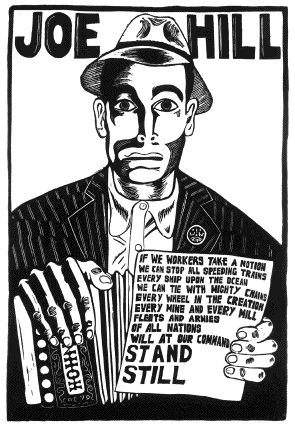
This is the anniversary of the death of the great poet and songwriter of the Industrial Workers of the World, Joe Hill, murdered by the authorities in Utah after a Kangaroo trial in 1915. Hill’s last word to his firing squad: Fire. Here is his hopeful take on the future, from his song The Preacher and the Slave.

Workingmen of all countries, unite
Side by side we for freedom will fight
When the world and its wealth we have gained
To the grafters we’ll sing this refrain
You will eat, bye and bye,
When you’ve learned how to cook and how to fry;
Chop some wood, ’twill do you good
Then you’ll eat in the sweet bye and bye

Thanks to Bill T, Bob A, Amber, Wayne, Beau, Bill, George (subscribe to Substance) Schmidt, Susan, Sharon A., Sally, Sandy, Colleen, Jim Wolin, Alexander, Victoria, Ileana, Marc, Bonnie, Christopher, William, Erin, and Tommie.
all the best, r

The evolution of creationism

http://www.salon.com/news/feature/2007/11/13/intelligent_design/print.html
Salon.com
The evolution of creationism
After their notorious legal defeat, intelligent design proponents are resurfacing with insidious new assaults on science.

By Gordy Slack

Nov. 13, 2007 | Two years ago, Pennsylvania federal Judge John Jones III handed down a stunning decision that many said would take down the intelligent design movement. But American creationism doesn’t die. It just adapts.

Decades earlier, when the courts deemed creation science — proto intelligent design — a religious view and not constitutionally teachable as science in public schools, it adapted by cutting God off its letterhead and calling itself “intelligent design.” The argument for I.D., and for “scientific creation theory” before it, is that evolution isn’t up to the task of accounting for life. Given biology’s complexity, and natural selection’s inability to explain it, I.D. thinking goes, life must be designed by a, well, designer. I.D.ers skirted any mention of God, hoping to avoid getting snagged on the First Amendment’s prohibition against promoting religion by arguing that I.D. was just a young and outlying science.

In the Pennsylvania case, Kitzmiller v. Dover, Judge Jones ruled that if you want to teach intelligent design in science class, first you have to show that it is a distinct species from its earlier, creationist form, not just a modified type. You’ve got to show us the science part, he said. Besides, Jones declared, your intelligent designer is obviously God.

The six-week trial — the focus of a Nova documentary, “Judgment Day: Intelligent Design on Trial,” airing Nov. 13 — addressed a host of heady questions. What is science and how does it work? Can evolution account for the diversity of life we see on earth? What is religion? Can science say anything about the existence of a creator and still be science? It also examined the motivations of a local school board that tried to smuggle creationism into its high school biology curriculum. The judge’s decision — that I.D. was not science and that the school board was trying to promote its members’ own religious views — was followed by a short period of shock from the I.D. community.

But like bacteria adapting to antibiotics, creationism has slimmed down once again, this time shedding even a mention of an intelligent designer. A new textbook put out by the Discovery Institute, the Seattle think tank that promotes I.D., doesn’t even have the words “intelligent design” in its index. Instead of pushing I.D. explicitly, “Explore Evolution: The Arguments for and Against Darwinism,” promoted as a high school- or college-level biology text, “teaches the controversy.” Teach the controversy is the new mantra of the I.D. movement.

“We want to teach more about evolution,” says Discovery Institute’s Casey Luskin, “not less.” The “more” they want to teach, of course, is what they see as evolution’s shortcomings, leaving an ecological niche that will then be filled by intelligent design.

But not all creationists have embraced the strategy. Many responded to the Dover trial by coming out of I.D.’s big tent, which once gave shelter to young earth creationists, old earthers, academics interested in I.D.’s hypotheses, and anyone who wanted to promote a Christian-compatible view of science. Judge Jones’ decision was like a lightning strike on the big top, sending many of the constituents running home through the rain. Creationist groups like Answers in Genesis, the Institute for Creation Research, and Reasons to Believe are now attacking I.D. for not having the guts to call its designer God or to be explicit about such key questions as the age of the world. (Answers in Genesis’ answer: about 6,000 years.)

Perhaps not surprisingly, the I.D.ers have adopted a persecution complex. “After Dover,” Luskin says, “there’s been an increase in the boldness of Darwinists who persecute I.D. proponents: researchers, teachers and students. The debate in the academy has intensified radically,” he says. “It’s just a lot more political.” He points to Guillermo Gonzalez, a physicist at Iowa State who failed to get tenure, allegedly because he is an advocate of I.D., and Richard Sternberg, a scientist at the National Institutes of Health who was “attacked” for publishing an article by Stephen Meyer, a proponent of intelligent design, in a peer-review journal Sternberg edited.

Evolutionary biologists respond that hiring a biologist who doesn’t accept evolution is like hiring a mathematician who doesn’t accept multiplication. That oversimplifies, but for better or worse, the battle has intensified and come out more into the open.

Recently, long retired chemist Homer Jacobson retracted a paper titled “Information, Reproduction and the Origin of Life,” which he’d published in the journal American Scientist 52 years ago. Upon Googling himself, the 84-year-old Jacobson found that his old paper was often cited by creationists as evidence of the implausibility of life emerging from the prebiotic soup found on early Earth. Jacobson noticed some errors in his paper (it was a half-century old!) and, in order to keep neo-creationists from engaging in “malignant denunciations of Darwin,” he wrote a letter of retraction to the journal. Retraction of a scientific paper is rare, and doing it for political reasons is rarer still. The act provoked accusations of “historical revisionism” from Discovery Institute senior fellow William Dembski.

Following the Dover decision, some I.D.ers became more timid, or at least more evasive. John Angus Campbell, a Discovery Institute fellow and coauthor of a book about teaching I.D. in the schools, ran for a school board seat in Mason County, Wash., last week. During his campaign, he intentionally left his middle name out of his election materials and failed to mention his affiliation with the Discovery Institute. The camouflage strategy worked and he was elected.

I.D. will also be striking back in “Expelled: No Intelligence Allowed,” a pro-I.D. documentary, to be released in February. Featuring conservative writer and political commentator Ben Stein, it portrays I.D. proponents as a group of iconoclastic firebrand scientists with the guts to go after the dogmatic Darwinists who have, the I.D.ers say, grown lazy and corrupt sitting atop a monopolistic theory with zero tolerance for dissent, within or outside of their ranks.

Stein told the New York Times that Darwin may well have been onto something with his theory of evolution, but that it is isn’t up to explaining the origins and diversity of life on its own. Plus, he thinks Darwinism leads to racism and genocide. If Stein had his way, he said, the documentary would have been called “From Darwin to Hitler.”

No, the battle between creationism and evolution is hardly over. The true believers in intelligent design and other forms of creationism aren’t about to lay down their worldview for a federal judge or anyone else. And polls show that about half of America is on their side. “Evolution remains under attack,” says Eugenie Scott, an anthropologist and a director of the National Center for Science Education, a nonprofit dedicated to teaching evolution in public schools. “If creationists have their way, teachers will eventually just stop teaching evolution. It’ll just be too much trouble. And generations of students will continue to grow up ignorant of basic scientific realities.”

— By Gordy Slack

Copyright ©2007 Salon Media Group, Inc. Reproduction of material from any Salon pages without written permission is strictly prohibited. SALON® is registered in the U.S. Patent and Trademark Office as a trademark of Salon Media Group Inc.


CFP: Theory into Action

Theory in Action, the Journal of the Transformative Studies Institute is soliciting papers for our issue on “Theory, Social Justice, & Direct Action” Submissions are due December 31, 2007.

INAUGURAL VOLUME ON THEORY, SOCIAL JUSTICE, & DIRECT ACTION

While there have been many theoretical analyses of such aspects of social justice as stratification and inequality, and civil rights, there is a need for more research that connects activism with theory. We believe that theory without action and action without theoretical grounding are inherently flawed. To change the world, activists and scholars need to collaborate in order to inform one other’s work. To this end, we especially seek papers in which theoretical analysis fosters societal change or in which practical experience guides theoretical research.

Theory in Action invites U.S. and international submissions of well-researched and thought-provoking papers from various disciplines, including sociology, political science, psychology, art, philosophy, history, and literature. We welcome works by activists, independent scholars, graduate students, and faculty. We accept both theoretical and empirical papers by scholar-activists. Topics may include, but are not limited to:

* Novel Means of Resistance
* Direct Political Action
* Environment, Space, Social Justice, & Direct Action
* Direct Action for Social Justice
* Labor / Civil Rights & Direct Action
* Globalization
* Sex & Gender
* Activism, Academia, & Scholarship
* Activism & Resistance through the Arts
* The Media & its Relationship to Societal Justice and Change
* Non-violence vs. Active Self Defense and its Effectiveness
* Historical Analysis
* The Psychology of Transformative Learning & its Relationship to Action

Theory in Action is an international peer reviewed journal.

Submissions are due December 31, 2007.
Guidelines for submission are online at: http://transformativestudies.org.htm
Submissions should be sent using our on-line form found in the ‘submissions’ menu.

Religious scholars mull Flying Spaghetti Monster

CNN: Religious scholars mull Flying Spaghetti Monster

(AP) — When some of the world’s leading religious scholars gather in San Diego this weekend, pasta will be on the intellectual menu. They’ll be talking about a satirical pseudo-deity called the Flying Spaghetti Monster, whose growing pop culture fame gets laughs but also raises serious questions about the essence of religion.

The appearance of the Flying Spaghetti Monster on the agenda of the American Academy of Religion‘s annual meeting gives a kind of scholarly imprimatur to a phenomenon that first emerged in 2005, during the debate in Kansas over whether intelligent design should be taught in public school sciences classes.

Supporters of intelligent design hold that the order and complexity of the universe is so great that science alone cannot explain it. The concept’s critics see it as faith masquerading as science.

An Oregon State physics graduate named Bobby Henderson stepped into the debate by sending a letter to the Kansas School Board. With tongue in cheek, he purported to speak for 10 million followers of a being called the Flying Spaghetti Monster — and demanded equal time for their views.

“We have evidence that a Flying Spaghetti Monster created the universe. None of us, of course, were around to see it, but we have written accounts of it,” Henderson wrote. As for scientific evidence to the contrary, “what our scientist does not realize is that every time he makes a measurement, the Flying Spaghetti Monster is there changing the results with His Noodly Appendage.”

The letter made the rounds on the Internet, prompting laughter from some and vilification from others. But it struck a chord and stuck around. In the great tradition of satire, its humor was in fact a clever and effective argument.

Between the lines, the point of the letter was this: There’s no more scientific basis for intelligent design than there is for the idea an omniscient creature made of pasta created the universe. If intelligent design supporters could demand equal time in a science class, why not anyone else? The only reasonable solution is to put nothing into sciences classes but the best available science.

“I think we can all look forward to the time when these three theories are given equal time in our science classrooms across the country, and eventually the world; one third time for Intelligent Design, one third time for Flying Spaghetti Monsterism, and one third time for logical conjecture based on overwhelming observable evidence,” Henderson sarcastically concluded.

Kansas eventually repealed guidelines questioning the theory of evolution.

Meanwhile, Flying Spaghetti Monsterism (FSM-ism to its “adherents”) has thrived — particularly on college campuses and in Europe. Henderson’s Web site has become a kind of cyber-watercooler for opponents of intelligent design.

Henderson did not respond to a request for comment. His Web site tracks meetings of FSM clubs (members dress up as pirates) and sells trinkets and bumper stickers. “Pastafarians” — as followers call themselves — can also download computer screen-savers and wallpaper (one says: “WWFSMD?”) and can sample photographs that show “visions” of the divinity himself. In one, the image of the carbohydrate creator is seen in a gnarl of dug-up tree roots.

It was the emergence of this community that attracted the attention of three young scholars at the University of Florida who study religion in popular culture. They got to talking, and eventually managed to get a panel on FSM-ism on the agenda at one of the field’s most prestigious gatherings.

The title: “Evolutionary Controversy and a Side of Pasta: The Flying Spaghetti Monster and the Subversive Function of Religious Parody.”

“For a lot of people they’re just sort of fun responses to religion, or fun responses to organized religion. But I think it raises real questions about how people approach religion in their lives,” said Samuel Snyder, one of the three Florida graduate students who will give talks at the meeting next Monday along with Alyssa Beall of Syracuse University.

The presenters’ titles seem almost a parody themselves of academic jargon. Snyder will speak about “Holy Pasta and Authentic Sauce: The Flying Spaghetti Monster’s Messy Implications for Theorizing Religion,” while Gavin Van Horn’s presentation is titled “Noodling around with Religion: Carnival Play, Monstrous Humor, and the Noodly Master.”

Using a framework developed by literary critic Mikhail Bakhtin, Van Horn promises in his abstract to explore how, “in a carnivalesque fashion, the Flying Spaghetti Monster elevates the low (the bodily, the material, the inorganic) to bring down the high (the sacred, the religiously dogmatic, the culturally authoritative).”

The authors recognize the topic is a little light by the standards of the American Academy of Religion.

“You have to keep a sense of humor when you’re studying religion, especially in graduate school,” Van Horn said in a recent telephone interview. “Otherwise you’ll sink into depression pretty quickly.”

But they also insist it’s more than a joke.

Indeed, the tale of the Flying Spaghetti Monster and its followers cuts to the heart of the one of the thorniest questions in religious studies: What defines a religion? Does it require a genuine theological belief? Or simply a set of rituals and a community joining together as a way of signaling their cultural alliances to others?

In short, is an anti-religion like Flying Spaghetti Monsterism actually a religion?

Joining them on the panel will be David Chidester, a prominent and controversial academic at the University of Cape Town in South Africa who is interested in precisely such questions. He has urged scholars looking for insights into the place of religion in culture and psychology to explore a wider range of human activities. Examples include cheering for sports teams, joining Tupperware groups and the growing phenomenon of Internet-based religions. His 2005 book “Authentic Fakes: Religion and American Popular Culture,” prompted wide debate about how far into popular culture religious studies scholars should venture.

Lucas Johnston, the third Florida student, argues the Flying Spaghetti Monsterism exhibits at least some of the traits of a traditional religion — including, perhaps, that deep human need to feel like there’s something bigger than oneself out there.

He recognized the point when his neighbor, a militant atheist who sports a pro-Darwin bumper sticker on her car, tried recently to start her car on a dying battery.

As she turned the key, she murmured under her breath: “Come on Spaghetti Monster!” E-mail to a friend E-mail to a friend

Copyright 2007 The Associated Press

“If your aspiration is to be a college president, that is a way to become a millionaire”

The New York Times: Increased Compensation Puts More College Presidents in the Million-Dollar Club

Soaring compensation of university presidents, once limited to a few wealthy institutions, is becoming increasingly common, with the number of million-dollar pay packages at private institutions nearly doubling last year, and compensation at many public universities not far behind.