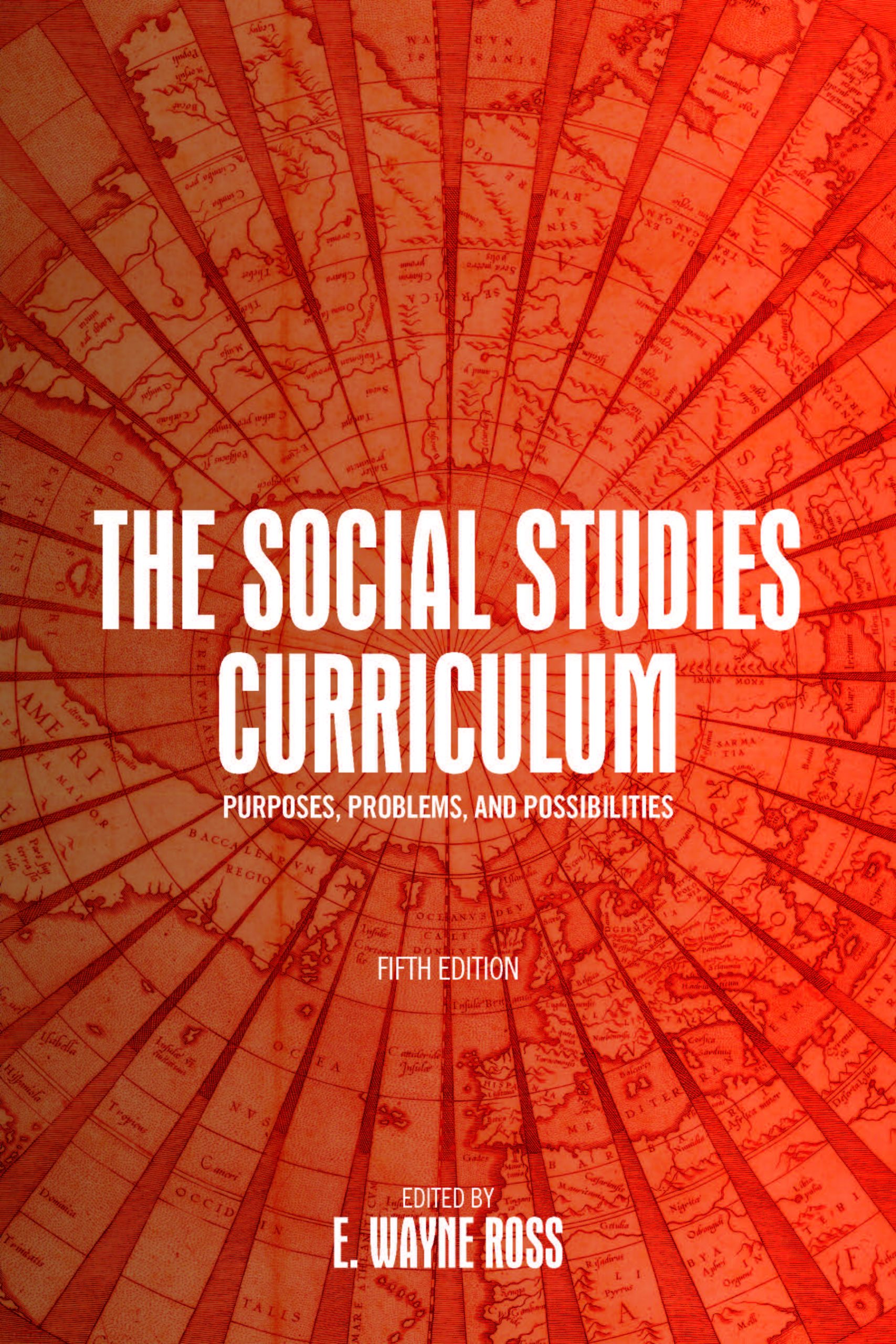
 I am happy to share a review of The Social Studies Curriculum: Purposes, Problems, and Possibilities (5th Ed.) by Peter M. Nelson (UBC) that was published in Theory and Research in Social Education on January 31, 2025.
While the focus of the review is on the fifth edition, Nelson puts the latest edition of the book in conversation with previous editions that were published in 1997, 2001, 2006 and 2014.
Taking stock of the field: Complicated conversations in social studies curriculum
Book Review by Peter M. Nelson
The social studies curriculum: Purposes, problems, and possibilities (5th edition), by Ross, E. W. (Ed.) Statue University of New York Press, 2024, 430 pp., $99.00 (hardcover), $36.95 (paperback). ISBN (hardcover) 9781438499024, ISBN (paperback) 9781438499031
With the fifth edition of The Social Studies Curriculum: Purposes, Problems, and Possibilities (TSSC), editor E. Wayne Ross and the book’s contributors deliver a vital, timely addition to the influential TSSC series. Across 17 chapters—14 of which are new to this edition—the boundaries of the social studies curriculum are relentlessly complicated and contested, and the book’s authors offer critical, compelling visions for how social studies teaching and learning can attend to a range of contemporary issues and topics.
Contextualizing the book
The fifth edition of TSSC arrives at a time when efforts to “capture,” or tame, social studies curriculum are ubiquitous and well-funded. To put it another way, if TSSC offers visions of the social studies curriculum as inherently wild terrain—even feral in its disorderly commitments to real-world action, to understanding that “social studies curriculum and teaching is by its very nature a political undertaking” (p. 381), to its critical attention to the complicated contexts in which education actually occurs—then the capture of social studies begins with its reduction. Phenomena like uncertainty, ambivalence, unpredictability, and spontaneity, while embedded in human experience (and presumably entangled with the project of education as well), are viewed by policy makers, administrators, ideologues, and politicians as problems to eradicate, let alone the more explicit socio-political potentialities that are part and parcel of any meaningful social studies education. To be sure, attempts to capture social studies curriculum, or to reduce its radical potential to foment sociopolitical change, are not new; what Evans (2004) called the social studies wars have been waged since the advent of the field in the early twentieth century. My point, here, is that the fifth edition of TSSC provides an updated glimpse of current contestations around numerous issues, and one of the book’s most valuable, and unique, contributions is how Ross and other chapter authors manage to frame a wide range of sociopolitical issues as readily available for social studies teachers and students to explore and attend to in meaningful ways. …
To continue reading the review see the link below or download the review here.
Peter M. Nelson (31 Jan 2025): Taking stock of the field: Complicated conversations in social studies curriculum, Theory & Research in Social Education, https://doi.org/10.1080/00933104.2025.2459031