
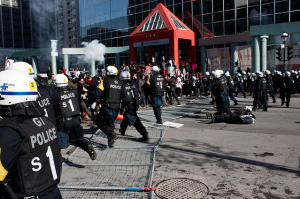
Montreal Gazette — More than 100 people were arrested and two were injured after a protest by Montreal students turned ugly on Thursday evening, with police firing tear gas into the crowd. The protest, a joint demonstration against rising tuition fees and police brutality began at about rush hour, but was confronted by Montreal police outfitted in riot gear. About 2,000 protesters headed north through the city, then west along Sherbrooke Street, but no police were visible along the route, although they were positioned on adjacent streets and in the city’s subway system. When about six officers did appear, a few protesters started throwing rocks at them. At one intersection, police fired off two loud stun grenades, sending a panic through the crowd. Protesters ran in all directions, but riot police formed a line, and banging on their shields with their batons, marched forward, shoving demonstrators north…. A young woman, who didn’t want to give her name, held a bag of ice to her right eye after a police officer whacked her with his baton. “(Riot police) were coming towards us and my friend dropped his cellphone so I bent down to pick it up with my arms raised in the air, so one hit me in the face and my back,” she said. Police made the majority of the evening’s arrests in front of a downtown library…. those arrested were just standing still, arms locked, in front of the library chanting. “They were the least provocative of the whole march.”
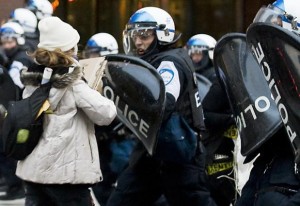
Photo by Graham Hughes, Montreal Gazette
Read more: Montreal Gazette



Net Zero Workers
There is a long history of wage freezes for workers that amount to wage cuts against rapidly rising costs of living. There was a time when governments were interested in supporting unions defending wages as a base for fair compensation for the work and a wage increase to maintain a decent standard of living against rising costs. In bad times, unions and employers could give and in depressions the unemployed ranks grow, families collapse, and businesses fold. Currently, governments are finessing to have it both ways. A psychology of governing parties is to assure consumers and investors that the economy is always looking up while convincing workers that the coffers are empty and the economy is recessing. While Athens burns business analysts comment daily that the markets are gaining lost ground. ‘Economic growth is on the horizon while we are pressed to freeze wages and put our fiscal house in order.’ Mixed messages for the consumer as worker, now the net zero worker.
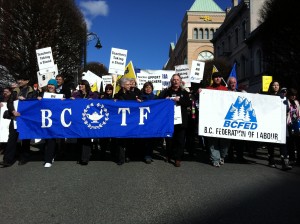
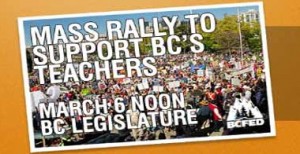
“Net zero,” newspeak for wage freeze, was introduced as a mantra in about 2002 and repeated by the Public Sector Employers’ Council (PSEC) in British Columbia from 2008 to this current point. In 2010 the “net zero mandate” was reinforced in BC government or PSEC policy. Public sector workers were again net zero workers. The BCTF rallied hard against this and are standing up again to pool together all unions, as the governing party in BC again designated teachers as net zero workers. Let them bargain, let them mediate, Minister of Education George Abbott insisted in legislative debate on 12 March, as long as “all of that is within the context of net zero.”
Thirty years ago, top executive salaries were about 15 times that of the average worker’s. Now, those executive salaries are 75 times that of the worker’s. It’s increasingly difficult to accept one’s fate as a net zero worker in the face of skyrocketing executive salaries and lawless mismanagement. Of course, things might change should the net zero worker threaten to become a net zero consumer. Net zero spending was once called a boycott.
10 Comments
Posted in BC Education, Commentary, Employment rights, Government, Politics, Solidarity, Strikes & Labor Disputes, Unions, Working conditions
Tagged Economic Trends, Government, Working conditions