
California State U. Faculty Union Agrees to Continue Negotiations in Effort to Avoid StrikeCalifornia State U. Faculty Union Agrees to Continue Negotiations in Effort to Avoid Strike

The Chronicle: California State U. Faculty Union Agrees to Continue Negotiations in Effort to Avoid Strike

California State University administrators and unionized faculty members agreed on Sunday to continue negotiations for 10 days in an effort to reach a new contract. Both sides said they hoped the agreement would prevent a systemwide faculty strike.

Mid-level administrators and staff get pay boost

Inside Higher Ed: Solid Raises for College Staff

The issue of whether faculty and staff should receive differential raises flared on several campuses in 2006, most notably the University of Kentucky, where President Lee Todd successfully argued (over strong opposition) that the institution needed to overcome nationally lagging faculty salaries by giving bigger average annual raises to professors than to staff members.

U of Alberta ends manditory retirement

University strikes down mandatory retirement

March 23, 2007 – Edmonton – The University of Alberta Board of Governors voted to eliminate mandatory retirement for academic staff today, allowing professors to continue to work and teach beyond the age of 65.

If ratified by the Association of Academic Staff: University of Alberta (AAS:UA) the policy will become effective June 30, 2007. The policy will help the university attract and retain the brightest minds, says U of A Provost and Vice-President (Academic), Dr. Carl Amrhein.

“It will allow us to more easily retain some of our very senior professors who find a mandatory retirement policy unattractive,” he said. “It should help in the recruitment of people who have no real idea of what they’re going to do at 65, but just like to have options. And I think it’ll bring an important level of stability to our academic situation comparable to the best in the class. There are not many institutions of our calibre that still have mandatory retirement.”

Amrhein added that the financial impact of this change will likely be minimal and easy for the university to manage.

The policy brings the U of A in line with that of most Canadian universities and makes the university more competitive in Canada, said AAS:UA President Dr. David Johnston.

“There’s a practical aspect as well., If we did not eliminate it, let’s suppose we have really good people who are 55 or 58. They might decide to go to Calgary or Toronto and depart. Obviously, if you have your choice between seven more years or 10 or 12 more years, you’d take advantage of going to a place that doesn’t have mandatory retirement,” he said.

“It’s also partly a retention issue, because given the demographics and what we know about Alberta’s economy and the plans for the university, we need all the best people we can get, and the people who are good we want to keep.”

Last spring, during academic staff contract talks, the university struck a taskforce made up of members from both the AAS:UA and university administration to look at the issues around mandatory retirement. Amrhein says today’s vote was “the natural follow-up” to the task force’s report.

“We recognize that today’s life and work environments are very different from a number of years ago,” said Amrhein. “People are living longer and want to continue contributing. Those who perform a positive service to the university beyond the age of 65 are important to the needs of our growing university.”

Off the Picket Lines in Philly

Inside Higher Ed: Off the Picket Lines

The faculty union and the administration at the Community College of Philadelphia reached a tentative agreement Sunday to end a strike that started March 13 and has halted classes since then. Also on Sunday, the faculty union and the administration at the California State University System agreed to a short extension of the current contract — through April 6 — with the goal of resolving contract differences without a strike. “Rolling strikes” have been expected to start as early as next week.

SMU profs protest intelligent design conference

Dallas Morning News: SMU profs protest intelligent design conference

Professors opposed to the Bush library aren’t the only angry faculty members at Southern Methodist University this week.

Science professors upset about a presentation on “Intelligent Design” fired blistering letters to the administration, asking that the event be shut down.

The “Darwin vs. Design” conference, co-sponsored by the SMU law school’s Christian Legal Society, will say that a designer with the power to shape the cosmos is the best explanation for aspects of life and the universe. The event is produced by the Discovery Institute, the Seattle-based organization that says it has scientific evidence for its claims.

Controversial Higher-Education Reforms Spark Riots in Athens

The Chronicle: Controversial Higher-Education Reforms Spark Riots in Athens

The Greek Parliament passed a controversial education bill this month that sparked rioting in the streets of Athens. Police said it was the worst unrest the city had seen for years. At least 20 people were injured, 47 were detained, and 11 were arrested, the Associated Press reported.

The protesters, whose number was estimated at 15,000, included students, professors, and members of labor unions opposed to the conservative government’s higher-education proposals. They began gathering in central Athens on the afternoon of the vote, on March 8.

The government’s education package includes measures that would limit the number of years students can take to complete a university degree and would curtail university asylum laws, which make it virtually impossible for the police to enter campuses. A separate proposal to alter the Constitution and allow the operation of private universities in Greece has also mobilized opponents, who believe the changes foreshadow a privatization of higher education and higher costs for students.

In a speech marking his government’s third anniversary in office, on the eve of the vote, Prime Minister Kostas Karamanlis said the higher-education legislation “effectively safeguards the academic asylum and ensures the free dissemination of ideas, which today is being violated by the uncontrolled violence.”

Also on the eve of the vote in Parliament, the main faculty union, the Panhellenic Federation of University Teachers’ Associations, vowed to continue its opposition to the government’s proposals, regardless of the result of the ballot.

Since Mr. Karamanlis’s governing New Democracy Party proposed the legislation last year, protests have hampered the operations of universities across Greece, and opposition demonstrations and marches have become a regular occurrence.

The opposition socialist party had originally supported the government’s higher-education agenda but in recent weeks had withdrawn its support and, along with two other opposition parties, refused to take part in the vote.

Faculty Support

The government nonetheless won passage of the bill, by a tally of 164 to 117. As news of the result emerged, protesters in Syntagma Square, just outside of the Parliament Building, erupted in anger.

Despite the spasm of violence, some academics and students expect that the finality of the vote will mean that Greece’s beleaguered higher-education sector can now focus on the future.

“Not everybody is very happy about the law, and it’s not that it is something that solves problems entirely, but at least it’s a step forward,” said Nancy Papalexandris, vice rector for academic affairs at Athens University of Economics and Business. “The majority feel that the government is right in what it is trying to do, and that they should proceed.”

Even the opposition of the main faculty union is not necessarily an impediment to progress, she said. The union does not represent the views of most professors, she said, and is dominated by extremist activists.

Ms. Papalexandris, whose institution has been effectively closed by protests for the past month and half, said Greek universities should now be able to resume something approaching normalcy.

Students on the far left of the political spectrum have said they would continue to oppose the government’s education package, but Andreas Katopodis, a student at the University of Patras who supports the government reforms, said most students seem to want nothing more than to resume their studies uninterrupted.

The protests and unrest have cost some students nearly a year of study, and most have tired of the disruption, Mr. Katopodis said.

Polish teachers march in Warsaw

_42695603_march-body_afp.jpg
BBC: Polish teachers march in Warsaw

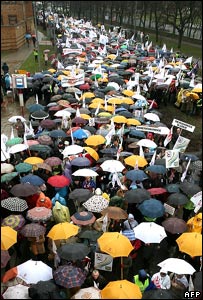
More than 10,000 teachers have marched through the Polish capital to demand pay rises and demonstrate against the government’s education policy.

Gay rights groups joined to protest against plans to dismiss teachers who promote homosexual behaviour.

Ministers have said they are preparing a bill to ban what they called “homosexual propaganda” from schools.

The teachers were demanding both improved retirement benefits and the dismissal of the education minister.

Federal Judge Dismisses Free-Speech Claims of Fired U. of Virginia Employee

The Chronicle: Federal Judge Dismisses Free-Speech Claims of Fired U. of Virginia Employee

Officials for the University of Virginia did not violate the First Amendment rights of an employee when they fired her for using her work e-mail account to send a message that was critical of the university’s policy objectives, a federal judge has ruled.

National Summit on Higher Education Concludes With a 25-Point Plan

The Chronicle: National Summit on Higher Education Concludes With a 25-Point Plan

Nearly 300 leaders from the worlds of business, higher education, and philanthropy convened in Washington on Thursday to discuss how to carry out the recommendations of the U.S. secretary of education’s Commission on the Future of Higher Education. By the end of the day, they had produced a list of 25 “action items” but no plan for how to put them into practice.

The leaders of the work groups then presented the 25 revised recommendations that participants came up with over the course of the day. Among them were proposals to:

* Finance statewide postsecondary-education information systems that can produce reports on student outcomes. Make the information public.

* Reward institutions and state systems that adopt aligned school and college curricula and assessments.

* Design market research studies and compile data on adult learners and prospective adult learners.

* Ensure that institutional, state, and federal financial-aid and enrollment policies consider the needs of part-time students.

* Provide financing incentives so institutions can align resources and policies designed to recruit, retain, and graduate more low-income students.

* Increase private-sector investment in need-based aid.

* Create incentives and rewards for institutions and systems to improve postsecondary attainment rates and student learning at lower per-student costs.

* Remove regulatory, legislative, and academic barriers that prevent institutions and systems from creating collaborative and innovative programs that could lower per-student costs and create value.

* Increase public awareness and understanding of the results of accreditation through greater openness.

* Develop and pilot the voluntary use of measures of learning that could facilitate comparisons across institutions.

Action, direction sought at higher education summit

USA Today: Action, direction sought at higher education summit

Education Secretary Margaret Spellings will convene a summit Thursday aimed at building consensus among higher education stakeholders as they chart a road map for reform.

More than 300 people, including college presidents, corporate CEOs and congressional representatives, will be asked to share views on how to move forward on 25 items identified by the department as having the greatest potential to improve higher education.

The list grew out of recommendations by a controversial Spellings-appointed commission last year that concluded, among other things, that college tuition is too high, graduation rates are too low, poor and non-traditional students are not being well served by the higher education system, and nobody really knows what college students actually learn.

CSU faculty backs strike systemwide

Contra Costa Times: 23-campus walkout in April and May over salary increases would be largest in history of U.S. higher education

California State University professors announced Wednesday that they will strike on all 23 Cal State campuses if they don’t reach a contract agreement with administrators this month.

Union leaders said 94 percent of voting members approved the strike, which they said would be the largest higher-education walkout in U.S. history. About 11,000 of the 23-campus system’s 24,000 faculty members belong to the union, and about 8,100 voted this month.

Two L.A. charter school teachers lose their jobs over a planned Black History Month presentation.

Los Angeles Times: Not the lesson they intended

By Carla Rivera
Times Staff Writer

March 19, 2007

Administrators at a Los Angeles charter school forbade students from reciting a poem about civil rights icon Emmett Till during a Black History Month program recently, saying his story was unsuitable for an assembly of young children.

Teachers and students said the administration suggested that the Till case — in which the teenager was beaten to death in Mississippi after allegedly whistling at a white woman — was not fitting for a program intended to be celebratory, and that Till’s actions could be viewed as sexual harassment.

The decision by Celerity Nascent Charter School leaders roiled the southwest Los Angeles campus and led to the firing of seventh-grade teacher Marisol Alba and math teacher Sean Strauss, who had signed one of several letters of protest written by the students.

The incident highlights the tenuous job security for mostly nonunion teachers in charter schools, which are publicly financed but independently run. California has more than 600 charter schools, and their ranks continue to swell. According to the California Teachers Assn., staff at fewer than 10% of charter schools are represented by unions.

“I never thought it would come to this,” said Alba, who helped her students prepare the Till presentation, in which they were going to read a poem and lay flowers in a circle. “I thought the most that would happen to me [after the event was canceled] is that I’d get talked to and it would be turned into a learning and teaching experience.”

School officials refused to discuss the particulars of the teachers’ firings but said the issue highlights the difficulty of providing positive images for students who are often bombarded by negative cultural stereotypes.

“Our whole goal is how do we get these kids to not look at all of the bad things that could happen to them and instead focus on the process of how do we become the next surgeon or the next politician,” said Celerity co-founder and Executive Director Vielka McFarlane. “We don’t want to focus on how the history of the country has been checkered but on how do we dress for success, walk proud and celebrate all the accomplishments we’ve made.”

McFarlane said details of the Till case were too graphic for an assembly that included kindergartners. The principal, Grace Canada, could not be reached for comment. McFarlane, speaking for the school, said her review of the incident did not support the teachers’ allegations that Canada had used the term sexual harassment to describe Till’s behavior.

But Alba said that when the principal informed the class that they could not recite their poem, she gave the example of a construction worker whistling at her as she walked down the street.

“She said that she would be offended by that and that what Emmett Till did could be considered sexual harassment,” said Alba. “She used the phrase a couple of times and when I objected, she said ‘OK, inappropriately whistled at a woman.’ ”

Many parents said their children affirmed that account. Marcia Alston, mother of a seventh-grader, called the school to say she was appalled at its interpretation of history and the treatment of the teachers. She said that in the conversation, the principal used the term “rude” to describe Till’s actions.

“Mr. Strauss and Ms. Alba were excellent teachers,” said Alston. “The fact that they and the students had signed a letter, I thought, was good; it was something they were passionate about and it could be used as a learning tool.”

Verna Hampton, whose daughter was in Alba’s homeroom and signed a letter, said she was especially offended that the incident occurred during Black History Month. Hampton said her daughter told her there was nothing offensive in the letter she signed.

“Those teachers should not have lost their jobs for standing up for what they felt was right; that sends the wrong message,” Hampton said. “The kids didn’t even get a chance to say goodbye.”

Alba, 30, began teaching at Celerity when it opened in the fall of 2005 shortly after she received her credential. She taught social studies and science and is now looking for another job. She is writing to the school’s board of trustees to request a hearing, and Strauss has drafted a letter to the board complaining that his firing was unjustified. Under the contract signed by the teachers, they can be fired with or without cause.

In the letter terminating his employment, dated March 6, Strauss was said to have been “disparaging the school to students and parents and authorizing by physical signature a nonsupportive message to the administrative staff.”

According to Alba and Strauss, individual students wrote 10 to 15 protest letters, some of which were signed by other students. Neither the teachers nor the students made copies, they said.

“The kids felt strongly about this, and because these are my students, I felt one of my jobs was to pay attention to them,” said Strauss, who is earning a credential at Cal State Dominguez Hills. “It’s important anywhere a teacher works that the employer be willing to listen and keep an open mind and maybe even be willing to change their mind if they learn something new.”

Frank Wells, a spokesman for the California Teachers Assn., said the Celerity incident highlights the importance his group has placed on organizing charter school teachers statewide.

“This points out the vulnerability of teachers in some charters where they don’t have safeguards and can be fired for any or no reason,” Wells said.

Celerity Nascent (the name is derived from words meaning swift or accelerated development) opened in the Jefferson Park area last school year as a K-6 charter campus with about 330 students. Seventh grade was added this year, and there are plans to add eighth grade next year.

Of its nearly 500 students, 80% are African American and about 19% are Latino. McFarlane, who is black, said 65% of the staff members live in the neighborhood and that part of the school’s mission is to create jobs in the community.

Most students are below grade level in reading when they enroll, and many have behavioral problems, school officials said. McFarlane, who worked for 14 years as a teacher and principal in the Los Angeles Unified School District, said that with its focus on project-based, “culturally responsive” learning, student achievement is rising and parents are more involved in their children’s learning.

Gary L. Larson, a spokesman for the California Charter Schools Assn., said Celerity is well-run and its administrators highly regarded. He defended the school’s right to judge the appropriateness of the Till presentation and to dismiss teachers.

“If they felt that it was too sensitive in nature, and as long as they are following approved procedures, they have the authority,” Larson said.

Many parents agreed with the school’s decision to omit the Till presentation. During February’s Black History Month program, the seventh-graders’ poem, based on the book “A Wreath for Emmett Till,” was replaced by a reading on the civil rights struggle as a whole.

“There’s no celebration in the Emmett Till story,” said Stephen Weathers, president of the school’s parent organization. “He was beaten for whistling at a white woman, and I don’t want my daughter to know that in the fourth grade. I don’t think a celebration of Black History Month is a forum for that story. It’s important, but that wasn’t the stage for it.”

Scot Brown, associate professor of history and African American studies at UCLA, said it was unfortunate that school officials and the teachers did not find common ground.

“I’m surprised that the teachers and principal could not work out a way for students to do this presentation in a way that highlights the significance and importance of Emmett Till’s loss to the larger black freedom struggle,” said Brown. “It’s much bigger than the acts of violence you don’t want kids exposed to ….

“It sounds to me that by laying a wreath and saying a poem, the students and teachers were working through the meaning of his sacrifice to the black freedom struggle, and that’s very important.”

Faculty Union for California State U. Authorizes ‘Rolling Walkouts’ if Contract Negotiations Fail

The Chronicle: Faculty Union for California State U. Authorizes ‘Rolling Walkouts’ if Contract Negotiations Fail

Unionized faculty members across the 23-campus California State University system have voted overwhelmingly to authorize a systemwide series of “rolling walkouts” that would send professors to picket lines for two days at a time, union leaders announced on Wednesday.

Prominent Scholar at Chinese University Is Demoted Over Criticism of Superiors

The Chronicle News Blog: Prominent Scholar at Chinese University Is Demoted Over Criticism of Superiors

People’s University, in Beijing, has demoted a dean after the well-known scholar criticized university officials and what he termed the “bureaucratization” of China’s higher-education system.

The incident started last week, when Zhang Ming, the university’s dean of political science, posted comments on his popular personal blog in which he defended a colleague who he said had been overlooked for a promotion. Mr. Zhang said the decision had been made by Li Jingzhi, dean of the School of International Studies, which oversees Mr. Zhang’s department, and not by a proper academic-review committee.

Instructor’s Comments About Republicans Draw Criticism — and Death Threats

The Chronicle: Instructor’s Comments About Republicans Draw Criticism — and Death Threats

An adjunct instructor at a two-year college in Idaho who reportedly made inflammatory remarks about Republicans in her English class has become a target of right-wing bloggers and has received several death threats.

Who’s Who at the Spellings Summit

Inside Higher Ed: Who’s Who at the Spellings Summit

For weeks, mystery has swirled around who will have a seat at the table(s) this week when Margaret Spellings convenes her higher education “summit,” which is designed to help set the course for how the Education Department moves forward in carrying out the recommendations of the education secretary’s Commission on the Future of Higher Education.

Would business leaders dominate? Will Washington’s higher education associations — which have been frozen out of several other recent policy discussions in Washington — get a golden ticket? Will you need a Texas birth certificate to join in?

Delicate Debate on Unionization

Inside Higher Ed: Delicate Debate on Unionization

A bill passed by the U.S. House of Representatives that is seen as the top legislative priority for organized labor this year is attracting attention and some opposition from college leaders.

The bill would generally make it easier for unions to be formed at private employers, including private colleges. The legislation wouldn’t affect who could unionize, so rulings by courts and the National Labor Relations Board that have stifled organizing of faculty members and graduate students at private institutions wouldn’t be affected. But where organizing drives are permitted and active — for example of custodial and clerical workers and of adjuncts — the legislation would help unions.

“No College Student Left Behind”?

CBS News: “No College Student Left Behind”?

(National Review Online) This column was written by Peter Wood.

Secretary of Education Margaret Spellings will kill off one of the most promising reforms in higher education of the last half century during the coming days. The funeral, I expect, will be sparsely attended; but I’ll be among the mourners.

In 1987 Allan Bloom’s book “The Closing of the American Mind” aroused national furor by describing — convincingly to millions of readers — what had gone wrong with American colleges and universities. Bloom depicted the university as awash in cultural relativism, emotionally shallow, robustly strong in the natural sciences but intellectually anemic in every other discipline, and careless about the core tradition of philosophical search for truth.

The Right Wing on Campus

mar07cvr.jpg
Z Magazine: The Right Wing on Campus

An interview with Anuradha Mittal

By Carolyn Crane

Anuradha Mittal is the founder of the Oakland Institute, a policy think tank. In 2005 the Institute published a paper outlining the role of right-wing organizations in shaping political dialogue on college and university campuses, prompting this interview.

CRANE: What has been the role of the right-wing on college campuses in the last decade or so?

MITTAL: Very often people think of a college campus with an image of the 1960s. Kent State and the free speech movement come to mind. We tend to believe that college campuses are basically hubs of political activity. After all, we have environmental studies departments, women’s studies departments, ethnic studies departments, multi-cultural curricula. It is true that in the mid-20th century, especially after the GI bill, very different kinds of people came to college campuses for the first time. Sons and daughters of people who could have never thought of going to college were suddenly in colleges and they were questioning the status of those in power. We saw the involvement of students against the war and for women’s rights and civil rights.That is when the right moved in.

John Simon was Secretary of Treasury under Nixon and Ford. In his book A Time for Action he urged the corporations and the right wing to see what was happening. The attack was coming, he said, from academia and it was very important to challenge it. A similar call was included in the Lewis Powell memorandum where he said that this left needed to be crushed.

It has been a very carefully crafted strategy by the right wing to take over campuses the last few decades. Millions of dollars from conservative foundations have reshaped the debates on college campuses. You find national networks being created, for example, the Intercollegiate Studies Institute or think tanks like the Heritage Foundation. These are the institutions funding right-wing publications on college campuses. A very systematic attack on freedom of speech and liberal professors.

If you look at the survey sponsored by the American Council of Education in 2003, it reported that only 17 percent of college freshmen considered it important to be involved in an environmental program. In 1992 the number doubled. In 2003 a majority, 53 percent, said they wanted affirmative action to be abolished while only 55 percent favored reproductive rights, compared to two-thirds in 1992.

Affirmative action is a big one. Over the last few years, the right wing has been organizing these bake sales across campuses. If you are a white student or faculty, you pay more for your cookie, whereas if you are a student of color, or faculty of color, you pay less than 50 cents. They simplified the message to convince students that affirmative action is unfair.

Those kinds of hypes have been very successful. Fifty-three percent of students in 2003 believed that wealthy people should pay a larger share of taxes than they do now. In 1992, 72 percent of students felt that richer people should pay more taxes.

Let’s go back to the Powell memo you mentioned What was in that memo? Who is Powell?

Lewis F. Powell was appointed to the U.S. Supreme Court by President Nixon. He wrote a memorandum in 1971 to Eugene Sednar, Jr., director of the U.S. Chamber of Commerce, warning that America’s economic system was under a broad attack by communists, new leftists, and other revolutionaries who would destroy the entire system, both political and economic. And that “the most disquieting voices joining the chorus of criticism came from the college campus, the pulpit, the media, intellectual and literary journals, the arts and sciences, and politicians.” So he recommended that the business community confront this by building organizations that would use careful, long-range planning and implementation.

It was the same message that in 1978 William Simon echoes in his books A Time for Truth and A Time for Action. He urged the right to rise and create a new set of institutions capable of leading the United States into a new age. He took funding from large corporations to support counter-intellectuals in the struggle. In 1978, he and Irving Kristol started the Institute for Educational Affairs, which played an important role in the rise of conservative college newspapers.

What about the chasm between funding of science and technology versus humanities and liberal arts?

In this whole effort to support the counter-intellectuals, corporate investments in universities have helped to dramatically change the mission of higher education. You have the revolving door between the CEOs and the university administrators to the corporate research and development in university labs. Basically, corporate influence has transformed every aspect of university life. At the same time, we have seen an attempt to de-fund humanities departments because they are supposedly the stronghold of leftist professors. They use the alumni, for example, who are often donors to the universities and dictate how their money is used. And that is not used for funding chairs in humanities programs. In the case of biotechnology you find in the state universities and the University of California system a strong takeover by the biotech companies. They have access to patents on research that is conducted in these state universities.

One of the biggest issues we have to deal with is that this corporate takeover is altering academic priorities. It is undermining the independence of university teachers, determining what research is done at the universities. Cal Bradford, a former Fellow at the University of Minnesota’s Humphries Institute for Public Policy, was denied an extension of his contract after he criticized the university’s ties to corporations. In his words, “…basically the outside funds determine what universities will teach and research, what direction the university will take and the corporate donors decide to fund chairs in areas that they want research done. And their decisions decide which topics universities explore and which aren’t.”

What other tactics do you see the right using?

Let’s look at Students for Academic Freedom, started in 2003 by David Horowitz, who is not a student. It encourages the states to adopt its very noble sounding Academic Bill of Rights. It is about insuring that right-wing professors are hired in universities, that certain kinds of books are taught in courses. This campaign resulted in the Colorado State Legislature hearing from students and faculty in 2003. Their claim was that left-wing professors ridiculed conservative students, graded them down, and they attemped to recruit them to leftist causes. So this Academic Bill of Rights has now traveled to several states, including Georgia, Missouri, Michigan, Oklahoma, Massachusetts, and California. In Florida in March 2005, a bill inspired by this Academic Bill of Rights, was adopted, which would basically allow Florida’s public university students to sue their professors for leftist “totalitarianism,” that’s what they call it. It was approved in the legislature.

Other actions are about intimidation. There’s a report put out by Lynn Cheney’s group (the Defense of Civilization Fund) called “Defending Civilization: How Our Universities are Failing America and What Can be Done About it.” This report attacks students and college faculty who oppose the war in Afghanistan and Iraq. It lists the names of 117 students and faculty and the unpatriotic statements they made. These unpatriotic statements include, “Break the cycle of violence” or “Ignorance breeds hate.” They were considered dangerous to national security. When your name is put on a list like that, that is intimidation. Students Against War, a campus group in Seattle, had these post-inaugural demonstrations. They were chanting at the recruiters and they ripped up their literature. They were told by the Administration to apologize to the U.S. Army or they would be responsible for their actions.

You have right-wing organizations helping to shape the message and providing talking points to conservative student activists. This is done through annual conferences, journalism courses, internships at right-wing institutions, and fellowships. For example, the Collegiate Network Handbook for student activists, which is called “Start the Presses,” states that media outlets have the power to transform a minor event or fact into a major embarrassment. If the school persecutes you, send out press releases, notify alumni, and give the Administration a public blackeye. So they love it when you have progressive students going in and tipping over bake sale tables. They are like, “See, we told you that they are hostile to us.”

Another myth is that campuses are hotbeds of the left; that there is a Marxist conspiracy in the universities and radicals have seized the administration of universities.

The thing that they have done very successfully is choose who will deliver the message. For example, you have conservative women empowering feminism. So, for example, you have conservative speakers like Ann Coulter, Kathryn Harris, or Christina Hoff-Summers going to college campuses to explore questions such as whether women’s studies programs harm women by propagating feminists myths of women as victims. Or they have brought in conservatives of color far more successfully than progressives have. If you look at the Young America Foundation and their speaker’s bureau, it has right-wingers like Stark Parker, Clarence Thomas, G.A. Parker, Ward Connelly, and Walter Williams—these are the “alternative” black speakers who are put out as spokespeople for black America who are against affirmative action. Their message is, we need to move beyond race and gender.

How much has the right wing invested in this project?

A dozen right-wing institutions have spent nearly $40 million each year over the last 30 years. In 2004 the three largest conservative campus organizations were Young America’s Foundation, Intercollegiate Studies Institute, and the Leadership Institute. They’ve spent approximately $25 million on various campus outreach programs. These resources were directed at four goals: training conservative activists, supporting right-wing student publications, indoctrinating the next generation, and generating myths about academia’s “liberal bias.”

There was a philanthropy roundtable in 1995 where Richard Fink, president of the Charles G. Coach and Claude Lamb Charitable Foundations, made use of the economist Frederick Kikes’s model of the production process to advocate for social change grantmaking. In his words, “Translation of ideas into action requires the development of intellectual raw materials. Their conversion into specific policy products and the marketing and distribution of this product to citizen consumers.” He was telling the foundations and grantmakers to invest in change along the entire production continuum, funding scholars and university programs where the intellectual framework of social transformation is developed; think tanks where these scholarly ideas get translated into specific policies; and implementation groups to bring these proposals into the political marketplace and, eventually, to consumers. According to the Media Transparency Grants database, between 1985 and 2000, conservative foundations had given away at least one billion dollars.

You seem to be describing a systematic, well-organized, and effective assault. Where is the left that is supposedly already in control of the universities?

In a recent poll, 27 percent of first year students described themselves as Democrats, 23 percent described themselves as Conservatives, and 50 percent have still not made up their minds. This battle has yet to play out. It’s still up for grabs.

Recently, we’ve seen something big happening on college campuses where students have organized walk-outs related to the war and military recruitment. They have organized protests against President Bush. Rock The Vote was a symbol of youth taking power and that progressives were recognizing the power of organizing on campuses. Also we have seen this national student outcry for corporate accountability, whether it was the success of the Coalition for Immokalee Workers against Taco Bell or Students Against Sweatshops. Look at the Kill-a-Coke campaign where students are getting Coca Cola out of the campuses. You have seen think tanks like the Oakland Institute delving into this issue. Or you have a student think tank called the Roosevelt Institute, which has been launched in Stanford. There’s a lot of activity. There’s Speak Out, which is bringing progressive speakers to college campuses.

What we need now is a long-term vision that can unite our efforts. We need funding and resources to implement these strategies and I think that’s a big question for progressives. Where is it going to come from? How do we reach out to students who have not yet identified themselves as progressives? Those 50 percent of the students—we have the potential to move them in that direction.
Carolyn Crane is a radio and print journalist whose work has appeared on community radio stations and magazines across the country.

Who Controls Textbook Choices?

Inside Higher Ed: Who Controls Textbook Choices?

Responding to student concerns and in some cases legislative mandates, a growing number of colleges are adopting book rental or buyback programs and urging professors to order books on time so their students have a chance to scour the market for the best deal.

The University of North Carolina is considering going a step further by adopting a plan that would require all its campuses to create a guaranteed rental or buyback program for large, lower-division courses. Faculty members who teach those courses would also be responsible for ordering their textbooks well in advance and agreeing to use the same title for two or three years.

In addition to the above recommendations, a UNC Board of Governors subcommittee also wants colleges to consider the rising cost of textbooks for the average student when deciding on tuition increases.