First Nations Singer: Jana Mashonee

[youtube]https://www.youtube.com/watch?v=OCu3HtydHsk&feature=related[/youtube] This compilation of music and art presents the story of First Nations peoples as presented through the singing of Jana Mashonee. This seems like a good example to present to young students. The blend of current First Nations art and traditional story gives a sense of balance. However, when I googled Jana Mashonee, the first thing that came up was a poster-like representation that definitely had a Pochahontas-feel to it. It certainly has a very commercial feel but the music also seems to present positive messages for First Nations students and she seems to present the image of being a good role-model. This reminds me of the discussion regarding the non-neutrality of the internet. There are always messages delivered on many levels and that understanding them requires sharp critical skills.

National Film Board: Dancing around the table

Dancing around the Table
The National Film Board has done a great job of documenting Canadian culture. In Dancing around the Table, Maurice Bulbulian in his 1987 film, documents the 1983 struggle of Aboriginal people to be recognized within the Canadian Constitution. They argue in international courts to have their rights to self-government and land use and consultation entrenched within the law. It was helpful for me to be able to review that. I recall watching it at the time, but now, with more background and more maturity, I’m able to see nuances that I likely missed at the time. That is one of the strengths of technology, that ability to review and to analyze from a more informed perspective. I found Nanook was the same for me: good to have the chance to revisit. Although documents can inform, they do not have the power and nuance of film.

TigaTalk: Fun Educational Technology to support children’s phonetic development

While there have no doubt been many instances of pejorative depictions of Aboriginal peoples on television and in film, there are increasingly common examples of inclusive and supportive depictions as well. Take TigaTalk, for example. Launched in 2008 on APTN, TigaTalk is a children’s television show (preschool level) that uses puppets, cartoon, and live-action stories to explore First Nations culture. This show is also attempting to address preschooler’s mastery of linguistic skills (in Aboriginal languages as well as English. TigaTalk also has an iOS App developed with licensed speech and language pathologists, providing a fun way for children to develop speech sounds through playful voice-controlled games that can improve speech clarity, articulation, and instill confidence.

Library & Archives Canada

Library and Archives Canada has a searchable database of historical government and private works, both published and non-published, for you to explore. Looking at the “archives” section will bring up photos and and documents often viewable online. The institution was brought together through federal legislation in 2004, tying together the National Library of Canada and the National Archives of Canada. They are mandated to provide a wealth of information and memory accessible to all Canadians. As one would expect, their collection is broad and could be of interest to many avenues of research. They do have a specific section on Aboriginal Peoples including databases, research aids, and virtual exhibitions.

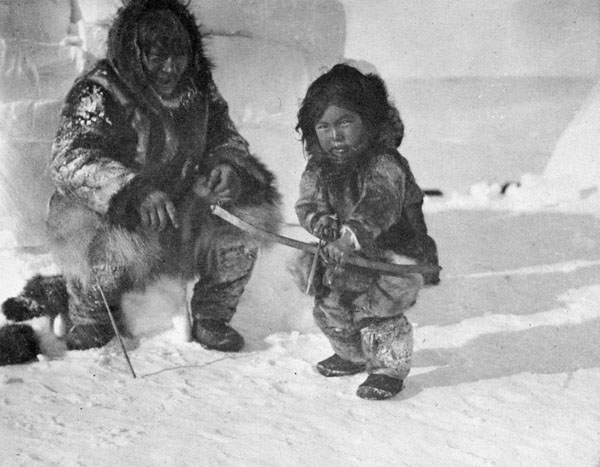
"MIKAN 3200866: Man with boy (probably Allakariallak/Nanook and Phillipoosie)"

DEB (M2-#3): Stereotypes of American Indians in Cartoons & Animations

[youtube]https://www.youtube.com/watch?v=2QlUcg_CqnA[/youtube]

“Children learn sterotypes and attitudes about race from their parents, caretakers and the world around them” (Linn & Paussaint, 1999).

There have been over 1000 movies about Native Indians produced in Hollywood for the last 100 years. Disney  also has produced animations about First Nations, such as Peter Pan and Pocahontas. Also, Charlie Brown and Popeye have some scenes that have American Indians in them. Most of these animations potentially produce negative associations with Indigenous people. In most of these films, the Indigenous people are portrayed as dumb, stubborn, and treacherous. In Popeye particularly, the Native Indians are portrayed as savages who don’t trust anyone and are violent.

This YouTube video introduces couple of animations that have American Indians depicted in wrong ways. They give wrong information to children and as a result, children who watch these animations could have stereotypes against the First Nations. I didn’t realize that the animations produced the stereotypes against the First Nations until I watched this clip. It’s a little shocking and sad that these popular animations can negatively affect children’s thoughts.

DEB (M2-#2): (CBC DIGITAL ARCHIVE) A LOST HERITAGE-CANADA’S RESIDENTIAL SCHOOLS

http://archives.cbc.ca/society/education/topics/692/

This website is a CBC archive of Canada’s residential schools. It has a total of 22 video clips from 1955 to 2002 which are related to residential schooling in Canada.

There is a brief description of what each video clip is talking about, some of the facts that we don’t know, and comments that people have left after watching/listening to the clips.

As I mentioned before, I would like to do some research on residential schools in Canada, so this archive will definitely be beneficial to my research topic.

More interestingly, this archive contains and suggests interesting writing topics for History or English classes. The topics are classified according to grades. It also provides brief history, the purpose and the outline of what students should expect to do, and the rubric. The CBC website is good for History/English/Social Studies teachers who teach the history of Canada.

DEB (M2-#1): NATIVE AMERICAN IDENTITY IN POPULAR FILM, 1950-PRESENT

http://bill-shiftingother.blogspot.com/

This blog introduces popular movies that have portrayed Native Americans.

As the only movie I watched from the list here is Dances with Wolves, there are some that I would like to include on my ‘must-watch’ list. 🙂

The blog was originally created to explore the connections between Native American history and cinema. I was surprised to see how many Native American movies have been produced since 1950’s. According to the blogger, representations of Native Americans in popular film have undergone a drastic shift. However, there still remains stereotypes against them in the movies. He also argues that the recent films created by Native Americans themselves can help people have less prejudice against them as well as provide an optimistic view, not just in a native community but also in general.

Perceptions of Self / Representation to Others

I’d like to share a site I found while searching online that is to the Indian Residential School Survivor’s Society.  While the link to module two may not be immediately apparent, I think that our discussion of how indigenous people need to control their own image can be tied closely to another desire; and that is to  culturally rehabilitate from an egregious past.  A confident and real perception of one’s self is of paramount importance when attempting to represent yourself and your story to outsiders.  The Indian Residential School Survivor’s Society website is aimed at providing a support network for those who attended or are related to someone who attended a residential school. The site provides a brief history as well as some personal accounts of abused suffered by their caregivers and teachers.  Monthly newsletters are issued with stories of survival and healing. This website also provides information for those wishing to seek legal advice for compensation.  Most importantly, the site offers hope for those who have suffered a great ordeal and injustice by providing a support network for survivors.

Learning Aboriginal Languages Online: First Voices

[vimeo]http://vimeo.com/10041997[/vimeo]

So I WAS really excited to share this, but as I went back through the previous weblog entries, I can see that others have already found this.  Not sure how I missed it.  So maybe it’s worth posting AGAIN.  As outlined on the website, FirstVoices is a group of web-based tools and services designed to support Aboriginal people engaged in language archiving, language teaching & culture revitalization.  This site is clearly very relevant to the conversations we’ve been having in class.  Please take a moment to visit the website: http://www.firstvoices.com/en/home

Basically, it’s all about learning First Nations languages online.  It includes an interactive map which allows you to select a language by region, and then you can actually listen to the pronunciation of many of the syllables of different First Nations Languages.

The unique feature I’d like to point out, which hasn’t been mentioned previously, is the existence of mobile app platforms.  Check out this link:  http://fnbc.info/first-voices-mobile-apps-iphoneipodipad After having visited some of the more poorly maintained First Nations Language websites, I think it’s fantastic to see a website and product so well developed and supported.  No doubt the financial support from groups such as New Relationship Trust, TELUS, the Department of Canadian Heritage, and the Government of British Columbia go a long way in ensuring that this is a successful venture.

United Nations Declaration on the Rights of Indigenous Peoples

The United Nations General Assembly adopted Resolution 61/295: The United Nations Declaration on the Rights of Indigenous Peoples on September 13, 2007. This declaration affirms that “indigenous peoples are equal to all other peoples, while recognizing the right of all peoples to be different, to consider themselves different, and to be respected as such”. The resolution contains 46 articles.

On November 12, 2010, Canada endorsed this Declaration in Ottawa. John Duncan, the Minister of Indian and Northern Development at the time stated that endorsement of the declaration will “further reconcile and strengthen our relationship with Aboriginal peoples in Canada”.

On December 16, 2010, the United States announced they would lend its support to the declaration after opposing the original United Nations resolution in 2007. Canada, New Zealand and Australia also opposed the resolution at the time.