INDIA: Ministry may allow private universities

The Economic Times: Sibal spells doom for deemed universities, bats for private ones

NEW DELHI: The human resource development (HRD) ministry may allow private players to set up universities instead of going through the “deemed to
be university” route. The ministry will also push for firm regulations which would demand transparency and accountability of the players in the education sector.

AAUP Censures 4 Colleges

Inside Higher Ed: AAUP Censures 4 Colleges

WASHINGTON — The American Association of University Professors on Saturday voted to censure four colleges: Cedarville University, Nicholls State University, North Idaho College and Stillman College. At the same time, the association lifted censure of the University of New Haven and took a step toward doing so for Tulane University.

The Nicholls State, North Idaho and New Haven cases all involved adjunct faculty members. And AAUP members, speaking at the annual meeting where the censure votes took place, noted that it was appropriate that the association is taking more censure votes over the rights (or violated rights) of those off the tenure track.

Long-Serving President of U. of Virginia Will Retire Next Year

The Chronicle: Long-Serving President of U. of Virginia Will Retire Next Year

John T. Casteen III, the longtime president of the University of Virginia, announced today that he would step down at the end of the 2009-10 academic year.

Mr. Casteen, who is 65 and has been president of the university since 1990, is known as a forceful advocate for increasing the ethnic and socioeconomic diversity of the university’s Charlottesville campus, which for much of its history has been mostly white, male, and privileged.

Academic Freedom Comes Under Fire at Law-School Clinics

The Chronicle: Academic Freedom Comes Under Fire at Law-School Clinics

Many faculty members at law-school clinics feel pressure from their bosses to steer clear of cases that might incur the displeasure of donors, lawmakers, or others who could complicate life for their institutions, the results of a recent survey suggest.

Adjunct and Tenure-Track Professors Need One Another, Say Speakers at AAUP Meeting

The Chronicle: Adjunct and Tenure-Track Professors Need One Another, Say Speakers at AAUP Meeting

Washington — Tenure-track faculty members and their adjunct brethren don’t have to be enemies, according to a paper presented here today during a conference held concurrently with the American Association of University Professors’ annual meeting.

AAUP Says It’s Rebounding, Though Challenges Remain

The Chronicle: AAUP Says It’s Rebounding, Though Challenges Remain

The American Association of University Professors is back on track after the financial and organizational derailments it endured over the past three years. That was the message the group’s leadership reiterated throughout the business portion of the association’s 95th annual meeting, which wrapped up here on Saturday.

President of Texas A&M’s Flagship Resigns Under Pressure

The Chronicle: President of Texas A&M’s Flagship Resigns Under Pressure

The embattled president of Texas A&M University at College Station, Elsa A. Murano, has resigned, effective today. Her announcement on Sunday came one day before a special meeting of the system’s Board of Regents during which she was expected to be fired or forced to resign.

Inside Higher Ed: Texas Showdown

An unusually public battle between the president of Texas A&M University’s flagship campus and her boss, Chancellor Mike McKinney, ended Sunday as the president announced her resignation, effective today. Elsa Murano’s job had been in limbo since McKinney, the system head, gave her a particularly stinging evaluation.

Survey Identifies Trends at U.S. Colleges That Appear to Undermine Productivity of Scholars

The Chronicle News Blog: Survey Identifies Trends at U.S. Colleges That Appear to Undermine Productivity of Scholars

The research output of faculty members at American colleges appears to be suffering at least in part as a result of declining financial support and scholars’ unwillingness to engage in collaborations with their peers abroad, according to a new analysis of international survey data.

A backdoor approach to the merger of the AFT and NEA

A backdoor approach to the merger of the AFT and NEA
By Rich Gibson

Since the rank and file delegates to the 1998 convention of the National Education Association rejected a leadership scheme to merge the 2 million + member NEA with the American Federation of Teachers and its parent body, the AFL-CIO, NEA bosses have worked hard to win a merger through the back door.

The run-up and result of the 1998 vote is described here http://clogic.eserver.org/2-1/gibson.html

From 1998 on, NEA executives struggled for a merger in other ways, urging state affiliates to join the state AFL-CIO, locals to join county AFL-CIO affiliates, and so on.

In 2006, Reg Weaver, then the NEA president, hugged AFL-CIO president John Sweeney in the Hotel Del Coronado in San Diego, favorite watering spot of George W. Bush, and declared that the two had reached an agreement that would spur more merger efforts. Sweeney called it the “Most Important Thing in the History of the Labor Movement Since the Merger of the AFL-CIO.” That silly comment, and the hug of two truly bulbous but very well dressed old men, is described in Substance, here: http://www.substancenews.com/content/view/352/81/.

Why would the growing and relatively strong NEA want to merge with the moribund, corrupt, sold out, quisling, racist, AFL-CIO which loses tens of thousand every month and does less than nothing, actually employing violence against militant workers who fight concessions?

Well, the most common excuse: Solidarity.

That’s a hollow claim, a lie. The AFL-CIO won’t offer solidarity with the rank and file members of NEA. To the contrary, NEA members will simply add another layer of enemies, AFL-CIO hacks, and redouble that problem with the fact that NEA will have to pay dues, subsidize, the rot of the AFL-CIO.

The AFL-CIO and its affiliates do not unite workers. They divide us–by job, by race, by industry, even by views on taxation–the public sector vs the private.

Not a single top leader of any AFL union (or the NEA for that matter) believes in the reason most people think they join unions in the first place: the contradictory interests of workers and bosses.

Instead, labor mis-leaders believe in corporate-state unionism, that is, the unity of labor bosses, government, and corporate heads, “in the national interest.” That’s why you see the UAW losing a million members and doing nothing whatsoever, other than break the strikes of their own members, in order to “save the auto industry.” We see the results of that now.

The entire AFL-CIO (split about in two by opportunist competitors who formed the Change to Win coalition–from the most corrupt unions in the USA like the Teamsters–about three years ago) has refused to fight concessions and labor retreats, instead organized the decay and ruin of industrial work in the US, while its guiding union, the American Federation of Teachers, organized the wreckage of urban education in the US, supports merit pay and national standards in education.

So, really, why the NEA push to merge with the AFL-CIO?

It is probably because some NEA leaders at the top, like NEA boss Dennis Van Roekel, envision jobs for life in a merged body that might be able to draw back CTW as well. This would apply to local NEA leaders too, being promised perks from on high and yet another meeting to attend in a fancy resort, far from the classroom, topped off by a new prestigious title. In exchange, the labor aristocrats can offer elites greater control over educators and schooling in general. The education agenda is a war agenda. Arne Duncan recently described the Detroit schools as a “Homeland Security issue.” Obama, the demagogue, sits on top of a full-blown corporate state promising perpetual war and lost, or meaningless jobs. Such a nation will make seemingly odd demands on schools: high stakes exams, a national curricula, militarization, merit pay, more inequality, racism, sexism, irrationalism taught as truth, nationalism over all, etc.

For the NEA rank and file, the AFL-CIO is just another link in the handcuffs.

But for AFL-CIO bosses, the millions of dollars that would be collected from educators’ dues could stave off bankruptcy for a bit.

We can expect to hear more merger talk at the upcoming NEA representative assembly in San Diego in early July. We surely will not hear the sensible cry: Organize a general strike to win taxing the rich! Nor, When They Say Cutback, We Say Fightback! Nor, Concessions Don’t Save Jobs! Not unless that comes from some rule breakers in the rank and file who have the good sense to set aside the prison of normalcy, storm the podium, grab a microphone, and say it. Perhaps to lots of cheers. Remember to hold up your web site.

For Adjuncts, Stitching Together Part-Time Jobs Into Full-Time Pay

The Chronicle: For Adjuncts, Stitching Together Part-Time Jobs Into Full-Time Pay

Washington — How can part-time adjunct professors cobble together enough jobs to get full-time pay, all while staying put at one institution?

By teaching and doing student-service work — such as developing courses, advising, and serving as a mentor — on a fee-per-service basis, said Treseanne Ainsworth, an adjunct who recently got a full-time non-tenure-track appointment at Boston College.

How to Fire Your President: Voting ‘No Confidence’ With Confidence

The Chronicle: How to Fire Your President: Voting ‘No Confidence’ With Confidence

College faculties often use votes of “no confidence” to try to push out the leader of their institutions. Many do so, however, without giving much thought to what such a vote actually means, whether they are using it appropriately, or how it will affect their institution—and their own future.

‘Mobbing’ Can Damage More Than Careers, Professors Are Told at Conference

The Chronicle News Blog: ‘Mobbing’ Can Damage More Than Careers, Professors Are Told at Conference

Washington — It probably wouldn’t be that hard for faculty members to imagine that academic mobbing — a form of bullying in which members of a department gang up to isolate or humiliate a colleague — could derail their careers. But a discussion of the phenomenon today at the American Association of University Professors’ international conference on globalization, shared governance, and academic freedom illustrated that the consequences can be much worse.

Who Profits From For-Profit Journals?

Inside Higher Ed: Who Profits From For-Profit Journals?

WASHINGTON — It’s time to shake loose from commercial journal publishers. That was the message here Thursday at the meeting of the American Association of University Professors, which urged academics to seek nonprofit venues for their work.

The proliferation of nonprofit publishing options should be driving down submissions to corporate journals, according to Salvatore Engel-DiMauro, professor of geography at the State University of New York at New Paltz, who, along with Rea Devakos, information technology services coordinator at the University of Toronto library, discussed the “Corporate Appropriation of Academic Knowledge” at the annual meeting of university professors yesterday. But that’s not happening.

Nevada: UNLV pres being forced out?

Las Vegas Review-Journal: UNLV PRESIDENT: Source: Contract renewal unlikely

Pressure also mounting for Ashley to resign post

UNLV President David Ashley’s contract probably will not be renewed by the state higher education system’s Board of Regents, according to a source within the system. The source also said that pressure on Ashley to resign is mounting.

Ashley returned to campus Wednesday after he cut short a trip out of the country.

Survey: Faculty out of the loop

Inside Higher Ed: Out of the Loop

Sixty-four percent of American faculty members at four-year colleges believe that their institutions have a “strong emphasis” on a “top down management style,” according to an international survey of professors being released today at the annual meeting of the American Association of University Professors. Only 31 percent said that they believed there was a strong emphasis on collegiality in decision making, and only 30 percent believe that there is a strong emphasis on good communication between management of higher education and academics.

British professors in the survey had an even gloomier view on those measures of shared governance. Professors in China saw a bit more collegiality (35 percent) and less of a top down management style (57 percent).

San Diego Teachers Union Joins Labor Council

VoiceofSanDiego.com: Teachers Union Joins Labor Council

The union that represents teachers in San Diego Unified, the San Diego Education Association, voted yesterday to join the San Diego and Imperial Counties Labor Council, signifying a tighter relationship between unionized teachers and other organized labor across the region.

C-J Still Ignoring UofL Leadership Failures

chroniclefront

PageOneKentucky.com: C-J Still Ignoring UofL Leadership Failures

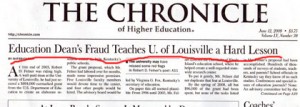
Yesterday we shared three lengthy articles from The Chronicle of Higher Education that essentially served as an indictment of the University of Louisville’s leadership team. The stories detailed the long nightmare of the Robert Felner scandal and the embarrassing lack of action and willful ignorance on the part of UofL’s head honchos.

Taylor & Francis reverses controversial publication deal

Inside Higher Ed: Et Tu, New Publisher?

Nearly four years after an academic journal nixed plans to publish a piece about sex between adult and adolescent males of antiquity, the controversy is erupting again. This time, however, it’s not conservative critics yelling the loudest. A group of classicists, now twice thwarted in efforts to publish on the provocative subject, have taken aim at one of the world’s largest publishers, saying Taylor & Francis Group has placed reputational concerns above the legitimate scholarly pursuits it ought to promote.

The story dates to 2005, when Haworth Press announced amid heavy criticism that its Journal of Homosexuality wouldn’t publish an article or book chapter about sexual relationships between men and boys in antiquity. Critics had learned of a particularly controversial piece in the forthcoming collection, which would argue that such relationships “can benefit the adolescent” in certain circumstances, prompting allegations that the author was advocating child molestation. Those allegations were trumpeted first and loudest by the Web site World Net Daily, whose readers vigorously complained to Haworth.

Second guessing Israeli-Palestinian conference

Inside Higher Ed: Second Guessing a Conference

In a move some critics have called unprecedented and dangerous, a Canadian government official has asked its humanities granting council to reconsider the funding of an academic conference some Jewish groups are calling “anti-Israeli” and “anti-Semitic.”

Gary Goodyear, minister of state for science and technology, asked the Social Sciences and Humanities Research Council – the Canadian equivalent of the National Endowment for the Humanities – to reconsider its awarding of $19,750 in funding for an upcoming conference at York University, in Toronto.

Greenwood chosen as new UHawaii president

Honolulu Star Bulletin: Greenwood chosen as new UH president

The University of Hawaii Board of Regents unanimously selected M.R.C. Greenwood today to become the next UH president after current UH President David McClain steps down on July 31.

Greenwood, 66, will be the first woman to lead the 10 campus UH system.

Greenwood will be paid $475,008 a year, board chairman Allan Landon said. But if UH administrators, as expected, are asked to take a salary cut because of the state’s budget crisis, Greenwood’s salary would be reduced by the same percentage.

McClain makes $414,096. Landon said the regents raised the salary for the position because a salary survey showed that was the amount needed to attract top candidates.

In a written statement, Greenwood said: “I am honored to be selected as the next president of the University of Hawaii. I know, and appreciate, how vitally important the university is to the state of Hawaii.”

“I am proud and very pleased to be joining such a fine institution, one that is and will continue to be, a vital resource to the state of Hawaii, the Asia-Pacific region and the worldwide community.

“I know that I have much to learn about Hawaii and its rich cultural and linguistic heritage. I believe that to succeed in the future one must appreciate the lessons and values of the past.”

Greenwood will start no later than Aug. 24, Landon said. She will have a three-year contract with options for renewal for each of the next two years. The position also comes with the use of College Hill, the UH president’s residence, a car allowance and expense account.

Landon said Greenwood was “the best fit” as president, citing her research background and experience in higher education.

He said he was confident she would be able to learn and adjust to the local culture here.

Greenwood has extensive experience as a university administrator and is a noted researcher in nutrition and obesity, but she also comes with some ethical baggage.

She resigned as provost, the second highest position in the UC system, in the midst of a investigation into her participation in the hiring of a friend and business partner for a high-paying position in the UC system office. The investigation found that she had violated the university’s conflict of interest policy by not reporting her shared ownership of a rental property and that she should not have participated in hiring her friend. Greenwood has since admitted her mistake and apologized.

The UH president search committee said it vetted Greenwood and concluded that what happened was an inadvertent mistake.

Landon said the search committee and the regents were confident that Greenwood’s participation in the hiring of a friend and business partner were an uncharacteristic mistake and that she had learned from it.

“If anyone has ever gone through this, it is a painful, painful experience,” Landon said. “Dr. Greenwood brings the silver lining of that dark cloud with her.”

Greenwood is currently director of the Foods For Health Initiative at the University of California at Davis. She also served as chancellor at UC Santa Cruz for eight years and worked in the White House Office of Science and Technology during the Clinton administration.

McClain pledged his full support to Greenwood, who will become the 14th UH president and said he would work with her during the transition.

Public testimony before the regents went into executive session was split on Greenwood.

UH Professor David Ross, speaking for the Faculty Senate, said they trusted the faculty representatives on the search committee and “we do not believe we can do better than Dr. Greenwood by going down the list.”

Ross said the worst thing that could happen would be for the regents to appoint an interim president while the search continued. “We think the choice is clear,” he said.

But Doodie Downs, an information center specialist at Hawaii Community College, urged the regents to expand the search.

“One candidate left standing is not enough,” she said. “This is not a choice.”

Downs said she would like to see someone who understands Hawaii.

“This particular candidate has a shadow over her,” Downs added.

Several native Hawaiian faculty and campus organizations also testified against Greenwood’s selection, asking the regents to appoint an interim president from among the current UH leadership, who they said would better understand Hawaii and the budget cuts that are coming.

J.N. Musto, the executive director of the UH faculty union, pointed out that the regents are also being asked to approve Mike Rota as chancellor of Honolulu Community College. Rota, Musto noted, was not on the search committee’s list of finalists for the position.

Liana Hofschneider, former chairwoman of the UH Student Congress, told the regents Greenwood would be the right choice.

“More (candidates) doesn’t mean it’s better,” she said.

The University of Hawaii Board of Regents unanimously selected M.R.C. Greenwood today to become the next UH president after current UH President David McClain steps down on July 31.

Greenwood, 66, will be the first woman to lead the 10 campus UH system.