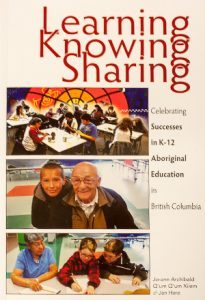
Listed below are selected teacher resources, picture books, fiction, and non-fiction related to storytelling and oral traditions in Indigenous literature and education.
Vous trouverez ci-dessous une sélection de ressources pour enseignants, de livres d’images, d’ouvrages de fiction et d’ouvrages non romanesques liés aux contes et aux traditions orales dans la littérature et l’éducation indigènes.
Teacher Resources (Ressources pour les enseignants)
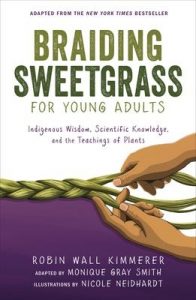
by Robin Wall Kimmerer; adapted by Monique Gray Smith; illustrations by Nicole Neidhardt
Niveau scolaire (Grade level): 7 – 12
Drawing from her experiences as an Indigenous scientist, botanist Robin Wall Kimmerer demonstrates how all living things—from strawberries and witch hazel to water lilies and lichen—provide us with gifts and lessons every day in her best-selling book Braiding Sweetgrass. Adapted for young adults by Monique Gray Smith, this new edition reinforces how wider ecological understanding stems from listening to the earth’s oldest teachers: the plants around us. Bringining Indigenous wisdom, scientific knowledge, and the lessons of plant life to a new generation.
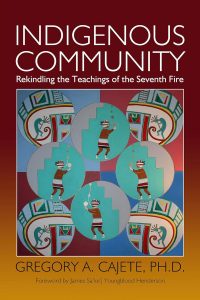 Indigenous community: rekindling the teachings of the seventh fire,
by Gregory A. Cajete, Ph.D.; foreword by James Sa’ke’j Youngblood Henderson
Niveau scolaire (Grade level): 9 – 12
Indigenous Community explores how community is the foundation and lifeblood of Indigenous education as well as the path to sustainable ways of life. In the words of Greg Cajete, the author, What I want Indigenous readers to get is that, along with our efforts to revitalize culture and language, we must also revitalize and sustain our sense for community, because it is the context in which culture and language flourish.
 Learning and teaching together : weaving indigenous ways of knowing into education,
by Michele T.D. Tanaka
Niveau scolaire (Grade level): Kindergarten – 12 (K-12)
Across Canada, teachers unfamiliar with Aboriginal approaches to learning are seeking ways to respectfully weave Aboriginal content into their lessons. It recounts how pre-service teachers immersed in a cross-cultural course in British Columbia began to practise Indigenous ways of knowing. Working alongside Indigenous wisdom keepers, they transformed earth fibres into a mural and, in the process, their own ideas about learning and teaching.
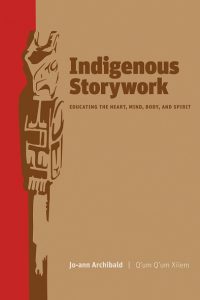 Indigenous storywork: Educating the heart, mind, body, and spirit,
by Jo-Ann Archibald
Niveau scolaire (Grade level): Kindergarten – 12 (K-12)
Builds on the seven principles of respect, responsibility, reciprocity, reverence, holism, interrelatedness, and synergy that form a framework for understanding the characteristics of stories, appreciating the process of storytelling, establishing a receptive learning context, and engaging in holistic meaning-making. Archibald worked closely with Elders and storytellers in order to develop ways of bringing storytelling into educational contexts. (eBook)
 Culturally Relevant Aboriginal Education,
by Nicole Bell and Terrylynn Brant
Niveau scolaire (Grade level): Kindergarten – 12 (K-12)
Provides teacher candidates and in-service teachers with relevant information to help them integrate Aboriginal, First Nations, Métis, and Inuit content, customs, and traditions into the classroom, providing students with a broader perspective of Canada and its population. Includes a chapter on storytelling and Aboriginal pedagogy.
 Braiding histories: Learning from Aboriginal peoples’ experiences and perspectives,
by Susan D. Dion
Niveau scolaire (Grade level): 10 – 12
Reflecting on the process of writing a series of stories, Dion takes up questions of (re)presenting the lived experiences of Aboriginal people in the service of pedagogy. Investigating what happened when the stories were taken up in history classrooms, she illustrates how our investments in particular identities structure how we hear and what we are “willing to know”. Will appeal to readers seeking a better understanding of colonialism and Aboriginal–non-Aboriginal relations. (eBook)
 Indigenous peoples and climate change,
by Marla Tomlinson
Niveau scolaire (Grade level): Kindergarten – 12 (K-12)
Indigenous Peoples and Climate Change is part of the series on Canada’s Changing Climate: Problems and Solutions. This series investigates the impact of climate change on Canada’s peoples, place and lifestyle.
Picturebooks
 How the robin got its red breast: A legend of the Sechelt People,
by The Sechelt Nation and Donna Joe, illustrated by Charlie Craigan
Niveau scolaire (Grade level): Préscolaire – 3 (PreK-3)
These traditional teaching legends come straight from the oral traditions of the Sechelt Nation. Simple and beautifully presented cautionary tales which include some Shishalh language. See also Mayuk the grizzly bear: A legend of the Sechelt People
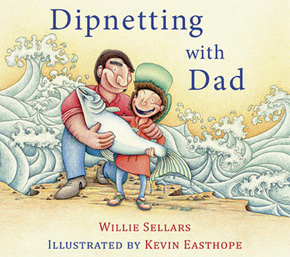
by Willie Sellars; illustrated by Kevin Easthope
Niveau scolaire (Grade level): 1 – 3
Set in the beautiful landscape of the Cariboo Chilcotin region, Dipnetting with dad is a delightful and colourful story of a father teaching his son the Secwepemc method of fishing known as dipnetting. Together they visit the sweat lodge, mend the nets, select the best fishing spot and catch and pack their fish through rugged bush back to the family home for traditional preparation.
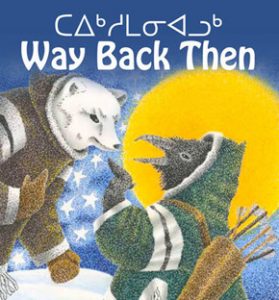 Taiksumanialuk / titiraqtat Niil Kuristavumut ; titiraujaqtat Jirmai Arnattaujurmut = Way back then,
by Neil Christopher; illustrated by Germaine Arnaktauyok
Niveau scolaire (Grade level): Préscolaire – Kindergarten
Kamik finally has his first sled, and he and Jake can finally begin exploring the tundra together. But Jake and Kamik are still inexperienced, and when a blizzard starts blowing in across the tundra, Jake has to rely on his knowledge to get home.
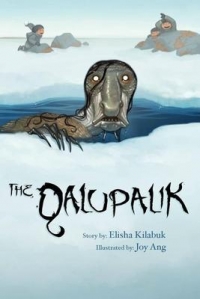
by Elisha Kilabuk, illustrated by Joy Ang
Niveau scolaire (Grade level): 1 – 3
All Inuit know about Qallupilluit, strange creatures that live under the sea ice and carry away unsuspecting children on their backs. But when one bright young orphan strays too close to the ice, he soon learns that while Qallupilluit may be very scary, they are also easily tricked. The Qalupalik is the first installment in The Unikkaakuluit Series a new, beautifully illustrated children’s series based on the work of celebrated contemporary Inuit storytellers.
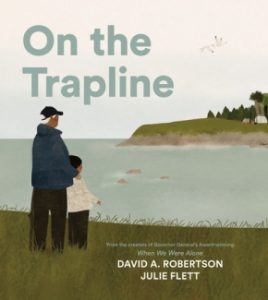
by David A. Robertson ; illustrated by Julie Flett
Niveau scolaire (Grade level): Préscolaire – 3 (PreK-3)
A boy and Moshom, his grandpa, take a trip together to visit a place of great meaning to Moshom. A trapline is where people hunt and live off the land, and it was where Moshom grew up. As they embark on their northern journey, the child repeatedly asks his grandfather, “Is this your trapline?” Along the way, the boy finds himself imagining what life was like two generations ago — a life that appears to be both different from and similar to his life now.
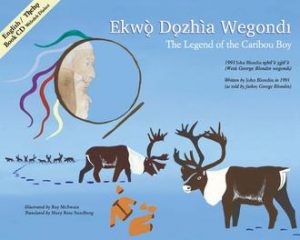 Ekwǫ̀ dǫzhìa wegondi (The legend of the Caribou Boy),
by John Blondin in 1993, as told by father, George Blondin, illustrated by Ray McSwain, translated by Mary Rose Sundberg
Niveau scolaire (Grade level): 2 – 4
A young boy is having trouble sleeping at night. He is being called to fulfill his destiny, a destiny which lives on today in the traditions and culture of the Dene people and their relationship to the caribou and the land on which they live. Although Dogrib Elder George Blondin is being acknowledged as the author and storyteller, this legend originated in Dene oral tradition several generations ago.
Fiction
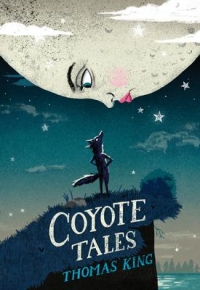
by Thomas King; illustrations by Byron Eggenschwiler
Niveau scolaire (Grade level): Kindergarten – 4
Two tales, set in a time “when animals and human beings still talked to each other,” display Thomas King’s cheeky humor and master storytelling skills. Freshly illustrated and reissued as an early chapter book, these stories are perfect for newly independent readers.
by Michael Nicoll Yahgulanaas
Niveau scolaire (Grade level): 7 – 12
Referencing a classic Haida oral narrative, this stunning full-colour graphic novel documents the powerful story of Red, a leader so blinded by revenge that he leads his community to the brink of war and destruction. Red blends traditional Haida imagery into a Japanese manga-styled story. Tragic and timeless, it is reminiscent of such classic stories as Oedipus Rex, Macbeth and King Lear. Also available as an eBook.
 Strangers: The Reckoner trilogoy, book 1,
by David A. Robertson
Niveau scolaire (Grade level): 9 – 12
With the aid of an unhelpful spirit, a disfigured ghost, and his two oldest friends, Cole tries to figure out his purpose, and unravel the mysteries he left behind a decade ago. Will he find the answers in time to save his community?This mystery-suspense novel incorporates elements of Indigenous storytelling using a modern lens. Coyote features prominently in this series, taking up the role of trickster.
Non-Fiction
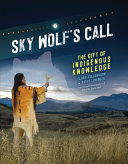 Sky Wolf’s call: the gift of Indigenous knowledge,
by Eldon Yellowhorn & Kathy Lowinger
Niveau scolaire (Grade level): 6 – 8
In Sky Wolf’s Call, award-winning author team of Eldon Yellowhorn and Kathy Lowinger reveal how Indigenous knowledge comes from centuries of practices, experiences, and ideas gathered by people who have a long history with the natural world. Indigenous knowledge is explored through the use of fire and water, the acquisition of food, the study of astronomy, and healing practices.
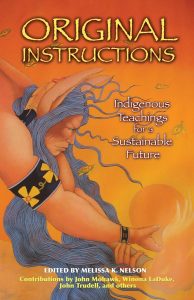 Original instructions: indigenous teachings for a sustainable future,
by Melissa K. Nelson
Niveau scolaire (Grade level): 11 – 12
For millennia the world’s indigenous peoples have acted as guardians of the web of life for the next seven generations. They’ve successfully managed complex reciprocal relationships between biological and cultural diversity. Awareness of indigenous knowledge is reemerging at the eleventh hour to help avert global ecological and social collapse. Indigenous cultural wisdom shows us how to live in peace–with the earth and one another.
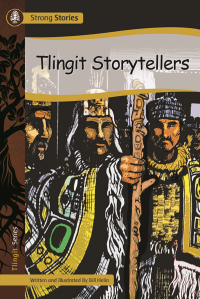
by Bill Helin
Niveau scolaire (Grade level): 2 – 4
In this book, Bill Helin explains the importance of stories and storytellers to the culture and history of the Tlingit people. Often using animals of the forest and ocean as characters, the storytellers wove teachings of survival, respect, and family life into the fabric of their stories.
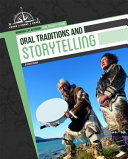 Oral traditions and storytelling,
by Anita Yasuda
Niveau scolaire (Grade level): 4 – 6
Explores the role of storytelling in Indigenous culture and how they are keeping their oral traditions alive for future generations. Part of the Indigenous Life in Canada series.
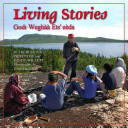 Living stories = godı weghàà ets’ eèda,
by Therese Zoe, Philip Zoe, and Mindy Willett, photographs by Tessa Macintosh
Niveau scolaire (Grade level): 4 – 7
In Living Stories, Therese Zoe translates the stories and traditional wisdom of Tlicho Elders Philip Zoe and Elizabeth Chocolate. Join Tlicho young people, Shelinda, Forest, and Bradley, as they learn about making dry-fish, bows and arrows, and birch-bark baskets; the practices of old-time healers; as well as the sacred stories that tell the history of the Tlicho people. Part of The Land is Our Storybook series.
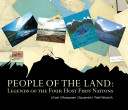 People of the land: Legends of the four host First Nations,
by Johnny Abraham and other contributors
Niveau scolaire (Grade level): 4 – 9
An anthology of the sacred legends of the four host First Nations, the Lil’wat, Musqueam, Squamish, and Tsleil-Waututh which have been passed down from generation to generation through the Elders and are integral to the teachings and oral traditions of First Nations people. These stories link people to the land and to each other and pass on traditional knowledge and history.
by Richard Wagamese
Niveau scolaire (Grade level): 10 – 12
Focuses on stories: how they shape us, how they empower us, how they change our lives. Ancient and contemporary, cultural and spiritual, funny, and sad, the tales are grouped according to the four Ojibway storytelling principles: balance, harmony, knowledge, and intuition. (eBook)
 The truth about stories: A Native narrative,
by Thomas King
Niveau scolaire (Grade level): 10 – 12
Beginning with Native oral stories, King weaves his way through literature and history, religion and politics, popular culture and social protest, in an effort to make sense of North America’s relationship with its Aboriginal peoples.
Trouver d’autres ressources
Voici quelques conseils pour trouver d’autres ressources dans ce domaine :
- Sur la page principale du site de la bibliothèque de l’UBC, utilisez la boîte de recherche générale pour rechercher des matériaux à travers toutes les succursales de la bibliothèque de l’UBC.
- Pour limiter vos résultats aux matériels disponibles à la Bibliothèque de l’éducation, visitez le site web de la Bibliothèque de l’éducation et effectuez une recherche à l’aide de la case “Search Education Resources” située dans la bande à gauche de l’écran.
- Remarque : les ressources étant principalement cataloguées en anglais, les termes ci-dessous donnent généralement plus de résultats que les recherches effectuées en français. Vous pouvez filtrer votre liste de résultats par langue dans la barre latérale de gauche.
- Utilisez des termes de recherche spécifiques, tels que
- “First Nations”, “Indigenous”, “Oral Tradition”, ou “Indigenous peoples AND Storytelling”
- Pour trouver des plans de cours, incluez “lesson plans”, “lesson planning”, or “activity programs” dans vos termes de recherche.
Finding More Resources
To find more resources in this area, try the following:
- Search using the General tab on the UBC Library website to look for material in all UBC Library branches.
- Search using “Search Education Resources” box in the left hand bar on the Education Library website to limit your results to physical materials in the Education Library.
- Use specific search terms, such as
- “First Nations”, “Indigenous”, “Oral Tradition”, or “Indigenous peoples AND Storytelling”
- To find lesson plans, include “lesson plans”, “lesson planning”, “juvenile fiction” or “activity programs” in your search terms.