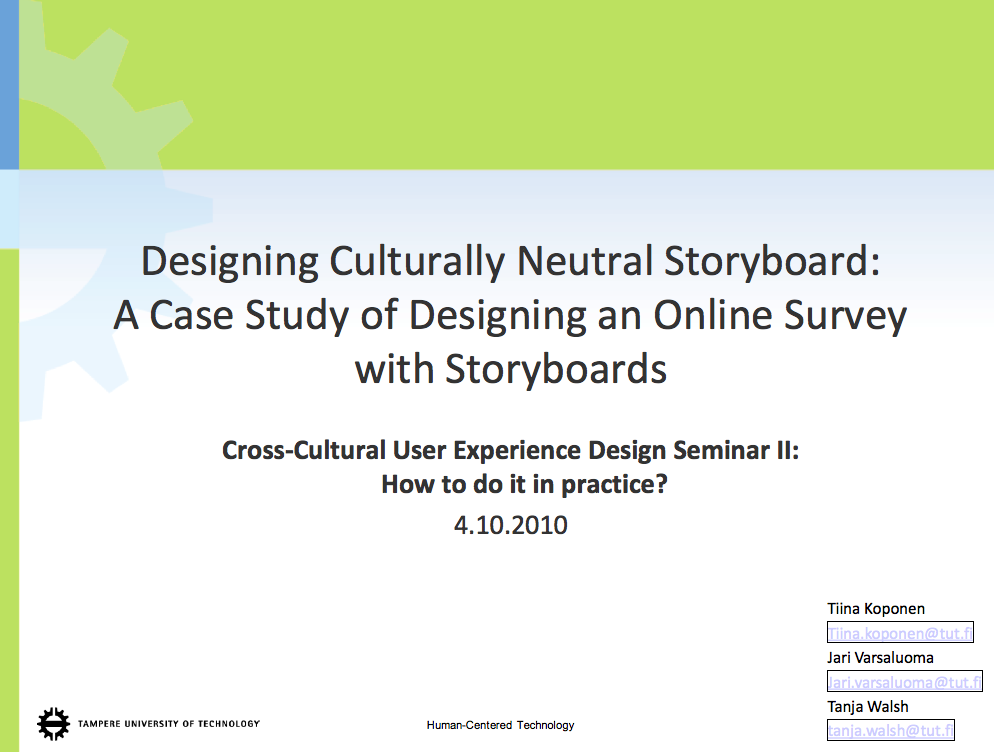
In Module 1, we’ve examined whether or not technology is culturally neutral. Our readings and interactions thus far have indicated it is not. I have discovered online a case study by the Tampere University of Technology which examines the design of an online survey using what is described as a “culturally neutral storyboard.” Many of the questions related to social networking services. While not explicitly related to aboriginal education, I thought this tied in nicely with our module one discussion on the cultural neutrality of technology, particularly since it was using storyboards as a vehicle. Aboriginal history, being based on an oral tradition, I believe can likely identify more with storyboarding as their history is, indeed, based on a series of stories. It was interesting to note in this study the different reactions different cultural groups would give to certain storyboard images. For example, Indian respondents interpreted a bunch of friends on a beach to be a family gathering, whereas other cultural groups may interpret the gathering differently. The results of the study identified a few main findings, including the fact that storyboards helped respondents to understand difficult concept ideas and imagine themselves into the use situations, which made answering to the social networking services questions easier and fun. In addition, the storyboards themselves were well understood by users with different cultural backgrounds. The case study presentation can be found online here.
Gitxaata & BC’s North Coast Economy
After watching the film “Returning to Gitxaata”, I became more interested in learning more about this area of British Columbia and the history behind it. My search led me to a paper online which explores the role of indigenous peoples in the resource extraction industry of British Columbia. It does this by focusing on both the Ts’msyen and Gitxaata people, who we are already familiar with. The paper identifies non-indigenous newcomers as “K’mksiwah” and appropriately decries their history of “discovery” as being misleading. The paper describes the social and economic context under which the Gitxaata people operate, offering insight into many of the primary industries which sustain the community. A historical perspective reveals the important role the Ts’msyen and Gitxaala peoples have played in the development of British Columbia’s resource economy. I’m happy to have been introduced to this community of Northern British Columbia, which I may have otherwise not known about! I hope you may find the linked paper useful and/or interesting.
Module 1: UBC Vancouver Aboriginal Portal
The recently-launched UBC Vancouver Aboriginal Portal is a way to connect students, scholars, and the public with issues relating to higher education, Aboriginality and inquiry at UBC. I believe the Portal is coordinated by the UBC’s First Nations House of Learning. With a heavy focus on video, the Portal respects the tradition of orality and the “Feature Stories” provide relevant information through digital storytelling. The Portal contains information for for current and prospective Aboriginal students of UBC, links to the myriad of programs at UBC relating specifically to Aboriginal issues, an overview research and initiatives across the university relating to Aboriginal issues, and an overview of the university’s First Nation’s community and youth programs.
You can also follow UBC’s First Nations Longhouse on Facebook 🙂
Connecting Weblog to Research Interests
In my current position as the District Technology Coordinator in SD 58 (Nicola Similkameen) part of my job is to implement and maintain the Aboriginal education section of our website. Our district student composition is over 40% Aboriginal (60% in Merritt and much lower in Princeton). As a person with no Aboriginal heritage I believe it necessary to develop my understanding of Aboriginal culture and views on education if I am to properly implement an Aboriginal learning website. The vision for the SD 58 Aboriginal website is to create a place for documenting ongoing projects and events as well as a resource for teachers integrating Aboriginal curriculum and a database for local Aboriginal history, language and culture.
With this in mind my weblog will focus on analyzing Aboriginal education sites targeting youth. The visited sites will include everything from international to local sites. My focus will be on the educational and cultural aspects of each of these sites. Specifically I want to explore how to create a valuable localized resources for an Aboriginal group. In doing this I hope to develop a culturally and educationally important resource for the students I work with as well as the community as a whole.
FNESC
FNESC.ca is the website for the First Nations Educational Steering Committee. This committee is an independent society created with the goal of improving First Nations education in British Columbia (learners in the public system and in First Nation schools). This site looks to address all aspects of education relating to First Nation learners (i.e. post-secondary, Special Education, community programs, work experience, scholarships and bursaries, etc.). From this site links are provided to other Aboriginal based education sites as well as non-Aboriginal education sites. This site provides a rich resource to First Nations students and schools alike.
Module 1: Aboriginal Education, Literacy, and Libraries
Indigenous tribes in Canada have a long history of oral tradition and most often did not have a traditional written language. Considering our discussions this week about the goals of Aboriginal Education versus the euro-centric mainstream and the struggles of Aboriginal children to relate to westernized instruction methods, perhaps it is no surprise that Aboriginal literacy rates in Canada are often lower than non-Aboriginal literacy rates. Compounding struggles for literacy is the fact that neither provincial nor federal library funding extends to Aboriginal reserve lands. Realizing the importance of literacy, First Nations in BC have begun to found private libraries on Reserve land. The first on-reserve library in British Columbia was opened in 2007 on Haida Gwaii, and more recently the Thistalalh Memorial Library opened it’s doors to the coastal community of Bella Bella. As a place for stories, oral traditions, games, family time and more, Libraries may become a more common feature of Reserve communities.
What’s it like to be immersed in a different value system and lose your identity? (Allen Module 1 #2)
Dr. Lee Brown’s video in Module 1 made me wonder what it would be like to have my culture suppressed. With no context of my own what better way to relate than hear a story from a fellow privileged white male (albeit a much smarter, articulate and famous one!)
Last week I was at an ET conference for community college teachers in Sarnia ON. Anthropologist Dr. Michael Wesch was a keynote speaker. He did a presentation on digital technology and global society.
He explained how he stayed in isolated communities in Papua New Guinea for 2 years. According to Dr. Wesch, he lost his entire identify while there. While immensely popular with hundreds of thousands of Web 2.0 followers, he had no reputation or following with the people he encountered. Unable to communicate, and with few “survivor skills”, he had little currency with these people. Vicariously, I can see how “different” his environment was and possibly what it might be like for others to be landed in learning environments unnatural to them.
[youtube]https://www.youtube.com/watch?v=pTE-eISav_Y[/youtube]
While his presentation recording is not available, I was able to find a video that gives a pretty good summary of his presentation. The video is a quite long, however, even if you can watch the first 5 minutes it will be worth it.
Visit Dr. Wesch’s University of Kansas web site for more information about his work.
Module 1- WNCP- The Common Curriculum Framework for Aboriginal Languages and Culture Programs
The following document is a collaborative framework that represents the values and beliefs inherent in all Aboriginal cultures. I find it quite interesting for I have yet to come across such a resource in Eastern Canada. The Common Curriculum Framework for Aboriginal Languages and Culture Programs: Kindergarten to Grade 12. This document is meant to scaffold schools and districts in Western provinces and the territories when developing curricula or learning resources that emphasize Aboriginal language.
Journal of American Indian Education
http://jaie.asu.edu/
The main aim of this peer-reviewed journal is “to improve Native Education through knowledge generation and transmission to classrooms and other educational settings”. While the journal is hosted by Arizona State University, USA, and its editorial board largely consists of US-based scholars, it seems to cover a wide range of indigenous issues of all Americas. For instance, it published an interesting article entitled Aboriginal Education in Canada: A Retrospective and a Prospective by V.J. Kirkness (2000) which overviews the development of indigenous education in Canada.
Ky.
Canadian Journal of Native Education
This journal (Website) that is published by UBC’s Faculty of Education and University of Alberta’s Department of Educational Policy Studies provides a wide range of interesting and timely topics on indigenous education, with particular reference to a Canadian context. The full-texts are available via UBC Library service. Avaiable via ProQuest
Ky.
