
Monthly Archives: December 2025

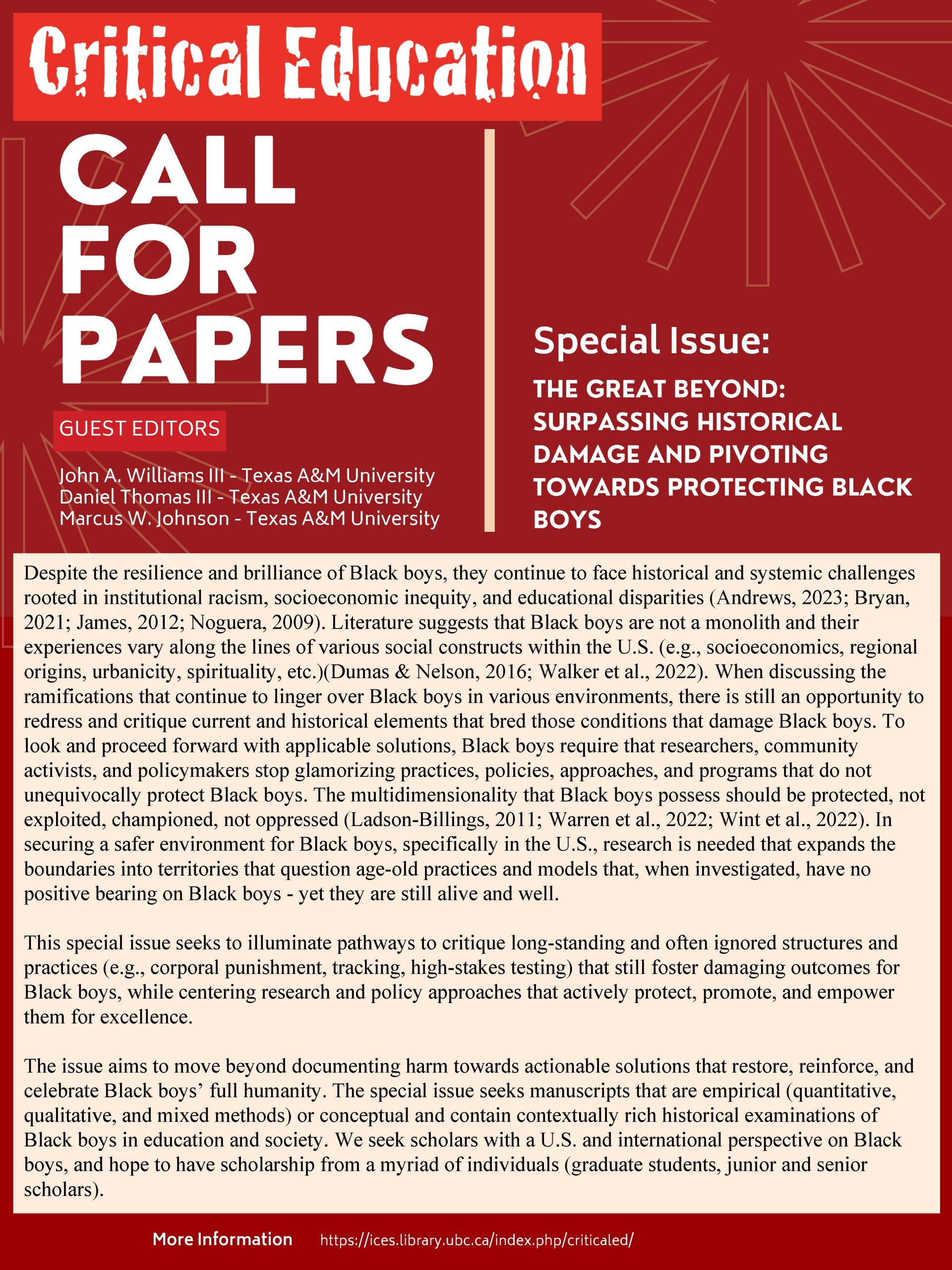
Critical Education Special Issue Call for Papers — THE GREAT BEYOND: SURPASSING HISTORICAL DAMAGE AND PIVOTING TOWARDS PROTECTING BLACK BOYS

Special Issue Call for Papers — THE GREAT BEYOND: SURPASSING HISTORICAL DAMAGE AND PIVOTING TOWARDS PROTECTING BLACK BOYS

Guest Editors:

John A. Williams III – Texas A&M University
Daniel Thomas III – Texas A&M University
Marcus W. Johnson – Texas A&M University

Despite the resilience and brilliance of Black boys, they continue to face historical and systemic challenges rooted in institutional racism, socioeconomic inequity, and educational disparities (Andrews, 2023; Bryan, 2021; James, 2012; Noguera, 2009). Literature suggests that Black boys are not a monolith and their experiences vary along the lines of various social constructs within the U.S. (e.g., socioeconomics, regional origins, urbanicity, spirituality, etc.) (Dumas & Nelson, 2016; Walker et al., 2022). When discussing the ramifications that continue to linger over Black boys in various environments, there is still an opportunity to redress and critique current and historical elements that bred those conditions that damage Black boys. To look and proceed forward with applicable solutions, Black boys require that researchers, community activists, and policymakers stop glamorizing practices, policies, approaches, and programs that do not unequivocally protect Black boys. The multidimensionality that Black boys possess should be protected, not exploited, championed, not oppressed (Ladson-Billings, 2011; Warren et al., 2022; Wint et al., 2022). In securing a safer environment for Black boys, specifically in the U.S., research is needed that expands the boundaries into territories that question age-old practices and models that, when investigated, have no positive bearing on Black boys – yet they are still alive and well.

This special issue seeks to illuminate pathways to critique long-standing and often ignored structures and practices (e.g., corporal punishment, tracking, high-stakes testing) that still foster damaging outcomes for Black boys, while centering research and policy approaches that actively protect, promote, and empower them for excellence.

The issue aims to move beyond documenting harm towards actionable solutions that restore, reinforce, and celebrate Black boys’ full humanity. The special issue seeks manuscripts that are empirical (quantitative, qualitative, and mixed methods) or conceptual and contain contextually rich historical examinations of Black boys in education and society. We seek scholars with a U.S. and international perspective on Black boys and hope to have scholarship from a myriad of individuals (graduate students, junior and senior scholars).

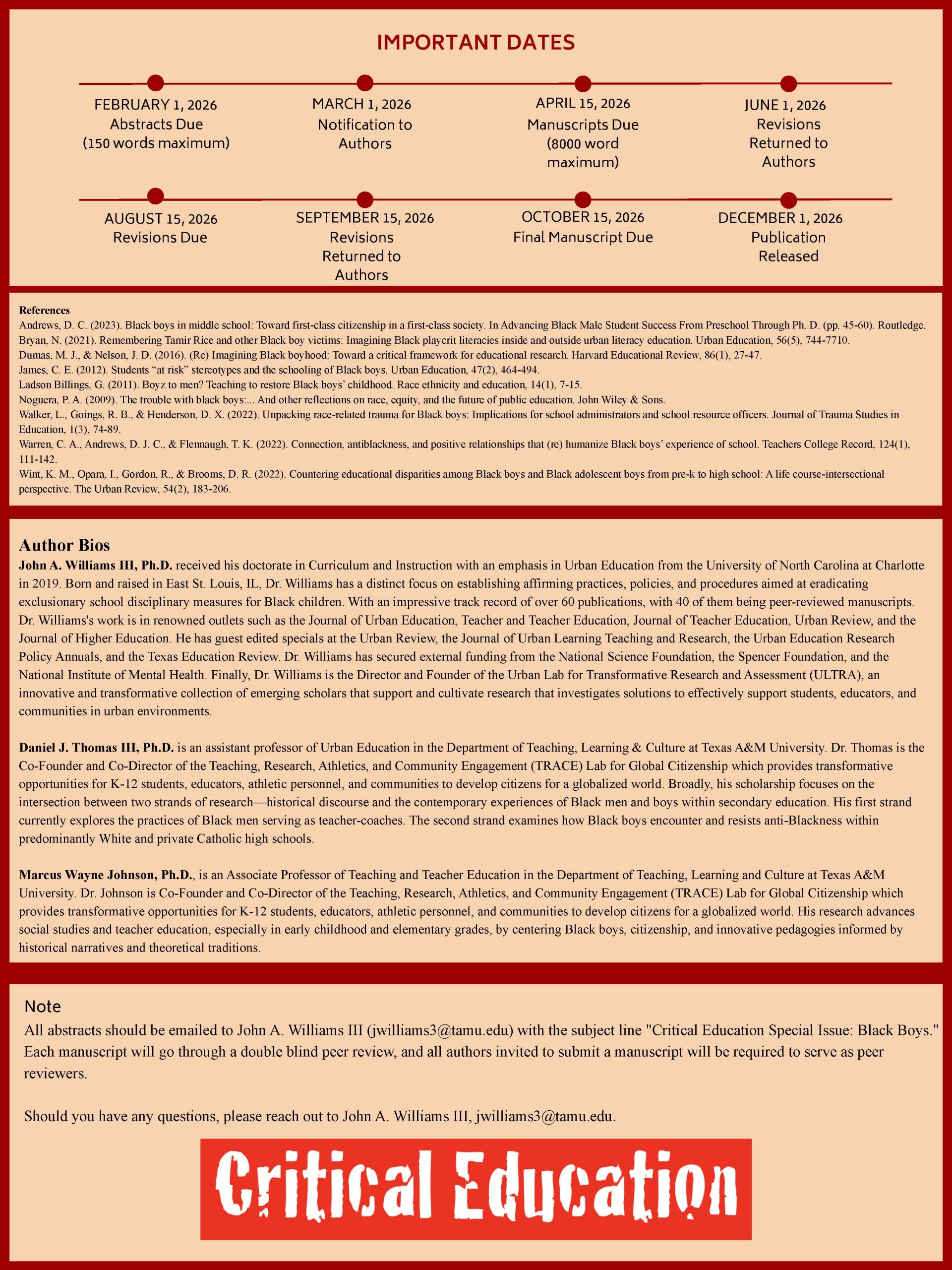
All abstracts should be emailed to John A. Williams III (jwilliams3@tamu.edu) with the subject line “Critical Education Special Issue: Black Boys.” Abstracts due: February 1, 2016.

 Each manuscript will go through a double blind peer review, and all authors invited to submit a manuscript will be required to serve as peer reviewers.

 Should you have any questions, please reach out to John A. Williams III, jwilliams3@tamu.edu.

 References

Andrews, D. C. (2023). Black boys in middle school: Toward first-class citizenship in a first-class society. In Advancing Black Male Student Success from Preschool Through Ph.D. (pp. 45-60). Routledge.

Bryan, N. (2021). Remembering Tamir Rice and other Black boy victims: Imagining Black playcrit literacies inside and outside urban literacy education. Urban Education, 56(5), 744-7710.

Dumas, M. J., & Nelson, J. D. (2016). (Re) Imagining Black boyhood: Toward a critical framework for educational research. Harvard Educational Review, 86(1), 27-47.

James, C. E. (2012). Students “at risk” stereotypes and the schooling of Black boys. Urban Education, 47(2), 464-494.

Ladson Billings, G. (2011). Boyz to men? Teaching to restore Black boys’ childhood. Race ethnicity and education, 14(1), 7-15.

Noguera, P. A. (2009). The trouble with black boys:… And other reflections on race, equity, and the future of public education. John Wiley & Sons.

Walker, L., Goings, R. B., & Henderson, D. X. (2022). Unpacking race-related trauma for Black boys: Implications for school administrators and school resource officers. Journal of Trauma Studies in Education, 1(3), 74-89.

Warren, C. A., Andrews, D. J. C., & Flennaugh, T. K. (2022). Connection, antiblackness, and positive relationships that (re) humanize Black boys’ experience of school. Teachers College Record, 124(1),111-142.

Wint, K. M., Opara, I., Gordon, R., & Brooms, D. R. (2022). Countering educational disparities among Black boys and Black adolescent boys from pre-k to high school: A life course-intersectional perspective. The Urban Review, 54(2), 183-206.
Critical Education Special Issue CFP: THE GREAT BEYOND: SURPASSING HISTORICAL DAMAGE AND PIVOTING TOWARDS PROTECTING BLACK BOYS

Special Issue Call for Papers — THE GREAT BEYOND: SURPASSING HISTORICAL DAMAGE AND PIVOTING TOWARDS PROTECTING BLACK BOYS

Guest Editors:

John A. Williams III – Texas A&M University
Daniel Thomas III – Texas A&M University
Marcus W. Johnson – Texas A&M University

Despite the resilience and brilliance of Black boys, they continue to face historical and systemic challenges rooted in institutional racism, socioeconomic inequity, and educational disparities (Andrews, 2023; Bryan, 2021; James, 2012; Noguera, 2009). Literature suggests that Black boys are not a monolith and their experiences vary along the lines of various social constructs within the U.S. (e.g., socioeconomics, regional origins, urbanicity, spirituality, etc.) (Dumas & Nelson, 2016; Walker et al., 2022). When discussing the ramifications that continue to linger over Black boys in various environments, there is still an opportunity to redress and critique current and historical elements that bred those conditions that damage Black boys. To look and proceed forward with applicable solutions, Black boys require that researchers, community activists, and policymakers stop glamorizing practices, policies, approaches, and programs that do not unequivocally protect Black boys. The multidimensionality that Black boys possess should be protected, not exploited, championed, not oppressed (Ladson-Billings, 2011; Warren et al., 2022; Wint et al., 2022). In securing a safer environment for Black boys, specifically in the U.S., research is needed that expands the boundaries into territories that question age-old practices and models that, when investigated, have no positive bearing on Black boys – yet they are still alive and well.

This special issue seeks to illuminate pathways to critique long-standing and often ignored structures and practices (e.g., corporal punishment, tracking, high-stakes testing) that still foster damaging outcomes for Black boys, while centering research and policy approaches that actively protect, promote, and empower them for excellence.

The issue aims to move beyond documenting harm towards actionable solutions that restore, reinforce, and celebrate Black boys’ full humanity. The special issue seeks manuscripts that are empirical (quantitative, qualitative, and mixed methods) or conceptual and contain contextually rich historical examinations of Black boys in education and society. We seek scholars with a U.S. and international perspective on Black boys and hope to have scholarship from a myriad of individuals (graduate students, junior and senior scholars).

All abstracts should be emailed to John A. Williams III (jwilliams3@tamu.edu) with the subject line “Critical Education Special Issue: Black Boys.” Abstracts due: February 1, 2016.

 Each manuscript will go through a double blind peer review, and all authors invited to submit a manuscript will be required to serve as peer reviewers.

 Should you have any questions, please reach out to John A. Williams III, jwilliams3@tamu.edu.

 References

Andrews, D. C. (2023). Black boys in middle school: Toward first-class citizenship in a first-class society. In Advancing Black Male Student Success from Preschool Through Ph.D. (pp. 45-60). Routledge.

Bryan, N. (2021). Remembering Tamir Rice and other Black boy victims: Imagining Black playcrit literacies inside and outside urban literacy education. Urban Education, 56(5), 744-7710.

Dumas, M. J., & Nelson, J. D. (2016). (Re) Imagining Black boyhood: Toward a critical framework for educational research. Harvard Educational Review, 86(1), 27-47.

James, C. E. (2012). Students “at risk” stereotypes and the schooling of Black boys. Urban Education, 47(2), 464-494.

Ladson Billings, G. (2011). Boyz to men? Teaching to restore Black boys’ childhood. Race ethnicity and education, 14(1), 7-15.

Noguera, P. A. (2009). The trouble with black boys:… And other reflections on race, equity, and the future of public education. John Wiley & Sons.

Walker, L., Goings, R. B., & Henderson, D. X. (2022). Unpacking race-related trauma for Black boys: Implications for school administrators and school resource officers. Journal of Trauma Studies in Education, 1(3), 74-89.

Warren, C. A., Andrews, D. J. C., & Flennaugh, T. K. (2022). Connection, antiblackness, and positive relationships that (re) humanize Black boys’ experience of school. Teachers College Record, 124(1),111-142.

Wint, K. M., Opara, I., Gordon, R., & Brooms, D. R. (2022). Countering educational disparities among Black boys and Black adolescent boys from pre-k to high school: A life course-intersectional perspective. The Urban Review, 54(2), 183-206.

Workplace welcomes new Co-Editor Rhiannon M. Maton

Workplace: A Journal for Academic Labor is pleased to announce the addition of new co-editor. Rhiannon M. Maton, PhD is Associate Professor in the Foundations and Social Advocacy Department at the State University of New York at Cortland. Dr. Maton will join Workplace as co-editor in January 2026.

Dr. Maton’s scholarship examines the intersections of teachers’ work, labor activism, and educational inequality across Canada and the U.S. Trained as a critical scholar of education with a Ph.D. from the University of Pennsylvania, Maton’s work brings together labor studies, educational leadership, and critical educational foundations to illuminate how educators understand, resist, and transform the social and material conditions of their work.

Her research has appeared in leading international journals including Teachers College Record; Curriculum Inquiry; History of Education Quarterly; Critical Studies in Education; Journal of Educational Change; and Gender, Work & Organization. She regularly publishes in Critical Education, Workplace, and Spectre journals, and strives to reach a practitioner and public audience through the creative use of multigenre communication methods. Across these publications and others, she advances critical and foresightful analyses of teachers’ work, educators’ grassroots organizing and unions, and the ongoing tensions between a common good ethic and the structural and institutional constraints of public schooling. Her scholarship consistently foregrounds the voices of educator practitioners, organizers, and activists, while drawing attention to their collective potency in challenging structural inequities and expanding the democratic possibilities of schooling. Maton’s research contributions have been recognized through several recent honors, including the Waring & DiNardo Outstanding Achievement in Research Award, which acknowledges her sustained impact on critical scholarship on teachers’ work and labor justice.

In addition to her research, Maton brings extensive editorial experience to her new role as Co-Editor of Workplace: A Journal for Academic Labor. She currently serves as Managing Editor of Wagadu: A Journal of Transnational Women’s and Gender Studies, where she supports feminist, anti-colonial, and gender justice-oriented scholarship through collaborative editorial processes. She views editorial work as a necessary space for elevating the intellectual strength and contributions of the radical left, and is committed to providing one-on-one mentorship and developmental writing support to new and emerging scholars—particularly those historically marginalized in academia.

Maton also plays a significant role in curating and advancing themed scholarship in the fields of labor organizing and teachers’ work. She is a co-editor of the Routledge series Critical Perspectives on Teaching and Teachers’ Work, alongside Denisha Jones and Arlo Kempf. This series brings together scholarship that examines teachers’ labor, professionalism, activism, and the broader social, political, and economic contexts that shape educators’ work globally. Through this role, Maton supports book projects that push the field in new theoretical and political directions, deepening scholarly engagement with issues of justice, labor, and educational transformation.

Her editorial experience also includes guest-editing four special issues of Critical Education with Erin Dyke and Lauren Ware Stark, which highlight interdisciplinary work on educator activism, transformative pedagogies, and the political economies of schooling. Most recently, she co-edited the Routledge Handbook on Teachers’ Work: International Perspectives on Research and Practice with Nina Bascia, a landmark volume mapping the global terrain of educators’ labor, professionalism, and collective action.

Across her research and editorial leadership, Maton remains committed to cultivating rigorous, accessible, and socially engaged scholarship. She looks forward to supporting authors in developing contributions that deepen critical conversations about K-12 and higher education, academic labor, and radical equity-oriented social transformation.

++++++++++

Workplace published its first issue in1998.  Closely connected to activism emerging from the Graduate Student Caucus of the Modern Language Association, the journal’s founding editors were Marc Bousquet (then of the University of Louisville) and Kent Puckett (then of Columbia University, currently UC Berkeley). The journal was originally hosted by the University of Louisville and moved to the University of British Columbia in 2012 with the archive of past issues republished in 2014 on the Open Journal System platform and hosted by the UBC Library.

Previous editors of Workplace include Stephen Petrina (University of British Columbia), Chris Carter (University of Oklahoma), Gordon Lafer (University of Oregon), Gary Rhoades (University of Arizona), Bruce Simon (State University of New York at Fredonia), Bill Vaughn (Central Missouri State University) and
Katherine Wills (then of University of Louisville, currently Indiana University Purdue University Columbus).

Workplace: A Journal of Academic Labor is a refereed, diamond open access journal published by the Institute for Critical Education Studies (ICES) and a collective of scholars in critical university studies, or critical higher education, promoting dignity and integrity in academic work. Contributions are aimed at higher education workplace scholar-activism and dialogue on all issues of academic labor.