Workplace #16 Academic Knowledge, Labor, and Neoliberalism

The Editors of Workplace: A Journal for Academic Labor are pleased to announce the release of Workplace #16—”Academic Knowledge, Labor, and Neoliberalism.”

Check it out at: http://www.workplace-gsc.com

Table of Contents

Articles
Knowledge Production and the Superexploitation of Contingent Academic Labor
Bruno Gulli

The Education Agenda is a War Agenda: Connecting Reason to Power and Power to Resistance
Rich Gibson, E. Wayne Ross

The Rise of Venture Philanthropy and the Ongoing Neoliberal Assault on Public Education: The Eli and Edith Broad Foundation
Kenneth Saltman

Feature Articles
Theses on College and University Administration: A Critical Perspective
John F. Welsh

The Status Degradation Ceremony: The Phenomenology of Social Control in Higher Education
John F. Welsh

Book Reviews
Review of The Last Professors: The Corporate University and the Fate of the Humanities
Desi Bradley

Authentic Bona fide Democrats Must Go Beyond Liberalism, Capitalism, and Imperialism: A Review of Dewey’s Dream: Universities and Democracies in an Age of Education Reform
Richard A. Brosio

Review of Capitalizing on Disaster: Taking and Breaking Public Schools
Prentice Chandler

Review of Pedagogy and Praxis in the Age of Empire: Towards a New Humanism
Abraham P. Deleon

Review of Cary Nelson and the Struggle for the University: Poetry, Politics, and the Profession
Leah Schweitzer

Review of Rhetoric and Resistance in the Corporate Academy
Lisa Tremain

Read the Workplace Blog: https://blogs.ubc.ca/workplace/
Join us on Facebook: http://www.facebook.com/group.php?gid=24374363807&ref=ts

A Call for Copyright Rebellion

Today’s Inside Higher Ed reports on Lawrence Lessig‘s call for copyright rebellion at the Educause Conference in Denver. Lessig is an open access advocate and law professor at Harvard University.

Lessig basic argument is that “the manner in which copyright law is being applied to academe in the digital age is destructive to the advancement of human knowledge and culture, and higher education is doing nothing about it.”

Academics — presumably stakeholders in the effort to advance knowledge — have been uncharacteristically and disturbingly silent on the copyright “insanity” that has befallen the information trade, Lessig said.

“We should see a resistance to imposing the Britney Spears model of copyright upon the scientist or the educator,” he said. “…But if you would expect that, you would be very disappointed by what we see out there in the scientific and and education communities.” Scholars, he said, have allowed the copyright conversation to be steered by lawyers and businesses who are not first and foremost to intellectual discovery.

To them, Lessig delivered a simple message: “Stop it.”

See this, for example.

Call for papers: Neoliberalism and public education

CALL FOR PAPERS

Educational Studies Special Issue:
Neoliberalism and Public Education

Guest Editors: Richard D. Lakes & Patricia A. Carter
Social Foundations of Education
Georgia State University, Atlanta
Email: rlakes@gsu.edu

Increasingly neoliberal economic policies are transforming the delivery of
public education. In the current era of marketplace reforms the idea of
the public has been supplanted by a private ideology of risk management;
whereby, under individualization, students as consumers are taught
responsible choice strategies designed for competitive advantage in the
so-called new economy.

Under Keynesian economics, which held sway in the U.S., Britain, Canada,
and Australia from the 1930s to the Thatcher-Reagan era of the 1980s, the
public sought to ameliorate inequities stemming from race, class and
gender bias, but under neoliberalism the state has shifted to promoting a
meritocratic myth of governing the self. As old collectivities and their
support structures such as working-class labor and unions have begun to
disappear under advanced capitalism so too have their counterparts within
the school system.

In this special issue we seek manuscripts that explore the devolution of
public education under neoliberalism. We are interested in scholarly
papers that trouble the notion of risk in an educational environment of
competitive capitalism, the nature of specialized curriculums that are
devoted to social advantage, the ways in which schools have outsourced
services and privatized operations; and the assaults on teachers’ rights
through de-unionizing practices, the dismantling of seniority, and the
erosion of benefits. We are interested in case studies of neoliberal
designed school-based reforms as well as accounts of teaching about
neoliberalism in the social foundations classroom.

To submit manuscripts please use our online submission and review system
at Manuscript Central: http://mc.manuscriptcentral.com/heds.

Be sure to include a note that your submission is for the Special Issue on
Neoliberalism and Public Education.

Deadline for manuscript submissions: June 1, 2010.

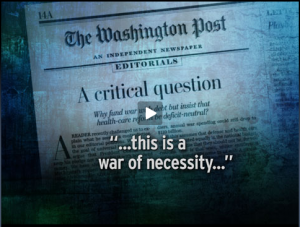
Bill Moyers on “Washington’s War”

Picture 1

Moyer’s links the war, economy, and the disintegration of the social fabric of the US and suggests:

So here’s a suggestion. In a week or so, when the president announces he is escalating the war, let’s not hide the reality behind eloquence or animation. No more soaring rhetoric, please. No more video games. If our governing class wants more war, let’s not allow them to fight it with young men and women who sign up because they don’t have jobs here at home, or can’t afford college or health care for their families.

Let’s share the sacrifice. Spread the suffering. Let’s bring back the draft.

Yes, bring back the draft — for as long as it takes our politicians and pundits to “fix” Afghanistan to their satisfaction.

Bring back the draft, and then watch them dive for cover on Capitol Hill, in the watering holes and think tanks of the Beltway, and in the quiet little offices where editorial writers spin clever phrases justifying other people’s sacrifice. Let’s insist our governing class show the courage to make this long and dirty war our war, or the guts to end it.

http://www.pbs.org/moyers/journal/10302009/watch3.html

More links from Historians Against the War

This is the latest biweekly collection links to recent articles by historians on HAW-relevant topics – or articles by other writers that provide historical background on these. Members of the working group for this project are: Matt Bokovoy, Carolyn (Rusti) Eisenberg, Jim O’Brien, Maia Ramnath, Sarah Shields.

“Honduras: Solution or Stall?”
By Greg Grandin, Z-Net, posted November 2

“Afghanistan as a Bailout State”
By Tom Engelhardt, TomDispatch.com, posted November 1
(applies Vietnam lessons in critiquing all the mainstream policy options under discussion in Washington)

“Afghanistan Déjà vu? Lessons from the Soviet Experience”
Edited by Svetlana Savranskaya, National Security Archive, posted October 30
(contains links to several Soviet primary sources and several newspaper articles based on them, including the Sebestyen op-ed piece listed below)

“Transcripts of Defeat”
By Victor Sebestyen, New York Times, October 29
(on the Soviet defeat in Afghanistan and its parallels to the present)

“Is Obama’s Iran Policy Doomed to Fail?”
By Dilip Hiro, TomDispatch.com, posted October 29

“What Savvy Leaders Could Do to Move Toward a Nuclear-Free World (Obama–Are You Listening?)”
By Lawrence S. Wittner, History News Network, posted October 26

“Review of Alfred W. McCoy, Policing America’s Empire: The United States, the Philippines and the Rise of the Surveillance State”
By Jeremy Kuzmarov, History News Network, posted October 24

No it’s not a conspiracy, it’s “educational reform”

In her latest “Outrage” Susan Ohanian exposes the web of connections among the CEO of Detroit Public Schools, mega textbook publisher Houghton-Mifflin, the American Federation of Teachers and the Broad Foundation’s effort to take control of city school systems via the mayors, while pacifying teacher unions.

Who benefits from this tangled web? Not the kids, not the teachers …

CALL: March 4 Strike and Day of Action To Defend Public Education

On October 24 more than 800 students, teachers, and other workers met to plan how to advance the struggle to defend and transform public education in California and beyond.

The 10/24 conference endorsed the U of California and California State U strike and mobilization on Nov. 17th– 20th and decided to call for statewide solidarity actions on these days.

In addition, Conference participants also called for a “Strike and Day of Action that is inclusive of all different tactics, including: walkouts, rallies, march to Sacramento, teach ins, occupations, and all other forms of protests chosen by schools and organizations.”

CALL: March 4 Strike and Day of Action To Defend Public Education

On October 24, 2009 more than 800 students, workers, and teachers converged at UC Berkeley at the Mobilizing Conference to Save Public Education. This massive meeting brought together representatives from over 100 different schools, unions, and organizations from all across California and from all sectors of public education – Pre K-12, Adult Education, CC, CSU and UC – to “decide on a statewide action plan capable of winning this struggle, which will define the future of public education in this state, particularly for the working class and communities of color.”

After hours of open collective discussion, the conference democratically voted, as its principal decision, to call for a statewide Strike and Day of Action on March 4, 2010. The conference decided that all schools, unions and organizations are free to choose their specific demands and tactics – such as strikes, walkouts, march to Sacramento, rallies, occupations, sit-ins, teach-ins, etc. – for March 4, as well as the duration of such actions.
We refuse to let those in power continue to pit us against each other. If we unite, we have the power to shut down business-as-usual and to force those in power to grant our demands. Building a powerful movement to defend public education will, in turn, advance the struggle in defense of all public-sector workers and services.

We call on all students, workers, teachers, parents, and their organizations across the state to endorse this call and massively mobilize and organize for the Strike and Day of Action on March 4.

Let’s make this an historic turning point in the struggle against the cuts, layoffs, fee hikes, and educational segregation in California.

To endorse this call and to receive more information, please contact march4strikeanddayofaction@gmail.com and consult www.savecapubliceducation.org

Rouge Forum Update: Great Depression Halloween Special: Boo!

Below are some some links from the most recent RF Update, read the full update here.

The core issue of our time: The real promise of perpetual war and rising inequality met by the potential of a mass class conscious movement for equality and justice.

Smile of the Week:
Student asks his principal, “Where is my teacher?”.
“Citywide layoffs”, replies the principal.
“My text books?” asks the student.
“State austerity plan”, says the principal.
“Student loan?” continues the student.
“Federal budget cuts”, says the principal.
Finally, exasperated, student asks, “But how am I going to get an education?”.
To which the equally exasperated principal replies, “This is your education”.

The Education Agenda is a War Agenda and the War Agenda is an Education Agenda Featurette:

Duncan Flunked Chicago School Closing Project: “This report reveals that eight in 10 Chicago Public Schools (CPS) students displaced by school closings transferred to schools ranking in the bottom half of system schools on standardized tests. However, because most displaced students transferred from one low-performing school to another, the move did not, on average, significantly affect student achievement.”

Hey Kids, Photograph that Recruiter

DFT Praises Extension Of Broad’s Bobb Contract

Detroit: An Individual and Collective Wrong–Award Winning Counselor Mr Z has to Go

NEA Loses NCLB Suit; How Many Hundreds of Thousands of Your Dues $s did NEA Waste?
“Depending on whom you ask, the No Left Child Behind Act might be described in many ways: bold, ground-breaking, noble, naïve, oppressive, all of the above and more,” Judge Sutton wrote. ” But one thing it is not is ambiguous, at least when it comes to the central tradeoff presented to the states: accepting flexibility to spend significant federal funds in return for (largely) unforgiving responsibility to make progress in using them.” NEA will do anything, like courts and ballots, to avoid educator/student alliances to control work places and communities, as those actions would make NEA as irrelevant as it already is.

NEA Bosses Escalated Their Once-Secret Effort to Boost Their Salaries and Merge With the Worst Union in the USA, the AFT and AFL-CIO, When NEA Prez Dennis Van Roekel Directed Key Committees to Revisit the Issue. This is what one researcher rightfully concluded about what would happen some time ago:

And this is what happened last time NEA tried the merger scheme

DPS Lost Millions on Corrupt Land Deals

$30+ Million Detroit Public School Fraud and Growing Every Day

Smashing Protest at Southwestern College, San Diego

Public Universities Gut Student Life, Charge More: “The stimulus isn’t a bridge; it’s a short pier…This fall, flagships still had to cut costs and raise tuition, most by 6.5 percent or more. And virtually all of the nation’s top public universities are likely to push through large increases in coming years.”..“The students are at a point of rebellion, because they’re paying more and getting less,” Flagships are attracting more wealthy and better-prepared students. At U.C.L.A., class size has increased by 20 percent over three years ..Today, UM is largely protected from Michigan’s plummeting economy. Only 7 percent of its budget is provided by the state.

Links to recent articles of interest from Historians Against the War

This is the fourth biweekly mailing of links to articles that provide historical background on HAW-relevant topics. Suggestions for inclusion are welcome: they can be sent to jimobrien48@gmail.com. Members of the working group for this project are listed below.

Sincerely,
Matt Bokovoy,
Carolyn (Rusti) Eisenberg
Jim O’Brien
Maia Ramnath
Sarah Shields

“What the U.S. Military Can’t Do”
By Nick Turse, TomDispatch.com, posted October 22
(historically based article on Afghanistan focusing on US military’s inability to “seal the deal” in previous wars)

“Lessons from the Long War and a Blowback World”
By Tom Engelhardt, TomDispatch.com, posted October 18

“Fighting the Taliban: What, Exactly, is Being Fought in Afghanistan?”
By M. Reza Pirbhal, CounterPunch.org, posted October 14
(long article on US involvement in Afghanistan and Pakistan by a Louisiana State U. historian)

“Left and Right Against War”
By Murray Polner, History News Network 9hnn.com), posted October 12

“Afghanistan – The Proxy War”
By Andrew Bacevich, Boston Globe, posted October 11

“Apocalypse Then, Afghanistan Now”
By William Astore, TomDispatch.com, posted October 11

“Obama’s Prize, Wilson’s Legacy”
By John Milton Cooper, History News Network (hnn.com), Posted October 11

“War and Peace Prizes”
By Howard Zinn, The Guardian, posted October 9

“Unintended Consequences in Nuclear Pakistan”
By Fred Branfman, TruthDig.com, posted October 9

“Honduran Coup Regime in Crisis”
By Greg Grandin, CommonDreams.com, posted October 9