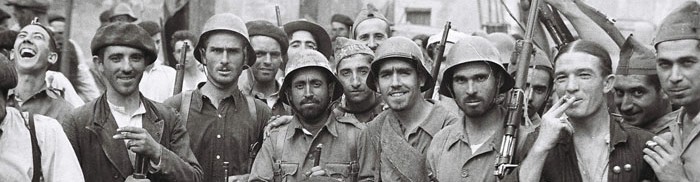
El libro para esta semana Homage to Catalonia escrito por el inglés George Orwell es menos complicado para leer en comparación con los de Cela y Malraux. No quiero decir que por eso es menos interesante, pues muchas veces al leerlo, lo encontraba muy divertido y me puse a reír. Tiene cierto sentido de humor, por lo menos para mí, un matiz satírico, aunque el tema que toca Orwell es realmente muy triste y se trata de una desilusión.
Todo el libro parece un proceso de la desilusión. En los primeros párrafos, Orwell nos presenta un miliciano italiano que ¨has stuck vividly¨ en su memoria. Esta imagen le afectó emocionalmente tanto que Orwell incluso escribió un poema Crystal spirit dedicado a él. Para Orwell, y muchos otros voluntarios internacionales, el perfecto italiano encarna este ¨crystal espirit¨, el cual atrajo a ellos a venir desde diferentes partes del mundo para luchar en contra el fascismo. En los primeros capítulos, el libro describe cómo era la sociedad de Barcelona bajo el ambiente del socialismo e igualdad. ¨It was the first time that I had ever been in a town where the working class was in the saddle...so far as one could judge the people were contented and hopeful. There was no unemployment, and the price of living was still extremely low; there was very few conspicuously destitute people, and no beggars...Above all, there was a belief in the revolution and the future, a feeling of having suddenly emerged into an era of equality and freedom. Human beings were trying to behave as human beings and not as cogs in the capitalist machine.¨ Esta sociedad suena fascinante y prometedora, en el libro todas las personas sumergieron en esta atmósfera y querían dejar sus propios trabajos que en ese momento lo más importante que parecía era participar en la revolución y realizar la esperanza. Orwell también dejó su intención del viaje de ser periodista y participó en el ejército. Estaban unidos en lo profundo por este espíritu cristal y querían llegar en la batalla y luchar por el empeño aunque podrían sacrificar su vida en la batalla.
¨War, to me, meant roaring projectiles and skipping shards of steel; above all it meant mud, lice, hunger, and cold. It is curious, but I dreaded the cold much more than I dreaded the enemy.¨ (18) ¿Cuánto tiempo Orwell esperaba para llegar al frente de la batalla? ¿Cuándo tiempo él esperaba para lograr un arma? ¿Cuándo tiempo esperaba para ver realmente a un enemigo y matar al primer enemigo? ¿Cuándo tiempo esperaba para ser herido como un soldado honrado? Las apasionantes escenas sobre la guerra, el sacrificio, el heroísmo, etc., como en las novelas o las películas, son simplemente piezas fragmentadas. Claro que existía la escasez de armas para los revolucionarios en el frente, como se describe bien en el libro de Malraux, pero creo que además de la falta de armas, en muchas situaciones las guerras no son tan apasionantes como uno imagina. En el libro, se tardó bastante tiempo para encontrarse con el primer enemigo, muchas veces los enemigos eran unos puntos vagos de lejos, casi invisibles, o sólo existían en la mente. Sin embargo, cuando lograron a un desertor del ¨monstruo fascista¨, se dio cuenta que el desertor del ¨monstruo¨ era como ellos, una persona pobre e ignorante de la guerra a veces. En la mayoría del tiempo, el enemigo real era el frió, el aburrimiento, la hambre, los piojos...o el enemigo real era uno mismo y era la esperanza, la fe (no importa ser ciega o no) o la imaginación del enemigo que apoya a la gente a persistir. Creo que es análogo a la revolución. En el libro, Orwell sí menciona pero no tanto a Franco, al fascismo, al enemigo real, pero describe y analiza con detalles los conflictos dentro de la revolución, la lucha dentro de sí mismo y el colapso de ese espíritu cristal. No critica contra ese espíritu cristal, que para él es siempre una belleza pura y más que una vez lo veía en algunas personas, pero critica cómo la gente no lo merecía, que traicionaron al espíritu, cómo el espíritu cristal se convirtió en pretexto para manipular a las personas y eliminar a los disidentes.
Dije al principio que me puse a reír al leer el libro porque muchas veces Orwell describe la guerra como una caricatura. No parece nada seria sino cómica e incluso ridícula como una broma. Por ejemplo: ¨As a matter of fact, on this front and at this period of the war the real weapon was not the rifle but the megaphone. Being unable to kill your enemy you shouted at him instead. This method of warfare is so extraordinary that it needs explaining.¨ "Sometimes, instead of shouting revolutionary slogans he simply told the fascists how much better we were than they were..'Buttered toast! ..'we are just sitting down to buttered toast over here! Lovely slices of buttered toast!' " La guerra es descrita a veces como fuera un juego de niños, pero ante la elevada esperanza inmortal, realmente sí somos mortales y carnales, e incluso infantiles, ¿no? Después de la risa también siento junto con el autor un cansancio de las luchas interiores incesantes, de la desconfianza, de las demasiadas informaciones o rumores, de las trampas...
En un párrafo dice:"To the Spanish people, at any rate in Catalonia and Aragón, the Church was a racket pure and simple. And possibly Christian belief was replaced to some extent by Anarchism, whose influence is widely spread and which undoubtedly has religious tinge." Recuerdo esta pieza porque después del libro, siento que Orwell cuestiona las apasionantes creencias y los partidos políticos o religiosos y sus convicciones, los cristianos, los fascistas, los comunistas o los anarquistas como sea. Si este libro es una propaganda, dudo que sea una propaganda completamente para el bando republicano.
Homage to Catalonia II
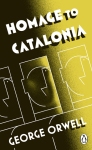
Concluding Homage to Catalonia, George Orwell tells us:
I suppose I have failed to convey more than a little of what those months in Spain mean to me. I have recorded some of the outward events, but I cannot record the feeling they have left me with. It is all mixed up with sights, smells, and sounds that cannot be conveyed in writing. (194)
To be fair, though, there’s no doubt that he has tried. Orwell is perhaps particularly attuned to smell: almost the first thing he describes is “the characteristic smell of war–in my experience a smell of excrement and decaying food” (15). Or for instance, as he approaches the front line itself what strikes him is “a sickening sweetish stink that lived in my nostrils for weeks afterwards” (19). More generally, Orwell continually emphasizes the visceral, embodied, affective aspect of participation in the Civil War. He opens his account, for instance, with a brief anecdote about an almost wordless encounter with an Italian militiaman that demonstrates (he claims) “the affection you can feel for a stranger! It was though his spirit and mine had succeeded in bridging the gulf of language and tradition and meeting in utter intimacy” (2). Not that his feelings are always positive; far from it. Orwell is as likely to tell us of the fear or, worse, the “horror” not so much of the war itself as of the backstage machinations, the “atmosphere of suspicion, fear, uncertainty, and veiled hatred” (155) that clouds especially is final few weeks in Barcelona, as the Communists crack down on the Anarchists and independent Socialists. For ultimately, these internecine battles had little to do with ideology of strategy, and it was this that made them so horrific. Ultimately, Orwell tells us, he “did not make any of the correct political reflections” and was left “conscious of nothing but physical discomfort and a deep desire for this damned nonsense to be over” (175).
Of course, Orwell’s “physical discomfort” at the end is not merely a matter of the intangible atmosphere of fear and repression. He has been shot through the neck, and is physically wounded. But whereas his account of the political intrigues and day-to-day life in the coffee shops and bars is heavily imbued with the emotional undercurrent that runs through them, his tale of being hit by an enemy sniper is surprisingly distanced, stoical, and understated. As he puts it: “The whole experience of being hit by a bullet is very interesting and I think it is worth describing in detail” (143). Though he reports “the sensation of being at the centre of an explosion,” he quickly finds he has “a numb, dazed feeling, a consciousness of being very badly hurt, but no pain in the ordinary sense” (143, 144). Once he understands that the bullet has gone through his neck, he is convinced that he is done for–“I assumed that I was killed” (145)–yet even this is depicted without much in the way of panic or doom, but as “interesting–I mean that it is interesting to know what your thoughts would be at such a time. [. . .] The stupid mischance infuriated me. The meaningless of it!” (145). And it is not long before he views the whole event with a sort of black humour: as everyone insists that “a man who is hit through the neck and survives it is the luckiest creature alive,” he retorts that he “could not help thinking that it would be even luckier not to be hit at all” (154).
So there is an odd discrepancy throughout the book between an affective treatment of politics, or what we might otherwise think of as an insistence on the affective infrapolitics that underlies and escapes all political discourse, and on the other hand a notably detached, distanced perspective on the body itself, which is treated as the object of almost quasi-scientific curiosity and scrutiny. This disconnect is further highlighted by what now appears as Orwell’s rather antiquated, perhaps quintessentially English attitude to anything that smacks of the personal. His injury is treated more as a nuisance than anything else. Beyond a brief description of a train journey in Burma (92), there is little to nothing in the way of Orwell recollecting or reflecting on his own personal history. His wife features frequently, but is never deemed worthy of a name. Orwell is honest about his own failings and minor hypocrisies (“God forbid that I should pretend to any personal superiority” [101]). And we learn much about his (lack of) personal hygiene on the front, and the lice that infest his clothing. But almost always Orwell’s gesture is to universalize, to present himself as a cipher for humanity as a whole: the lice, for instance, prompt the thought that “in war all soldiers are lousy [. . .]. The men who fought at Verdun, at Waterloo, at Flodden, at Senlac, at Thermopylae–every one of them had lice crawling over his testicles” (54).
Perhaps all this is because, in the end, Spain itself is something of a cipher for Orwell. Indeed, he claims not to have the chance to “look at Spain” at all until very late in the day, once he is finally discharged. With his “discharge papers in [his] pocket,” he tells us that “For almost the first time I felt I was really in Spain” (164). But even this Spain ends up being more a country of his own invention or fantasy than a real place: “I seemed to catch a momentary glimpse, a sort of far-off rumour of the Spain that exists in everyone’s imagination” (143). By implication, then, everything else that he has witnessed and described–the May Days in Barcelona, the Aragon Front, but also the militiamen and shopkeepers and so on–is in some sense not Spanish. They have all somehow obscured from view some other, supposedly more “real” Spain that would accord with the collective fantasy of what the country should be like. In short, the strange thing about the Spanish Civil War in Orwell’s eyes (but perhaps not only his) is that it is not really “Spanish” at all. And no doubt this is why his final thoughts are not with Spain but with England and its “deep, deep sleep [. . .] from which I sometimes fear that we will never wake till we are jerked out of it by the roar of bombs” (196).
See also: Homage to Catalonia I; Spanish Civil War novels.
Homage to Catalonia
So far on the reading list, Homage to Catalonia appears to be the only one non-fictional, a memoir that recounts the real-life experiences of author George Orwell during the conflict. It is told in first person, narrated by Orwell himself. The story follows him as he first joins the ranks of the POUM (Workers’ Party of Marxist Unification) rather than the International Brigades purely by chance, because he was first issued with papers from the Independent Labour Party (ILP). There, he found a society most resembling and embodying socialism, where people were truly comrades in a fleeting egalitarian realm.
One recurrent theme within the story was the fact that both sides, but especially the Republicans were frequently inadequately armed, with hopelessly obsolete rifles, shells that didn’t explode, and limited ammunition. There were boys as young as fifteen fighting in their ranks in order to support their families.
In addition, there was a lot of intra-Republican squabbling where they would produce nasty, unconstructive rhetoric in the newspapers about their own comrades from different parties. When distributing rifles, this same type of petty politics was present as seen when weapons weren’t distributed to Republican soldiers that needed them most, but rather to those that aligned most with their party (as the Soviets did).
I found it quite interesting that on one hand he constantly berated the Spaniards for their lack of military prowess, terrible marksmanship, lack of organization etc., but on the other hand he praised them for their generosity, their largeness of spirit and their indomitable idealism. Nonetheless, in Orwell’s Homage to Catalonia, the Spanish civil war is almost portrayed as a farcical war, a joke war waged by people who don’t know how to handle weapons.
One notion of the book I don’t completely understand is the part about revolution in chapter 5. According to Orwell, “the whole world was determined, upon preventing revolution in Spain. In particular the Communist Party, with Soviet Russia behind it, had thrown its whole weight against the revolution. It was the Communist thesis that revolution at this stage would be fatal and that what was to be aimed at in Spain was not workers’ control, but bourgeois democracy… Foreign capital was heavily invested in Spain… If the revolution went forward there would be no compensation, or very little; if the capitalist republic prevailed, foreign investments would be safe. And since the revolution had got to be crushed, it greatly simplified things to pretend that no revolution had happened.”
What difference would it make whether the press called it a revolution or not? The land reforms were still taking place as they spoke, and the foreign investments still in danger of being relinquished by the state. In fact, when the foreign press simplified the war to merely a struggle between “fascism and democracy”, were they still not lending their propagandist support to the Republicans who were instituting this land reform? Also, why were the communists against the land reform?
Homage to Catalonia
Having read a few of Orwell’s other books (Animal Farm, Down and Out in Paris and London, and Burmese Days) I’m quite familiar with his writing style, which has a very matter-of-fact way of explaining and analyzing situations. There seems to be a deep sense of pessimism and disappointment with human nature throughout his works, from his account of the conditions in the trenches along the Aragon front, his experience in poverty recounted in Down and Out, or his chilling depiction of colonialism in Burmese Days. Disillusionment seems to be a common theme; the loss of one’s ideals in the face of a reality to which they don’t conform.
After being swept up by the revolutionary fervor that had overtaken Barcelona and joining a Marxist militia, he sees the egalitarian principles by which the war was conducted on the Republican side slowly eroded away by sectarian in-fighting and propaganda. The experience seems to have dispelled any romantic notions he may have held about communism (or at least the “official” communism promoted by the Soviets) and hardened his resolve as an opponent of totalitarianism (a role he would continue when writing Animal Farm and 1984).
Perhaps the pessimism expressed throughout Orwell’s work results from the era in which he lived, one in which war and economic hardship were prevalent for decades in a row. One can trace the formation of his political and social views throughout his books, and Homage to Catalonia could possibly be seen as a turning point in his political education. The point where rosy ideals about social equality are brought face-to-face with the tangible threat posed by fascism and Stalinism. Indeed, his account of the conflict provides us a glance into the ideological divisions and partisan conflicts that engulfed not just Spain but all of Europe at the time.
In response to the question of what type of book this is, I think it combines elements of a historical novel with those of an autobiography. Personable, anecdotal accounts of events as they happened to him, as well as an informative overview as to the larger political developments surrounding those events, combine to create a work of literature that not only draws the reader into a story of wartime struggle but is a critical account of the political climate of the time. Perhaps its difficulty in being neatly categorized reflects its strengths in providing both an entertaining account of the war while also maintaining a journalistic duty to report the facts as they were witnessed.
Reflecting on our discussion . . .
Our discussion last week centered around two broad questions: What are they fighting for? and why did Malraux choose to write this book? There are certainly many answers to these questions and our discussion covered many related topics. The passage on pg. 263-267, in which Manuel had to keep the men from taking a train to Madrid with no one to operate it, provided considerable material to help ponder these questions: the Republicans’ clear technological disadvantage, their lack of organization or unity, and the shortage of necessary supplies all paint a dim picture. Yet the revolutionary fervor that animates everyone against the common foe of fascism gives them a somewhat misplaced sense of hope that persists throughout the novel.
We also touched upon the great diversity of the men fighting the fascists: Italians, Germans, Algerians, Poles, etc. What exactly was it that motivated them to leave their homelands and fight in another country’s civil war? Were they so committed to their ideologies that they jumped at the chance to fight for their cause alongside their comrades? Perhaps the sense of duty that brought them there in the first place was what kept them going even when their prospects were clearly grim.
Homage to Catalonia I
George Orwell is probably the most famous English political writer of the twentieth century. As such, it is surprising, in Homage to Catalonia, to read him telling us that, at the front of the Spanish Civil War, “the political side of the war bored” him (208). He says of his initial impressions of Catalonia that
the revolutionary atmosphere of Barcelona had attracted me deeply, but I had made no attempt to understand it. As for the kaleidoscope of political parties and trade unions, with their tiresome names–PSUC, POUM, FAI, CNT, UGT, JCI, JSU, AIT–they merely exasperated me. It looked at first sight as though Spain were suffering from a plague of initials. (197)
This book, then, part memoir and part political analysis, documents a change in Orwell’s perspective, a form of politicization. For, in his words, “everyone, however unwillingly, took sides sooner or later” (198). Homage to Catalonia is, as much as anything, an account of how and why Orwell took side, and began to view the array of political acronyms as more than just some alphabet soup. For it turns out that the war had everything to do with politics–“it was above all things a political war” (197)–and so boredom or disinterest are no longer viable options. It is in the name of politics that a certain–largely fictitious–narrative of the conflict had been propagated, and it is likely that it is in the name of politics that the Republic would be lost.
Yet, if this is the message of the book, Orwell remains strangely ambivalent about it. He tells us, at the start of his first extended disquisition on the internal struggles between Anarchists and Communists, that “if you are not interested in the horrors of party politics, please skip.” As he notes, he separates out the analysis from the memoir “to keep the political parts of this narrative in separate chapters” precisely so that the disinterested reader can pass over them and continue following Orwell’s personal journey unperturbed. In other words, in this conflict in which “everyone” has to take sides, the reader is carefully shielded from this responsibility. In fact, in later editions of the book the “political” chapters are relegated to appendices, pushed even more to the margins of the main narrative. But does this not allow precisely the depolititicization, or refusal to engage in politics, against which Orwell’s book is otherwise written? Orwell wants both to protect us against the “horrors of party politics” and (if we are curious to read through the appendices that contain them) to tell us that they are essential to any understanding of the situation in Spain–and indeed, Europe as a whole. At one and the same time, the book both directs us to the centrality of political disagreement and aspires to shield us from it.
It may then be better to think of this as an infrapolitical book, in the sense that it is about what is simultaneously a necessary link and an absolute breach between war and politics. The Spanish Civil War is at the same time a thoroughly political war and absolutely non-political at the same time. The “horrors” of politics are both inevitable and to be avoided if at all possible. Orwell has both to show the connections between the “common decency” for which he came to fight (197) and the political machinations that make it both possible and impossible, and at the same point to keep them utterly separate. This is, of course, an impossible task, which is why in some sense this is an impossible book, fractured and somewhat absurd. But it is in that fracture that we see the struggle between politicization (taking sides) and commonality (common decency) played out, which are the stakes of the war itself, which ultimately can only be understood in these infrapolitical terms.
Crossposted to Infrapolitical Deconstruction Collective.
See also: Homage to Catalonia II; Spanish Civil War novels.
Orwell’s Homage to Catalonia
The attempted fairness in Orwell’s narration is what originally struck me in this narrative. It’s not common for authors to point out their own allegiances and limited scope when writing to illustrate to their reader how their writing may not be a precise account of the actual events.
Unfortunately (for Orwell) I believe he did not do enough to accomplish a fully fair narrative. I think he creates an ambiance of chaos and distrust of other sources, which coupled with his sporadic admissions of bias creates an artificial trust in his narrative over all other sources. His repeated cherry picking from other journalists in order to discredit them maybe does paint a picture of how badly this war was being told internationally, but ultimately just discredits all journalists from that time period as a whole (at least to the simple eyes of a reader) and Orwell fills the vacuum for information (even if unintentionally) with his own narrative exclusively.
I mention this may be unintentional because he does a fairly good job physically separating (by chapters) discussing historical events and his own experience. The problem I’m alluding to is, in terms of perceived accuracy of the story as a whole, I believe Orwell could easily trick readers.
Orwell does an effective job as described above in singling out his narrative as accurate. For the chapters in which he isn’t (exclusively) dealing with his own experiences like his time in the trenches and on guard, but talking about party politics and historical events that may be the case. For the other chapters, which occupy the vast majority of the book, I don’t believe there is the same fairness in recognizing bias and warning the reader of this fact.
Once the reader is convinced that all other sources are a lie trying to further their own agenda, and Orwell is being absolutely fair, nothing stops them from extrapolating from his experience to the entire war. Orwell, as objective as he may have tried to remain for the entire book, voluntarily signed up to fight in a foreign war. He was being shot at by another faction. He endured hunger and lack of every day amenities. He was restricted to a very specific geographical area. Just as foreign journalists had their reasons to misrepresent this war, I believe it’s quite evident so did Orwell.
I may be letting my cynicism get to me again, but I don’t believe these are the traits and experiences that lead to an unbiased account of an event as polarizing and agonizing as is a war. For an author personally involved in the conflict he probably did an extremely good job at being unbiased, but I claim he could not avoid it altogether and misleads the reader into thinking he has.
“The Ghosts of the Civil War”
Leave a reply
This is an interesting article, just published on The Guardian. It includes an overview of the war, and the difficulty of coming to terms with its trauma. It mentions the importance of foreigners, even now, in keeping memories alive. And it notes the role of novels (such as Soldados de Salamina, which I write about here) in stoking a renewed conversation about the events and their impact.
Stasis
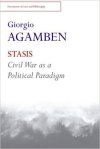
Giorgio Agamben’s short book Stasis: Civil War as a Political Paradigm comprises two brief essays, one on the Athenian concept of “stasis” or civil war, the other on the role of the multitude in Hobbes’s Leviathan. What links them, he tells us, is the notion that “the constitutive element of the modern State” is “ademia [. . .] that is, [. . .] the absence of a people” (vi). Obviously enough, this will come as something of a surprise to “the Western political tradition” for which, as Agamben notes, the “concept of people” is “arguably the fundamental concept” (39). Think after all of the opening of the United States constitution, for which “we the people” are presented as that country’s basic political bedrock.
Agamben proposes instead the multitude as the core concept of political theory. So far, so good, and no doubt also so Italian. But what Agamben adds to the work of (say) Toni Negri and Paolo Virno is the observation that “the multitude is the subject of civil war” (40) and, further, that it is thus through civil war that the political realm is established. Or, as he puts it in his discussion of the Greeks:
it constitutes a zone of indifference between the unpolitical space of the family [oikos] and the political space of the city [polis]. [. . .] In the system of Greek politics civil war functions as a threshold of politicization and depoliticization, through which the house is exceeded in the city and the city is depoliticized in the family. (12)
For, as Agamben points out, Solon’s law explicitly punishes those who do not take part in civil war: such people forfeit their rights to citizenship; “not taking part in the civil war amounts to being expelled from the polis and confined in the oikos” (13). Civil war is, therefore, not (as we tend to see it) simply the point at which the political dissolves, as the state fractures and society is reduced to warring factions. It is also constituent, “the unforgettable that must always remain possible in the city,” however much today, by contrast, we regard it as “something that one must seek to make impossible at every cost” (16).
To put this another way (in terms that Agamben himself does not use), it is civil war that is the threshold or hinge between infrapolitics and politics per se. He offers here a theory of the ways in which the political emerges and is dissolved. Moreover, in his study of Hobbes, Agamben further offers civil war as the process by which what he calls the “dissolved multitude” (the multitude subject to biopolitical power) is transformed into the “disunited multitude” that makes itself known by turning on the absent people (absorbed into the figure of sovereign power, the Leviathan). And though it is not entirely obvious how these two conceptions mesh with each other, in both cases civil war has to remain an intimate possibility in the heart of any and every political order. For sovereignty, at least until the coming of the end times, can only remain an (optical) illusion, a trick of representation. In the meantime, “no real unity, no political body is actually possible: the body political can only dissolve itself into a multitude” (49). Agamben thus reverses the eschatological tendencies inherent (as I have argued elsewhere) in Negri’s vision of the multitude: here it is only the state that dreams of a substantial presence and unity to come. The multitude, by contrast, is located on a perennial threshold, figured as civil war, between house and city, infrapolitics and the political.
The sting in the tail of Agamben’s analysis, however, is given only sotto voce, in a digression or coda to the first essay that’s presented in smaller font than the rest. This is the observation that “the form that civil war has acquired today in world history is terrorism. [. . .] Global terrorism is the form that civil war acquires when life as such becomes the stake of politics” (18). This only goes to show once again that (whatever Negri thinks) nobody should look to the multitude for their salvation. But instead of denying the possibility of civil war, trying to exclude it from the political order, we need to recognize that order’s indebtedness to it, and pick one of the many sides (who says there should be just two?) that any such conflict opens up. For this is the very paradigm of the political, of the perpetual emergence and dissolution of political activity as such.
Crossposted to Infrapolitical Deconstruction Collective.
Sobre la discusión sobre San Camilo (II)
*OS DEJAMOS ABAJO EL LINK DE LOS APUNTES Y EL PPT QUE HICIMOS PARA MODERAR LA DISCUSIÓN*
No es sorprendente que planear y guiar una discusión sobre San Camilo, 1936 por Camilo José Cela (un libro sumamente difícil de leer y entender, tanto por los hispanohablantes como aquellos para quien el castellano es su segundo idioma) será una tarea bastante difícil y complicado, y aún más dado que a ninguno de los dos facilitadores les gustó al libro.
Pero a pesar de las dificultades inherentes, creemos que hicimos un esfuerzo admirable generar varios temas y citas de discusión, intentando cubrir la mayoría de lo que sucede en la segunda mitad del libro. Si hubiéramos podido hacer algo más para mejorar la presentación, habríamos preparado más preguntas específicas de discusión para incluir en el PPT para así estimular más discusión. Al planear cómo íbamos a guiar la discusión, nos pareció que tuvimos demasiado que decir entre nosotros dos y por eso, decidimos cortar las preguntas de discusión del PPT. Otra motivación por esta decisión fue nuestra creencia que las citas, las cuales habíamos seleccionado el libro para estimular la discusión, eran bastante reveladoras y así estimularían discusión sin la necesidad de articular una pregunta específica. Pero al fin, debido a los pocos comentarios y preguntas que estas mismas citas generaron (a pesar de nuestros intentos de guiar la clase un poco hacia estas respuestas), nos dimos cuenta que hubiera sido útil incluir preguntas específicas.
Obviamente, otro factor para nuestra discusión guiada en particular era el hecho de que pocos habían leído el libro, y por eso sólo pocos podían participar y contribuir a la discusión. Pero, otra vez, si hubiéramos incluido más preguntas, tal vez habríamos podido estimular más participación. Al fin y al cabo, el libro de Cela fue muy difícil y confuso, justo como fue la tarea de intentar descifrarlo y determinar qué se podía decir sobre ello, con fin de llegar a algunas conclusiones sobre ello y entender cómo cabe este texto no sólo en nuestra clase, sino también en nuestro entendimiento sobre cómo se representa la guerra civil española por través de la literatura.
*Aquí puedes ver los apuntes y el PPT que hicimos para preparar para esta discusión.*