Author Archives: chendric

etmooc: Rhizomatic learning in philosophy courses

I recently watched Dave CormiersIntro to rhizomatic learning” presentation as part of my participation in etmooc. Here, I’ll explain what rhizomatic learning is as briefly as I can, discuss what it might look like in a university level philosophy course, and ask a few questions.

In the next post I explore a possible critique that I’ve been mulling over. I’m not just assuming here that rhizomatic learning is a good thing (though obviously I find it interesting enough to write about), but rather just at this point examining the idea to help me better work to evaluate it.

What is “rhizomatic learning”? (according to Cormier)

I expect there are numerous views on what rhizomatic learning (or rhizomatic education) are, so I’ll just stick to Cormier’s view here for the sake of clarity. The following is just a brief summary of some parts of his view. If you would like more details, you can watch Cormier’s presentation for etmooc on YouTube, or read his paper on the topic, published in 2008 and posted on his blog, called “Rhizomatic Education: Community as Curriculum.”

In his etmooc presentation, Cormier started off by suggesting that the “best learning” has to do with helping people deal with uncertainty, to figure out how to make decisions and choose the paths they should take when faced with situations in which the outcomes are uncertain. Education is tricky because we don’t know exactly what sorts of knowledge will be needed in the future, the changes different fields will undergo, the changes new technologies will bring, etc. So encouraging good decision-making and creative problem-solving skills, as well as the ability to continually guide one’s own learning to gain new knowledge as needed, are critical.

Cormier then introduced the idea of the rhizome, and rhizomatic learning, as “a model for learning for uncertainty.” I didn’t remember what “rhizomes” were, as it’s been quite some time since I took a botany course, and I’m not much of a gardener. Here’s what I found: some plants (such as ginger, hops, asparagus, and bamboo) have rhizomes, which are stems that are usually underground, and that have nodes from which the plant can move upwards to create above-ground stems, leaves, etc. So, if you have some asparagus in your garden, for example, you won’t just get one clump of it; the rhizomes underground will move horizontally and you will get above-ground asparagus stems popping up in numerous places.

by Rhian vK

“Iris Rhizomes,” by Rhian vK, from Flickr (links below)


A rhizomatic plant has no center and no defined boundary; rather, it is made up of a number of semi-independent nodes, each of which is capable of growing and spreading on its own, bounded only by the limits of its habitat. (Cormier (2008), “Rhizomatic Education: Community as Curriculum”)

Rhizomes are very resilient as well; such plants are very difficult to get rid of, in part because new shoots can arise even if you break up the rhizome. As Cormier put it in his etmooc presentation: you can take any part of a rhizome and drop it somewhere else, and the plant will start to grow again. This idea of propagating laterally, rather than horizontally, is important in Cormier’s view of rhizomatic learning–this sort of learning takes place through connections made amongst groups of people, forming a network, rather than through knowledge or information-transmittal through experts (top-down) such as instructors or researchers publishing in peer-reviewed journals. Since in many fields “[i]nformation is coming too fast for our traditional methods of expert verification to adapt,” it makes sense to develop environments where “collaborative learning construction” can take place (Cormier (2008), “Rhizomatic Education: Community as Curriculum”). Such environments include wikis, collaborative documents, as well as environments such as the “personal learning networks” made possible by sharing tools such as Twitter, blogs, social bookmarking and social curation sites, and more. In these collaborative spaces individuals come together in various groups to learn and to create knowledge. Each individual may be a member of multiple groups, and these groups form, change, disband, reform continually.

Cormier also gets some of his ideas for rhizomatic learning from Deleuze and Guattari’s A Thousand Plateaus: Capitalism and Schizophrenia. I haven’t read the book, but found these brief notes on Deleuze & Guattari’s notion of rhizomes useful (I got think link from a google doc linked to a post on Dave Cormier’s blog).

My sense of rhizomatic learning at this point, then, is that it is the sort of thing that is happening in etmooc, as well as informally by many, many people around the globe working with the kinds of social tools noted above, but also working in face to face situations with others. It’s probably the kind of learning most of us do in lives outside of educational institutions.

But Cormier seems to be arguing for it also to be part of more “formal” education. Instead of instructors creating a curriculum in advance that is the same for every student in the course, the community of learners constructs the curriculum.

In the rhizomatic model of learning, curriculum is not driven by predefined inputs from experts; it is constructed and negotiated in real time by the contributions of those engaged in the learning process. This community acts as the curriculum, spontaneously shaping, constructing, and reconstructing itself and the subject of its learning in the same way that the rhizome responds to changing environmental conditions. (Cormier (2008), “Rhizomatic Education: Community as Curriculum”)

Note that in this quote Cormier says the community not only creates the curriculum, it is the curriculum, an idea he reiterated in his etmooc presentation. I am not entirely sure what he means by this, but perhaps the thought here is that as the community changes (and it is always changing–if not in terms of people coming and going, then in terms of what people say and do in it, what they share and discuss, never remaining static), so does the curriculum. “A curriculum for a course is something that can be created in time, while a course is happening,” Cormier says in a blog post called Rhizomatic Learning: Why we Teach”.

What is the role of the instructor in rhizomatic learning environments? Here’s what Cormier says:

The role of the instructor in all of this is to provide an introduction to an existing professional community in which students may participate—to offer not just a window, but an entry point into an existing learning community. (Cormier (2008), “Rhizomatic Education: Community as Curriculum”)

In rhizomatic learning environments, then, what is learned and how is shaped by a community of learners, and this changes constantly. I imagine that for a formal educational environment, one could have students set out what they’d like to investigate, help them with the tools they can use to investigate it and to form a community of people to help (a “personal learning network,” e.g.). I also imagine using a grading contract; that’s exactly what Cormier did with one of his courses last year.

When is rhizomatic learning appropriate?

Is Cormier suggesting that all learning should take place through the rhizomatic model? Definitely not. He said in his etmooc presentation that for learning situations in which specific kinds of knowledge must be gained, rhizomatic learning is the wrong way to go. In addition, if a body of knowledge that needs to be learned is stable, then rhizomatic learning may not be appropriate and information transfer more so. Also, as Phil Macoun noted in a blog post, if there are certain basic principles and foundational information needed in a field before learners can really benefit from discussions within a wider network of other learners, researchers and practitioners, then more “traditional” learning approaches would seem to be best for those earlier steps.
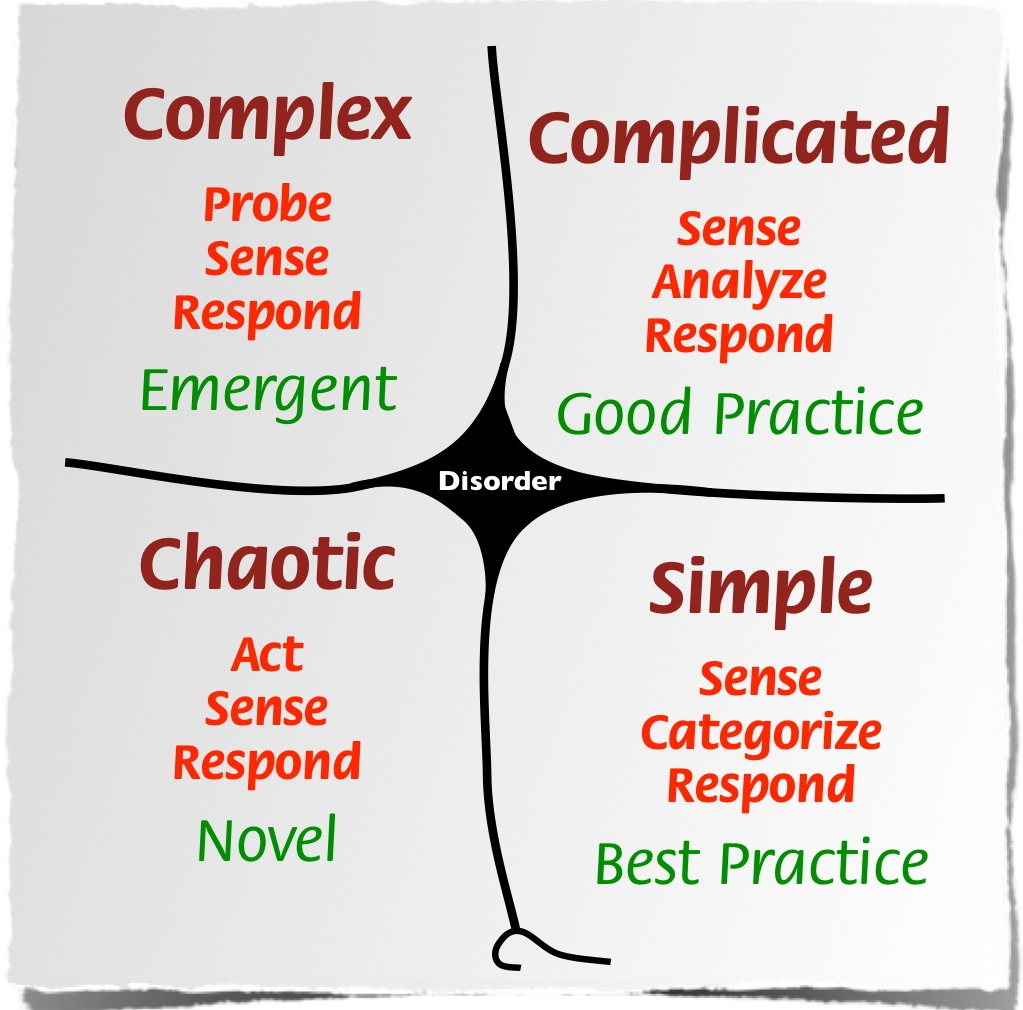
 

 Cormier explained this point in his etmooc presentation by using the Cynefin decision-making framework from Dave Snowden. Explaining this framework would take an entire blog post in itself, but thankfully Cormier has a post that does so. Rhizomatic learning is appropriate for situations that fall into the “complex” part of the framework, where, as Cormier puts it, there are no clear “right answers.” There is no obvious “best practice,” and we can’t just turn to experts to find out what to think, what is right to do, or what counts as true knowledge. Snowden says in the video linked above that in the complex domain, outcomes are uncertain and unpredictable; cause and effect relationships can’t be known in advance, only in hindsight. One can only engage in experiments and see what happens to determine the best course. This is the domain where novel practices and knowledges are tested and may be adopted, instead of seeking to find already-established solutions from experts. The Cynefin framework is much more complicated than this, but I won’t go into its other parts here.

This is enough to suggest that rhizomatic learning is not so great, perhaps, for basic mathematical skills or some aspects of science education, but it might, on the other hand, be useful for philosophy. We deal in questions that are still open in many ways (though there are some recognized procedures and accepted truths, there is much that is still negotiated and a good deal of room for novel approaches and arguments).

Rhizomatic learning in philosophy

What would rhizomatic learning look like in a postsecondary philosophy course?

For an introduction to philosophy course, e.g., one might allow students to identify what philosophical questions they are interested in, and then provide them with the tools to find out what others have said about those questions and to formulate their own response. The common instruction in the class could be on things like: what common philosophical questions are and a chance to develop your own if you don’t want to pursue one of those; what arguments are, how to evaluate them, and how to construct your own; how to write philosophy essays, etc. Then students could spend part of the class time and part of their own time doing research to work on their questions.

I can imagine this happening in groups within the class, so students interested in the same areas could work together, and thereby build a small network. Then the groups could create wikis, videos, slideshows, or use other means to share what they have found with the rest of the class; individuals could share what they have developed as their own views on the questions separately, perhaps.

The professor could also suggest web resources for certain kinds of questions, and any social networks related to people interested in philosophical issues, as well as social bookmarking sites that might have good links.

This could work for an intro to philosophy course in which the students involved don’t need to gain knowledge of the history of philosophy so much as get a taste of what philosophers do. For courses that are required for majors, and in order for students to take more upper-level courses that rely in part on knowledge of certain aspects of the history of philosophy, then a more focused approach is required to ensure that students are exposed to the necessary authors and texts.

Questions and concerns:

— I can think of a few websites with philosophy information that would be good for introductory-level students, but not many. Of course, they could work to find others that I don’t know about. It would help if there were more open educational resources available in philosophy.

— I’m not sure how I would introduce students into a wider social network of people that could help them with their questions. I guess I could try to include more philosophy teachers in my own PLN (so far it’s mostly people talking about education generally), and connect students that way. Ideally, I would help them connect with other students investigating similar issues (outside the course), so they could learn and generate knowledge together…but I honestly don’t have a clue how I might go about doing that.

— Why only point them to other websites and other people to connect with? Am I not a good connection to have, and shouldn’t I share my own knowledge as part of this community creation of knowledge? Perhaps the idea is to work more one-on-one with individuals or groups on their own projects, and be part of their network that way? That would be fantastic, if only it were possible in intro-level philosophy courses in a large university (ours are about 150 students or so). They can work together as teams on specific questions, but I don’t have time to offer directed help to each team.

— How is this different from students getting together in groups to do research projects and then presenting them to the rest of the class? Is it that one should be helping them develop a larger network to discuss their projects in, rather than just doing research and discussing within the small group?

— If the previous point is the case, then I see this being difficult to do in a short (13-15 week) course. Building that kind of network takes a long time, and then discussing things within it takes awhile too…I doubt there would be time to do it in a single semester/term.

Your comments

 I’m wondering if I’ve misconstrued anything about rhizomatic learning here, or if there are other ways it might be used in a course like philosophy. Or any thoughts about my questions, above?


“Iris Rhizomes,” by Rhian vK, CC-BY 2.0, via Flickr

Cynefin Framework, CC-BY-3.0, via Wikimedia Commons

etmooc: Are moocs learner centred?

There have been too many great #etmooc tweets to mention, and I’m trying to keep track of my favourite tweets and posts in a growing Storify board. But this particular post is focused on a conversation begun by the following tweet from Christoph Hewett:


Keith Brennan wrote a nice post on this issue, replying to Christoph’s tweet, called The sense of self, how a MOOC can make or undermine you. Christoph’s tweet, and Keith’s reply, have got me thinking. Here are some results of that thinking.


Keith gives a nice definition of learner-centred learning:

Learner centred learning takes account of, and speaks to the differeing [sic] needs, requirements, and contexts of the students we engage with.

He then focuses on how taking into account students’ prior knowledge (and variations therein) must be a major part of making courses student-centred. In addition, he explains the idea of self-efficacy, from psychologist Albert Bandura, and how factoring in prior learning can enhance learner’s sense of self-efficacy. As Keith puts it,

Self efficacy is, simply put, your confidence in your own ability, and capacity to succeed at a task, as well as belief that the task is achieveable due to the contexts, tools, constraints and the overall situation.

[As an aside, I am thankful to Keith for pointing me to this idea, as I hadn’t heard it before and it’s very useful for thinking about why some students seem to lose faith and heart and just drop out of courses, whether officially or unofficially. I need to look into the self-efficacy notion further to see if there is something about the way my courses are structured, or about how I’m teaching them, that could lower some students’ self-efficacy.]

Keith then went into some suggestions for how to make etmooc more responsive to prior learning and thus more supportive to self-efficacy, such as: setting up a series of clear paths for learning and tasks to measure one’s progress, being sure to have resources ready for common problems faced by novices to the technology being introduced, structuring the teaching into clear chunks (since novices often prefer specificity to freedom), and more.

These are all useful ideas for helping some people feel that the course is more learner-centric, and that they can succeed. And, as Keith notes, those of us who want less specificity or don’t want to follow directed paths to learning can just ignore those things and learn what and how we wish.

Further thoughts

I want to think a little differently about Christoph’s original tweet, the idea that cMOOCs are crowd-centric rather than learner-centric. When Christoph said that, I thought immediately of a MOOC I sat in on a little while ago, which was more the “traditional” type of MOOC, with very structured learning paths, videos to watch, quizzes to take, etc. It was most definitely a content-delivery course.Crowd Photo by James Cridland, from Compfight.com

I can see that that sort of MOOC could be said to be more crowd-centric in the sense that the learning is the same for the crowd–the content is provided centrally, and it’s the same for everyone. There is no individuation for specific learners, nor changing of the content according to how the class is going (though that is at least possible–one could monitor the questions and comments fora and decide to add new videos or tasks to the course as it goes along, so at least some of that is possible).

However, it really got me thinking because my experience so far in etmooc has been very, very different from the other MOOC I took, and I actually think of it as more learner-centred. This is because there is much less in the way of centralized guiding of learning in this MOC than in the other one. There are only a couple of presentations per week, and even in those (from what I’ve seen so far), the point is less to provide content than to provide tools for connecting with each other, our students, and with more people around the world through global and social media.

This seems to reflect the difference between an “xMOOC” (content-focused) and a “cMOOC” (connection-focused)as explained by Martin Lugton in a blog post. I like his description of a cMOOC, as it fits well my experience with etmooc so far:

It’s a chaotic experience (as @RosemarySewart put it) and is inherently personal and subjective, as participants create their meaning and build and navigate their own web of connections. cMOOCs are not proscriptive, and participants set their own learning goals and type of engagement.

This is why I think of etmooc as actually learner-centred in its own way: learners focus on what is most meaningful to them, and they build their own connections through following the advice provided by the facilitators to blog, comment on blogs, read the discussions on Google+ sometimes, and read some of the Twitter feed. You can’t do it all, all of the time, but doing just some begins, even if slowly, to help you build connections and start contributing to conversations.

But that’s not what Christoph said

He said “cMOOCs” are crowd-centric, rather than learner-centric. I can see it for xMOOCs, but it didn’t seem to be so for cMOOCs, to me, until I started thinking about it more for this blog post. How can cMOOCs be said to be crowd-centric?

Perhaps insofar as they offer many, many resources and tools for people to choose from, and can’t possibly tailor those to each person’s needs so individuals themselves have to find what they need out of the wealth of information. I don’t know if that’s what Christoph meant, but it’s one way to think about it.

Still, of course, there is individual tailoring: partly by individuals themselves, but also from the community–others read one’s questions and prompts for advice on Twitter, Google+, blogs, or elsewhere, and (hopefully) comment and provide help with one’s specific issues. The individual has to centre the course for him/herself, with the help of others in the course. The course itself is, and must be if it’s a MOOC at all, crowd-centric in the sense of offering information that could apply to the crowd, to anyone in the audience equally. No facilitator can hope to tailor it to each person in such a large course, so we all have to help each other do so.

Keith still has a point

But this means there’s going to be much more information, tools, resources than is going to be digestible or really serve the needs of any individual participant. As many of us have noticed in blog posts, tweets, and more, numerous participants are feeling a bit at sea, overwhelmed, wondering how they can possibly do everything in etmooc, how they can keep up with all the conversations, etc. That theme has stood out to me over the past week or so, and it’s something I’ve felt too. I’ve had to repeat to myself a line that I learned from a post by Gayle in her blog, Learning by Doing:

Don’t feel guilty if you don’t do everything — only feel guilty if you don’t do anything.

I’ve tried to pass that sort of idea on to anyone I hear expressing a sense of drowning.


Providing a set of tools and lots of information, and allowing people to pick and choose what interests them most, may not work for all learners. Those with little prior knowledge, or who feel they don’t have the same tech skills as many others in the course may get too lost in the swarm of new things they could be learning about, and, realizing they don’t have time to do it all, could drown and drop out.

Also relevant is this post by Nick DiNardo at his blog, Live Curious. Nick notes that the style of learning in etmooc is such that, “What you put into it, you get out of it.” This can be one way of thinking of etmooc as learner-centred, because learners can pick and choose what to do amongst the many things on offer. As Nick puts it, “Learners can come and go as they please throughout the course, participating socially as they see fit.”

However, Nick also notes a downside to such a structure: it may be best for autodidacts, “learners who take an entrepreneurial approach to learning what they are curious about.” What of those who do not learn this way?

Questions

Could Keith’s suggestions above for etmooc or other cMOOCs work to help those types of learners? Or would they turn cMOOCs more towards xMOOCs in a problematic way? Is there a way to keep the focus on connection and the ability to leave people free to choose what to focus on, while structuring a cMOOC a bit more?

My fear is that if etmooc were more structured I personally would feel like I should follow the learning paths specifically, and then it would feel more crowd-centric, designed for a crowd, and less open for my own tailoring. Yet there are problems with the latter as well, as noted above.

I must admit I’m kind of stuck here. Maybe one should offer more structured learning in cMOOCs like etmooc and yet emphasize that that is not the only way to do the courses, that people can come in and out as they please, but those who wish it can do the more structured paths? Would those who choose not to feel like they are missing something important, and so ultimately the cMOOC experience turns into more like an xMOOC one?

Ideas? I am new to the whole xMOOC vs. cMOOC distinction, so perhaps there’s something important I’m missing here!


Photo Credit: James Cridland via Compfight cc

Photo Credit: dameetch via Compfight cc

etmooc: Social bookmarking of sites behind a paywall

"Colourful Journals," by Selena N.B.H.

“Colourful Journals,” by Selena N.B.H. http://www.flickr.com/photos/moonlightbulb/6307443777/
CC-license: http://creativecommons.org/licenses/by/2.0/deed.en


Note: In this and future posts having specifically to do with my participation in etmooc (a massively open online course in educational technology), I will preface the posts with “etmooc,” so those readers not interested in educational technology stuff can ignore if they want!

I recently watched the archived presentation for etmooc by Jeffrey Heil and Michelle Franz on Introduction to Social Curation. One of the things that really stuck with me from that presentation was the idea that we should share our research, not simply be “re-tweeters.” I have feared being little more than a re-tweeter on Twitter, as much of my access to information comes from Twitter itself, so I just re-tweet interesting things out. That’s important, of course, but not all that one should do.

I really appreciated that we should be engaging in and following people on social bookmarking and social curation sites, for numerous reasons, including connecting with others and finding new sources of information. This could be a way to find things beyond what I locate on my own, and tweet out to others in my network.

Obviously, though, one needs to be a contributor as well to social bookmarking and curation sites, to add to one’s PLN (personal learning network) rather than just being a “lurker.” But my problem is that a good deal of my time is spent on sites that are behind a paywall–specifically, journal articles. My research is focused on journal articles and books, largely in the Scholarship of Teaching and Learning. It’s not that I never visit more “open” sites for other things; I do, it’s just that most of my own time and research are about things that one has to pay for to receive access (unless one’s school or university subscribes). So if I were to share my own research, then I’d be sharing things that many people in the world can’t access. As a result, so far I haven’t done much in the way of sharing my own research.

But I got to thinking about this and wondered: well, there are people out there who can access these sites…many other scholars at colleges and universities and other schools who have similar interests to me. Why not at least share these articles, collating them into lists according to topic, for those who can access them and are interested? It would be a much smaller audience, of course, but personally, I’d love it if others were doing this for my field of interest!

To add to the articles behind a paywall, I’d also link to my blog where relevant, because one of the things I’ve been doing while on sabbatical this year is to take notes on articles and comment on them in my blog. Partly that’s for my own research, but also partly for people who are interested in the same topics. And I do a pretty thorough job of summarizing, so those w/o access to the articles could at least get the main arguments, if they’re interested. So in the comments to the links to paid articles on Diigo, for example, I could post a link to my blog summary of those articles. (Diigo is a social bookmarking site that is really great for highlighting and taking notes on webpages.)

Of course, I’d keep my other Diigo lists for free and open sites, and make sure much of any other content curation sites I have (such as my Learnist boards) is open to anyone.

Does this seem like a good idea? Let me know in the comments!

(I’m also unhappy with the way I did the attribution for the photo–Flickr doesn’t have that cool attribution HTML text that Compfight does, and I can’t do links in the caption for the photo on WordPress, I think! Ideas?)

Introduction: etmooc

I am taking part in a MOOC (massive, open, online course) focused on educational technology called etmooc. As part of that, I will have certain posts in the “etmooc” category that are designed for that mooc, specifically. I hope they will be interesting to my other readers as well!

This is just to introduce myself to the rest of the mooc: I’m Christina Hendricks, and I’m a Sr. Instructor in Philosophy at the University of British Columbia. A “Sr. Instructor” is a tenured, teaching-focused position (my merit and promotions are based on teaching and service, rather than research; though research on teaching counts!). I also teach in a first-year, interdisciplinary, team-taught course called Arts One. This is one of the three options for students in the Faculty of Arts to fulfill their first-year requirements. It is a year-long course, and students get 18 credits: 6 each in introductory English, History and Philosophy. I was Chair of that program from 2010-2012.

I am currently on sabbatical in Melbourne, Australia (July 2012-July 2013), and am doing research in the area of SoTL (the Scholarship of Teaching and Learning). Specifically, I’m interested in trying to analyze the value of the Arts One program for students. For more on my research this year, just look over my posts on this blog from the last 4-5 months! I’m particularly interested in peer assessment and feedback at the moment, but also in providing good feedback to students on writing, and how to effectively teach writing generally.

Looking forward to moving forward with the mooc, though I’m late in starting!

Problems with grading rubrics for complex assignments

In an earlier post I discussed a paper by D. Royce Sadler on how peer marking could be a means for students to learn how to become better assessors themselves, of their own and others’ work. This could not only allow them to become more self-regulated learners, but also fulfill roles outside of the university in which they will need to evaluate the work of others. In that essay Sadler argues against giving students preset marking criteria to use to evaluate their own work or that of other students (when that work is complex, such as an essay), because:

  1. “Quality” is more of a global concept that can’t easily be captured by a set of criteria, as it often includes things that can’t be easily articulated.
  2. As Sadler pointed out in a comment to the post noted above, having a set of criteria in advance predisposes students to look for only those things, and yet in any particular complex work there may be other things that are relevant for judging quality.
  3. Giving students criteria in advance doesn’t prepare them for life beyond their university courses, where they won’t often have such criteria.

I was skeptical about asking students to evaluate each others’ work without any criteria to go on, so I decided to read another one of his articles in which this point is argued for more extensively.

Here I’ll give a summary of Sadler’s book chapter entitled “Transforming Holistic Assessment and Grading into a Vehicle for Complex Learning” (in Assessment, Learning and Judgement in Higher Education, Ed. G. Joughin. Dordrecht: Springer, 2009). DOI: 10.1007/978-1-4020-8905-3_4).

[Update April 22, 2013] Since the above is behind a paywall, I am attaching here a short article by Sadler that discusses similar points, and that I’ve gotten permission to post (by both Sadler and the publisher): Are we short-changing our students? The use of present criteria in assessment. TLA Interchange 3 (Spring 2009): 1-8. This was a publication from what is now the Institute for Academic Development at the University of Edinburgh, but these newsletters are no longer online.

Note: this is a long post! That’s because it’s a complicated article, and I want to ensure that I’ve got all the arguments down before commenting.

Continue reading

On not living up to my open access values

Two things happened in the last couple of weeks that brought home to me how much more work I need to do to really be an open access advocate.


1. Hypatia announced their Book Reviews Online site: Hypatia Reviews Online

I just got an email in the last couple of days noting that the feminist philosophy journal Hypatia has set up a separate site for open access book reviews. The site states that from Fall 2012 all book reviews will be published online, open access (I don’t know if book reviews will also be available in print in the future or not). Previously, the Hypatia website had a book review archive that went from 2000-2004, and HRO extends that from 2004-the present (there are reviews from 2013 there already).

What a great idea! I thought, when I saw the new site. Of course! Why not have all your book reviews be open access, so everyone can get a good sense of various books in a field before they consider whether or not to buy them. It could even, potentially, help book sales (though that is pure speculation on my part).

I immediately sent an email offering to review books for Hypatia.


2. I received a copyright form for a book review I recently finished writing, as well as information on how to make that review open access.

The first thing I got was an email giving me a link to choose to make my book review open access. I knew it would cost money, of course, but I was shocked at the amount: $3250. Really? For a 1500-word book review?

I think if someone could break down those random-seeming numbers that appear in open access prices for articles to show where that money is going and why they need to charge that much for a single article, I might be less inclined to simply write off such amounts as absurd. All you get as an author is a number, and a choice to take it or leave it. No explanation is provided for where that number comes from.

Obviously I’m not going to pay that kind of money out of my own pocket, and I don’t have any grant money as I’m in a teaching rather than a research position. And even if I did, I wouldn’t pay that much for a book review, but would save it for a more original and substantive contribution to the scholarly literature that more people might want to read (hopefully).

So no open access for me on that one.

How about the copyright and author’s rights for this review? Fairly restrictive, it turns out. I can, at least, post a “preprint” of the review on my own website, as well as a copy of the version accepted for publication (after editing), so long as I don’t use the exact format they use in publishing (i.e., no final page numbers, no layout as it looks in the journal, etc.). But I can post the postprint on my website only after 18 months from publication.

And further, at no time can I post the pre- or postprint of this book review on a “systematic” basis, such as on a third-party database (wording: “not for commercial sale or for any systematic external distribution by a third party (for example a listserv or database connected to a public access server)”).

I’m assuming that means I can’t post on a site like Philpapers.org or Academia.edu, where I am in the process of posting many of my other works (subject, of course, to the copyright policies governing each one).

That’s the one that really gets me–it looks like I can’t make this widely accessible, just post it on my personal website (or my institution’s website or the institution’s “intranet”). Perhaps I’m reading that wrong, but sites like Philpapers and Academia.edu do distribute works on a systematic basis, don’t they? Do they count as databases “connected to a public access server”?

I can, at least, give out final, published copies to colleagues or students, but not in any “systematic” way.


My lesson

I didn’t pay any attention at all to the open access policies of the journal when I agreed to do this book review. That’s just downright embarrassing when I think of how much I’ve tweeted and blogged and talked about the value of open access. Okay, so it’s a small thing–a short book review–but the principle should be that if the policies for distributing the article are too restrictive, I should say no.

And in the meantime, I hopefully I’ll review a book or two for Hypatia.


Your thoughts

Might I have something wrong in reading the rules for preprint and postprint publication, given the quote above? Does it makes sense to say “no” to a journal’s request to review a book based on the publisher’s restrictive policies, even if the journal is one you like and the publisher’s policies are not really under their control?

Any other thoughts?

The Power of Space in the Classroom

Most of us know very well the importance of space in the classroom–how the room is set up can really change the dynamics of a class. For example, in a discussion course, I try to set up the room in as much of a circle as possible (which, given the configuration of some rooms, is sometimes impossible). Once I had a seminar-style class in a room where we simply could not put the tables and chairs into a circle, and had to leave them in rows (because there wasn’t enough room to put them in a circle). That was the worst term I’ve ever had for discussion.

A colleague of mine in the Arts One Program was even more innovative in her use of space than I’ve ever thought of being myself.

I have had the chance to view the classes of some of my colleagues in Arts One over the past few years. I wish I had more such chances to see others teach, since I always learn from what others are doing in their classes.

Arts One has two, 75-80 minute seminar-style discussion classes per week, with a maximum of 20 students, so most of the rooms we have allow for circular (actually rectangular) seating. There are tables arranged in a circle, with a big space in the middle of them. That works pretty well, since everyone can see everyone else.

Still, the professor usually sits at one of the “heads” of the table, on one of the shorter ends (we don’t have to do this, of course, but I’ve often seen it done). Subtly, then, we are still making ourselves the focal point by making sure most students can see us well (often students avoid sitting right next to the prof, and sit on the longer sides of the table instead).

This sort of setup is good for having books, paper and computers (if they’re allowed) out on the desk while engaging in discussion, but the tables with the big space in the middle cuts us off from one another in a sense, providing a pretty big distance from one another.

Continue reading

Using SoTL to create guidelines for teaching

On the Resources” page of the International Society for the Scholarship of Teaching and Learning (ISSOTL), I came across a link to “Guidelines on Learning that Inform Teaching,” a project by Adrian Lee, Emeritus Professor at the University of New South Wales, in Sydney, Australia. Through his work in his position as Pro Vice Chancellor (Education & Quality Improvement) at the University of NSW, Lee decided to work with others to create a set of guidelines, based on research, on what “works” in teaching.

The main ideas behind the project are stated as follows:

  • As academics, our task is to help students learn.
  • There is a vast research literature on how students learn and examples of good teaching based on this research.
  • As we claim to be research intensive institutions should not our teaching be based on this research?

But, as Lee notes, most faculty are very busy, and don’t have time to look into the relevant research on teaching, on top of their own research and teaching activities (I am lucky to be able to spend my sabbatical time doing lots of research into teaching, given that I’m in a teaching position, but most people don’t have that luxury). So he decided to distill the research into a set of guidelines, with links to relevant research papers.

Lee’s paper, “From Teaching to Learning,” linked at the bottom of the front page of the website, provides information (towards the end) on how the guidelines were developed. It also provides a great summary of some other excellent work done at UNSW on professional development for faculty re: teaching and learning–some things to learn from there, for institutions!

There are 16 guidelines, each with its own dedicated page. On those pages are quotes from various research papers that are meant to illustrate the guideline. I found these somewhat helpful, but would liked to have seen more narrative description of each guideline and what kind of research supports it. Perhaps one or two disciplinary examples would have helped illustrate the guideline a bit better, though those are all collected in a different section (see below). There are also links to research papers related to that particular guideline, for those who are interested in seeing some of the sources of the guideline. Of course, this effort is hampered by the fact that so many SoTL articles are not open access, so they can’t be easily linked to. Or rather, he could have put links to them, with notes that they are subscription only–so those whose institutions do have subscriptions could read them. Still, interested faculty could look up some of the non-linked papers themselves if their institutions have subscriptions.

There is also a section that hasDiscipline-specific exemplars,” which has links to ways people are putting the guidelines into action (whether they are consciously aware of these specific guidelines or not!) in different disciplines. The “humanities” section is fairly sparse at this point, but Lee asks for exemplars and provides his email address.

Finally, each guideline has a “toolkit” designed to encourage reflection on each one by individual teachers (linked at the bottom of each guideline page). It asks instructors to think of examples, to engage in reflection on the guideline, to consider obstacles to implementing it, and more. I find the toolkit a bit sparse, and think that more instruction could be helpful–more specific questions to guide reflection, for example. And perhaps a prompt to ask instructors to come up with a way they could use it in their own teaching in the future.

Lee’s larger project is to encourage institutions to set up their own guidelines, for a similar purpose–to help faculty think about the current research in a distilled fashion, and see examples of work being done at their own institution and elsewhere that conforms to the guidelines. On the homepage he links to three universities that have used the 16 guidelines as a model for their own set of guidelines. For example, MIT has a page listing exemplars of the guidelines from MIT itself.


I think this is a very important concept–for those who don’t have the time to go to workshops on teaching where they might get similar information (or those for whom such workshops are not available), it’s helpful to have research-based information on quality teaching in higher ed available. Of course, a project like this requires upkeep, and some of the links on the site are currently broken (including the link to one of the three universities with their own, similar guidelines, University of Bedfordshire-UK). In addition, the latest papers linked to on the site are from the mid-2000s, and it would be nice to have later papers available as well. Still, what Lee is really hoping will happen is that universities create their own guidelines and sites, and keep these up to date; and that’s an excellent idea.

Do you know of any colleges or universities that have similar sorts of guidelines, backed by research? If so, please give links in the comments and I’ll send them to Adrian Lee! Or, if you have some discipline-specific exemplars for one or more of the guidelines, please post those below.
P.S. I’m off and on out of town for the next month, as it is summer here in Australia (where I am for sabbatical), so I may be a little slow in responding to comments!


MOOCs in Humanities: too massive?

I recently tweeted about an article I heard about from The Guardian (newspaper) higher education twitter feed: @GdnHigherEd: “Could online courses be the death of the humanities?” by Aurélien Mondon and Gerhard Hoffstaedter, co-founders of Melbourne Free University. I want to discuss that article briefly, and then give some thoughts on the benefits and drawbacks of scale in MOOCs (Massive Open Online Courses).

In the article noted above, Mondon and Hoffstaedter are commenting on a previous article, “Do online courses spell the end for the traditional university?,” by Carole Cadwalladr, in The Observer. There, Cadwalladr discusses how open education, and free online courses, could have an impact on traditional university education. Why pay thousands of dollars when you can get the same content taught by the same professors for free? Of course, you don’t get degrees or credit (yet), but for those who just want to learn something, MOOCs are likely a better option than signing up for a face-to-face class that you have to pay for.

In their response to this article, Mondon and Hoffstaedter suggest that the expansion of MOOCs could spell the death of humanities, specifically.

Continue reading

How does giving comments in peer assessment affect students? (Part 3)

This is the third post in a series summarizing empirical studies that attempt to answer the question posed in the title. The first two can be found here and here. This will be the last post in the series, I think, unless I find some other pertinent studies.

Lundstrom, K. and Baker, W. (2009) To give is better than to receive: The benefits of peer review to the reviewer’s own writing, Journal of Second Language Writing 18, 30-43. Doi: 10.1016/j.jslw.2008.06.002

This article is focused on students in “L2” classes (second language, or additional language), and asks whether students who review peers’ papers do better in their own (additional language) writing than students who only receive peer reviews and attempt to incorporate the feedback rather than giving comments on peers’ papers.

Participants were 91 students enrolled in nine sections of additional language writing classes at the English Language Center at Brigham Young University. The courses were at two levels out of a possible five: half the students were in level 2, “high beginning,” and half were in level 4, “high intermediate” (33). The students were then divided into a control and experimental group:

The first group was composed of two high beginning and three high intermediate classes, (totaling forty-six students). This group was the control group (hereafter ‘‘receivers’’) and received peer feedback but did not review peers’ papers (defined as compositions written by students at their same proficiency level). The second group was composed of two high beginning classes and two high intermediate classes, (totaling forty-five students), and made up the experimental group, who reviewed peer papers but did not receive peer feedback (hereafter ‘‘givers’’). (33; emphasis mine)

Research questions and procedure to address them

Research questions:

1. Do students who review peer papers improve their writing ability more than those who revise peer papers (for both beginning and intermediate students)?

2. If students who review peer papers do improve their writing ability more than those who revise them, on which writing aspects (both global and local) do they improve? (32)

Continue reading