Monthly Archives: December 2025

New article in Critical Education: Global Pedagogy and the Question of Palestine

Global Pedagogy and the Question of Palestine: A Dialogue

Linda Herrera
University of Illinois at Urbana Champaign

Michael A. Peters
Beijing Normal University / University of Illinois Urbana Champaign


DOI: https://doi.org/10.14288/ce.v16i4.187433 

Keywords: Palestine in Critical Pedagogy, Paulo Freire, critical pedagogy, popular education, empowerment, grassroots, global citizenship, genocide, Anti-colonial pedagogy

Abstract

Global pedagogy refers to a broad, ethically grounded approach to education that extends beyond national boundaries and emphasizes the collective responsibility to teach and learn about interconnected global crises and historical injustices. The question of Palestine and the ongoing genocide in Gaza serve as the “canary in the coalmine”. Its suppression is not an isolated phenomenon but a diagnostic for a wider authoritarian turn that seeks to foreclose the very possibility of critical, transnational solidarity. In this dialogue, Michel Peters, a philosopher of education, and Linda Herrera, a critical anthropologist of education in the Middle East, engage in a dialogue about how educators can keep critical thought and solidarity alive by partaking in practices that are resilient, resourceful, and relentlessly focused on building counter-publics. These requires embracing a “fugitive” pedagogy, curating and archiving counter-memories, and building transnational literacies of solidarity.

Author Biographies

Linda Herrera, University of Illinois at Urbana Champaign
Linda Herrera is Professor in the Department of Education Policy, Organization and Leadership at University of Illinois, Urbana-Champaign. She has researched, written about, and taught courses on education and power in the MENA region, qualitative research methods (with a focus on critical ethnography and oral history), international development policy, youth and generations, childhood in global context, the social effects of technological change, and critical democracy and citizenship education. Her books include, Education 2.0: Chronicles of Technological and Cultural Change in Egypt (OUP, 2025), Educating Egypt: Civic Values and Ideological Struggles (American University in Cairo Press, 2022), Global Middle East: Into the Twenty-first Century (University of California Press, 2021), Revolution in the Age of Social Media: The Egyptian Popular Insurrection and the Internet (Verso, 2014), Wired Citizenship: Youth Learning and Activism in the Middle East (Routledge, 2014), Being young and Muslim: New Cultural Politics in the Global South and North (Oxford University Press, 2010), and Cultures of Arab Schooling: Critical Ethnographies from Egypt (State University of New York Press, 2006).

Michael A. Peters, Beijing Normal University / University of Illinois Urbana Champaign
Michael A. Peters is Distinguished Professor of Education at Beijing Normal University Faculty of Education PRC, and Emeritus Professor in Educational Policy, Organization, and Leadership at the University of Illinois at Urbana–Champaign. He is the executive editor of the journal, Educational Philosophy and Theory, and founding editor of five international journals, Policy Futures in Education, E-Learning and Digital Media (SAGE), and Knowledge Cultures (Addleton), The Video Journal of Education and Pedagogy (Springer), Open Review of Education Research (T&F). His interests are in philosophy, education and social policy and he has written over eighty books, including most recently: Wittgenstein and Education: Pedagogical Investigations, (2017) with Jeff Stickney, The Global Financial Crisis and the Restructuring of Education (2015), Paulo Freire: The Global Legacy (2015) both with Tina Besley, Education Philosophy and Politics: Selected Works (2011); Education, Cognitive Capitalism and Digital Labour (2011), with Ergin Bulut; and Neoliberalism and After? Education, Social Policy and the Crisis of Capitalism (2011). He has acted as an advisor to governments and UNESCO on these and related matters in the USA, Scotland, New Zealand, South Africa and the European Union. He was made an Honorary Fellow of the Royal Society of NZ in 2010, a Fellow in 2018, and awarded honorary doctorates by State University of New York (SUNY) in 2012 and University of Aalborg in 2015.

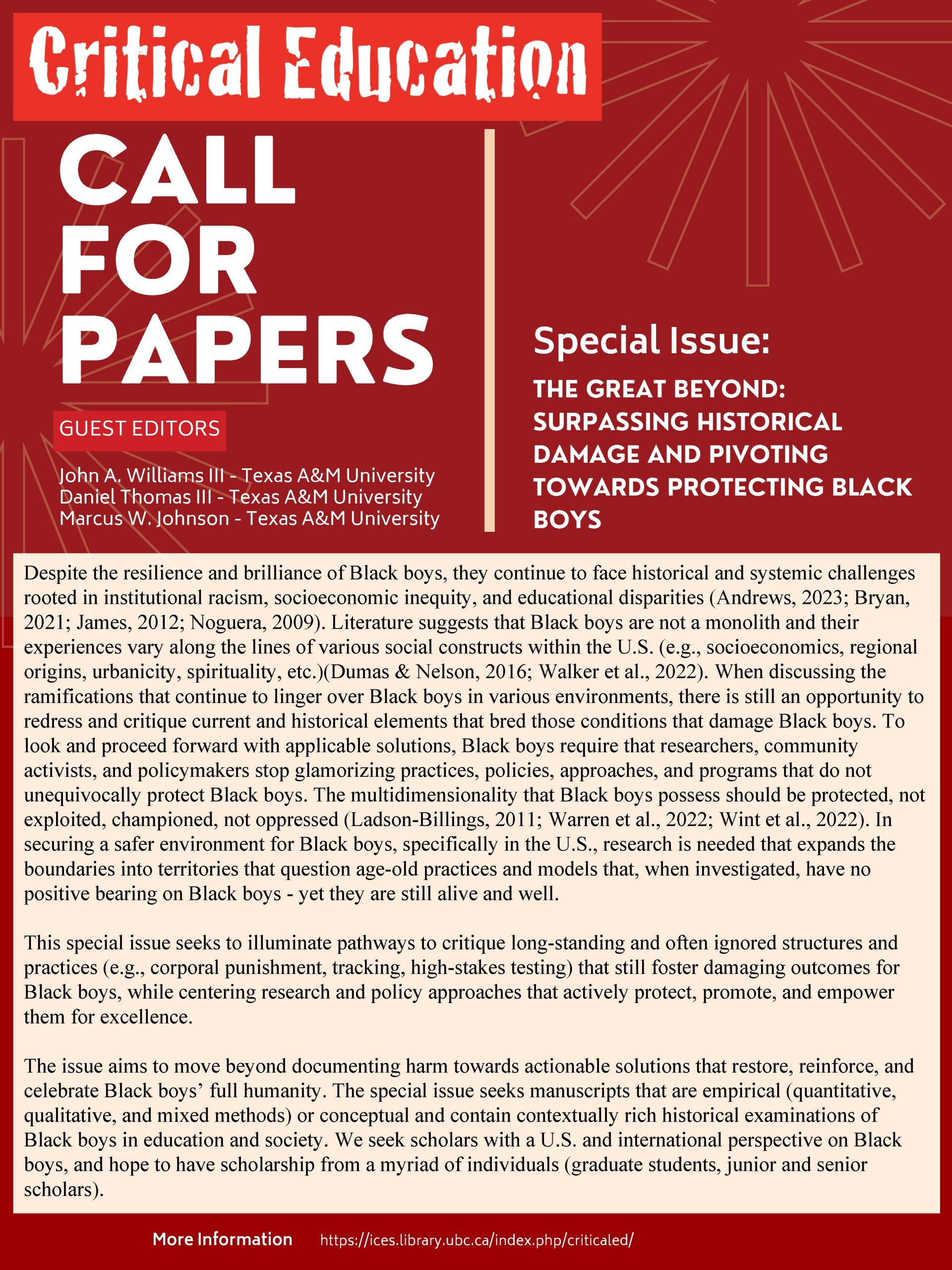
Special Issue Call for Papers — THE GREAT BEYOND: SURPASSING HISTORICAL DAMAGE AND PIVOTING TOWARDS PROTECTING BLACK BOYS

Special Issue Call for Papers — THE GREAT BEYOND: SURPASSING HISTORICAL DAMAGE AND PIVOTING TOWARDS PROTECTING BLACK BOYS

Guest Editors:

John A. Williams III – Texas A&M University
Daniel Thomas III – Texas A&M University
Marcus W. Johnson – Texas A&M University

Despite the resilience and brilliance of Black boys, they continue to face historical and systemic challenges rooted in institutional racism, socioeconomic inequity, and educational disparities (Andrews, 2023; Bryan, 2021; James, 2012; Noguera, 2009). Literature suggests that Black boys are not a monolith and their experiences vary along the lines of various social constructs within the U.S. (e.g., socioeconomics, regional origins, urbanicity, spirituality, etc.) (Dumas & Nelson, 2016; Walker et al., 2022). When discussing the ramifications that continue to linger over Black boys in various environments, there is still an opportunity to redress and critique current and historical elements that bred those conditions that damage Black boys. To look and proceed forward with applicable solutions, Black boys require that researchers, community activists, and policymakers stop glamorizing practices, policies, approaches, and programs that do not unequivocally protect Black boys. The multidimensionality that Black boys possess should be protected, not exploited, championed, not oppressed (Ladson-Billings, 2011; Warren et al., 2022; Wint et al., 2022). In securing a safer environment for Black boys, specifically in the U.S., research is needed that expands the boundaries into territories that question age-old practices and models that, when investigated, have no positive bearing on Black boys – yet they are still alive and well.

This special issue seeks to illuminate pathways to critique long-standing and often ignored structures and practices (e.g., corporal punishment, tracking, high-stakes testing) that still foster damaging outcomes for Black boys, while centering research and policy approaches that actively protect, promote, and empower them for excellence.

The issue aims to move beyond documenting harm towards actionable solutions that restore, reinforce, and celebrate Black boys’ full humanity. The special issue seeks manuscripts that are empirical (quantitative, qualitative, and mixed methods) or conceptual and contain contextually rich historical examinations of Black boys in education and society. We seek scholars with a U.S. and international perspective on Black boys and hope to have scholarship from a myriad of individuals (graduate students, junior and senior scholars).

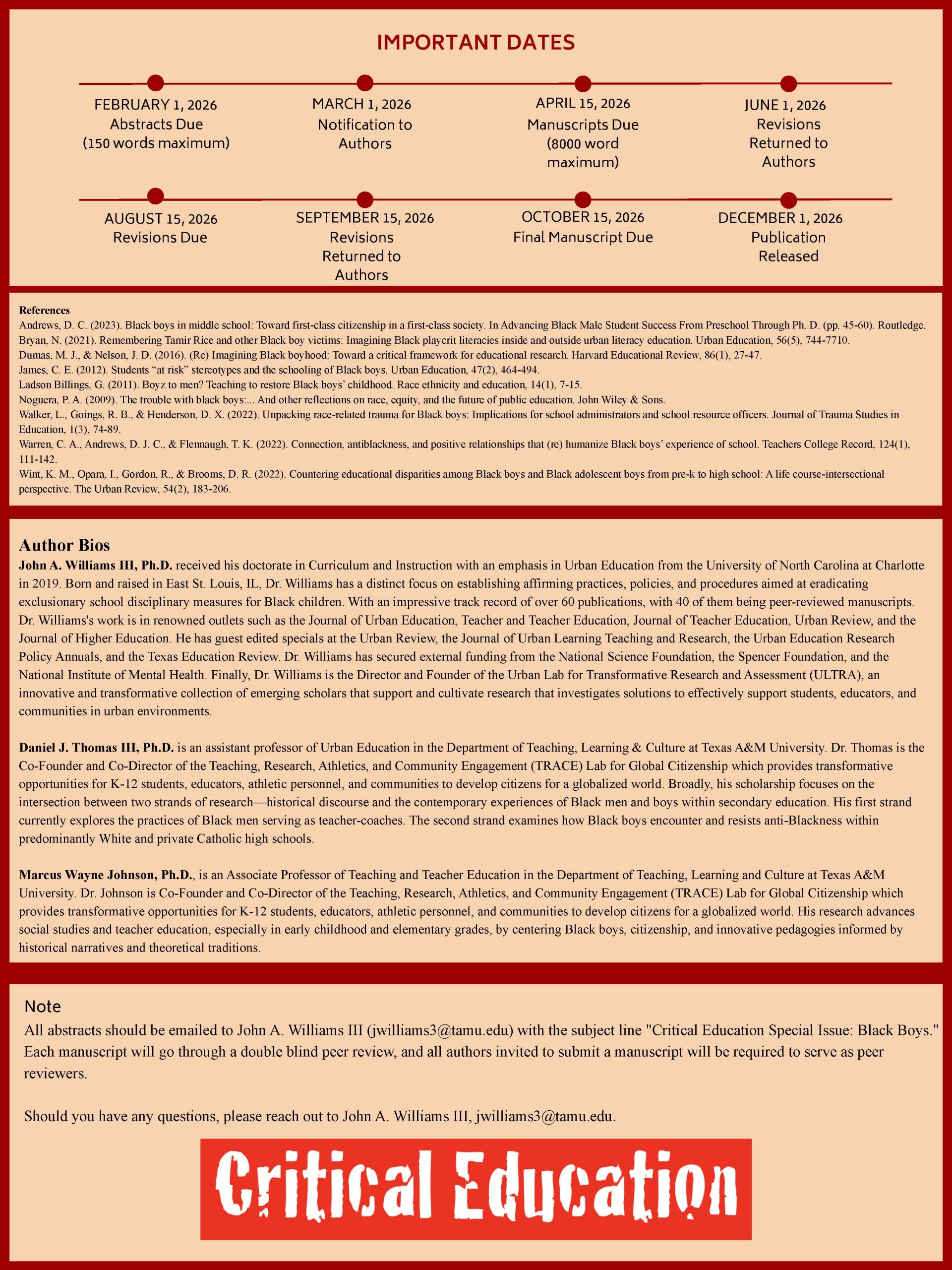
All abstracts should be emailed to John A. Williams III (jwilliams3@tamu.edu) with the subject line “Critical Education Special Issue: Black Boys.” Abstracts due: February 1, 2016.

 Each manuscript will go through a double blind peer review, and all authors invited to submit a manuscript will be required to serve as peer reviewers.

 Should you have any questions, please reach out to John A. Williams III, jwilliams3@tamu.edu.

 References

Andrews, D. C. (2023). Black boys in middle school: Toward first-class citizenship in a first-class society. In Advancing Black Male Student Success from Preschool Through Ph.D. (pp. 45-60). Routledge.

Bryan, N. (2021). Remembering Tamir Rice and other Black boy victims: Imagining Black playcrit literacies inside and outside urban literacy education. Urban Education, 56(5), 744-7710.

Dumas, M. J., & Nelson, J. D. (2016). (Re) Imagining Black boyhood: Toward a critical framework for educational research. Harvard Educational Review, 86(1), 27-47.

James, C. E. (2012). Students “at risk” stereotypes and the schooling of Black boys. Urban Education, 47(2), 464-494.

Ladson Billings, G. (2011). Boyz to men? Teaching to restore Black boys’ childhood. Race ethnicity and education, 14(1), 7-15.

Noguera, P. A. (2009). The trouble with black boys:… And other reflections on race, equity, and the future of public education. John Wiley & Sons.

Walker, L., Goings, R. B., & Henderson, D. X. (2022). Unpacking race-related trauma for Black boys: Implications for school administrators and school resource officers. Journal of Trauma Studies in Education, 1(3), 74-89.

Warren, C. A., Andrews, D. J. C., & Flennaugh, T. K. (2022). Connection, antiblackness, and positive relationships that (re) humanize Black boys’ experience of school. Teachers College Record, 124(1),111-142.

Wint, K. M., Opara, I., Gordon, R., & Brooms, D. R. (2022). Countering educational disparities among Black boys and Black adolescent boys from pre-k to high school: A life course-intersectional perspective. The Urban Review, 54(2), 183-206.