Anarchist scholar to speak at RF@AERA denied entry to Canada

Abraham P. DeLeon, assistant professor in the College of Education and Human Development at the University of Texas, San Antonio was refused entry to Canada today. He was scheduled to deliver a papers at the American Educational Research Association meeting and the pre-conference meeting of the Rouge Forum @ AERA, both which are being held in Vancouver, BC this weekend.

DeLeon, who holds a PhD from the University of Connecticut, does research in the areas of cultural studies, anarchist theory, post-colonialism, and animal studies in educational theory. His articles that have appeared in The Social Studies, The Journal for Critical Education Policy Studies, Educational Studies, Equity & Excellence in Education, and Theory and Research in Social Education. He is associate editor of Critical Education, which is based at the University of British Columbia. He has also co-edited two books: Contemporary Anarchist Studies: An Introductory Anthology of Anarchy in the Academy (Routledge, 2009) and Critical Theories, Radical Pedagogies, and Social Education: Towards New Perspectives for Social Studies Education (Sense Publishers, 2010).

DeLeon was scheduled to deliver an AERA paper titled: “Lured by the Animal: Rethinking Nonhuman Animals in Educational Discourses” and he was also scheduled to speak at the pre-conference Rouge Forum @ AERA on “What might happen when teachers and other academics connect reason to power and power to resistance?”

Canada Border Services Agency refused to give a reasons for denying DeLeon entry to Canada. CBSA has also repeatedly denied entry to American educator Bill Ayers, a Distinguished Professor at the University of Illinois, Chicago. The CBSA’s actions raise serious concerns for Canadians and Americans who value free speech, open debate and academic freedom.

Welcome Rouge Forum @ AERA 2012 Participants!

The Institute for Critical Education Studies (ICES) extends a warm welcome to all Rouge Forum @ AERA 2012 participants, international, national, and local! We look forward to a lively, engaged conversation or perhaps debate at Friday’s conference, with our intent of exploring what it means for scholars, and educators in general, to move beyond “knowing” to the pursuit of activist agendas for social change.

  • What happens when teachers and other academics connect reason to power and power to resistance?
  • How can academic work (in universities and other learning environments) support local and global resistance to global neoliberal capitalism?
  • How do we respond to the obstacles and threats faced as activist scholars?

For more information and directions, go to Rouge Forum @ AERA.  We are meeting Friday April 13, 2012 (9:00am – 6:00pm) at the University of British Columbia Robson Square Campus (downtown Vancouver).  See you there! *Remember it is free and all are welcome!

Chomsky sounds off… the assault on public education

Not a new message, but a good op ed nonetheless. Chomsky describes the “failure by design” that has lead to the current financial crises in higher education, including the lack of public moneys to fund PUBLIC education, as well as the push for privitization, and the corporatization of higher education.

CFP Rouge Forum 2012 (Deadline April 15)

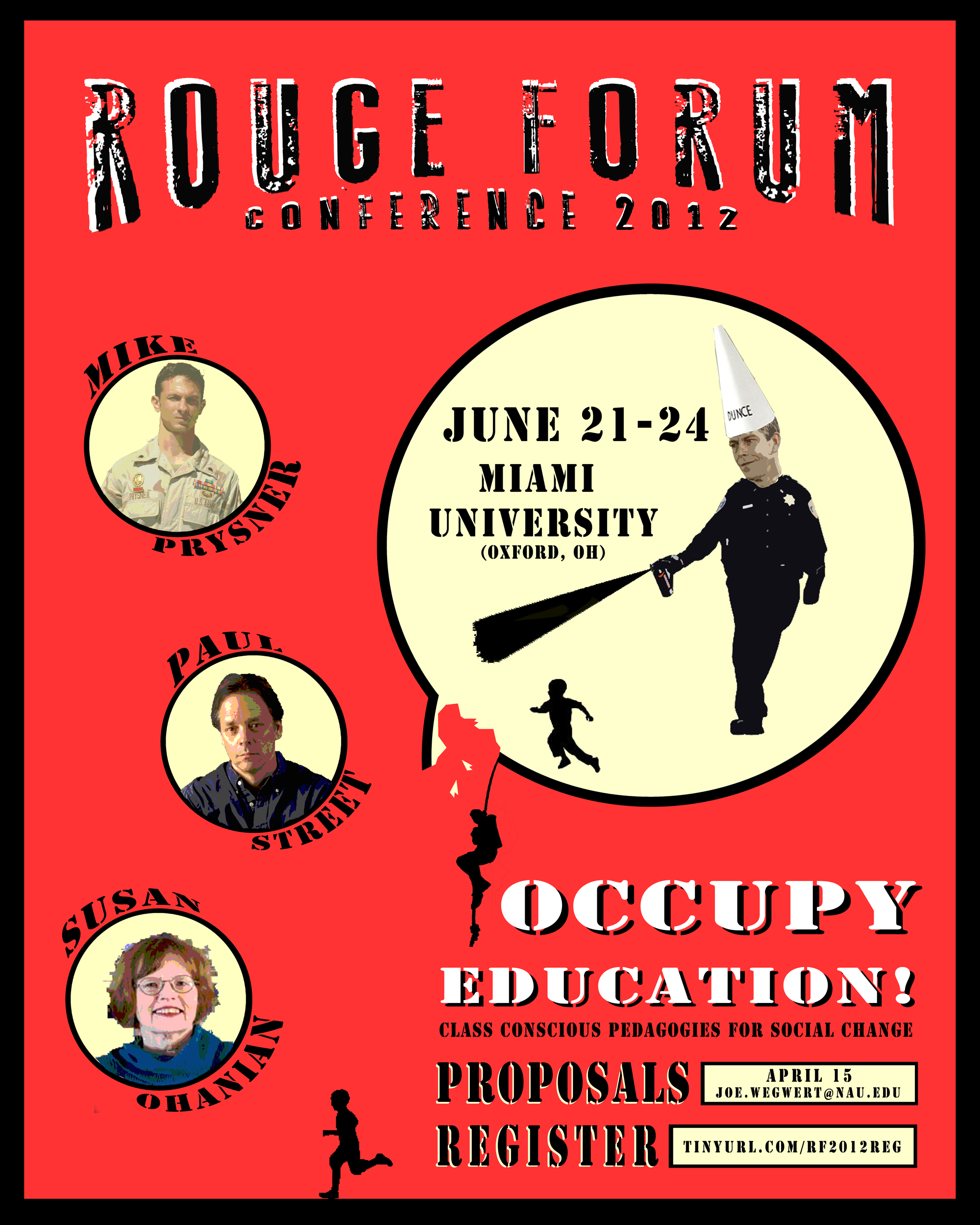
The Rouge Forum 2012 will be held at Miami University in Oxford, Ohio. The University’s picturesque campus is located 50 minutes northwest of Cincinnati. The conference will be held June 22-24, 2012.

Proposals for papers, panels, performances, workshops, and other multimedia presentations should include title(s) and names and contact information for presenter(s). The deadline for sending proposals is April 15.  The Steering Committee will email acceptance notices by May 1.

Read the Call for Proposals.

Featured speakers this year include Mike Prysner, Paul Street, and Susan Ohanian.

“We want… education! When do we want it? Now!”

Detroit High School Protest: Students Suspended After Demanding ‘An Education’

About 50 students were suspended Thursday from the all-boys Frederick Douglass Academy in Detroit, Mich. for walking out of classes in protest, demanding “an education.”

Among their complaints: a lack of consistent teachers, the reassignment of the school principal, educators who abuse sick time and a shortage of textbooks.

Call for papers special issue of Workplace: A Journal for Academic Labor (Graduate Studies and the Academic Labor Market)

Call for Papers:
Graduate Studies and the Academic Labor Market

Special Issue of Workplace: A Journal for Academic Labor 2012
Guest Editors: Bradley J. Porfilio, Julie A. Gorlewski, and Shelley J. Jensen

 Workplace invites and authors to submit papers for a special issue on Graduate Studies and the Academic Labor Market. What are the futures of the academic labor market for graduate students? Or more to the point, is there a future in academic labor for graduate students? Even a casual glance at The Chronicle of Higher Education and, in Canada, at the CAUT Bulletin and University Affairs, suggests a shrinking job market for PhDs. In some disciplines, academic careers have all but disappeared. Post-PhDs are increasingly tracked or streamed into adjunct and sessional appointments, most of which are dead-end and even on full time bases may amount to less than $25,000 per year. This “income” is oftten typically annulled by student loan payments; indeed, the income to debt ratio for post-PhDs adds to a heavy burden of anxiety. We readily romanticize the life of the intellectual, but – more and more – this life does not put food on the table. Food banks are becoming more and more common on university grounds and the lines are not limited to students.

  •  What is the nature of this phenomenon in higher education?
  •  What do these trends mean for the future of education and learning beyond mere technical training?
  •  How do economic hardships affect scholarly pursuits?
  •  How might graduate students reclaim their futures in the professoriate?
  •  What roles exist for the scholar activist – both novice and veteran?
  •  What other questions we should be asking?

The editors request abstracts for papers by September 15, 2012, with full drafts due by December 15, 2012.

For more information and due dates contact Brad Porfilio (porfilio16@aol.com)

Critical Education: “Water is a Right: A Critique of Curricular Materials and Learning Experiences in Schools Sponsored by the Transnational Water Utility Service Industry”

Critical Education has just released a new issue, featuring the article “Water is a Right: A Critique of Curricular Materials and Learning Experiences in Schools Sponsored by the Transnational Water Utility Service Industry” by J. Hall.

Critical Education 3(3), 2012
Water is a Right: A Critique of Curricular Materials and Learning Experiences in Schools Sponsored by the Transnational Water Utility Service Industryd
J. Hall

Abstract

There is no longer an infinite supply of fresh water on the planet. In large part, the global water crisis is a result of large-scale, destructive, industrial “innovations.” In just fifteen years, two-thirds of the people on the planet will feel the impact of the diminishment of safe drinking water. Given the global water crisis, the focus is this analysis is on the transnational water utility service industry as well as the larger shift from the notion of drinking water as a public right to a commodity to be privately owned and sold on the global marketplace. I discuss the very different ways these corporations are entering communities in the Southern compared to the Northern hemisphere, including attempts to re-brand their image after public failures. I then consider the particular strategies these conglomerates use to seep into cities and towns in the North. Emphasis is placed on how this sector of the water industry is becoming involved in schooling through sponsoring curricular materials and activities. I also provide initial analysis of the messages distributed in a sample of such materials and activities intended for K-12 students. While literature exists that explores curricular materials in schools provided by transnational corporations involved in direct control of natural resources, surprisingly, the privatization of the world’s fresh water supply receives little attention in both education-based scholarship and media.

Want to express your concern about the US federal government “leadership” in educational reform?

Check out the petition at dumpduncan.org

From the website:
“The future of public schools is in jeopardy. Private interests, aided by the Federal Government, are attempting to supplant local control and to transfer public funding to the hands of corporate interests. Public schools, locally controlled, are a cornerstone of our democracy. Relegating them to corporate-owned test prep factories places our nation at risk and steals our children’s future.”

The petition currently has 4300+ signatures.

Chicagoland researchers urge CPS to smarten up about using value added teacher evaluation

In an open letter to the Chicago Mayor Rahm Emanuel,
Chicago Public Schools CEO Jean-Claude Brizard, and the Chicago School Board educational researchers in and around Chicago offer a suggestion for caution in implementing a plan to use student achievement test scores as a substantial part of the evaluation of teachers and principals. They urge the CPS to:
1. Pilot and adjust the evaluation system before implementing it on a large scale.
2. Minimize the percentage that student growth counts in teacher or principal evaluation.

Vancouver School Trustees show support for teachers

VSB Trustees Chair Patti Bacchus sent this letter to Premier Christy Clark urging the repeal of Bill 22.