Semiahmoo First Nation

Having grown up in White Rock and living so close to the Semiahmoo First Nation (even attending Semiahmoo Secondary School), I have never known much about the Semiahmoo First Nation community. Looking into it, I found Semiahmoo First Nation listed in Wikipedia: http://en.wikipedia.org/wiki/Semiahmoo_First_Nation

I can’t help but wonder who authored this wiki page. When I click on the “discussion tab” it states that the site has been entered by the Canadian Government and the Indigenous Peoples of North America Wiki Project. I wonder if the Semiahmoo First Nation community was included in the content that was published to this site – or if they even approve of the listing page on wikipedia?

How Hollywood Stereotyped the Native Americans

40Discos.com
Related Videos of Stereotyping Indigenous People

http://www.40discos.com/video/_hJFi7SRH7Q.html

This website is a great resource for Module 2’s theme of Stereotypes of Indigenous Peoples. It has great videos about many different aspects of Indigenous peoples and their cultures including many of the different stereotypes that Hollywood has presented and supported of Indigenous peoples. The Youtube video is embedded on the page and links to similar films with similar themes are listed below with a description of the video and the video on the left. The site is user-friendly and easy to navigate. This site will be an excellent resource for my research on Elders and Technology as the Hollywood representation of Indigenous peoples can’t be ignored.

[youtube]https://www.youtube.com/watch?v=_hJFi7SRH7Q&feature=player_embedded[/youtube]

The video How Hollywood Stereotyped the Native Americans includes interviews of Indigenous people (some actors) and their thoughts on Hollywood’s representation of their culture and people. They indicated that growing up with these images on film of their people, they never saw their own image in their reality, instead, they saw the fantasized Hollywood version of how their lives and cultures were and should be. It discusses the ‘white audience’ and how they have influenced the content of Native American films. The portrayal fo the white-man was unrealistically positive, always coming out ahead and better than his Indian foe. They confuse the Native American and Euro-American phenomenon and try to perpetuate the image of the savage Native American and white, Western mainstream Again, this correlates well with Module 2’s Prins (2002) reading and his description of the duality of the “paradox of primitivism”. I love the final quote in the film from a Native American: “A Nation that does not know its history has no future!” That’s a very powerful statement and one Western mainstream should acknowledge.

Nanook of the North (Full Version)

In preparing Week 5 reading (i.e. Nanook of the North), I found the full version of Nanook of the North on Youtube. The full length film provides a context for better understanding the excerpt of the film, posted on the Module.  In particular, the full version seems to show more clearly the gendered nature of Nonook and his family. That is, Nanook as a bread-winner leads hunting while other family members are depicted in the domain of more domestic labor.

– The director Robert J. Flaherty earned reputation by this film due to its commercial success and its contribution to the field of visual anthropology.

– There is a feature film about making Nanook of the North; the film is entitled Kabloonak.

Ky (#4: Module 2).

Representation & Media (Stuart Hall)

In his lecture, Representation & the Media, distinguished media theorist Stuart Hall introduces how to analyse the process of representation in media, with interesting examples. Originally released in 1997 by Media Education Foundation, a proactive organization for critical media pedagogy, Hall’s lecture explores how and why representation is more than the reflection of meanings and reality. In the lecture, our common sense of representation as reflection is challenged by a new view to understand representation as constitutive of reality, as Hall notes that representation is not simply distortion or accurate reflection of reality and meanings that exits out there.  

This talk offers a critical approach to representation of marginalized people and therefore can be effectively applied to the case of indigenous people in the media. The linked video clip is only the first bit of the lecture. Other parts of the lectures may be found here and there. The full script of the lecture is available, as well.

Ky (#3: Module 2)

The National Film Board of Canada

Related videos to stereotyping

http://www.onf-nfb.gc.ca/eng/collection/film/?id=32975

The National Film Board of Canada has a website that has great videos about many different aspects of Indigenous peoples and their cultures. It provides a description of the films and then links to the films themselves. Links to similar films are listed on the right. The site is user-friendly and easy to navigate. One interesting series in particular (Daughters of the Country) is about a few different Metis women, their experiences (how some feel torn between their people and their husbands – if they married outside the tribe) and how the Metis (in Canada) had become a forgotten people. One of the films was made in Alberta which I found very intriguing (as I’m an Albertan), I love seeing videos created in Alberta’s beautiful landscape. These videos along with many created by the National Film Board of Canada connect with my topic of Elders and Technology as they depict some of the historical views & stereotypes that Western mainstream society articulates about Indigenous peoples in many different dimensions (including technolgoy) – we may say in correlation with Module 2’s Prins (2002) “paradox of primitivism”.

Common Portrayals of Aboriginal People

Media Awareness Network
http://www.media-awareness.ca/english/issues/stereotyping/aboriginal_people/aboriginal_portrayals.cfm

In my Module 2 searches of stereotypes of Indigenous peoples, I came across this great site by the Media Awareness Network and Media Stereotyping and Common Portrayals of Aboriginal People. This site provides excellent links to other related resources (reports, articles, websites, and even contests) on stereotyping and Indigenous peoples such as: Stereotyping Indians by Omission (Peace Party, 2001); Indian Women as Sex Objects (Blue Corn Comics, 2001); The Basic Indian Stereotypes (Blue Corn Comics); Coyote Goes Hollywood (Native Peoples Magazine, 1997); Indian Princesses and Cowgirls: Stereotypes from the Frontier (An Exhibition by Gail Guthrie Valaskakis and Marilyn Burgess, 1997); Daughters of the Country (NFB, 1987); Stereotype of the Month Contest

It describes the background of stereotypes of Indigenous peoples and how Hollywood has portrayed these stereotypes. This site ties in well with my topic of Elders and Technology and closely correlates with our Module 2 discussions of stereotypes. This site does a great job of addressing different types of Indigenous stereotypes as well as Prins (2002) description of ‘the paradox of primitivism’ and the romantic exoticism embedded in white ideology and Hollywood’s depiction of Indigenous peoples.

It is well designed, aesthetically pleasing, user-friendly, easy to navigate, includes 3 different menu bars. On the right it is organized into the following categories: Overview, Media Violence, Media Stereotyping, Online Hate, Information Privacy and Media and Canadian Cultural Policies. At the bottom, further links to Common Portrayals of Aboriginal People. On the left it has page links for Blog & News, Issues, Research, Educational Games, Special Initiatives, Resource Catalogue, Content Cart, Site Directory, & Help. On top the menu includes home, about us, memberships, supporters, press center, contact us (to find contact information, etc.), a French language choice and a search bar. Excellent information, this site will be one that I will use and reference in the future!
The Reciprocal Research Network

The Reciprocal Research Network (RRN) is an online catalog which was developed by the Museum of Anthropology at UBC (MOA), in collaboration with Musqueam Indian Band, the Stó:lō Nation/Tribal Council, and the U’mista Cultural Society. It provides fascinating images of 245,255 objects (including MOA’s 38,000 items). 

This online museum catalog seems to embody indigenous ways of knowing and archiving to some extent, given the introductory demo video. According to the video statement, the catalog is reciprocal, creative, collaborative, respectful, and accessible. The users, once log in, can browse and archive the web-displayed items and make comments on them.

RRN is a good example of how indigenous communities and the mainstream research institution can collaboratively develop the technological design which can benefit both indigenous and non-indigenous communities.  

Ky (#2: Module 2).

Residential Schooling in BC

In case I have not been too clear on my topic for area of research from looking at the theme of my previous posts, it will be on Residential Schooling in British Columbia.

My final topic for the weblog will focus on the perspectives of First Nations in Residential Schools in B.C. I would like to have some of the focus to be on the interior of BC, but I am unsure at the moment of how much information there will be on specific Residential Schools.

Part of my focus will be on perspectives of First Nations, so I will be looking at some personal accounts of students who attended the schools. I am also wanting to do my research in this area to strengthen my knowledge and understanding to be better able to teach this in my classes.

This is my first draft and it is still early in the course, I hope to refine and focus the topic more as my research continues.

Web Design “Well suited to a First Nations philosophy”

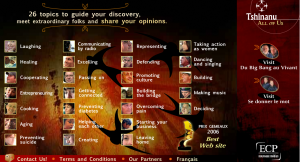
Although it was created over five years ago (that’s a lot of Internet time!)  I found navigating around “Tshinanu / All of Us” to be an interesting “sandbox” exercise.  With no instructions on how to use the website, it’s background or meaning; I began exploring the 26 modules at random and found a surprisingly engaging and user-friendly experience.

All Of Us website

Digging deeper, I discovered the website is based on a television series developed to depict the “social, economic and cultural realities of Quebec Aboriginal communities.”  The project brings together community members of all ages and many viewpoints to discuss meaningful issues, covering a range of topics from the politics to cooking to gender issues to coming of age. Each interactive module allows the watch an overview, meet people involved with the “theme,” participate in an interactive activity, share an opinion on the topic discover related resources, and more.

The design concept behind this website was based “on principles of interactivity, discovery and exchange well suited to First Nations philosophy.” Having stumbled upon the website at random, I have never seen the TV series that the clips/themes are taken from, nor was I expecting such a surprisingly pleasurable web-browsing experience!

Media Awareness Network

Media Awareness Network provides resources about media literarcy, for educators and parents. In particular, it offers well-organized examplary media education programs for teachers. As discused in Module 2, the stereotyping of indigenous people in media needs to be critically examined and, for that purpose, media literacy education is required. Since the Internet allows its users an extensive and almost unlimited access to a wide range of information, it is especially important for young people to be discreet and critical about a plethora of images, narratives, and commodities on indigenous people which they don’t know much. In this regard, the Media Awareness Netowork seems a very useful site for educators to guide young people. 
  
Ky (#1: Module 2).