

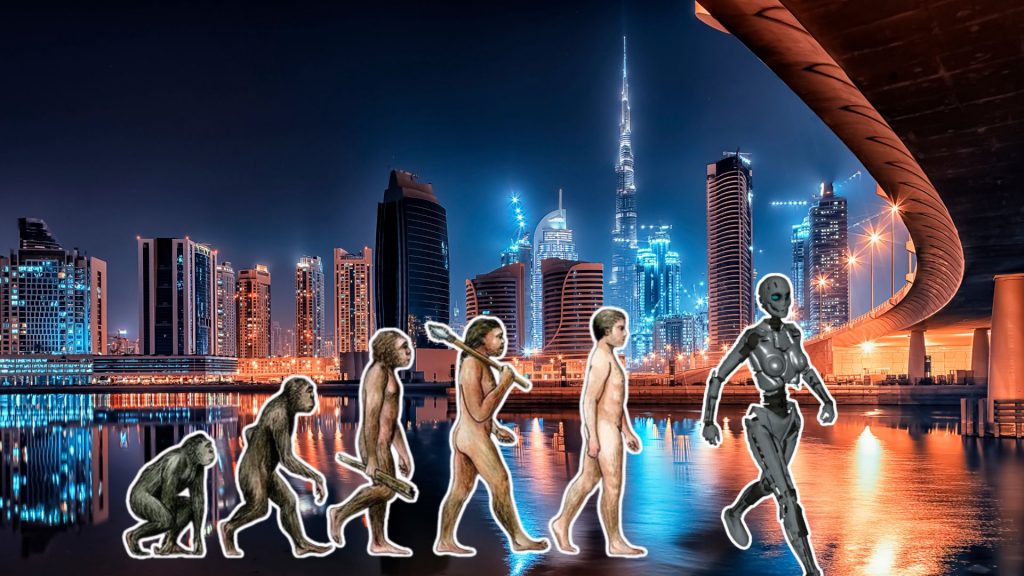
Postmodernity & Posthumanism
Jean Baudrillard theorizes that media creates ‘simulations’ which has destroyed the separation “between the real and the simulacrum, between the authentic and the inauthentic, between the natural and the artificial” (Landsberg, 2004, p. 32). Thus, it calls into question the dichotomy between the materiality and immateriality of technology. Technology is immaterial in the sense that it exists only as an extension of the body (through amplifying actions), yet is profoundly material with its impacts on the mind (through amplifying emotions). These simulations create a bridge between the real and the simulacrum, creating a postmodern society where humanity and technology are deeply entrenched within each other. Postmodernity, as characterized by Baudrillard, is devoid of ‘real’ experience due to the extensions and amplifications afforded by technology (p. 32). However, because of rapidly developing technology, progress has lost its meaning and change is now miniscule, thus encroaching on human autonomy.
Posthumanism opposes the notion that humans are autonomous creatures by arguing that humans are highly “physically, chemically, and biologically enmeshed and dependent on the environment” (Keeling & Lenman, 2018). As technology and environment are inseparable–technology is not only around us, but also on and in us–, humans thus become dependent on it as lives are influenced by and are incorporated into technology. Humanity and technology are inherently intertwined and interdependent of each other. Technology cannot exist without humanity, as its primary function is to extend and amplify the human experience, which also highlights humanity’s growing dependence on it. With these ever-expanding technologies that encompass our lives, the four laws of media are also being lost. What are we expanding, or retrieving? Is there anything that is being truly left obsolete?
Images by Bridghet Wood / Created on Canva
Blogpost by Bridghet Wood and Xelena Ilon
References
Keeling, D., & Lehman, M. (2018, April 26). Posthumanism. Oxford Research Encyclopedia of Communication. Retrieved 27 Oct. 2025, from https://oxfordre.com/communication/view/10.1093/acrefore/9780190228613.001.0001/acrefore-9780190228613-e-627.
Landsberg, A. (2004). Prosthetic memory: The transformation of American remembrance in the age of mass culture. Columbia University Press.
Van Den Eede, Y. (2014). Extending “extension”. In D. M. Weis, A.D. Propen & C. E. Reid (Eds.), Design, mediation, and the posthuman. Bloomsbury.