Introduction
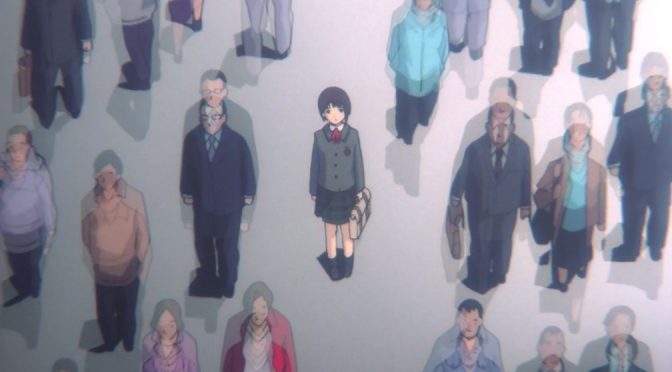
Serial Experiments Lain is a 1998 cyberpunk anime which follows a girl called Lain in a world where the boundary between the physical realm and the Wired – a fictionalized version of what we know as the Internet – progressively becomes more blurred. Lain grapples with confronting her digital alter egos and trying to make sense of her ever-shifting reality. While the series quickly spirals into surreality and confusion, the themes of memory, identity and mass media ring clear. The specific concept of prosthetic memories comes into view when it is revealed that the world’s chaos can be traced back to a digitally-omnipresent antagonist named Eiri, whose ability to manipulate collective memory can shape reality.
Hence, I found that this series resonates heavily with Alison Landsberg’s 1995 paper Prosthetic Memories, in which she defines such memories as ones that are implanted instead of coming from lived experiences. While her discussion focuses on prosthetic memories as experienced through film and mass media, my blog post explores how Serial Experiments Lain extends her ideas to the modern age of the internet and social media. I go further to argue that the late-90s series prophetically illustrates how the internet is used as a powerful tool for systems of power to manipulate memory, alter reality and reshape history to the detriment of society.
Prosthetic memories through social media
Landsberg explains that the mass media is a site for the production of prosthetic memories, with cinema in particular. As a medium that makes images available for mass consumption, it creates experiences and implants memories “which become experiences that film consumers both possess and feel possessed by” (176). Spectators witness memories depicted on screen that they have not actually lived through, prosthetically experiencing the histories of a collective past. Landsberg suggests that this complicates identity formation and results in the creation of “partial identities” (179).
Similarly, Lain is a figure whose identity is fragmented and shaped by prosthetic memories. Midway through the series, a mind-bending twist reveals that Lain is a digital entity entirely constructed by Eiri with the purpose of bridging the gap between the real world and the Wired. She grows to become a figure whose identity is shaped by the human collective unconscious present in the Wired, resulting in different “Lains” who are constructed by various people’s experiences and memories. While the Wired presents an exaggerated, more advanced version of how the Internet functions in real life, Lain’s experiences with partial identities is reflective of how our identities are shaped online. Beyond the images depicted in films as discussed by Landsberg, social media has made it so that users can easily upload documentations of their memories to the digital realm, readily accessible for others to prosthetically experience these histories and internalize them as their own.
Perception becomes reality
Landsberg explains that what is real and what is not becomes blurred when an individual’s identity is affected by prosthetic memories. She asks the question “What might it mean to say that those memories are ‘just’ from a movie?”, arguing against any attempt to distinguish between prosthetic memories and “real” ones, since anything that we experience to be real becomes our reality regardless of the source. Serial Experiments Lain echoes this point by positing that perception becomes reality, and extends this discussion to the realm of collective memories and the act of memory erasure.
“A memory is only a record. You just have to rewrite that record.” – Lain
While the series explores Landsberg’s ideas of experiencing additional memories outside of one’s own lived experience, it also explores what happens when memory is erased. As Lain becomes a powerful, God-like being that crosses between planes of reality, she grows to realize the detrimental impacts of her abilities, and uses memory manipulation as a positive force to remove herself from society’s collective memory. She continues to live on, but in a peaceful world where she was never remembered, and thus the impacts of her existence are no longer present. This bittersweet ending highlights a central idea that ripples throughout the episodes: that people only have substance within the memories of other people.
Memory as shaped by power
Following this idea that people only have substance within memories of others, could this also apply to global issues or events? Our collective memory and experience of reality is largely shaped by our engagement with social media and the images that we see online. If something is documented less or hidden from public view, society becomes prone to forgetting it, which essentially removes it from our perception, and thus our reality.
Adriaansen and Smit explain how platformization reshapes the act of remembering and forgetting through algorithmic curation. They define platformization as the way in which our pasts are actively and continuously reshaped by the infrastructures of digital platforms. They use the example of Facebook and Apple’s “Memory” features that algorithmically select old posts to surface as memories based on engagement metrics and positive content. These features strategically reconstructs individual’s memories into tailored narratives that highlight certain moments while erasing those deemed less desirable. Adriaansen and Smit also explain how, on a collective scale, algorithms aid in the dissemination of content throughout social networks, with algorithmic bias playing a part in determining which narratives gain visibility and credibility. This proliferates the spread of “fake news”, leading to collective yet false memories about public events that become part of our perceived reality and experiences (2).

Serial Experiments Lain extends Landsberg concept of prosthetic memories to the modern age of the Internet, and illustrates how social media is a prominent site for memory construction and the shaping of our collective reality. The power of memory manipulation that Eiri, and consequently Lain, hold, make them figures that are allegorical of these systems of power and regimes that enforce censorship in attempts to make us remember and forget. While there is no God-like entity that can literally extract and implant memories into the minds of individuals (hopefully), the erasure and fabrication of narratives happen all the time, subtly but surely. Hence, it remains important for us to look through the cracks and think critically about the information we engage with online so that we don’t fall into a perception of reality that blinds us from truth.
By: Adela Lynge
References
Adriaansen, Robbert-Jan, and Rik Smit. “Collective memory and social media.” Current Opinion in Psychology, vol. 65, Oct. 2025, pp. 1–4,
Landsberg, Alison. “Prosthetic Memory: Total Recall and Blade Runner.” Body & Society, 1995. pp. 175-189.