Tag Archives: critical terms

Memory is Soul:

A Response to “Umberto Eco: A Library of the World” By Christine Choi and Aminata Chipembere

Introduction: 

In Davide Ferrario’s documentary Umberto Eco: A Library of the World, the viewers are given a tour of the inner workings of Umberto Eco’s mind. The audience has the chance to revisit many of his influential theories on materiality, memory, and knowledge. Early in the film, Eco asserts that “Memory is Soul,” setting up his reflections on the human need to preserve and seek out knowledge. Eco introduces an intersection between libraries and memory. For him, a library is more than just a collection of books; it is “mankind’s common memory”. It serves as a living embodiment and symbol of humanity’s collective effort to make sense of the world. 

The concept of the library being a vessel for memory connects to Eco’s broader reflections on archives and materiality. Eco’s attachment to physicality resonates with the knowledge introduced by Bill Brown in Materiality, which considers how physical objects reshape one’s lived experience. Eco’s theories warn about the dangers of the internet and overcomposition. These theories can be explored in relation to Annalee Newitz’s My Laptop, which describes how digital technologies have transformed our relationship with information. Eco’s work alongside these theories highlights the evolving relationship between memory, materiality, and media. Reminding audiences that the mediums in which we store knowledge reshape the way we remember and understand. 

Memory & Information: 

In the documentary, Umberto Eco introduces three types of memory: Organic, Vegetal, and Mineral. Organic memory resides in the brain, “made of flesh and bone” (Eco), and encompasses our ability to recall and forget. Vegetal memory refers to written media (books, papyrus) and represents memory in its physical form. Mineral memory, the newest form, is stored in silicon or digital technology. This form highlights technology’s ability to hold and collect knowledge. While each of these forms serves its own purpose and works to expand knowledge. Eco suggests that mineral memory introduces a paradox: an overload of information that could eventually overwhelm rather than benefit. 

Eco warns that human beings aren’t meant to know everything, stating that “if we knew all that is contained on the web, we’d go crazy.”(Eco). He points to the flood of digital content as the main reason behind what he calls information noise, the idea that so much information exists that it becomes impossible to distinguish meaning from distraction. He argues that the world is constantly overloaded with messages that often say nothing. He warns that this noise disrupts one of the core functions of memory: the ability to select, filter, and prioritize important information. In this era, dominated by mineral memory, this filtering process is breaking down. The internet, as Eco puts it, functions as “an encyclopedia where everything is potentially recorded, but without the tools to filter its content.” Eco highlights an important issue with the ability to filter information and organize its content; its usefulness diminishes. 

In discussing the overflow of digital content, Eco causes us to reconsider this dependence on mineral memory. Over time, humanity has become increasingly more reliant on technology and has slowly turned away from organic memory. This is evident in Annalee Newitz’s work, My Laptop, where she describes that she relies on digital tools to store and recall information. She writes, “It’s practically a brain prosthesis.”(Newitz 88), highlighting the extent to which her laptop has replaced her own cognitive abilities. This dependence serves as a real-world example of Eco’s fears coming true, that technology, instead of working alongside organic and vegetal memory, has begun to replace them entirely. As we continue to store our memories in technology, we risk weakening our own abilities to process and record information. This raises the question, what is the point of remembering, writing or archiving, if everything can be conserved online? The answer to this dilemma lies in Eco’s ideas on the importance of materiality. 

Memory & Materiality: 

It is no wonder, then, that Eco has a preference for physical books over digital files when it comes to reading, citing reasons such as how you are unable to underline passages, make dogears, nor smear the pages with a dirty thumb when reading on a digital interface. This, too, reveals a part of the memory that is held within the books themselves, giving them their own uniqueness and individuality. As Bill Brown quoted in the Materiality chapter of Critical Terms for Media Studies, “Information, delaminated from any specific material substrate, could circulate—could dematerialize and rematerialize—unchanged (55).” This unchanging and immaterial nature of digital media (or “new media”), would lead us to believe that it comes with immortality since it appears immune to the environmental changes and deterioration that physical media tend to be prone to—which is why we often see digitization of physical media as a form of preservation. However, Brown argues that “digital media are themselves subject to deterioration” since “they still require physical support”. This, too, highlights the threats that come with shifting towards depending on mineral memory more than vegetal memory as Brown also notes that “all media may eventually be homogenized within the hegemony of the digital” (53). 

Brown further asserts the threat that the digital landscape brings to materiality as more and more media get “dematerialized” (51). With the increase of communication occurring in our digital devices, it is also just as susceptible for it to vanish without the physical traces that take its form in our physical world, and with it, the memories of them would be forgotten to time. This sort of archaeological view of the media that we leave behind is, of course, great concern as media academics. As Eco stated, “we are beings living in time. Without memory, it’s impossible to build a future,” and without the vegetal memory that we can refer back to, it could end up compromising the very foundations and integrity that media studies is built upon. This is also the type of future that Brown is concerned with, as he states, “the homogenizing, dematerializing effects of digitization,” which would result in “the human body thus becom[ing] the source for “giv[ing] body to digital data” (58).” As a result, this affects the way we, as human subjects and media consumers, are mediated and facilitated by the information in our environment. 

Conclusion:

From Eco, Newitz, and Brown, we have seen how our modern-day society has a complicated dynamic when it comes to organic, vegetal, and mineral memory. We can also see why, then, libraries like Umberto Eco’s would be so significant in our current media landscape. From Eco’s teachings and theories brought attention to the pitfalls the over-reliance on technology and the mediation of mineral memory through them. This documentary serves as a reminder that too much information can ultimately cause harm rather than benefit us. It causes us to rethink the constant need to gain more knowledge, as we can easily drown in the noise rather than learn from it. We must distinguish what information is crucial for us to keep and what we can discard. As media theorists, it allows us to think more critically about the fallibilities that we have often overlooked as we continue to adapt and familiarize ourselves with mineral memory in favour of vegetal memory. Much like Eco continued to emphasize throughout the film, “sentimentally, you cannot replace books.”

Citations

Brown, Bill. “Materiality.” Critical Terms for Media Studies, University of Chicago Press, 2010, pp. 49–63. 

Ferrario, Davide, director. Umberto Eco: A Library of the World. Film Commission Torino-Piemonte, 2023. 

Larsen, Martin Grüner. Umberto Eco in front of the bookshelf in his library which contains books he has written and translations. 9 May 2011. Flickr, https://www.flickr.com/photos/mglarsen/5772998464/in/photolist-9N98jh-9N6bdM-9N69ti-9N95nS-9N93EQ-9N8SFU-9N8QWo-9N6g9a-9N8ZtJ-9N63Hg-9N62ya. Accessed 19 Oct. 2025. Newitz, Annalee. “MY LAPTOP.” Evocative Objects: Things We Think With, edited by Sherry Turkle, The MIT Press, 2007, pp. 86–91. JSTOR, http://www.jstor.org/stable/j.ctt5hhg8p.14. Accessed 20 Oct. 2025.

The Game Controller: Mediating Between Virtual and Physical Worlds

Introduction

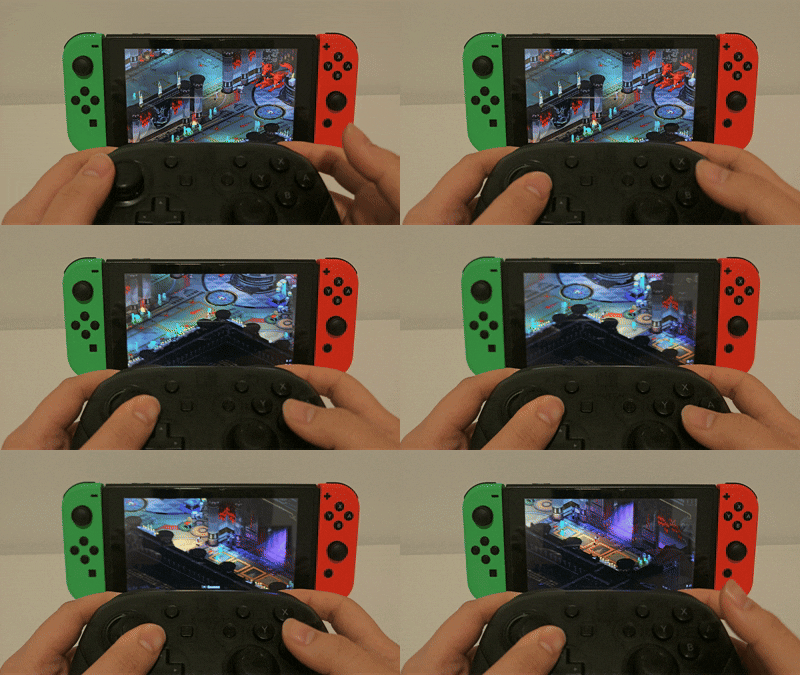
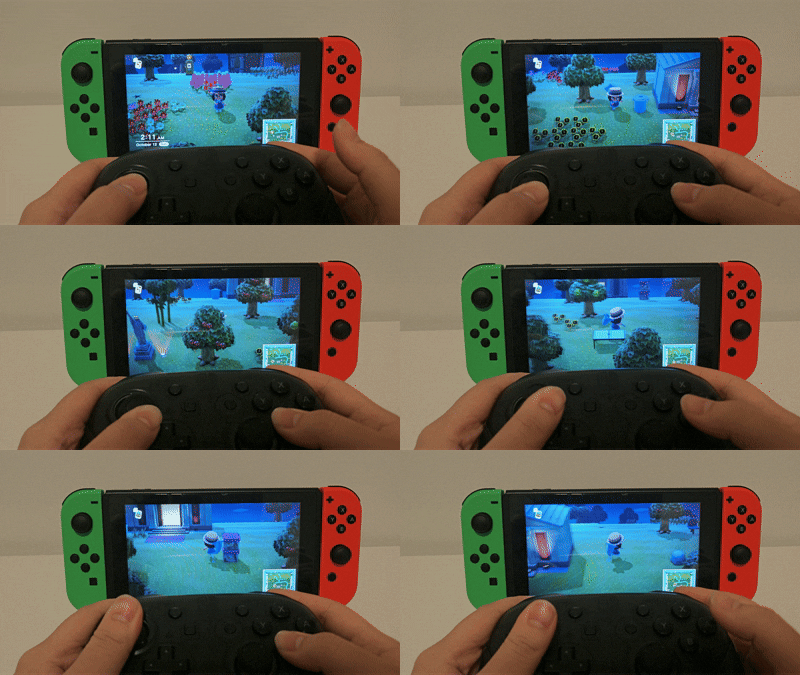
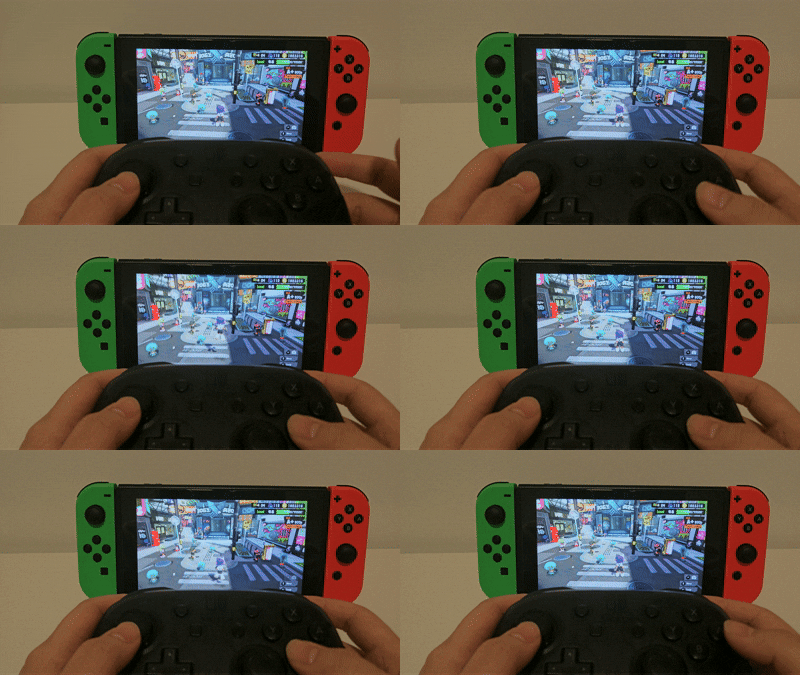
What do the buttons on a game console controller represent for you? Each button most likely has different functions which vary among each game’s unique game mechanics. Take for example, the “B” button. In Splatoon, pressing it results in your in-game avatar to jump, in Hades, it makes you dash forward, whereas in Animal Crossing: New Horizons, holding it down makes your avatar run. Our real-life act of pressing a button translates into another action occurring in-game, as depicted on the screen. One could even say that the buttons having diverse effects in each game’s unique mechanics, representing their own specific set of rules, relies on their own system of signs.  

Avatar in Splatoon 3 displaying “jump” mechanic – Footage by Christine Choi
Character, Zagreus, in Hades displaying “dash” mechanic – Footage by Christine Choi
Avatar in Animal Crossing: New Horizons displaying “run” mechanic – Footage by Christine Choi

This fascination surrounding such concepts is precisely why I chose a game controller as my evocative object. Although there are so many different variations of a game controller, I am going to use the Nintendo Switch Pro Controller as an example as it is the controller I was mediated by the most and is also one of the more “standard” modern designs when it comes to game controllers (the existence of a joystick, four buttons with letters/symbols, L and R buttons, etc.). By analyzing the game controller, I will highlight the ways that it mediates between us, the player, and the virtual world that the game exists in. 

The Controller and the Player

As mentioned before, the game controller has the unique ability to mediate between us and the virtual world displayed within the hardware (whether that is the console or the PC). When it comes to “playing” a game via a controller, there is a unique set of feedback that is inputted and outputted mediating between our physical corporeal bodies and the incorporeal in-game virtual bodies. 

You would first take in the world through senses, like sight and hearing. Certain in-game index, symbols, and icons may evoke feelings of fear, especially if it had informed the player of it causing harm to the avatar in the past. Others may evoke curiosity, enticing the player to explore more of the game and the “rules” of this digital world. Once you have cognitively processed that, your instincts—shaped by in-game and real-world experiences—would inform you to react. You would react by pressing buttons or rolling the joystick to the direction you want it to. We know, or at the very least expect, that the controller has received input when we receive the tactile feedback of the button being pushed down then springing back as we release it from pressing down on it. Then you would see the fruition of your act of button-pressing/joystick pushing by seeing the pixels on-screen change to indicate movement/change within this virtual world. 

Feedback of input and output between virtual and physical worlds – Diagram drawn by Christine Choi

The feelings evoked from the virtual information would translate in the grip of our controller; dodging enemies evoking another emotion of relief and safety, the achievement leading to satiate more of our curiosity, all driving our progression of the game. Thus, the controller is the mediating object for the player’s input and the software (which would be the game). Without the game, there is nothing for it to control and without the player input, there is nothing being controlled. 

Exerting Control over in-game “bodies”

Much of what is being said about the “control” over avatars/characters is correlated to what is said about the “body” as a medium in Critical Terms for Media Studies. After all, the controller could be seen as an extension of our own body, which extends into what is being “embodied” in-game. Wegenstein, too, utilizes psychoanalytic theories of how video games allow us to play the role of the “other”, a virtual embodiment that differs from the embodiment of ourselves. She quotes Slavoj Zizek on “a figure capable of taking on, or projecting itself into, many simultaneous roles” (28). The concept of roles that we project onto is correspondent with how the controller that mediates and perpetuates this “ego” that we project onto, making the body of the playable character another medium. 

Thus far, I have only discussed characters and avatars that have an anthropomorphic body, which is easy to visualize as we easily project our human bodies onto these characters. But what about games with no “avatar” or humanistic representation of our own bodies? I would argue that there is still a “body” or “vessel” in which we, in our physical and corporeal forms, exert control over digitally. Take Tetris for example, the falling blocks would be the body that we project ourselves onto. As the blocks fall, we move with it left or right via the joystick or D-pad. 

Game Controller as a “Black Box”

Even the most avid gamers most likely do not know the internal computational and mechanical workings of what occurs in between the space and time in which we press the button and watch the game do its magic. The game controller generally works under the “black box” heuristics (a cybernetics theory coined by Norbert Wiener), in which the processes of the input from our button to the output in the game is shrouded in mystery for the average user (Wiener, page xi). However, I would argue that this knowledge we lack of our game controller’s internal workings is precisely the tool we use to immerse ourselves in the virtual space of a video game. What we do know as gamers is that eventually, its mechanics is burned into the memory of our bodies through “muscle memory” as the controls become second nature to us, thus “mediating” our physical bodies in the real world and the incorporeal bodies that exist in the virtual space of a video game.

Citations

Wegenstein, Bernadette. “Body.” Critical Terms for Media Studies, University of Chicago Press, Chicago, Illinois, 2010, pp. 19–34.

Wiener, Norbert, et al. Cybernetics: Or, Control and Communication in the Animal and the Machine. MIT Press, 2019.

Images and footage were all taken by Christine Choi

The Window as An Evocative Object

Introduction

The setting sun slowly hiding behind distant mountains, groups of students walking between classes, the whistle of wind and the rumble of thunder – these are all sights and sounds accessible through my bedroom window. An object integral to architectural design, windows are embedded within the walls of almost every building, bridging the gap between interior spaces and the outer world. They allow for both the acts of looking outwards and looking inwards, offering a view of reality that is separate from one’s current situation. 

Windows have always been a significant part of my life, taking up space on the walls of my bedrooms, from the one in which I spent my childhood, to the ones in my different living situations during university life. They offer a view into the natural world that lies beyond the internal space that exists physically within my room and cognitively within my mind. Despite the ever-changing scenery, my bedroom window remains still and unmoving, acting as a constant that is always there. 

To understand more about the affordances of windows and what they can mediate, I turn to some relevant media theorists who were discussed in class. 

Objects of transition and shifting meanings

Sherry Turkle describes how the meaning of evocative objects “shifts with time, place, and differences among individuals” – a sentiment I find particularly relevant to windows (307). Sunlight streaming through a window could make it an object associated with positivity, encouraging someone to go outside. Conversely, the scene of heavy rain gives the window a gloomy evocation that is in contrast with the safety and warmth within one’s home. These are associations that I personally make with such scenes, though someone with different experiences may perceive things differently. 

Despite not quite fitting Turkle’s discussion of transitional objects as small, handheld ones that remain the same over time and distance, I find that windows can be still considered an object of transition and passage. They stay with us as we grow into adulthood, always present regardless of location. The view from my childhood bedroom differs from my current one, but the window’s function of showing the outside world remains the same. Windows can also be transitional in how they are decorated and personalized. In my first year of university, I made a crochet garland for my dorm window and continued to hang it up on my new one after relocating. This item holds memories from the past, framing the outside world through a sentimental lens despite the view being different from before.     

Old dorm room window (left) and current dorm room window (right)

Objects of discipline

Turkle’s discussion of objects associated with discipline and desire also resonates with my experience with windows. Opening the blinds in the morning and closing them at night is a simple part of my daily routine that I pay no mind to, but can be considered an act of discipline that has ingrained itself within my life. Michelle Hlubinka expresses how her watch and datebook structure her life and keep her on schedule. These objects are described by Turkle as having the ability to take over one’s life and control their perceptions of time, and thus, actions (310). Indeed, my digital devices, and all their applications, perform functions like these, but my window always reaches me first. It acts as my primary indicator of time and weather before I check my phone. Windows engage my senses and tell me information about the world before I even consciously think about it. The pattering of rain on my windowsill enters my ears, so I pack an umbrella; the rays of morning sun hit my eyes as I lie in bed on my phone at 5AM, so I finally decide to go to sleep. Hence, the window subtly acts as an object of discipline that dictates daily actions.

Mediators of the senses 

Caroline Jones’s chapter on the senses brings up Plato’s allegory of the cave. It describes prisoners trapped within the depths of a dark cave, with their only perception of the world being through the sight of shadows instead of the real figures that cast them. The prisoners are victims of a “partial form of sight”, blinded to the true content of the media that the shadows mediate and only being able to derive individual interpretations about what they see (Jones 89).

Since windows allow light to shine into a room, informing its inhabitants of the outside world in a factual and realistic way, they can be seen as something opposite to the cave. However, I realised that windows also have their limitations, and the somewhat limited world that they depict could, conversely, be thought of as the deceptive shadows in Plato’s allegory. 

Windows, most of the time, only span certain parts of walls, each providing a specific view of the exterior. For instance, my room’s only window is west-facing, which allows me to see the sunset. However, this means I see sunlight later in the day than those with rooms opposite to mine since theirs face the sunrise, leading to me having a skewed perception of time when first waking up. I have also experienced hearing music from outside without being able to see its source, leading to me only being able to make assumptions about the source’s location and the people involved. Windows are like transparent barriers to the outside, letting us witness the world while physically isolating us from it. They allow us to see, hear and smell information, but not touch or taste anything; we cannot touch the grass we see from the view of a window, nor can we feel the rain on our skin.

Jones states that only by exiting the allegorical cave can one understand the full dimensions of things, “thereby also discovering what has been mediating reality”(89). Similarly, windows provide useful but limited views of the world, and only by going outside can one immerse themselves in the scene and find the sources that information is coming from. 

Conclusion

Drawing connections between windows and media theory made me realize just how significant of a role they play as mediators of senses, memories and so much more. They ground us in reality, tell us about the world and subtly guide our perceptions and actions. I have found that my time spent looking out of the window has gradually lessened as the time I spend looking at my digital devices has increased. Although these virtual screens act as windows into different worlds that bring new perspectives to my life, they can never act as a replacement for the physical, natural reality that I live in. Finally, we must be reminded that despite their affordances, the extent to which windows mediate information is limited, and gaining a deeper understanding of everything requires going outside to experience the world in its full scope. 


References

Caroline, Jones. “Senses.” Critical Terms for Media Studies, Edited by W. J. T. Mitchell and Mark B. N. Hansen, The University of Chicago Press, 2010, pp. 88–100. 

Turkle, Sherry. “WHAT MAKES AN OBJECT EVOCATIVE?” Evocative Objects: Things We Think With, edited by Sherry Turkle, The MIT Press, 2007, pp. 307–27. JSTOR, http://www.jstor.org/stable/j.ctt5hhg8p.39. Accessed 6 Oct. 2025.

Written by Adela Lynge

Images by Adela Lynge

The Locket I Never Filled (Until Now): A Heart as Medium for Memory and Intimacy

❦︎

Introduction


Growing up as an only child, I received a lot of speculation — usually in the form of little jokes — about my parents absolutely spoiling me. The logic being that, since my parents have only one child, all birthdays, Christmases, and even day-to-day gestures of giving were magnified, as they only had to make one child happy via gifts. Although my parents were generous with the gifts they gave me on the two major celebrations per year, they were, above all, thoughtful with their giving; every gift had to have deep emotional meaning and was usually small, in some form of metal. One of the first gifts that I can remember receiving from my parents was a small heart locket. It is silver, engraved with swirls and now slightly tarnished from years of wear. I have worn it since childhood, and initially, my parents gave it to me so I could place photos inside that represented the subjects that mattered to me deeply at the age of five. I always wanted to put my parents inside of it, but alas, I didn’t have a colour printer for the first nine years of my life, and after that point, I had simply just forgotten about it. For years, the locket sat empty around my neck, enduring the hot waters of many showers and the stinging cold of the winters it brought to the metal. Only recently have I filled it with photos of my partner and me. To me, my locket mediates both potential and presence-in-absence. Even when empty, it carried cultural meaning and expectation; when filled, it enacted intimacy, rendering it a rich example of media theory around hypomnesia, anamnesis, and image as paradox.

Description

Describing my evocative object is fairly simple: if one pictures a heart locket in their mind, there is a high chance that the conjured image will resemble my locket. I wear a thick, 15-inch chain, which has replaced the thin, 20-inch chains that came before and broke due to excessive wear. On the chain sits the pendant itself, which is round and heart-shaped, meant to carry images close to the heart, quite literally. Despite the locket being empty for fourteen years, the absence of the photos did not erase the meaning of the locket for me, as the shell of the pendant reminded me of what is missing, and what is yet to come. As I have recently filled my locket with two images of my partner and me, the locket now mediates and embodies intimacy, love, and continuity.

Mediation

When empty, my heart locket mediated potential and expectation, as it was quite literally an object “waiting” for memory, in the form of special images. In terms of cultural and historical significance, heart lockets have been “associated with love, affection, and emotional connection” (Locket Sisters). Lockets bloomed in popularity as early as the Victorian era, in which lovers would store photos, letters, and even locks of hair from their loved ones — even when a pendant is empty, it stages that possibility of being filled. When filled with sentimental items, most commonly images, the heart locket mediates presence-in-absence: in my case, the photos of my partner stand in for him when apart. The heart locket creates intimacy through selection and scarcity, as the two images that are selected to reside inside the pendant are special and limited in quantity. Furthermore, the ritual of opening and closing the pendant’s hinge is a tactile mediation of memory itself. Empty or filled, the locket is never neutral. Rather, the shift demonstrates that this object and its mediation are dynamic and flexible, never fixed.

Theory

Upon thinking of which object of mine I would like to write about as an evocative object, my heart locket came to mind because of its ties to the theories and discussions we have engaged with in class. In Critical Terms for Media Studies chapter 05 “Memory”, Bernard Stiegler writes about hypomnesis, as the technical and externalized forms of memory, such as photography serving as memory externalizations, and anamnesis, “the remembering of things from a supposed previous existence” (Oxford). The former correlates to the locket when it held no photos, as it was already a technical support of memory. Its very design, with the hinge, cavity, and chain, indicates its intended use, of holding images of ones near and dear to your heart. When I wore my necklace as a child, I was very much aware of what it should contain — this cultural script is a form of hypomnesis as the object outsources memory before it is even filled. Its design and cultural script reminded me of the relationships I may one day want to preserve and honour with my pendant. When I finally placed photos of my partner inside, the locket became a coupling of hypomnesis and anamnesis: the images function as external memory supports, but only matter because they call forth embodied recollections each time I open it. In Stiegler’s terms, the locket demonstrates how technical memory and lived memory are inseparable in mediation (Memory 77).
In chapter 03 “Image”, W. J. T. Mitchell argues that images are always paradoxical — they are both present and absent, here and not-here (Image 35-36). My heart locket demonstrates this paradox in both ways: when it was empty, the absence of images was still meaningful as it reminded me of what should be there, consequently staging the absence as potential presence. Once filled, the photos embody the paradox even more clearly. My partner’s face is materially here in the locket, but he is also not here — only represented. Each time I open it, I experience both recognition and loss, the double-moment Mitchell describes where an image appears as both a physical object and a ghostly apparition (Image 39).

Conclusion

As a mediator, a heart locket is certainly dynamic, as they do not necessarily have to be “used” in the intended manner to mediate meaning. Connecting my evocative object to Stiegler’s theories of memory’s exteriorization and Mitchell’s detailing of image’s paradoxical nature reminded me that mediation is not solely about digital technologies — even small analog objects shape memory, intimacy, and identity. This is something that was also revealed to me in Sherry Turkle’s Evocative Objects: Things We Think With. However, connecting these theories to an object that I consider mundane and wear every day, is even more revealing, as it suggests that mediation includes both what is present and what is possible.

Works Cited

“Locket Sisters.” Locket Sisters, 2020, thelocketsisters.com/locket-stories/the-meaning-behind-heart-lockets-a-symbol-of-love-connection-and-cherished-memories/. Accessed 4 Oct. 2025.

Stiegler, Bernard. “Memory.” Critical Terms for Media Studies, edited by W. J. T. Mitchell and Mark B. N. Hansen, University of Chicago Press, 2010, pp. 64–87.

Mitchell, W. J. T. “Image.” Critical Terms for Media Studies, edited by W. J. T. Mitchell and Mark B. N. Hansen, University of Chicago Press, 2010, pp. 35–38. Accessed 4 Oct. 2025.

Turkle, Sherry, ed. Evocative Objects: Things We Think With. MIT Press, 2007. Accessed 4 Oct. 2025

“Anamnesis.” Oxford Languages, Google, 2025, https://www.google.com/search?q=anamnesis+definition. Accessed 4 Oct. 2025.