Tag Archives: Video Games

The Game Controller: Mediating Between Virtual and Physical Worlds

Introduction

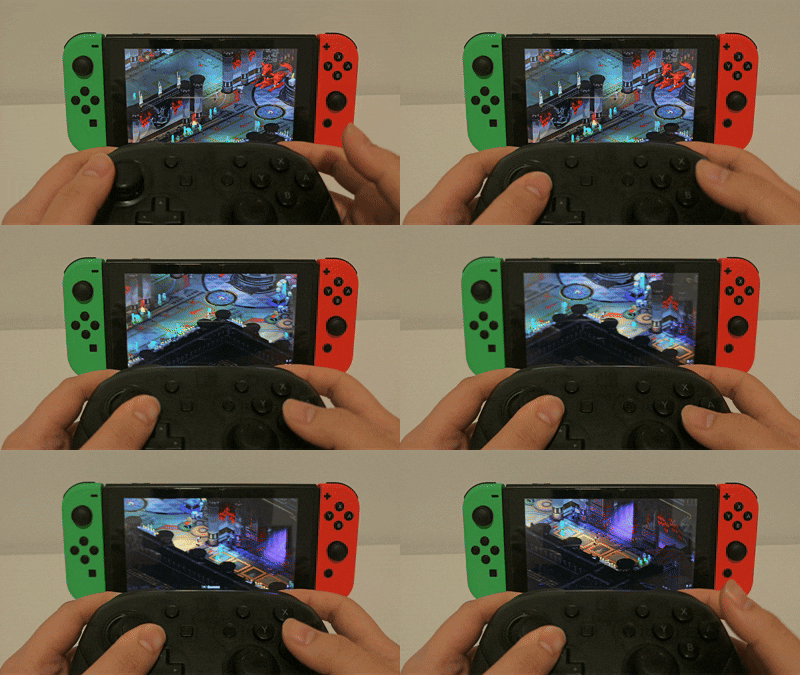
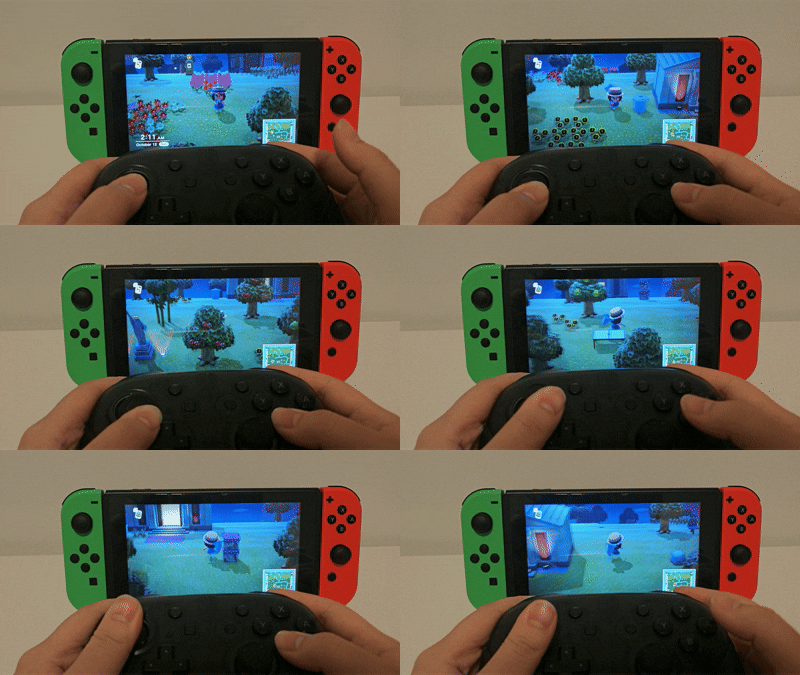
What do the buttons on a game console controller represent for you? Each button most likely has different functions which vary among each game’s unique game mechanics. Take for example, the “B” button. In Splatoon, pressing it results in your in-game avatar to jump, in Hades, it makes you dash forward, whereas in Animal Crossing: New Horizons, holding it down makes your avatar run. Our real-life act of pressing a button translates into another action occurring in-game, as depicted on the screen. One could even say that the buttons having diverse effects in each game’s unique mechanics, representing their own specific set of rules, relies on their own system of signs.  
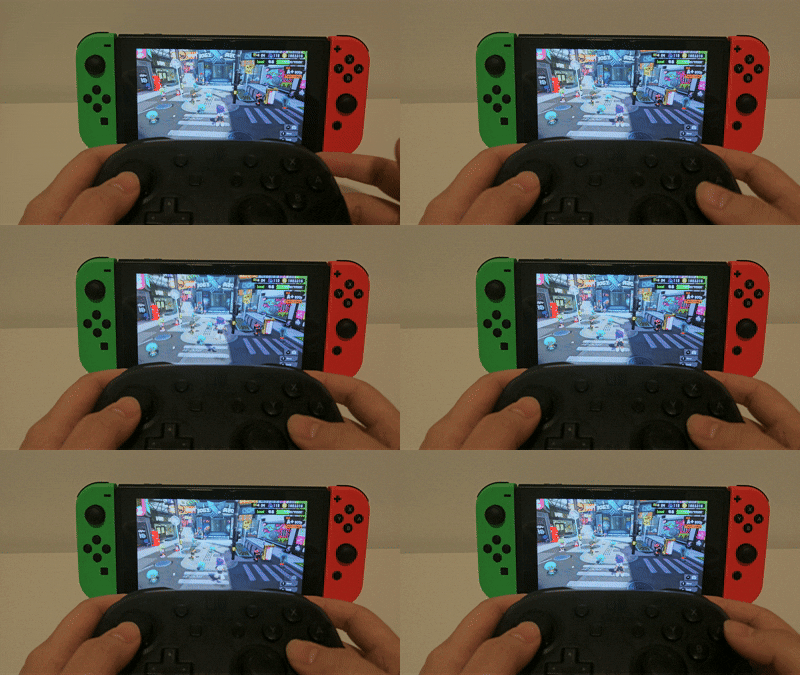
Avatar in Splatoon 3 displaying “jump” mechanic – Footage by Christine Choi
Character, Zagreus, in Hades displaying “dash” mechanic – Footage by Christine Choi
Avatar in Animal Crossing: New Horizons displaying “run” mechanic – Footage by Christine Choi

This fascination surrounding such concepts is precisely why I chose a game controller as my evocative object. Although there are so many different variations of a game controller, I am going to use the Nintendo Switch Pro Controller as an example as it is the controller I was mediated by the most and is also one of the more “standard” modern designs when it comes to game controllers (the existence of a joystick, four buttons with letters/symbols, L and R buttons, etc.). By analyzing the game controller, I will highlight the ways that it mediates between us, the player, and the virtual world that the game exists in. 

The Controller and the Player

As mentioned before, the game controller has the unique ability to mediate between us and the virtual world displayed within the hardware (whether that is the console or the PC). When it comes to “playing” a game via a controller, there is a unique set of feedback that is inputted and outputted mediating between our physical corporeal bodies and the incorporeal in-game virtual bodies. 

You would first take in the world through senses, like sight and hearing. Certain in-game index, symbols, and icons may evoke feelings of fear, especially if it had informed the player of it causing harm to the avatar in the past. Others may evoke curiosity, enticing the player to explore more of the game and the “rules” of this digital world. Once you have cognitively processed that, your instincts—shaped by in-game and real-world experiences—would inform you to react. You would react by pressing buttons or rolling the joystick to the direction you want it to. We know, or at the very least expect, that the controller has received input when we receive the tactile feedback of the button being pushed down then springing back as we release it from pressing down on it. Then you would see the fruition of your act of button-pressing/joystick pushing by seeing the pixels on-screen change to indicate movement/change within this virtual world. 

Feedback of input and output between virtual and physical worlds – Diagram drawn by Christine Choi

The feelings evoked from the virtual information would translate in the grip of our controller; dodging enemies evoking another emotion of relief and safety, the achievement leading to satiate more of our curiosity, all driving our progression of the game. Thus, the controller is the mediating object for the player’s input and the software (which would be the game). Without the game, there is nothing for it to control and without the player input, there is nothing being controlled. 

Exerting Control over in-game “bodies”

Much of what is being said about the “control” over avatars/characters is correlated to what is said about the “body” as a medium in Critical Terms for Media Studies. After all, the controller could be seen as an extension of our own body, which extends into what is being “embodied” in-game. Wegenstein, too, utilizes psychoanalytic theories of how video games allow us to play the role of the “other”, a virtual embodiment that differs from the embodiment of ourselves. She quotes Slavoj Zizek on “a figure capable of taking on, or projecting itself into, many simultaneous roles” (28). The concept of roles that we project onto is correspondent with how the controller that mediates and perpetuates this “ego” that we project onto, making the body of the playable character another medium. 

Thus far, I have only discussed characters and avatars that have an anthropomorphic body, which is easy to visualize as we easily project our human bodies onto these characters. But what about games with no “avatar” or humanistic representation of our own bodies? I would argue that there is still a “body” or “vessel” in which we, in our physical and corporeal forms, exert control over digitally. Take Tetris for example, the falling blocks would be the body that we project ourselves onto. As the blocks fall, we move with it left or right via the joystick or D-pad. 

Game Controller as a “Black Box”

Even the most avid gamers most likely do not know the internal computational and mechanical workings of what occurs in between the space and time in which we press the button and watch the game do its magic. The game controller generally works under the “black box” heuristics (a cybernetics theory coined by Norbert Wiener), in which the processes of the input from our button to the output in the game is shrouded in mystery for the average user (Wiener, page xi). However, I would argue that this knowledge we lack of our game controller’s internal workings is precisely the tool we use to immerse ourselves in the virtual space of a video game. What we do know as gamers is that eventually, its mechanics is burned into the memory of our bodies through “muscle memory” as the controls become second nature to us, thus “mediating” our physical bodies in the real world and the incorporeal bodies that exist in the virtual space of a video game.

Citations

Wegenstein, Bernadette. “Body.” Critical Terms for Media Studies, University of Chicago Press, Chicago, Illinois, 2010, pp. 19–34.

Wiener, Norbert, et al. Cybernetics: Or, Control and Communication in the Animal and the Machine. MIT Press, 2019.

Images and footage were all taken by Christine Choi

Video Games as Evocative Objects

Video games can evoke feelings of liberating escapism while shaping perceptions of real life. In her anthology, Evocative Objects: Things We Think With, Sherry Turkle demonstrates the ability of objects to facilitate transitional periods of life. Several chapters demonstrate how beloved objects can mediate coming-of-age experiences. When reflecting on my own belongings, I realized a Nintendo game titled, Harvest Moon: More Friends of Mineral Town, mediated my perceptions of adulthood. I perceive this cherished game as my own “evocative object”; as a young child, its virtual world evoked my excitement towards growing up. 

For my seventh birthday, my oldest sister gifted me a mysterious Macy’s box. Inside the box was my first video game console–a pink, hand-me-down GameBoy Advance. Inside the console was a game cartridge titled, Harvest Moon: More Friends of Mineral Town. As I flipped the console’s on-switch for the first time, a saturated, pixelated screen and a cheerful soundtrack greeted me. The game was a farming simulator, where the main character collects profits by selling dairy, poultry, crops, and foraged items across the quaint atmosphere of Mineral Town. While creating a profitable farm, the player can build relationships with NPC townspeople, get married, and start a family. The game never ends; however, one can presume that winning consists of bringing economic prosperity to the town and becoming a likeable figure among its citizens. At the young age of seven, I did not realize the game’s themes of coming-of-age, hard work, and social acceptance. Now, as a twenty-year-old reflecting on its narrative, I recognize its depiction of adulthood through the player’s journey of moving to a new town, meeting new people, and pursuing a risky career.

I played this game for hours on end, under the covers past bedtime, and during the morning before school; Harvest Moon: More Friends of Mineral Town not only catalyzed my love for video games, but mediated my expectations of adulthood. Through numerous hours of improving my farm and achieving a successful lifestyle for the in-game protagonist, the game subconsciously instilled the message that hard work results in joy and companionship. Additionally, the game introduced concepts of trade and capitalism to its child audience by framing a profitable lifestyle as the player’s ultimate goal. Within the game, the protagonist can earn the townspeople’s admiration by gifting them items and talking to them on a daily basis. This mechanic led my immature mind to think that in reality, showering individuals with their favoured items and repeatedly speaking to them would guarantee their loyalty. The addictive, interactive medium illustrated friendships as collectible prizes, rather than everchanging, complex relationships. Unknowingly, this piece of electronic media produced an unrealistic view of adult life as fun, easy, and exciting.

I believe this evocative object would belong in Turkle’s chapter, “Objects of Transition and Passage”. Turkle notes transitional objects “[mediate]” a child’s “growing recognition” of their independence (Winnicott qtd. in 314). Harvest Moon: More Friends of Mineral Town taught me such independence by forcing me to make responsible choices in a low-stakes environment. If I forgot to feed my livestock or water my crops, my profits could hinder. Then, I would have less money to purchase gifts for my in-game neighbours and I would lose their friendship; as a result, the game taught me accountability in a simulated setting. However, as I grew older, I lost interest in the game. I no longer needed it to simplify the concept of responsibility to me; instead, I practiced “real-life” responsibility through managing schoolwork, chores, and extracurricular pursuits. As I ventured into my teenage years, the game sat in my dusty drawer, supporting Turkle’s view that these objects of childhood development are “destined to be abandoned” (314). 

Harvest Moon: More Friends of Mineral Town as a Cyborg Object

Furthermore, this game acts as a “cyborg” object–an object which combines the “natural and the artificial” (Turkle 325).  An example of a “cyborg” object is Annalee Newitz’s beloved laptop in the chapter “My Laptop”. Newitz’s relationship with her laptop is deeply “intimate”; the inanimate device melds with her natural self causing her difficulty in distinguishing “where it leaves off and she begins” (Turkle 325). She exists as “one with her virtual persona” and views herself as the ‘“command line…of glowing green letters”’ on her screen (Turkle 325). Similarly to Newitz, I developed an emotional attachment to my virtual persona–the tiny, pixelated farmer on the screen of my GameBoy Advance. The more time I invested in my persona, the more she represented my hard work. As a result, my connection to her grew, similarly to the laptop’s “co-extensive” relationship with Newitz’s “self” (Turkle 325). Altogether, this avatar was not just an escape to a simplistic world where adulthood did not seem so frightening, but a representation of myself and the adult I aspired to be.


Harvest Moon: More Friends of Mineral Town’s Mediation of the Body

As Wegenstein states in Critical Terms for Media Studies, “‘the logic of the computer”’ has afforded humans the ability to exist as numerous “selves” (28). She notes that modern individuals experience satisfaction by constructing several virtual “personas” that contrast their real-life, “mundane” selves (Wegenstein 28). I experienced this phenomenon while developing my in-game persona; my avatar’s economic and social autonomy contrasted my supervised upbringing. Moreover, the amount of exciting tasks the game afforded my character differed greatly from my simple, repetitive childhood. Rather than being a supervised seven-year-old child, the game transformed myself into a farm-owner, creating a self-sufficient life.

Conclusion

Altogether, my virtual experiences afforded by Harvest Moon: More Friends of Mineral Town mediated my expectations of adult life. Through using this object as a form of escapism, I gained a deep emotional connection to this game that remains with me today. While glamourizing adulthood, this game played a role in my childhood development by introducing concepts of hard work and responsibility.   

Works Cited

Wegenstein, Bernadette. “Body.” Critical Terms for Media Studies, edited by W.J.T. Mitchell and Mark B.N. Hansen, U of Chicago P, 2010, pp. 19-34.

Turkle, Sherry. “WHAT MAKES AN OBJECT EVOCATIVE?” Evocative Objects: Things We Think With, edited by Sherry Turkle, The MIT Press, 2007, pp. 307–27. JSTOR, http://www.jstor.org/stable/j.ctt5hhg8p.39 . Accessed 4 Oct. 2025.

Written by Emily Shin

Photos taken by Emily Shin