

I was about forty minutes into watching Hirokazu Kore-eda’s 2023 film, Monster, when my understanding of the film completely altered. The pieces seemed to fit together so seamlessly, so inevitably. I was certain I had a grasp of who the monster was in the film until the film restarted and the same scenes were depicted through different lenses. The feelings I felt while the tone of the narrative shifted encapsulate why this film is now one of my all-time favourites. The uncomfortable, almost physical sensation of a memory changing was beautifully illustrated once the first part of the film closed out and began again with a new perspective. Not just my understanding, but my actual recollection of what I had witnessed had completely changed—the scenes I had experienced as sinister now carried entirely different emotional weight.
This unsettling experience is precisely what media theorist Alison Landsberg describes as “prosthetic memory,” where the memories we acquire do not come from lived experiences, but rather through cinema and mass media while still feeling deeply personal and emotionally resonant with our physical bodies. Landsberg argues that prosthetic memories allow us experiential access to the lives and perspectives that we haven’t lived through cinema.
Cinema has the powerful capability of building empathy across social, cultural, and historical divides. Following Benjamin and Kracauer, Landsberg claims that the cinematic experience “has an individual, bodily component at the same time that it is circumscribed by its collectivity.” (Landsberg, 180) The publicity of cinema allows individual bodies to form new means of collectivity through prostheses and prosthetic memories. Oftentimes, what we witness on film actually becomes part of one’s “personal archive of experience,” (Landsberg, 179) and can alter our overall sentiments towards the film and the movie-watching experience altogether. Monster take advantage of our memory. It doesn’t just give access to unfamiliar experiences, but forces us in participating in the very stigmatization the film ultimately condemns. What if the real power of Kore-eda’s film lies not in revealing who the “monster” actually is, but in making us feel what it’s like to have named one?
Landsberg discusses the concept of ‘emotional possession,’ where an individual identifies with the plot so much that they are carried away from the usual trend of conduct (Landsberg, 179) to describe the potential cinema has in emotionally resonating with individuals. Monster’s three part structure reveals different perspectives of the same event, first from the perspective of mother, Saori, then from teacher, Mr. Hori, and finally from the perspective of her son and his friend, Minato and Yori. The film takes advantage of traditional film technique, the Rashomon Effect, to reveal different aspects of the truth as the film progresses. This technique takes advantage of the idea of the unreliable narrator, where notions of memory and the truth are blurred based on differing perspectives and subjective views of one central event (Prince). By following one character per act, each section allows audiences to emotionally connect with the section’s protagonist, investing their emotional possession on that one character as that is the narrative they are initially exposed to. It is easy for movie-watchers to immediately assume what they first watch is true, thanks to imaginative identification, where audiences often project themselves on to the film’s protagonist (Landsberg, 179). The initial emotional investment in the first character, Saori, in the first act weighs more as the movie progresses and more perspectives and truths unravel. Further more, it makes the tone switch as the perspectives change more impactful, as it brings tension and surprise when it is revealed that nothing is really what it seems. Each retelling of the event doesn’t just add information, but it overwrites our experiential memory of what truly happened. What we first see from the perspective of Saori now becomes completely different in the eyes of Mr. Hori. We don’t understand the truth until we follow the children’s lenses, which even ends ambiguously. Because of the realism in Monster’s narrative, it becomes even more difficult for audiences to distinguish between truth and fiction, between the cinematic world and our society. The film deals with topics of intimacy, self-discovery, and innocence through perspective and memories. Upon my first screening of this film, it was compelling to see how the initial mystery of a teacher hitting a schoolboy unravelled into an exploration of two young children’s relationship with themselves, each other, and their surroundings. It was something I could have anticipated, when looking through the narrative from only one set of memories.
This form of prosthesis extends viewers’ relationship to the film itself, rather than just the content and the watcher. As Landsberg emphasises, the nature of cinema gives us access to experiential knowledge and perspectives that we would otherwise not have access to. Unlike traditional flashback scenes, Kore-eda forces us to relive these moments through multiple different characters. By forcing us to “remember” the same scenes with different emotional contexts, audiences are given a bodily, highly sensory experience of having the wrong assumption about someone. What we knew at the end of the first act is never the lasting impression we have once the film ends. Oftentimes, the ‘truth’ lies within adults, those who are mature and of sound mind and children’s perspectives are ignored or seen through a childish lens. Monster plays with the idea of children as the truth and as critics. As children are more capable of being influenced by the world around us, and have little to no filters at a young age, this critique comes from innocence and wonder. Kore-eda gives us prosthetic access to these children’s perspectives, which are the very perspectives that the past two acts have misinterpreted.
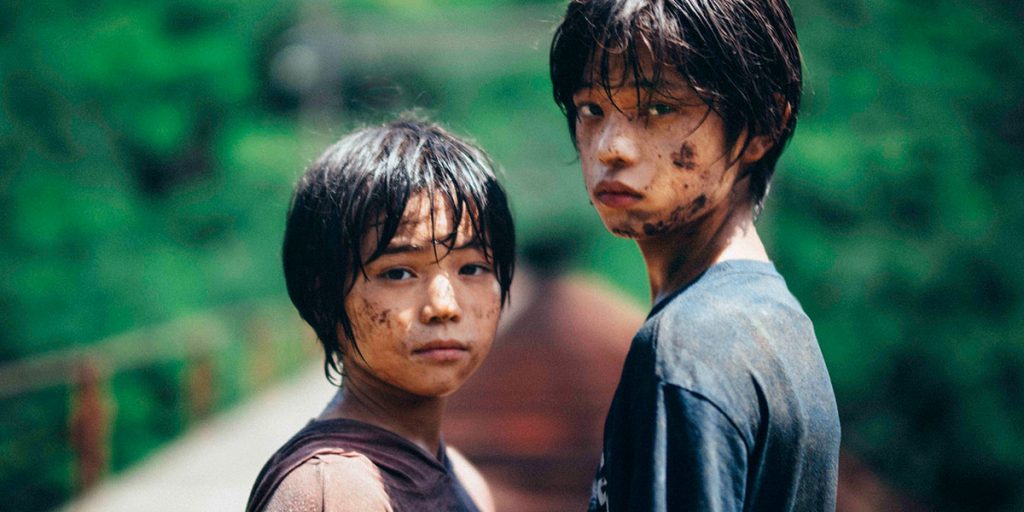
As director Kore-eda explains, the poster features the two children ‘looking our way and they’re evaluating us adults and they’re saying, “Hey you’re creating this world with monsters everywhere and that’s our world.”‘ (Fernandes) This is the political power of prosthetic memory that Landsberg describes: by literally making us experience what we’ve been missing. By witnessing the third and final act, we are able to feel the consequences of that exclusion. We carry the prosthetic memory of having participated in a world that creates monsters by refusing to see through children’s eyes.
The prosthetic memory that Monster implants in us is not just the children’s stories of what they witness, but the experiential knowledge of what we dismiss, damage, and mislabel as ‘monstrous.’ It forces us to use this movie and apply it to our own society and how we are so quick to critique others based on one perspective—but more than that, we now carry a memory of having done exactly that, of having gotten it wrong, that feels as real and uncomfortable as our own lived mistakes.
Sources
Fernandes, Marriska. “Monster’s Hirokazu Kore-Eda on the Two Entities in His Films: ‘Children and Dead People.’” Toronto Film Critics Association, 25 Sept. 2023, torontofilmcritics.com/features/monsters-hirokazu-kore-eda-on-the-two-entities-in-his-films-children-and-dead-people/.
Landsberg, Alison. Prosthetic Memory: Total Recall and Blade Runner.
Prince, Stephen. The Rashomon Effect | Current | The Criterion Collection, 6 Nov. 2012, www.criterion.com/current/posts/195-the-rashomon-effect.
This was such a interesting read! Even without having seen the film, your explanation made it easy to understand how the shifting viewpoints create a kind of prosthetic memory that feels bodily and immediate. Your connection reminded me of how easily a single narrative can overwrite our assumptions in real life. Do you think prosthetic memory always produces empathy like Landsberg suggests or can it also mislead us when a film never provides the kind of corrective perspective Monster ultimately does?
Thank you for the comment, Nihitha! To answer your question, I think that the film definitely plays with humans’ inherent ability to empathise with prosthetic memories that we are exposed to, whether through real-life experiences or fictional stories. Because of that, it is super easy to misinterpret things and the truth is never fully uncovered, similarly to how the film ends. I think that the movie was a very realistic commentary on how common this type of thing is, where word-of-mouth stories become the basis of one’s opinion of another, rather than having lived experiences to make personal conclusions about something.
Wow, excellent blog post. The Rashomon Effect is such an interesting concept and one of the times life has imitated art, as the Rashomon effect is sometimes used in legal proceedings to explain instances where everyone is a little untrustworthy. It is also an interesting way to examine a social situation where everyone seems to be leaving out information. This happened to me about a month ago, but I digress.
Hi Ela! This is such a clearly written breakdown! I love how you described that physical feeling of your memory shifting mid-film. It’s such a perfect real-world example of Landsberg’s prosthetic memory actually happening to you in real time. The way Monster forces the audience to overwrite their own assumptions really reminds me of how Landsberg talks about cinema giving us an “experiential archive” that isn’t ours but still feels lived. It also makes me think about how easily we trust the first narrative we’re given! Do you think the film is almost using that instinct against us to show how fragile our sense of truth really is?
Hi Nate! Thank you for your comment! I’m so glad you thought of experiential archives because that is exactly what I thought of as well. It is so easy to claim one’s memories as ours even when telling a story to a friend, like when people don’t realise if what they did actually happened or if it just happened in a dream.
To answer your question, yes! I definitely think that the film took advantage of our habit of immediately trusting our first point of reference. It is incredibly tough when word of mouth is so convenient and easy, sometimes we have no choice but to believe it because that is all that we are initially exposed to.
Hi Ela, your work is wonderful and reading it has left me wanting to watch this movie right away! I really enjoyed your thorough breakdown of the movie’s content, as well as how you layered in Landsberg’s concept of “prosthetic memories” to further enrich your analysis. The ’emotional possession’ capabilities of cinema are very well shown, even in just the poster featuring the children’s gaze at the viewers. I’m really fascinated by how you mentioned that the movie forces us to re-examine our sense of reality, and I can definitely relate to you when Landsberg says that cinema affords us the experiential chance to live the lives of these characters. Would you say that upon consuming too much media, the effects of prosthetic memories, however, could become so drastic that one might inevitably lose track of one’s identity? Like how, in “living” so many lives, we might eventually fail to distinguish our own from the ones on the screen?
Hi Nam! Thanks for your comment! Your question reminds me of the idea of having 3 faces mentioned in a Japanese proverb, where it mentions having a public self, a private self, and a true hidden self. It highlights the complexities of our identities and how we are perceived based on the spaces we are in. I definitely think that media consumption has a lot to do with how these different senses of the self blur over time. This could be seen when we watch movies or play games online, where we are projecting onto a different persona or emotionally resonate with a character or online figure.
Hi Ela, I love your perspective on this film. Prosthetic memory is such a broad concept that it can truly be connected to any form of contemporary media, which makes it difficult sometimes to understand how this manifests in real life. I appreciated the way you used the specific format of Monster to illustrate how viewers are invited to create their own memories and perspective on the scenes before they’re forced to reevaluate and learn with new information, much like the very human and genuine process of growing up and having their own experiences. This is a great breakdown of cinematic techniques and how these media theories can help us connect with our audiences as creators, and make more of an impact by utilizing their experiences to our advantage. Thank you for not including any spoilers — I really want to watch this movie now!
Hi Dea! Thanks for your comment, and I would looove to know if you end up watching the movie and what you think about it! Especially with the ending of the film, because it continues the cycle of leaving viewers guessing based on the three sources of information they are given. It truly goes to show how this process of recalling memory and finding the truth can never exactly be finished, but rather it opens up a book of even more questions.
Hi Ela! This is such a beautifully written post, I love how clearly you connect Landsberg’s prosthetic memory to the emotional mechanics of Monster. The way you describe that “physical sensation of a memory changing” really captures what Kore-eda is doing with perspective: it’s not just narrative information shifting, it’s our embodied sense of what we think we witnessed. Your discussion actually made me think of film theorist Vivian Sobchack, who argues that cinema doesn’t just show us experiences but makes our bodies participate in them. Her idea that “the film’s body and the viewer’s body mutually inform one another” feels so relevant here, because Monster doesn’t simply depict false memories, it produces them in us through the act of re-seeing. Your point about the Rashomon structure overwriting our initial assumptions fits perfectly with Sobchack’s argument about how film reorganizes our sensory and moral orientation.
I also really appreciate your reading of the children as the holders of truth. By the time we reach their perspective, we aren’t just understanding the story differently, we’re carrying the prosthetic memory of having misjudged them. That’s such a powerful extension of Landsberg’s idea of emotional possession. Overall, your post made me rethink prosthetic memory as not just an empathetic tool, but a corrective one a way cinema can let us feel the consequences of our own misrecognition. Really wonderful work.
Thank you for the comment Nicole! I love Sobchack’s idea of how the body relates to not only the physical one of the viewer but also the film itself, I think that’s really powerful! It is cool to think about how acting and movies can evoke such strong, visceral emotions sometimes, like making us mad at a certain character or shocked and betrayed after a plot twist is revealed. Another movie that I can recently remember watching that mirrors the Rashomon style of narration is the 2025 film Weapons by Zach Cregger. He similarly employs three acts to unravel the mysteries surrounding children who are missing from an elementary class. What I especially enjoyed in this movie is how the exact same scenes are replayed but from a different angle and emotional context depending on the perspective we follow. Rather than a shocking twist Cregger focuses on the small nuances, and that builds a lot of tension as a viewer as well.
Anyways, these two movies were really strong in getting their audiences emotionally invested based on the structure and narrative flow, and I am glad you recognised how prosthetic memory in film can apply to us in real life!
It was fun to read! I really loved your point about imaginative identification. It’s so true that we instinctively latch onto the first perspective that we’re given and treating it as the “truth” simply just because it comes first. The children’s perspective as the truth we’re denied until the end is really powerful too. It kind of reframes the whole film as not just a mystery, but a critique of the way adults project, misinterpret, and label. We do learn from the last act by realizing how complicit we were in creating monster in our own minds.