Tag Archives: making

Ways of ‘Telling’ and ‘Knowing’: How We’re Able to Communicate ‘Tacit’ Knowledge

In the second-to-last chapter of Tim Ingold’s Making: Anthropology, Archeology, Art and Architecture, Ingold centres around the idea of ‘the hand’ and brings up philosopher Michael Polanyi in his opening statements to highlight ideas of ‘telling’, ‘articulating’, and ‘knowing’. Ingold believes that while everything can be told, not everything can be articulated, and to strengthen his argument he uses one of Polanyi’s notable pieces of work, the book The tacit dimension, as a framework for what Ingold believes about knowledge and how it is communicated.

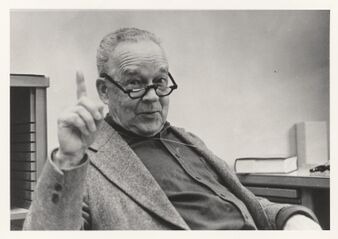
Background on Michael Polanyi and his work

Michael Polanyi was a physicist, chemist, and philosopher who was born in 1891 and passed away in 1976. He lived through both world wars, even migrating from Germany when Nazis took power (The Polanyi Society), and his philosophical work that he developed later in life was heavily influenced by living through those global events, being introduced to philosophy via Soviet ideology under Stalin (Polanyi 3). The book that Ingold refers to, The Tacit Dimension, was originally published in 1966 and introduces Polanyi’s idea of “we know more than we can tell” (Polanyi 4). 

Formal vs. Personal Knowledge

Polanyi’s view on thinking and knowledge was that ‘we know more than we can tell’ (Polanyi 4) and he classified knowledge into two camps: personal and formal. Formal knowledge is knowledge that can be specifically articulated and explained clearly to someone else, whereas personal knowledge cannot. Personal knowledge, to Polanyi, is the type of ‘know-how’ that only comes from the experience and practice that an individual goes through, whether it be perfecting a craft or learning how to hunt, which he also described as tacit knowing (Polanyi 20). It is not able to be articulated and thus, it cannot be taught. Ingold very much disagrees with Polanyi’s sentiment about personal knowledge being ‘untellable’ and argues, for example, that the idea that the age-old example of a craftsman being suddenly unable to explain how they do what they do when asked, is unfounded (Ingold 109). Ingold argues that people are absolutely able to communicate and “tell” others what they do, no matter how innate or personal it may seem. However the telling is not necessarily verbal, but it can be shown and demonstrated. This ties into Ingold’s belief that people correspond with the world and think through making. Polanyi’s perspective doesn’t make sense through Ingold’s lens, because if unspoken stuff or lessons couldn’t be taught since they were ‘personal’, then no one could learn through making, and learning through doing is a well-established fact of life. Polanyi’s view on knowing is also a bit confusing, as when he describes it in detail when describing an experiment involving a frog, he seems to assume that knowing what a frog is and knowing to do an experiment is tacit knowledge (Polanyi 21), despite the fact that a frog very much can be taught about. The ‘otherness’ of a frog might be innately human and ‘tacit’, but to suggest that that cannot be described makes me agree with Ingold.

Ways of Telling

To further help prove his point, Ingold in this chapter highlights the different forms of ‘telling’ to both debunk Polanyi’s ideas, and set up Ingold’s overall argument, which is that everything can be ‘told’. Ingold talks about storytelling, which is a form of telling where a narrative is told that includes lessons and patterns, and then there is ‘telling’, which is the more discernible approach where people search for ‘tells’ in others. For example, studying someone’s face while playing poker is a ‘tell’, since you are using environmental clues such as the furrowing of their brow and the tapping of their fingers on the table to make a judgement for yourself about what is really going on. Ingold brings up an example of being able to tell the tone in which a handwritten note was meant (or not meant) to be received, based on the inflection marks on the letters (Ingold 110). These two methods of telling come together in storytelling as well, but if Polanyi’s method of thinking on ‘tells’ were accurate, Ingold states that that would mean all stories would have the same exact meanings or lessons because of how rigid Polanyi’s ‘formal’ and ‘personal’ knowledge perspective functions. Stories do not work that way though, as they are purposely told with a degree of open-endedness so that the audience can bring about their own meaning and takeaways from it. As an example, Little Red Riding Hood is a classic tale that, in effect, teaches children about stranger danger. The story does not set out to literally warn children of actual wolves that can eat one’s grandparent, but it is close enough to a real example of a wolf being a shady stranger that readers can figure out the lessons behind the words. For Ingold, the lessons that stories give are less of an ‘answer’ and more of a path or trail that one can follow (Ingold 110), and from there everyone gets something unique out of it.

Ways of Thinking

To close out his argument regarding Polanyi’s words specifically, Ingold talks about ‘articulate thinking’, which is the process of thinking about one’s words before speaking them, organizing them in the brain all in advance before sharing the thoughts with anyone else. He argues that if every time people thought it were ‘articulated’, no thinking or ‘making’ would happen because everything would have to be thought of in advance, which goes against the learning-through-doing that Ingold has mentioned in the past. While Polanyi sees the ideas of formal and personal thinking as an iceberg nearly completely submerged in water, with only the formal tip of the ice peeking out of the water (Ingold 109), Ingold sees it as a series of islands that water flows freely around, knowledge being a mix of the two (Ingold 111), instead of a cut-and-dry one or the other. Ingold highlights the fact that in Chapter 1 of Making, he also talks about the idea of ‘knowing’ and ‘telling’ being the same thing, and he argues now that Polanyi is wrong because to know is to tell (Ingold 111), and so to suggest that people possess knowledge that cannot be conveyed is preposterous. Once again, this is not to say that everything ‘told’ will be in a neat verbal package, but rather that everything a person does is telling something in some way. So while not every scholar can articulate their knowledge, they can all tell it (Ingold 111). 

Polanyi in The tacit dimension draws upon Plato’s theories to try and explain how someone can’t search for an answer (if they know what to look for they’re fine, and if they don’t know what to look for then they don’t know) as support for Polanyi’s arguments about how knowledge cannot be ‘explicit’ (Polanyi 22). This is an interesting perspective that Ingold does not write about, since if you break it down you can find a sort of through-line for all knowledge, like how you go to school to learn, ask teachers questions for more information, and so on. Despite this, it still does not address Polanyi’s flawed claim that personal knowledge cannot be taught, giving Ingold the more compelling argument.

In short, Ingold uses Polanyi’s ideas on ‘telling’ and ‘personal knowledge’ to highlight how his own perspective is correct, because to know is to tell, and even if it’s something as simple as a mechanic tuning up a car or a person knitting a sweater, even without step-by-step instructions they are wholly able to tell what they are doing to others.

Works Cited

Ingold, Tim. Making: Anthropology, Archeology, Art and Architecture. 1st ed., Routledge, 2013, https://doi.org/10.4324/9780203559055. Accessed 4 December 2025.

Polanyi, Michael. The tacit dimension. Edited by Internet Archive, Gloucester, MA, 1983. Internet Archive, https://archive.org/details/tacitdimension0000pola/page/4/mode/2up. Accessed 4 December 2025.

The Polanyi Society. “Michael Polanyi.” The Polanyi Society, https://polanyisociety.org/michael-polanyi/. Accessed 28 October 2025.

Podcast Episode: Is AI Killing Creativity? Or Making It Better?

In this podcast, Siming, Eira, and Aubrey explore whether Gen AI should be considered a creative medium and whether it suppresses or improves creativity. Through different examples in video editing, 3D modeling, and design, we explore what AI mediates and reflect on how these technologies reshape both creativity and authorship in contemporary media.

Citations 

Adobe. (n.d.). Automatic UV Unwrapping | Substance 3D Painter. https://helpx.adobe.com/substance-3d-painter/features/automatic-uv-unwrapping.html

Bollmer, G. (2019). Materialist media theory: An introduction.

Maisie, K. (2025). Why AI Action Figures Are Taking Over Your Feed. Preview.

https://www.preview.ph/culture/ai-action-figures-dolls-a5158-20250416-dyn

Ingold, T. (2013). Making: Anthropology, Archaeology, Art and Architecture. Routledge.

Salters, C. (2024). The New Premiere Pro AI Tools I’ll Definitely Be Using. Frame.io Insider.

https://blog.frame.io/2024/04/22/new-premiere-pro-generative-ai-tools-video-editing/

Schwartz, E. (2023). Adobe Brings Firefly Generative AI Tools to Photoshop. Voicebot.ai

https://voicebot.ai/2023/05/23/adobe-brings-firefly-generative-ai-tools-to-photoshop/

Faribault Mill. (n.d.). The Spinning Jenny: A Woolen Revolution. https://www.faribaultmill.com/pages/spinning-jenny

Van Den Eede, Yi. (2014). “Extending ‘Extension’: A Reappraisal of the Technology-as-Extension Idea through the Case of Self-Tracking Technologies.” Design, Mediation, and the Posthuman, edited by Pieter Vermaas et al., Lexington Books.

UX Pilot. (n.d.). UX Pilot: AI UI Generator & AI Wireframe Generator. https://www.figma.com/community/plugin/1257688030051249633/ux-pilot-ai-ui-generator-ai-wireframe-generator

Loveable. (n.d.). Learn about Lovable and how to get started. https://docs.lovable.dev/introduction/welcome

Morality and Materiality in Digital Technology and Cognition

Introduction

Peter-Paul Verbeek’s examination of the ethics and materiality of digital media in his book, Materilizing Morality, coincides with Grant Bollmer’s seventh thesis as described in Materialist Media Theory

“Media transforms cognition and thought. This is either a direct transformation, extending the body beyond the limits of the skin into body-brain-world assemblages, or an indirect one, through technological metaphors that remake how a body is understood”(174).

Verbeek discusses the ethical quandaries surrounding digital media, examining how immaterial modern technologies shape human action, ultimately affecting the material world. Bollmer correspondingly emphasizes media’s significance as an active participant in its consumption, noting how media’s materiality influences its overall message. Furthermore, Bollmer and Verbeek’s works highlight the complex material dynamics of digital media and cognitive processes to understand it. Both are immaterial, yet require material mediators to function effectively and ultimately have material impacts on physical reality. The moral implications and physical responses to immaterial digital media urge consideration of the material consequences of media, regardless of its original form and representation.

Materiality, Representation & Ethics: 

Bollmer challenges the assumption that media and technology are neutral and immaterial forces arguing that media is not passive; rather, it serves as a material infrastructure that mediates and influences the user. He critiques past scholarship that views materiality as self-evident; he states sarcastically that “media are material, period”(16). This satire critiques the notion that materiality simply refers to physicality. For Bollmer, materiality is a more complex concept that encompasses embodiment and representation stating that, “the belief that media is immaterial and detached from physical devices—a popular belief in 1990s’ discussions of cyberspace that persists today—is simply false”(18). This statement clarifies Bollmer’s views, as he sees media as material agents interconnected with physical means. Bollmer’s main argument is that the media shapes the conditions in which the world can be understood. A screen is not just a physical tool but an interface that affects human behavior through how users consume information. To Bollmer, materiality is not separate from meaning but embedded in it, providing a medium for representation to take shape. 

These ideas parallel Verbeek’s theories, similarly rejecting the idea that technology is morally neutral and that ethics exist separate from materiality. Verbeek argues that technology “coshape human action, [giving] material answers to ethical questions of how to act”(361). This perspective views media and technology as material as they mediate human action, ethics, and perception. This is evident with his example about medical imaging devices, as these tools shape how doctors interpret the human body. This example demonstrates how morality is not only about human intention but is shaped by technological design. Verbeek introduces the idea of “scripts,” which indicate how “technologies prescribe human actions”(361). Scripts are the “inscriptions” left by designers, who anticipate how users will interact with a product. To Verbeek, scripts are not merely physical, as technology goes beyond their “function” and influences human action (362). Scripts work as a framework to understanding how technology works to connect humans and materiality. This concept ties into Verbeek’s argument that ethics are embedded within materiality and that design itself is a moral act. Verbeek connects ethics with materiality by showing that technology does not merely carry morality but embodies it. 

Bollmer and Verbeek’s work grounds the argument that media should be viewed as material and reinforces the idea that technology is not neutral. Both theorists show that materiality is intertwined with morality and representation. Bill Brown’s writing Materiality strengthens this argument by demonstrating that materiality is simply about the physicality of an object, but the way objects influence how we experience life, media, and reality. Brown argues that debate on material/immaterial is often misconcluding, as objects that are often viewed as “immaterial,” like scripts or digital communities, still shape how we interact with the world. He points out that material is not solely limited to what is tangible or visible. This correlates with Bollmer’s argument that the materiality of any medium, whether physical (hardware) or digital  (e.g., the internet), shapes how people understand social, political, and cultural norms. Verbeek’s work extends this argument through his concept of “scripts”, demonstrating how technology shapes human action and moral decisions. He reminds the audience that the design of a device carries ethical consequences, as they impact how users perceive the world around them. Together, these viewpoints cause us to reconsider the importance of understanding media’s materiality. If media is seen as immaterial or neutral, we overlook its influence on reality. Treating media as immaterial ignores the political, ethical, and represented work embedded within technology. Bollmer and Verbeek’s theories, with the support of Brown, demonstrate how the media is not a neutral agent of information but a material being that mediates the world around us. 


The (Im)Materiality of Digital Media and Cognition

The materiality of digital technology is comparable to that of cognition. Materialist approaches to human cognition view the essence of thought as “[existing] in organizational structure rather than physical matter” and assume that human thoughts can be adequately translated into computational systems, provided they are designed to mimic human brains (Bollmer 127). This conceptualization of thought investigates the very nature of humanity and poses, if our thoughts are equally applicable to digital technologies, what exactly makes us human? 

Viewing our thoughts as finished, tangible materials to be moved and translated results in existentialist ideologies surrounding humanity and technology in the modern age. Instead, we should consider our bodies as materials, not our cognition. Bollmer describes the body–and by extension, the brain–as mediums that “[negotiate] external world and internal sensation” that are both made and modified by the outside world, aligning with Tim Ingold’s concept of transducers: the means through which a message is communicated and understood (Bollmer 118; Ingold 102). By effect, our thoughts are products of, and effectively embody, the experiences of our bodies. Embodiment, within the context of media, is “the cognitive possibility of a body and envisioning technology not as itself but as a mediational extension of the body”(Bollmer 131). Similarly, an embodying relationship with media sees users understanding technologies not as themselves, but as tools to further perceive environments, also using them as extensions of the human body (Verbeek 365). Essentially, embodiment is using media to extend one’s body, effectively incorporating these medias into a material role regardless of their original physicality.

Bollmer defines cognition as an immaterial process that “interprets information within contexts that connect it with meaning”, paralleling Verbeek’s definition of hermeneutic relationship with media (132). Hermeneutic media provides a representation of reality which requires interpretation, establishing a relationship between humans and reality by “[amplifying] specific aspects of reality while reducing other aspects” much like the aforementioned definition of representation (Verbeek 363). The experiences of our physical body dictate our sensory relationship with reality, transforming how we perceive it. Our brains facilitate cognition influenced by physical circumstance and experience, mediating our ultimate conclusions. Likewise, hermeneutic media mediates the world around us, influencing its users’ perceptions and subsequently the cognitive processes they undergo to form understandings.

This relationship between the material brain and immaterial cognition translates to that between digital media and what it communicates. Similar to our bodies, technological artifacts “[facilitate] people’s involvement with reality, and in doing so, [coshape] how humans can be present in their world”(Verbeek 363). Virtual media presents information akin to that presented by our senses, influencing perceptions of reality and therefore physical actions. Both phones and bodies are material, each presenting immaterial media to be processed in our cognition. This immaterial media’s impact grows as it integrates further within our societies, ultimately urging us to reconsider the boundaries of what is deemed material. While our cognition is biased through our own lived experiences, digital media is imbued with the biases of their creators. Consequently, “technologies have “intentions,” they are not neutral instruments but play an active role in the relationship between humans and their world”(Verbeek 365). The structures presenting digital media are saturated with their creators’ biases, influencing their purpose and overall effect, affecting how users interpret them, the conclusions users come to, and their actions in response.

The material definition of cognition and digital media is complex and nuanced. While our phones and brains are decidedly physical, our thoughts and virtual worlds are not, yet digital technologies influence how we act in the material world and how we cognitively process media. Overall, regardless of their immateriality, digital technologies have material effects and should be handled accordingly.

Conclusion

As media students, understanding different lenses on materiality helps us recognize that media does more than just carry information; they reshape how we interact with the world around us. Bollmer and Verbeek show that media are intertwined with materiality, influencing how people think and decide. Media works alongside cognitive processes by mediating our senses and structuring how meaning is formed. This hermeneutic and embodiment view on cognition demonstrates how digital technologies go beyond physicality and influence our experience with reality. For Media students, it’s crucial that we understand that media has material effects: they shape power structures, ethics, and thought processes. Understanding this view on materiality trains us to identify the hidden biases and ethical decisions embedded in technology designs. This framework allows us to expand our ideas of materiality and understand that media matters because of what they “do” and how they “act” within society. 

Works Cited

Bollmer, Grant. “Conclusion: Ten Theses on the Materiality of Media.” Materialist Media Theory: An Introduction. London: Bloomsbury Academic, 2019. 173–176. Bloomsbury Collections. Web. 15 Nov. 2025. http://dx.doi.org/10.5040/9781501337086.0009

Brown, Bill. “Materiality.” Critical Terms for Media Studies, edited by W.J.T Mitchell and Mark B.N. Hansen, The University of Chicago Press, 2010, pp. 49-63.

Ingold, Tim. Making. Routledge Taylor & Francis Group, 2013.

Verbeek, Peter-Paul. “Materializing Morality: Design Ethics and Technological Mediation,” Science, Technology, and Human Values, 2006, vol. 31, no. 3, pp. 361-380. 10.1177/0162243905285847. 

Written by Molly Kingsley and Aminata Chipembere

Image by Molly Kingsley

The Invisible Interface: Materializing Morality in Media Design

In Materialist Media Theory: An Introduction and Materializing Morality, both Bollmer and Verbeek argue that media and technology play a performative and biased role in influencing human actions and the world. Though written almost 20 years apart, both pieces share critical concerns that can be productively examined through a relevant design-centered foundation. The Double Diamond Design Process, developed by the British Design Council in 2005, provides a fitting and contemporarily relevant lens for this comparison. Consisting of four iterative stages—Discover, Define, Develop, and Deliver—the Double Diamond represents the cyclical research, prototyping, and evaluation phases of designing a product or experience. Through this framework, I position both theorists as offering insight into the ethical and material conditions of design, and all of us as designers who must understand and critically navigate the systems we create and inhabit.

The 4 Ds of the Double Diamond design-thinking model (Discover, Define, Develop, Deliver). From Dwass, S. (2023, January 30).

In the Discover phase, designers start by researching and reframing challenges through human needs and contextual insights (Design Council, 2019). Bollmer and Verbeek both provide extensive research to argue against the common misconception that media and technology are neutral, immaterial tools. Instead, they argue that technologies are deeply performative—they shape how we act, think, and relate to the world around us. Bollmer’s (2019) point of performative materialism states that in order to know what media are, the concentration should not be on the content that it presents but rather what actions they create in the material world. Verbeek echoes this sentiment through his concept of technological mediation, or the role of technology in human action (how we are present in their world) and human experience (how the world is present to us). A clear example of this is eyeglasses: the user’s focus is not on the glasses themselves but rather the world they reveal and the visual experience that they mediate – the tool becomes an extension of the body and human life (Verbeek, 2006, p. 365). To exemplify this, both scholars reference philosopher Martin Heidegger notion of “readiness-in-hand”: tools disappear into the background of use until they malfunction and become present-at-hand (Heidegger, as cited in Verbeek, 2006, p. 364). In UX design, this principle aligns with the notion that effective interfaces “disappear” so users can focus on their tasks (Fowler, 2019). This invisibility can become negatively habitual: gestures like swiping left or right on a phone are now so deeply internalized that users forget the device’s mechanics, effectively training the body to perform unconsciously (WIRED, 2022). These examples illustrate Verbeek’s and Bollmer’s shared critique: technologies mediate our relationship with the world by prescribing ways of seeing and acting. From this phase, we learn that media artifacts should be approached not as transparent tools but as active participants in human-world relationships.

In the Define phase, designers synthesize insights into a clear, actionable human need which becomes the target of the design solution (Design Council, 2019). As we delve deeper into the arguments of media and materiality present in these two texts, Bollmer and Verbeek converge on the underlying problem: the need to design with awareness of technological intentionality: the ways technologies amplify certain realities while reducing others. Verbeek (2006) draws from Don Ihde’s notion that technologies have “intentions” embedded in their design. For instance, we have a hermeneutic relation to a thermometer that does not result in a direct sensation of heat or cold but gives a value that requires interpretation to make a statement about reality. Similarly, ultrasound imaging renders the fetus visible as a diagnostic object, shaping moral decisions about birth and health. In this sense, technologies do not merely represent reality, they also construct what counts as real and morally actionable. However, these intentionalities are not fixed – they are shaped by the relationship humans have with the artifacts. This idea, which Idhe coined as “multistability”,  can be seen in the telephone and typewriter being originally developed as equipment for the blind and hard of hearing instead of mass communication and writing technologies (p. 369). Bollmer (2019) parallels this with his engagement of the encoding/decoding model from cultural studies: although media texts are encoded with intended meanings, audiences are creative in their interpretations and may very well receive a message that is antithetical to the creator’s intent. He draws on the controversial claim of “the death of the author” (Barthes 1977, 142–48) because the true control of a text’s meaning for a reader comes not from the text itself, but from the context in which it is read. We can now see how the design of technology and media is an inherently moral activity when we are creating technologies that appear to give material answers to ethical questions. Verbeek stresses that as media creators, we have a unique responsibility of “materializing morality”, and considering the mediating role that technologies will eventually play in society, whether aligned with our intention or not (2006, p. 370). Bollmer (2019) complements this by situating materiality within power and politics, arguing that “relations of opposition and conflict” are inseparable from design’s performative agency (pp. 174–176). The problem statement arising from this Define stage could then be: how might we design media and technologies that make their mediating influence visible and ethically accountable, so that users and creators alike can recognize how design choices shape perception, interpretation, and moral action?

In the Develop phase, designers prototype and test potential solutions, iterating toward a design that balances functionality, context, and ethics (Design Council, 2019). Both Bollmer and Verbeek highlight the importance of anticipating the mediating role technologies will play once situated in society. Verbeek introduces the concept of scripts, or implicit instructions that artifacts have embedded in their material design. For example, a stop sign has the script “stop when you see me”, and we follow this instruction because of what it signifies, not because of its material presence in the relation between humans and the world (2006, p. 367). Bollmer (2019) complements this with his focus on semiotics, noting that while media operate through systems of meaning and representation, designers must move beyond mere symbolism to engage with how technologies act materially in the world (pp. 41–46). However, both scholars agree that semiotic methods cannot be the sole philosophy of design today. Technologies are able to exert influence as material things, not only as signs or carriers of meaning, and should be created with this in mind. Because technologies are multistable, their future uses and mediations are inherently uncertain. Verbeek therefore recommends conducting mediation analyses, or imaginative exercises where designers envision possible user interactions and ethical consequences. This anticipatory reflection bridges the gap between the context of design and the context of use (2006, p. 374). A classic example is the speed bump: it embodies moral intention (“slow down”) through physical form, while simultaneously limiting perceived freedom for drivers. These trade-offs illustrate that every design choice creates a negotiation between competing values and stakeholders. Bollmer (2019) extends this to and asserts that design prototypes not only mediate actions but also perform political struggles. Materiality is not neutral; it structures who can act, who can speak, and whose perspectives are amplified or reduced (pp. 175–176). Thus, the Develop phase becomes an important exercise in iterative ethical reflection: designers must continuously test how their material decisions mediate power, freedom, and meaning in lived contexts.

In the Deliver phase, designers refine and release a final design that responds to user and ethical insights gathered through iteration (Design Council, 2019). For both Bollmer and Verbeek, this stage is not merely about delivery but about accountability and understanding design outcomes within larger material and moral environments. Bollmer’s concept of neurocognitive materialism (2019, pp. 171–175) highlights how the body, brain, and media form a single interactive system. To deliver responsibly, designers must recognize that the artifacts they produce literally shape the embodied experience of being human. Verbeek (2006) shares this concern, emphasizing that designers cannot simply “inscribe” a desired form of morality into an artifact. Delivery of media artifacts requires the acknowledgement that once a design enters the world, it becomes co-authored by users and contexts, and morality becomes a shared responsibility between humans and technologies (as illustrated in Figure 1). Altogether, Bollmer and Verbeek remind us that delivering a media product to the public is a reflective act of material responsibility. Through this lens, delivering a design no longer means finalizing product details, it means nurturing an ongoing relationship between humans, matter, and ethics. As Bollmer concludes, “Materiality means we all exist together, in one world… If we want to create a better world, we have to begin with what matters” (2019, p. 176). As media consumers and creators, we must remember that what matters is not only the usability or efficiency of media systems but also the ethical weight of their mediations and the ways in which design makes, and remakes, our shared reality.

Sources of Mediation. From Verbeek, P.-P. (2006).

Citations:
Bollmer, G. (2019). Materialist media theory: An introduction. Bloomsbury Academic.
British Design Council. (2019). The double diamond: A universally accepted depiction of the design process. https://www.designcouncil.org.uk/our-resources/the-double-diamond/history-of-the-double-diamond/
Fowler, D. (2019). The design of everyday things: How design makes us think. MIT Press.
Verbeek, P.-P. (2006). Materializing morality: Design ethics and technological mediation. Science, Technology & Human Values, 31(3), 361–380.
WIRED. (2022). How phone taps and swipes train us to be better consumers. https://www.wired.com/story/phone-interface-trains-us-to-be-consumers/

From Object to Ongoing: Ingold’s Response to Gell on Art and Agency

In Ingold’s Making: Anthropology, Archaeology, Art and Architecture, he identifies a major theoretical source of anthropologist Alfred Gell’s Art and Agency: An Anthropological Theory, published in 1998, in which he uses as a point to expand, challenging Gell’s focus on the finished artwork and its social functions, and discovers for an anthropology that emphasizes process, practice, and correspondence.

About Alfred Gell

Alfred Gell (1945–1997) was a British social anthropologist who was trained by professors of both Cambridge and the London School of Economics. He was known for sharp, concept-driven writings mostly based on ethnographic cases. Gell was deeply interested in how humans use material objects to act, communicate, and exert influence, and his research varied across topics such as symbolism, ritual, the cognitive dimensions of art, etc. 

About the Source

Gell’s book, Art and Agency: An Anthropological Theory (1998), has became famous for changing the way many scholars think about art. Instead of treating art mostly as a vehicle for aesthetics or cultural meanings, Gell claims artworks as parts of social action. He argued that artworks help to make things happen as they guide attention, influence decisions, and carry the presence of people across time and space. Gell further claimed that objects can be understood through the ways in which they connect to people and their original intentions. Moreover, he stated that the “anthropology of art” is the study of a set of social relations that an object stands in a special, “art-like” relation to a social agent. In other words, it is to start from the object, map the social relations around it, and then reconstruct the intentions and meanings that brought it into being.

Ingold’s Citation

Ingold cites the above idea in his book that Gell’s definition captures a widespread habit in the anthropology of art, in which specifically, the process of taking a finished object, placing it in the social context, and reading it backwards from the object to the maker’s intention or cultural meanings. From this, Ingold suggested that Gell refers to that  “it should be possible to trace a chain of causal connections, in reverse, from the final object to the initial intention that allegedly motivated its production, or to the meanings that might be attributed to it” (Ingold 7). Ingold further thinks this move turns art into a static thing to be decoded, and that it hides the actual, living work of making, which is the growth of form in materials and the skilled perception of practitioners as they act and respond. In this case, Ingold sets out his own alternative that rather than an anthropology of art that reads in reverse from object to intention, he is convinced that it would be an anthropology with art that moves forward along with practice, and following how forms arise in time through attention, action, and material response.

Ingold’s Application of Source

Gell tends to reject the idea that artworks are only aesthetic objects or only symbols. As we mentioned before, he treats them as parts of action. In this view, it was further argued that an artwork is an index of a person or event and that it can stand in for a maker, bind a promise, intimidate, attract, or persuade. From Ingold’s perspective, he thinks that starting from the finished object leads us to miss or pay less attention to the ongoing movements, adjustments, and sensitivities through which forms actually come to be and these are the most vital parts. While Gell’s tool helps us to analyze how objects work in social networks after they are made, Ingold tends to want a tool for staying with the momentum growth of the work during its making process. Therefore, we suppose this was the reason that Ingold distinguishes the anthropology of art from the anthropology with art, in which further emphasizes the learning from art as a practice that trains perception and judgment in real time.

Across the book, Ingold argues that anthropology, archaeology, art, and architecture are not only fields that study things, but they are crafts of inquiry and that they share a basic commitment of that knowledge grows by working with materials, paying careful attention, and adjusting to it as we gain them. From this, he raises the term participant observation. According to Ingold, participant observation is not just a technique for gathering “qualitative data” to analyze for later, it is also a way of knowing from the inside. 

Applying Gell’s insights, he stated a clear statement of a dominant approach that he wanted to challenge which is it focuses on the object and reconstructs intentions in reverse. Ingold calls this a “reverse-reading, analytic approach” and mentions that it leads to a dead end for the relation between anthropology and art, as it encourages anthropology to make other practices into objects for study instead of learning along with them. He proposes a different relation of that to think of art and anthropology as companion practices that both “reawaken our senses” and let knowledge grow “from the inside of being.” 

We would say that Ingold uses Gell’s views as motivations to sharpen his own terms. Gell offers “agency” as an answer to the problem of how objects can matter in social life. In this case, Ingold responds by shifting the starting point that instead of asking how finished objects “act back” on people or stand in for them, he perhaps question how the work would involve materials, and how creators follow the lines of movement, force, and flow as they bring the work alive. 

Overall, Gell provides us a strong analysis of art as part of social action, in which Ingold does somehow agree, but Ingold comes up with his own insights towards that with the living processes of making and seeing. By citing Gell’s views and then offering his own insights on “anthropology with art”, “knowing from the inside”,  and “correspondence”, Ingold redirects the vision from what an object leads to how a work would process through time. This shift also reshapes his view of method, in which participant observation becomes a craft commitment to learn by moving with people and materials. 

Contributors

Christina Zhao

Jacqueline Shen

References

Alfred Gell. Editorial Herder Mexico. (2022, February 21).

Claude Smith. (2015, April 9). A messy studio is a happy studio….work in progress.

Gell, A. 1998. Art and Agency: An Anthropological Theory. Oxford: Clarendon.

Ingold, T. (2013). Making: Anthropology, Archaeology, Art and Architecture (1st ed.). 

Routledge. https://doi.org/10.4324/9780203559055

Ingold, Conneller, and the Materials of Creation

If there is one foundational argument in all of Ingold’s Making, it would be the one presented in Chapter 2: Materials of Life. The book explores our relationship with the act of “making” through many mediums, but in this chapter, he focuses on the materials themselves, centered around the idea that it is not a project’s surrounding idea that creates it, but rather, the engagement with both materials and consciousness. In order to solidify this argument further, he cites the work of Chantal Conneller, whose 2011 book An Archaeology of Materials: Substantial Transformations in Early Prehistoric Europe prescribes concepts to Ingold that elevate his argument to a higher level of understanding- namely, the return of alchemy.

Project v. Growth

Before we begin to characterize Conneller, however, we must recap Ingold first. And this chapter can be best illustrated by a graph he provides. Two vertical lines parallel each other- one stands for a flow of consciousness, the other is a flow of materials. Then, the flow of consciousness stops to form an image, while the flow of materials stops to form an object. But instead of letting these stoppages occur and resolve naturally, we have instead formed a new connection, one where ideas and objects feed off the flows of consciousness and materials, instead of letting the natural movement of both create on their own accord. (Ingold, 20)

The diagram of consciousness, image, materials, objects. (Ingold, 20)

This is a view that Ingold and many others characterize as hylomorphism, a theory by Aristotle that creates an object from start to finish with a predetermined purpose, function, and amount of raw material. It is this to which, Ingold states, we are accustomed to- the concept of making as a project. But rather, he proposes a new way of thinking; that is, viewing making as a process of growth, an interaction with the world of materials, an intervention in worldly processes. Instead of having an ouroboros of images and objects reign supreme without paying mind to the matter that constitues them, they should be formed as natural interventions within both- not wanting to know what will occur when consciousness and materials collide, but waiting in anticipation for the result of them doing so. (Ingold, 20) And in order to do that, we need to stop viewing materials through the lens of chemistry, and instead through the lens of alchemy.

About Chantal Conneller

This perspective of alchemy is one that Conneller has focused on for quite some time, in her position as an archaeologist and a professor of early prehistory at the University of Newcastle. With a focus on the mesolithic period, her book An Archaeology of Materials: Substantial Transformations in Early Prehistoric Europe helps to shift the view of materials away from one that fuels an image or its object, but as a unique form of matter with its own qualities and manifestation. Within this book, she argues that materials cannot be understood by one singular, all-encompassing, rigid definition, but rather through the social, cultural, and technical practices in which they are appropriated. (Conneller) And this perspective is one best understood by one who works with materials for a living, one who studies the art of alchemy.

One key example by Conneller is the differences in the characterization of gold- for a chemist, gold is a periodic element and has a form different from its physical manifestation. But for the alchemist, gold is a yellow, shining matter that glows brighter under water and can have its shape transformed- and the definition of gold is applicable to anything that fits the subject criteria. (Ingold, 29) This difference is key to Conneller’s main argument- “different understandings of materials are not simply “concepts” set apart from “real” properties; they are realised in terms of different practices that themselves have material effects.” Just because one material has a specific composition does not mean it is limited to it- instead, the alchemist views the material by “what it does, specifically when mixed with other materials, treated in particular ways, or placed in particular situations.” (Ingold, 29)

Chemical Ignorance

When comparing Ingold and Conneller to one another, parallels start to form- where Ingold expresses skepticism against the loop of image and object feeding into one another, Conneller directly warns against using one context of a material as a universal definition for all others. It is the same point- one conclusion on an idea or material cannot be used as a basis of knowledge for other forms of matter. Both consciousness and materials are vast in their complexity, difference, and position in space and time- no two forms of matter are ever the same. 

And where Conneller proposes a shift to view materials as not singular categories, but amorphous forms that shift with the winds of time and context, Ingold uses this logic as a platform to propose his own shift; a shift that begins to view the act of making as a multifaceted processes that observes and intervenes in the world around us, specific to time and place. One practice, as Conneller observes, is not a basis on which one can interpret and make conclusions upon another. Instead these practices differ immensely in their purpose, their interaction with the world around it, and the final artifact they happen to create. (Ingold, 29) Everything in the act of creation, according to Ingold, is relative to the world around it- Conneller just so happens to agree.

Conclusions

To summarize, ideas and objects cannot blindly survive on their own- an awareness and a centering of creation must be shifted back to consciousness and materials. In doing so, we are giving these materials sentience and life, gifting them a wide-varying, complex definition that shifts with the practice and purpose they are used for. Conneller encourages creators to, instead of viewing materials solely through their form, view them through their process, intervene in their evolution, create with them in the forefront of their mind. Both ideas, like the diagram of creation theorized by Ingold, work in tandem to produce one another- where consciousness and materials collide and swirl to create images and objects, Conneller’s theory of material context supports and validates Ingold’s rally to indeed, shift our thinking by a quarter term- view the act of creation not as a project to be completed, but as an interaction to be mediated and observed.

Sources

Ingold, Tim. Making: Anthropology, Archaeology, Art and Architecture. Routledge, 12 Apr. 2013.

Conneller, Chantal. An Archaeology of Materials: Substantial Transformations in Early Prehistoric Europe. Routledge, 28 Mar. 2012.

Making… In a Silent Search

Tactility and silence are essential conditions of meaningful learning. The blog post, “In a Silent Search: Reflection on Umberto Eco’s Library of the World”, by Maryam Abusamak, is a film analysis of the documentary, Umberto Eco: A Library of the World (2022), directed by Davide Ferrario. In this blog post, Abusamak summarizes the core themes of the documentary; she demonstrates how the library of the famous philosopher, Umberto Eco, acts as a meaningful tool of knowledge production. She proves that in an information-saturated world, this biographical film demonstrates the importance of learning slowly and selectively. To extend her analysis, I propose that this film also exemplifies the cruciality of knowing through being, a concept explained in Tim Ingold’s book, Making: Anthropology, Archaeology, Art, and Architecture. Through connecting Abusamak’s analysis to Ingold’s framework, I aim to show the importance of learning independently and critically through slow-paced and tactile methods; this message is especially important in a world where mis- and disinformation is instantaneously available through simple clicks.

Both Eco and Ingold illustrate inanimate objects as living beings. Interacting with these beings achieves meaningful knowledge production. I place emphasis on the word “with”, as Ingold repeatedly encourages the reader to not think “of” but “with” objects (8). Abusamak perceives Eco’s library, as presented in the documentary, as a “living organism” that “binds matter, meaning, and mediation”. In each book, “matter and meaning are inseparable”, demonstrating Ingold’s view that knowledge is made “in correspondence” with a material rather than extracted “from” it (94, 8). To Ingold, objects are alive due to their everchanging state; a building is never fully completed, as it will experience reconstructions, mold removal, and repainting over time (48), and a statue changes continuously, as it is chiseled by its artist and eventually “worn down by rain” (22). Abusamak’s interpretation of Eco’s library exemplifies this concept metaphorically and physically. She describes his library as a “living system of technical memory”, as well as “living matter” made of “ink” and “paper” (Abusamak). As a result, the individual who peruses this library acts as a maker of knowledge among a collection of living beings. Therefore, Eco’s library exemplifies Ingold’s view by acting as a “world of active materials” in which the maker is a “participant” (Ingold 21).

Furthermore, Eco’s library exemplifies Ingold’s view that tactile mediums enable nonconformist learning. Within her blog post, Abusamak claims the library exemplifies Stiegler’s concept of  “epiphylogenesis”–the recording of human evolution through “tools, marks and traces we create” (qtd. in Abusamak). These physical traces externalize memories which survive “across generations” (Abusamak). While Eco favours tactile media consumption, Ingold favours tactile media-making; he believes handwriting, handdrawing, “weaving, lacemaking and embroidery” portray “the stories of the world” (112). He states that human knowledge production should replicate the “ongoing movement of” handdrawn and handwritten lines (Ingold 140). Furthermore, he does not praise “straight-line people” who run from point “A to B” (Ingold 140), but instead promotes “pack-donkey people” who “wander” and learn through “self-discovery” (140, 141). Rather than pursuing a linear path leading from “idea” to “action”, he embraces learning through instinct and curiosity (Ingold 140). This idea is upheld by Eco’s library, which “resists the linear order and embraces the chaos of curiosity” (Abusamak). Altogether, Eco’s library promotes knowing through being; its collection of non-chronological memories embraces the whimsical, unconventional learning promoted by Ingold.

Lastly,  Eco’s library and Ingold’s theory express skepticism towards virtual learning. According to Eco, “clicking a button” brings about a “bibliography of 10,000 titles” that is “worthless” due to its sheer ubiquity; however, if one discovered three library books, they “would read them… and learn something” (qtd. in Abusamak). Ingold agrees with this statement; he believes modern consumers abandon learning as soon as they “[fill] [their] bags” with information (5). Like Eco, he condemns the mindless clicks produced by our fingers. He states that when ubiquitous information “is at our fingertips” it is simultaneously “out of our hands” (122). Additionally, he promotes Heidegger’s views of the “hand” as a symbol of sentience; when it writes with pen, “it tells” (Ingold 122). Therefore, he argues traditional penmen produce emotional “gesture and inscription”, while modern typists do not “feel” their “letters” (Ingold 122, 123).  He shows that in order to generate true making, we must engage the entire human hand, rather than press buttons that enable machinic processes. To Ingold and Eco, technological advancement, sensitive to the touch of our fingertips, has decimated emotionally-engaged learning and impactful media consumption.

In a distracting, information-saturated world, Eco and Ingold emphasize the importance of learning through instinctual, nonconformist, and tactile means. Rather than gathering ubiquitous information through a mindless press of a button, individuals must attentively engage with physical materials to produce meaningful knowledge. As Abusamak states, Eco’s philosophy “challenges the illusion that more information equals more knowledge”; instead he attributes intellect to thinking slowly and selectively. According to Abusamak, Eco’s library relates to our curriculum through its transformation of media theory into “something we can see and feel”; her physical description of Eco’s library and its ability to evoke curiosity demonstrates the importance of slow, tactile learning. As a result, Eco’s library is an example of a tool that enacts Ingold’s concept of “knowing” occurring “at the heart of being” (6). Instead of instantaneously summoning innumerous sources of digestible information, we can engage directly with a physical environment, such as that of a library, to independently conceive truth.

Works Cited

Abusamak, Maryam. In a Silent Search: Reflection on Umberto Eco’s Library of the World, UBC Blogs, 9 Oct 2025, https://blogs.ubc.ca/mdia300/archives/394 .


Ingold, Tim. Making: Anthropology, Archaeology, Art and Architecture, Taylor & Francis Group, 2013, https://doi.org/10.4324/9780203559055.

Image Taken by Emily Shin (Page 83 of George Orwell’s 1984)

Post Written by Emily Shin

From Ingold And Clark: An Explanation On Making And Mind

By Micah Sébastien Zhang

So…Ingold……

Tim Ingold, the author of the book Making: Anthropology, Archaeology, Art and Architecture, has presented an innovative perspective into media studies, especially the realm of production. Rather than viewing the production as a fixated, point-to-point linear path, Ingold sees production as a cumulative process that goes beyond the traditional, distinct boundaries between the creators and the creations. To further define that, Ingold thinks that the creation, or "making" as suggested by this book’s title, is a self-evolving process that entwines with the materiality and thought within creation itself.

This view into creation and media can be peeked within the chapter 7 — Bodies On The Run, in which he explored his topic deeper on the concept of body. Upon reviewing the two sculptures shown in the figures — in which one of them (Simon Starling, Infestation Piece (Musselled Moore)) was covered with mussels — he critically compares the forms between the original sculpture, Warrior with Shield by Henry Moore, and the modified piece and claims "where the former is a movement of opening" while "the latter is bent on closure" (Ingold p.94). His explanation is that the infested piece with mussels denoted a fact that "its surfaces have opened up to the surrounding medium" rather than being "wrapped up in itself that any residue of animate life has been stilled" (Ingold p.94). Drawing from the theorist Joshua Pollard, Ingold argues that the process of "making" takes similarity between the relationship between objects, subjects, and things as they "can exist only in a world already thrown, already cast in fixed and final forms; things, by contrast, are in the throwing – they do not exist so much as carry on" (Ingold p.94). Within this process, people are also "processes, brought into being through production, embroiled in ongoing social projects, and requiring attentive engagement" (Ingold p.94 via Pollard 2004: 60).1

Of course we have bodies – indeed we are our bodies. But we are not wrapped up in them. The body is not a package, nor – to invoke another common analogy – a sink into which movements settle like sediment in a ditch. It is rather a tumult of unfolding activity.

—— Tim Ingold, p.94

Nevertheless, this article’s focus is not on Pollard or any other theorists. The focus will be on the arguments proposed by Tim Ingold and Andy Clark, and we will see how their views come close together.

So Who’s Andy Clark (out of all the names from the reference list)?

Andy Clark (he/him/they) is a cognitive philosophy professor from the University of Sussex at United Kingdom. According to his biography page, his research interests include artificial intelligence, embodied and extended cognition, robotics, and computational neuroscience. He has proposed the idea of "the extended mind" and co-wrote the article The Extended Mind — the article that Ingold has also cited2 — with the Australian cognitive scientist David Chalmers.

So What Did They Say?

Clark and Chalmers argued in their article that the cognitive process does not completely rely on an internal process, but rather having external environments as attributes that constantly play a role in cognitive processes. They have made a pretty straightforward and summative description on this idea at the start of their article, in which they " advocate a very different sort of externalism: an active externalism, based on the active role of the environment in driving cognitive processes" (Clark and Chalmers p.7). Ingold has personally described that their theory "postulates that the mind, far from being coextensive with the brain, routinely spills out into the environment, enlisting all manner of extra-somatic objects and artefacts in the conduct of its operations" (Ingold p.97).

We propose to take things a step further. While some mental states, such as experiences, may be determined internally, there are other cases in which external factors make a significant contribution. In particular, we will argue that beliefs can be constituted partly by features of the environment, when those features play the right sort of role in driving cognitive processes. If so, the mind extends into the world.

—— Clark and Chalmers, p.12

We can take a look at a simple way to comprehend Clark and Chalmers’ theory by examining the example they gave in their The Extended Mind article. In their example (Clark and Chalmers p.12-14), an exhibition is happening at the Museum of Modern Art at 53rd Street. One person, Inga, recalls in her mind that the museum is at 53rd Street, so she successfully goes to the right place. Another person, Otto, suffers from Alzheimer’s disease and can’t recall the museum’s location in his head, but he also successfully arrives at the museum by looking at the note of the museum’s location from his notebook. Inga used memory retrival to get the information from her mind, and Otto did the same thing by retriving the same information from his notebook. Clark and Chalmers argue that since they achieved a congruent result even while retriving information in a physical and tangible or cognitive and non-tangible way, Otto’s notebook in this case can be recognized as the congruent component to a cognitive mind, as "the information in the notebook functions just like the information constituting an ordinary non-occurrent belief" (Clark and Chalmers p.13). Considering that Otto constantly uses his notebook, it can be viewed as "central to his actions in all sorts of contexts, in the way that an ordinary memory is central in an ordinary life" (Clark and Chalmers p.13).

And So How Do They Connect To Ingold?

Both viewpoints from Clark and Ingold presented an acknowledgement to the nuances and complexities lying within the process of mediation. Considering that both Clark and Chalmers have worked as cognitive scientists, we, in my humble opinion, might be safe to assume that they started off their idea on a more scientific approach, in which their theory draws more similarities and explanations from natural sciences than humanities.

However, Ingold proposed to push the idea further and more expanded in the realms of humanities and mediation. He argues that the sole "interactions" between the mind and materialistic objects do not fully constitute as the integral process of making (Ingold p.98). He argues that this general idea focuses too much on the external materialistic attributes to constitute or to define the whole cognition experience of engaging with the world. Rather than embracing this idea, Ingold was drawn more to the concept that regards thinking as more of a kinetic and dynamic flow, which reflects on another opinion by Sheets-Johnstone (Ingold p.98).

My Own Thoughts?

Even though we could see some differences between Ingold and Clark’s ideas, their theories and interpretations still provide some abundant insights to explain media studies in some more innovative perspectives. Personally, I found that their ideas are sufficient enough to explain my thought of interpreting mediation as a dimensional perspective. This idea will be further explained and discussed in my upcoming blog article here.

Thank you so much for your attention.

Works Consulted

“Andy Clark.” University of Sussex, profiles.sussex.ac.uk/p493-andy-clark. Accessed 27 Oct. 2025.

Clark, Andy, and David Chalmers. “The Extended Mind.” Analysis, vol. 58, no. 1, 1998, pp. 7–19. JSTOR, www.jstor.org/stable/3328150.

Ingold, Tim. Making: Anthropology, Archaeology, Art and Architecture. Routledge, 2013.

Media Usage Statement

The feature image in this article was published under the CC0 Public Domain License. The source of the image can be found here.

Footnotes

  1. Here’s the original citation of Pollard provided in Ingold’s book: Pollard, J. 2004. The art of decay and the transformation of substance. In Substance, Memory, Display, eds. C. Renfrew, C. Gosden and E. DeMarrais. Cambridge: McDonald Institute for Archaeological Research, pp. 47–62.

  2. The book’s original citation: Clark, A. and D. Chalmers 1998. The extended mind. Analysis 58: 7–19.

Content creation is not a linear process

Making as a Source of Media-Theoretical Tools

Introduction

Throughout this class, we have explored many topics, but one area we have not yet deeply examined is social media, something that has had a tremendous influence on our everyday lives. After reading Tim Ingold’s Making: Anthropology, Archaeology, Art and Architecture, I began to see common parallels between his theories and the work of content creators. Ingold’s exploration of anthropology, ethnography, and the process of “thinking through making” can be directly applied to the practice of digital creation in the media. As a content creator myself, I found that many of Ingold’s concepts mirror the creative processes, challenges, and inspirations that shape content production for social media platforms.

The process of content creation

One of Ingold’s main arguments is that making is not a linear process, but rather an evolving relationship between the maker and the materials they work with. He writes that “making creates knowledge, builds environments and transforms lives” (Ingold, 2013, p.1). This perspective resonates strongly with the world of content creation. Many assume that creating online content is as simple as coming up with an idea and executing it, but in reality, it is a continuous process of experimentation and adaptation. A content creator may start with a basic idea, but as they film, edit, and engage with feedback the idea evolves. The “materials” of content creation are not just physical tools like cameras and editing software; they also include trends, cultural conversations, algorithms, and the audiences themselves. In this sense, social media creation is an ongoing dialogue between creator, material, and environment, much like Ingold’s conception of making.

Ingold’s example of the mason further illustrates this point. He explains that traditional masons learned their craft through practice and mentorship rather than formal education (Ingold, 2013, p.52). Their knowledge came from direct engagement with materials like “trowel, plumb line and string” (Ingold, 2013, p52) which guided their learning and skill development. This process closely parallels how many content creators work today. Few creators attend formal training programs in content creation; instead, they learn through trial and error, observing others, and experimenting with new techniques. For instance, when I first started creating videos, I did not have access to professional equipment. I used natural lighting, basic editing apps, and my phone to bring my ideas to life. Over time, I learned how different materials, for instance light, sound, and even social media algorithms shaped my work. Like the masons, creators learn by doing.

Anthropology and Ethnograpy relationship with content creation

Another key concept Ingold explores is that creativity is inherently relational; it develops through connections with people and materials. He writes, “We go to study with people, and we hope to learn from them” (Ingold, 2013, p.2). This anthropological approach aligns with how many creators learn and grow today. Being part of a creative community is important for inspiration and growth. Personally, I feel most motivated when surrounded by other creators because brainstorming new ideas, assisting on shoots, and watching others work spark my creativity and help me think differently about my own projects. Many creators also rely on their audiences for this same kind of learning. Asking questions like “What do you want to see next?” allows creators to engage in a dialogue that both inspires and informs their process. This is why anthropology in the making process is important as Ingold mentions. 

Ingold’s concept that “materials think in us, as we think through them” (Ingold, 2013, p.2) further deepens this connection. For content creators, the “materials” might include digital tools like editing software or even the social platforms themselves. When creators work with these tools, they are not just manipulating them, instead they are also shaped by the tools’ affordances and limitations. The platform’s design, algorithm, and audience behavior all influence how creators think and what they produce. This two-way relationship highlights Ingold’s notion that thinking and making are inseparable; our thoughts are formed through the process of working with materials.

While anthropology emphasizes learning through relationships, ethnography focuses on observing and documenting human experiences. In the context of social media, ethnography can be compared to how creators use data and analytics to understand their audiences. Engagement metrics, user-generated content, and algorithm trends all act as forms of documentation that inform creators’ strategies. Ingold, however, cautions against relying too heavily on documentation and accuracy, noting that “the speculative, experimental and open-ended character of arts practice is bound to compromise ethnography’s commitment to descriptive accuracy” (Ingold, 2013, p.8). This means that strict adherence to data or predetermined formulas can hinder creativity. The same applies to content creation while analytics can provide useful guidance, they should not dictate every decision. Even if a creator uses the information from the analytics for success, there is no guarantee that their content will resonate. Creativity thrives on uncertainty and risk-taking, not just replication.

The Art of inquiry


I also found Ingold’s discussion of the “art of inquiry” particularly insightful. He describes anthropology as an “‘’indispensable to the practice of anthropology as an art of inquiry’’” (Ingold, 2013, p.2). This suggests that makers, through their curiosity and exploration, embody the same investigative spark as anthropologists. Many content creators express a similar mindset that they constantly observe, experiment, and learn from the world around them. Interestingly, this also raises questions about influence and intention. Many creators resist the label of “influencer” because they associate it with inauthenticity or a label that they will have to rely on. However, Ingold’s theory suggests that all makers inevitably influence others through their work. Whether they intend to or not, content creators shape public conversations, trends, and perceptions. Recognizing this influence can empower creators to approach their work more thoughtfully, considering how their content might impact their audiences.

Concluding thoughts

The connection between Ingold’s theories and social media becomes even clearer when we consider the concept of evocative objects. Social media platforms themselves can be seen as evocative objects, tools that evoke emotions and dependencies. For many creators, these platforms are more than just spaces for sharing work; they become extensions of identity and creativity. However, this connection can also become overwhelming. For instance, if a creator stops posting for several months, they often see a drop in engagement, followers, and even income opportunities. I’ve experienced this myself feeling pressured to post regularly, not because I was inspired, but because I feared losing visibility. Over time, this reliance on social media can blur the line between passion and obligation. Ingold’s reminder that materials should support thinking, not control it. Creators need to maintain a healthy relationship with their platforms and use them as tools for creative exploration rather than letting them dictate their worth or direction.

Reflecting on Ingold’s ideas through the lens of social media has given me a deeper understanding of my own creative process. I’ve learned that making is not about perfection or linear progress, it’s about engaging with materials, environments, and people in ways that generate knowledge and growth. Anthropology and ethnography offer valuable frameworks for understanding how creators learn and evolve within communities. They remind us that creativity is not isolated; it is social, collaborative, and constantly changing. Ingold’s theories encourage creators to think critically about their tools and to embrace the process of making as a form of inquiry. Social media should serve as a space for exploration, not a trap of comparison or pressure. By thinking through making rather than simply producing algorithms or trends creators can rediscover the joy and curiosity that fuel genuine creativity.Ingold’s Making ultimately challenges us to rethink what it means to create in the modern media.

Bibliography

Making. (n.d.). http://ndl.ethernet.edu.et/bitstream/123456789/8315/1/179.pdf

Images are all mine.

Shaping the World & Letting It Shape Us

Shaping the World & Letting It Shape Us

In the Making

Oftentimes, we may think that making starts with an idea in our head that turns into a physical form in the real world. However, every time we make something, sketch an idea, or fix something broken, we are also learning along the way. Tim Ingold’s Making: Anthropology, Archaeology, Art and Architecture (2013) reconsiders what it means to create. Instead of viewing the act of making as simply turning concepts into objects, Ingold describes it as a process of growth and interaction with materials. Amongst many theorists and scholars, his thinking builds on the psychologist James Jerome Gibson, who argued that we experience the world through an “education of attention,” gaining knowledge by simply noticing the environment around us. As we live and learn amid the world around us, we continuously pick up creativity through exploring and responding to the interactions that shape our experiences.

About James Jerome Gibson

James Jerome Gibson was an American psychologist known for his influence in the field of ecological psychology, the study of the relationship between organisms and their environments, where an organism’s behaviour is shaped by “affordances”. Born in McConnelsville, Ohio, in 1904, Gibson earned his Ph.D. in psychology from Princeton University in 1928 then taught at Smith College and Cornell University, where he began his pioneering research. 

https://monoskop.org/James_J._Gibson

Gibson explains in his most influential work, The Ecological Approach to Visual Perception (1979), that affordances are the possibilities for specific actions that the environment provides and the perceiver’s abilities. (Gibson 119). For instance, how a chair invites us to sit and a path invites us to walk on it .

Gibson’s theory rejects the notion that the mind and body are independent from one another and emphasizes that our perception and actions work hand in hand to understand our world through our bodies as we move and interact with it. This is what Gibson refers to as the “education of attention,” which is the process of learning by noticing information through participating experience and movement, rather than by solely passive observation (Ingold 2).

The Art of Paying Attention

Ingold draws from James Gibson’s concept of the education of attention to explain how people learn by doing. Through every move we make in our bodies, we learn to perceive by being active participants in our environment. Ingold draws Gibson’s concept of the education of attention to argue that making works the same way, as the maker learns through attentive participation while being attentive to materials, developing sensitivity to their textures, resistance, and potential.

In Making, Ingold writes that learning occurs through “what the ecological psychologist James Gibson calls an education of attention” (Ingold 3). The maker learns by feeling, sensing, and responding to the materials, not just by following a set plan in their head. Ingold also says that we “learn by doing, in the course of carrying out the tasks of life” (Ingold, 13), explaining that creativity is an ongoing journey between the maker, their bdy, and then the materials that they interact with.

Affordance in Materials

Ingold provides an example in chapter 3 of Making, “On Making a Handaxe”Ingold describes the Acheulean handaxe, which was made from flint over more than a million years ago. The origin of this axe came about when knappers paid attention to how the stone reacted when struck, noticing how the sharp edge and shape of the axe formed naturally (Ingold 34–38). This example proves that  Ingold extends this idea into materials themselves when making, where they also “join forces” in possibilities for action (Ingold 21). For example, clay affords shaping, wood affords carving, and yarn affords knitting. Thus, the maker’s creative process is shaped by both their intention and by the affordances that materials and tools display through use.

I want to think of making, instead, as a process of growth. This is to place the maker from the outset as a participant in amongst a world of active materials. These materials are what he has to work with, and in the process of making he ‘joins forces’ with them, bringing them together or splitting them apart, synthesising and distilling, in anticipation of what might emerge.” (Ingold 21)

Ingold’s approach to affordances indicates that materials and textures are not just passive tools because they indirectly participate in the creative process. Our duty is to respond to these affordances through attention so that making becomes a partnership between us and the world, rather than a one-sided action of control by humans.

Applying Gibson and Ingold to Our Media Environment

In terms of media studies, Gibson’s theory about affordances as well as the notion of “education of attention,” are relevant. Though Gibson’s ideas are connected to ecological affordances, we can use them to discuss media landscapes and what they provide us with. Ingold and Gibson’s theories surrounding anthropology, ecology, and psychology, when translated to understanding digital media, provide valuable insight about how we interact with, and use technology. 

A current example of Ingold’s application of Gibson’s theory can be seen in our digital habits, where we feel confused and overwhelmed with the features of emerging technologies. However, through continuous engagement, experimenting with new technological tools rather than repressing them, we slowly develop a system’s flow. Understanding the environment remains relevant now, beyond building axes and houses, as we are now experiencing a new type of environment, the media environment. Our perception and creative abilities evolve faster as media itself becomes a space of exploration between human attention and technological affordance.

By drawing on Gibson’s concept of “the education of attention,” Ingold shows that learning, creating, and perceiving all arrive from active engagement and participation with the environment. Though Gibson was mentioned only once throughout the entire book, the concept of the education of attention helps lay the groundwork for his later arguments on correspondence and material growth, where Ingold explains that perception, movement, and creation are all essential and related processes. Hereafter, making is a way of paying closer attention to the environment and being in touch with the world as it takes shape through our hands.

Contributors:

Kenisha Sukhwal, Aubrey Ventura

References:

Gibson, James J. The Ecological Approach to Visual Perception. Houghton Mifflin, 1979.

Ingold, Tim. Making: Anthropology, Archaeology, Art and Architecture. Routledge, 2013.

“James J. Gibson.” Monoskop, https://monoskop.org/James_J._Gibson. Accessed 18 Oct. 2025.