All posts by Aubrey Ventura

Why We Fight Online: Environmental Polarization in Digital Media

Introduction

Even though everyone has come to realize that internet has always been a medium of chaos and conflict, but it has always been mildly confusing for us that while verbal sparring in reality is a relatively mild and civilized form of exchanging viewpoints, online it becomes a genuine battlefield—strangers clash fiercely over differing opinions, or sometimes simply to provoke, with conflicts erupting openly for all to see. I’ve also seen many ordinary content creators who share their daily lives eventually forced to turn off private messages after gaining attention, because clearly, many people use such channels like random assailants, aiming only to wound without reason. 

If aliens studying Earth were to witness the spectacle of online discourse, they might be astounded by the stark contrast with the polite and respectful demeanor most people display in real life. What causes such a clear divide in behavior between the online and offline worlds for the same individuals? Does the digital environment inherently make people more irritable, less tolerant, and unwilling to understand others? In this article, we will explore this very question—specifically, the causes of environmental polarization and the role the media plays in it.

Network Polarization and the Online Environment 

Network polarization refers to the phenomenon where issues that might be understandable in real life are continuously amplified and fixated upon by online communities to the point of harsh criticism. People become less tolerant of differing viewpoints online, while growing increasingly exclusive within their own labeled groups—even if their so-called “allies” might struggle to hold a two-sentence conversation with them in real life. Environmental polarization makes everyone more sensitive and defensive. In this climate of pervasive insecurity, individuals seek solace in groups, yet this very process only deepens the divides between people. While cooperation and understanding thrive offline, online, certain opinions are immediately branded as heresy worthy of burning at the stake—judged with absolute, uncompromising harshness.

If we look back at the online environment around 2000, although media technology was far less efficient and accessible than today, the atmosphere of communication was generally much healthier than the current state, where a single comment can rapidly poison a community. Does this mean the advancement of media technology is not truly a positive development? Perhaps, as Umberto Eco wrote in Chronicles of a Liquid Society (2017), “Progress doesn’t necessarily involve going forward at all costs.” While Eco was mainly discussing the unnecessary “diversification” of physical inventions that replace what already exists, I suspect he would also disapprove of today’s digital landscape.

Potential Reasons Behind Network Polarization and the Influence of Media

To understand why online environments intensify conflict, we can turn to Gibson’s ecological perspective, which helps explain why digital environments intensify conflict and relies on what the environment makes available to us. Applied to online usage, this suggests that when people use social and online platforms, they shape the exact platform they are using while the platform itself simultaneously shapes them. 

In The Ecological Approach to Visual Perception, Gibson emphasizes that the “animal and the environment make an inseparable pair” (p. 8). Gibson writes that the perceiver is always surrounded by “the medium in which animals can move about (and in which objects can be moved about) is at the same time the medium for light, sound, and odor coming from sources in the environment.” (p. 13), meaning that perception is shaped by whatever information the environment supplies.

One major factor of polarization is selective perception. Our online feeds are not a neutral environment, as algorithms curate and amplify content that they assume the user appears to be “looking for.” This makes polarization feel natural and unavoidable because the environment reinforces the observer. Online, this means users often search for confirmation validation that aligns with existing emotions and beliefs.

Gibson also reminds us that perception is active, not passive. He states, “we must perceive in order to move, but we must also move in order to perceive. ” (p. 213). Online, there is constant “movement” in scrolling, liking, and reposting, which affects what the users perceive next based on the algorithm. The environment is always refreshing, adjusting to user behaviour. This repeated cycle then boosts reactions and reinforces patterns, making it easier for polarization to become a way of interacting.

Looking into Media: a Tool or an Amplifier?

Concluding from Gibson, we can say that the internet we are looking into is not a neutral environment, and media does not only act as a tool for our voices. Depending on algorithms, the pages shown to everyone are different, designed for our own taste. By manipulating what people perceive, media and the internet can easily influence the opinions of people, and the information cocoon will naturally feed towards the minds of the opinions already there, making the opinions increasingly polarized and entrenched. People use the internet to voice themselves, but the internet will also amplify what they are saying to other people’s ears. 

Sources:

Eco, Umberto. “Have we really invented so much?”. Chronicles of a Liquid Society. Boston: Houghton Mifflin Harcourt. 2017. https://archive.org/details/chroniclesofliqu0000ecou 

Gibson, James. J. The Ecological Approach to Visual Perception. Psychology Press

. 2015. https://library.uniq.edu.iq/storage/books/file/The%20Ecological%20Approach%20to%20Visual%20Perception%20Approach/1667383098The%20Ecological%20Approach%20to%20Visual%20Perception%20Classic%20Edition%20(James%20J.%20Gibson)%20(z-lib.org)%20(1).pdf

Törnberg, K.P. (Petter). “Social media polarize politics for a different reason than you might think”. University of Amsterdam. 2022.https://www.uva.nl/en/shared-content/faculteiten/en/faculteit-der-maatschappij-en-gedragswetenschappen/news/2022/10/social-media-polarize-politics-for-a-different-reason-than-you-might-think.html?cb

Collaborators:

Siming Liao, Aubrey Ventura

Podcast Episode: Is AI Killing Creativity? Or Making It Better?

In this podcast, Siming, Eira, and Aubrey explore whether Gen AI should be considered a creative medium and whether it suppresses or improves creativity. Through different examples in video editing, 3D modeling, and design, we explore what AI mediates and reflect on how these technologies reshape both creativity and authorship in contemporary media.

Citations 

Adobe. (n.d.). Automatic UV Unwrapping | Substance 3D Painter. https://helpx.adobe.com/substance-3d-painter/features/automatic-uv-unwrapping.html

Bollmer, G. (2019). Materialist media theory: An introduction.

Maisie, K. (2025). Why AI Action Figures Are Taking Over Your Feed. Preview.

https://www.preview.ph/culture/ai-action-figures-dolls-a5158-20250416-dyn

Ingold, T. (2013). Making: Anthropology, Archaeology, Art and Architecture. Routledge.

Salters, C. (2024). The New Premiere Pro AI Tools I’ll Definitely Be Using. Frame.io Insider.

https://blog.frame.io/2024/04/22/new-premiere-pro-generative-ai-tools-video-editing/

Schwartz, E. (2023). Adobe Brings Firefly Generative AI Tools to Photoshop. Voicebot.ai

https://voicebot.ai/2023/05/23/adobe-brings-firefly-generative-ai-tools-to-photoshop/

Faribault Mill. (n.d.). The Spinning Jenny: A Woolen Revolution. https://www.faribaultmill.com/pages/spinning-jenny

Van Den Eede, Yi. (2014). “Extending ‘Extension’: A Reappraisal of the Technology-as-Extension Idea through the Case of Self-Tracking Technologies.” Design, Mediation, and the Posthuman, edited by Pieter Vermaas et al., Lexington Books.

UX Pilot. (n.d.). UX Pilot: AI UI Generator & AI Wireframe Generator. https://www.figma.com/community/plugin/1257688030051249633/ux-pilot-ai-ui-generator-ai-wireframe-generator

Loveable. (n.d.). Learn about Lovable and how to get started. https://docs.lovable.dev/introduction/welcome

Materialism and Mediation: The Shared Critique of the Subject-Object Divide

Photo by Aubrey Ventura

Introduction

Grant Bollmer’s Materialist Media Theory and Dennis Weiss’ “Seduced by the Machine” both show how media are material forces that structure experience. Bollmer emphasizes how infrastructures perform power and organize social relations, while Weiss highlights how technologies act through the body. While Bollmer focuses on the political and social effects of material media, Weiss raises ethical questions about the authenticity of emotions mediated by technology. Together, they show that mediation is both material and emotional, intertwining power, feeling, and ethical experience in human life.

Overview of Bollmer’s (2019) Materialist Media Theory 

Grant Bollmer’s Materialist Media Theory: An Introduction (2019) explores how materialist perspectives shape how we understand and study media. Bollmer argues that “media and technology are not mere tools” that shape our perceptions of power and discrimination; instead, they are “locations for the perpetuation of inequality and the management of social difference” (Bollmer 1). Throughout the book, he critiques the common form of solely studying symbols and representations in media studies, claiming that it disregards how media truly produce cultural and political effects. He explains that when we “only examine meaning, what a medium is and does is limited to human perception and experience,” which he identifies as a key flaw in traditional meaning-based media studies education (Bollmer 2). Instead, he encourages a materialist approach, where media act as “participants” that influence our relations with people, objects, and ideas, rather than serving as a passive, neutral tool (Bollmer 25).

Overview of Dennis M. Weiss’ “Seduced by the Machine” 

Dennis M. Weiss’s essay “Seduced by the Machine: Human-Technology Relations and Sociable Robots” (2014) from Design, Mediation, and the Posthuman tries to answer key questions related to sociable robots and “relational artifacts,” machineries designed to mimic emotions, empathy, and human connection. Weiss has used four major perspectives to support his discussion. He has used Turkle’s “Machines Take Advantage of Human Vulnerability” to “seduce us into a relationship” (Turkle et al. 2006, 326). This can lead to a new kind of “loner yet never alone,” an extended loneliness, and a feeling of loss and longing that paradoxically arises in the context of an abundance of networked connections. Later, with Corry and Allenby in Final Position, bringing the ideas on emotional companionship, Corry describes the intense relief of one when receiving the illusion of a companion, which suggests that machines can fulfill a basic human social connection. However, Allenby, after fulfilling a human contact, is later shot to prove Corry’s point of emotional bonding between human and machine, which raises the question of how to understand the role of relational robots in our lives. (Weiss 218) Lastly, Weiss mentions Verbeek’s philosophical counterargument on the separation of subjects from objects, bringing a cautious view on how technology can co-shape human existence and morality, that “we are profoundly technologically mediated beings” (Weiss 223).

Comparison of Bollmer’s and Seduce by the Machine

The strongest bond between Weiss and Bollmer is the broader philosophical critique of the separation between humans and technology, which is the central project of Bollmer’s materialism theory. In his work on materialism, Bollmer claims that “physical materiality… matters in the shaping of reality” in his Thesis 9, which, with media, we come into contact with and become something else (Bollmer, 176), with the key concept of interacting with some medium that alters human beings. This is going hand in hand with Weiss’s argument using Verbeek’s theory: “Humans and technologies do not have a separate existence anymore but help to shape each other in myriad ways” (Weiss 224). To further support this case, in Bollmer’s book, he states that “media are performative.” He sees them as active participants: they do things. They shape how people, objects, and ideas relate to one another. He also argues that media are “vital objects, possessive of their own agencies and abilities” (Bollmer 176). This is similar to Verbeek’s philosophical argument that technologies are not just tools but actively “co-shape” human existence, morality, and perception. For example, the sociable robot, Paro, is the evidence for this case study, with the robot’s material design, which is fluffy and reacts to touch. It becomes a presence that shapes the person’s emotional response and social habits, which might match the definition of “companion.”

However, the authenticity of human emotion is the core of the contradiction between Bollmer’s theory and Weiss’s essay. While Bollmer’s materialism tries to move away from centering human experience and avoiding reducing the machines to human experience to focus more on material performance and political outcome, especially in thesis 5. Weiss focuses more on the simulated emotion (machine) and authentic emotion (human), which is the core of Turkle’s critique. In his conclusion, the Twilight Zone episode reveals the ethical cost of such mediation. The prisoner Corry fell into despair and realized that the companionship with Allenby was only an illusion, which shows a hierarchy where human connection is morally superior to the machine-mediated one.

Distinguishing the Im/material in screen-based media

The distinction between what is material and what is immaterial has become increasingly vague with the rise of new media and technology, especially with the rise of artificial intelligence. Bollmer argues that “media are vital objects, possessive of their own agencies and abilities,” meaning that even intangible forms of media, such as an app interface and networks, influence our perception and behaviours. (Bollmer 174). On the other hand, Weiss’s focus on “social” robots and their ability to mimic human emotions and empathy exhibits its need for material design, such as their programmed tone of voice and trained outputs. Weiss explains that “the truth is that we are profoundly technologically mediated beings,” indicating that our emotional and thinking processes are continually built by the technologies we interact with. Considering this, the ability to differentiate between material and immaterial does not have much value in the context of screen-based media, as scrolling through an app or talking to an AI chatbot relies on physical systems and even our own bodies to operate.

The importance of Materiality in Media Technology

According to Bollemer, materiality can be considered the basis of media, and to understand media, one has to move beyond the representation and meaning to how they act, affect, and structure relations between humans and technology, in other words, the material means. Weiss reinforces this by quoting the views of Turkle, who has written, “Material culture carries emotions” and ideas of startling intensity (Turkle 6) in Evocative Objects, and noting that media technology is already interacting and reshaping the material world. Concluding from both readings, materiality is crucial when it comes to discussing media technology because the function – or the “affordance” – of media technology is what humans can discern directly. This is the first step of understanding media technology, which is rapidly evolving and developing new applications every day. 

The affordance of media technology changes as their materiality changes, as Bollemer noted; media are not neutral and produce and sustain power structures through their material existence. Weiss supports this through examples and presents that the difference in materiality caused a large division in the human’s attitude towards machines, which shows the importance of materiality when it comes to discussing media technology. 

Link back to previous readings

Bollmer argues that media are “not mere tools” but “locations for the perpetuation of inequality and the management of social difference” (Bollmer 3), shaping how we relate to others, objects, and the world. By defining media as performative, things that act and make things happen, Bollmer emphasizes that technological mediation is an active, material process organizing human experience. Media are not neutral backdrops; they structure social relations and determine which bodies, histories, and interactions are made visible. Weiss illustrates this on a bodily level, showing that human attention, emotion, and desire are shaped by technological design. Users are pulled into emotional and social patterns by technology, and interfaces guide how they interact, showing that humans and machines shape each other. Annalee Newitz’s “My Laptop” personalizes this idea, describing a reciprocal relationship of care and dependence: “It doesn’t just belong to me; I also belong to it” (Newitz 88). Together, these works show that mediation operates materially, socially, and emotionally, challenging the traditional separation between subjects and objects. Humans don’t act alone on passive tools but are connected with technology, which influences who we are, how we interact, and what matters to us.

Conclusion

Between the two readings, what defines materiality is presented in various ways. In conclusion, materiality is the wires, the shape, and the technical form of the medium, as well as the way they “speak” and “express” to humans. Bollmer and Weiss may both agree that materiality is the crucial element in defining a media technology, which is not only a tool but also an outlet that shapes and bends our emotions and perception of the world. 

Works Cited

Dennis, Weiss M. “Design, Mediation & The Post Human. Chapter Eleven, Seduced by the Machine: Human-Technology Relations and Sociable Robots.” Accessed 8 Nov. 2025. 

Grant, Bollmer. “Materialist Media Theory: An Introduction.” Bloomsbury, www.bloomsbury.com/us/materialist-media-theory-9781501337093/. Accessed 8 Nov. 2025. 

Newitz, Annalee. “MY LAPTOP.” In Evocative Objects: Things We Think With, edited by Sherry Turkle, 86–91. The MIT Press, 2007. http://www.jstor.org/stable/j.ctt5hhg8p.14.

Turkle, Sherry. Evocative Objects: Things we work with. The MIT Press. 2011. https://williamwolff.org/wp-content/uploads/2016/01/turkle-objects-2011.pdf. Accessed 9 Nov. 2025.

Turkle et al. “A Nascent Robotics Culture: New Complicities for Companionship.” [online] AAAI Technical Report Series, July 2006. Available at: web.mit.edu/sturkle/www/nascentroboticsculture.pdf.

Contributors: Lorriane Chua, Siming Liao, Eira Nguyen, Aubrey Ventura

What Alison Landsberg and Van Den Eede Teach Us About Technology

Nowadays, we are seeing emerging technologies like the Apple Vision Pro, Fitbits, and Oura Rings, which are making our senses increasingly extended and reshaped by digital media. This begs the question as to whether or not our senses are being strengthened or even manipulated due to technology. Alison Landsberg, in “Prosthetic Memory” (1995) and Yoni Van Den Eede in “Extending Extension” (2014), question how we understand the relationship between humans and media. Landsberg sees media as a “prosthetic”, technology that inserts itself into ourselves, affecting our mind and body (Landsberg 175). On the other hand, Van Den Eede sees media as an extension that expands and redefines what it means for us to be “human” (Van Den Eede, 151). Though their ideas are slightly different, each reveals how media and technology may not be neutral tools, presenting media as the active players in shaping us as modern humans. In an increasingly mediated world, their discussions depict how representation and interface influence our identity, control, and perception in an increasingly mediated world.

Landsberg: Prosthetic Memory

In “Prosthetic Memory,” Allison Landsberg begins by presenting the idea that cinema and mass media can implant memories in audience members and viewers, reshaping their identity, even though these recollections never truly occurred to them in real life. Landsberg defines these as “memories which do not come from a person’s lived experience in any strict sense”, but are still real nonetheless (175). The media we consume, including film, television, and social media content, can make us feel as if we are living in someone else’s experiences rather than just following their narrative. As Landsberg explains, cinema is “aware of its ability to generate experiences and to install memories of them ― memories which become experiences that film consumers both possess and feel possessed by” (176). Landsberg explained this idea using the film The Thieving Hand (1908), a story that follows a one-armed man who is given an artificial limb that causes him to steal from people against his will (175). Just like how technology can create and amplify our experiences, oftentimes, it is extended too far, where there is a loss of control. In this case, media can write images, feelings, and experiences into our minds that were never ours. Now, our screens can edit our sense of who we are, rewritten by the cultural technologies we consume, whether we like it or not. Especially where the algorithm feeds AI content, Landsberg’s argument that media “implants” memories is a cautionary tale that every image or video we encounter, real or fake, has the possibility to rewire who we think we are. 

Eede: Critical Awareness towards “Extension”

In Extending “Extension”, Eede mainly discusses the relationship between technology and the human being by applying the idea proposed by Marshall McLuhan – technology is the extension of the human being – and uses this as a way to call on the public to perceive technology in a more critical way. 

Eede points out that modern researchers often look at technology under an “external” context: “technologies and humans are seen here as independent entities, and the relation between them—the extension—as an external supplement to both.”(Eede, 156) This approach only leads to two extreme directions in which one side relies on technology blindly while the other side completely rejects it. 

To look at technology in a more practical sense one needs to accept that technology is not only “simple intermediaries” or a tool for humans to use but also acts as a source of influence that co-shapes human beings. To internally approach technology, one has to accept that we have already intertwined with technology, though one should remember to trust their own thinking rather than technology, despite its convenience in many aspects. At the same time, according to Eede, technology is also self-tracking and constantly shifting its position in the human-technological relationship and the boundaries between it and humans. This goes back to Eede’s promotion in critical thinking in a time when everyone needs to have awareness when it comes to treating technology.

Common ground and relations

Eede and Landsburg both made similar statements along with their main ideas when it comes to human-media relations. Eede emphasized on the fact that technology and media can influence and co-shape human beings, and that technology today should be seen as an internal element for humans since they can reflect and intervene with what people think they originally thought. The idea similar, or even can be considered an continual to “extending the mind through technology” can be found in Landsburg’s works, in which he describes how human memories can be influenced by what they watch on different media outlets and so “tricking” the mind to accept them as part of reality – consciously or subconsciously. In both works, the authors try to raise the awareness amongst the public to see media and technology in a more critical way. 

Main differences

While both thinkers see media as a force that is entangled with human experiences, they approach these ideas from different perspectives. Landsberg’s concept of prosthetic memory depicts media entering our bodies and creating emotional memories that are not ours. On the other hand, Eede focuses on media as an entity that is “an extension of ourselves” (151), rather than media being inserted into us. His perspective is loyal to McLuhan’s thinking about media as “technology is an extension of the human being, of human organs, body parts, senses, capabilities, and so on. ” (153). For Eede, media stretches and reshapes our sensory boundaries; it changes the way we move, see, and act in the world.

Landsberg emphasizes how media implants memories and emotions, while Eede is concerned in how media transforms our abilities in perception and our abilities as humans. Lansberg approaches media with more regard for its ability to emotionally penetrate ourselves with new memories, producing empathy and identity through what she calls the “unsettled boundaries between real and simulated ones” (174). In contrast, Eede’s priority in his thinking is not about emotional manipulation but about our loss of understanding of how media shape us while we use them, which is becoming increasingly unclear. Eede mentions technology itself creates a “fog to distort our sight; a blindness we are victim to or, even more precisely, an inability to assess the “why” and the ‘how’ of technologies in an immediate and direct way, at a glance so to speak.” (168). 

Contextualizing in Media Theory

Landsberg and Eede remind us that media are not just things that we consume, because it is a heavy influence on how we think, feel, and behave. We’ve often returned to McLuhan’s idea that “the medium is the message.” Van Den Eede explicitly extends this saying, while Landsberg adds by presenting the implantation of memories and emotion. This shows that modern media can impact us from many directions, both outward and inward.

Even further, Ingold’s mention of correspondence in Making or Gibson’s “education of attention” also applies here. According to Ingold, our perception arises through actively interacting with materials. Then, for Gibson, we observe affordances that invite us to act. Landsberg’s ideas similarly lean toward feeling through film’s affordances, while Van Den Eede’s extensions demand continual adaptation to technology.

Conclusion

Both of the readings emphasized on the importance of critical thinking with media and technology, and in a society filled with advertisements, new technology and implementations of various ideas from billions of people, critical awareness and consideration to accepting these information are indeed of vital importance. Meanwhile, not easily accepting the provided ideas also extends to the researching grounds – taking in the ideas and reminders from Eede and Landsburg, implementing them as an “extension” to our own thoughts and memories entirely without critical consideration is probably not what the authors would like to see, either. Indeed, our knowledge should come from our own interactions with materials, and this should be kept in mind in both interactions with the passages by Eede and Landsburg as well as with media and technology in our daily lives. 

References

Landsberg, Alison. “Prosthetic Memory: Total Recall and Blade Runner.” Cyberspace/Cyberbodies/Cyberpunk: Cultures of Technological Embodiment, edited by Mike Featherstone and Roger Burrows, SAGE Publications, 1995, pp. 175–186.

Van Den Eede, Yoni. “Extending ‘Extension’: A Reappraisal of the Technology-as-Extension Idea through the Case of Self-Tracking Technologies.” Design, Mediation, and the Posthuman, edited by Pieter Vermaas et al., Lexington Books, 2014, pp. 151–164.

Image: Pierznik, Christopher. “Our Brains Can’t Handle Technology.” Medium, 5 June 2019, https://medium.com/the-passion-of-christopher-pierznik-books-rhymes/our-brains-cant-handle-technology-8dfabe90505d

Contributers:

Siming Liao, Aubrey Ventura

Shaping the World & Letting It Shape Us

Shaping the World & Letting It Shape Us

In the Making

Oftentimes, we may think that making starts with an idea in our head that turns into a physical form in the real world. However, every time we make something, sketch an idea, or fix something broken, we are also learning along the way. Tim Ingold’s Making: Anthropology, Archaeology, Art and Architecture (2013) reconsiders what it means to create. Instead of viewing the act of making as simply turning concepts into objects, Ingold describes it as a process of growth and interaction with materials. Amongst many theorists and scholars, his thinking builds on the psychologist James Jerome Gibson, who argued that we experience the world through an “education of attention,” gaining knowledge by simply noticing the environment around us. As we live and learn amid the world around us, we continuously pick up creativity through exploring and responding to the interactions that shape our experiences.

About James Jerome Gibson

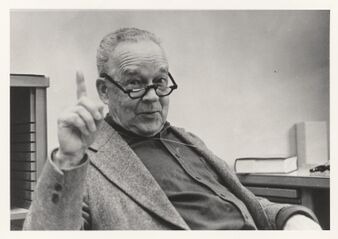
James Jerome Gibson was an American psychologist known for his influence in the field of ecological psychology, the study of the relationship between organisms and their environments, where an organism’s behaviour is shaped by “affordances”. Born in McConnelsville, Ohio, in 1904, Gibson earned his Ph.D. in psychology from Princeton University in 1928 then taught at Smith College and Cornell University, where he began his pioneering research. 

https://monoskop.org/James_J._Gibson

Gibson explains in his most influential work, The Ecological Approach to Visual Perception (1979), that affordances are the possibilities for specific actions that the environment provides and the perceiver’s abilities. (Gibson 119). For instance, how a chair invites us to sit and a path invites us to walk on it .

Gibson’s theory rejects the notion that the mind and body are independent from one another and emphasizes that our perception and actions work hand in hand to understand our world through our bodies as we move and interact with it. This is what Gibson refers to as the “education of attention,” which is the process of learning by noticing information through participating experience and movement, rather than by solely passive observation (Ingold 2).

The Art of Paying Attention

Ingold draws from James Gibson’s concept of the education of attention to explain how people learn by doing. Through every move we make in our bodies, we learn to perceive by being active participants in our environment. Ingold draws Gibson’s concept of the education of attention to argue that making works the same way, as the maker learns through attentive participation while being attentive to materials, developing sensitivity to their textures, resistance, and potential.

In Making, Ingold writes that learning occurs through “what the ecological psychologist James Gibson calls an education of attention” (Ingold 3). The maker learns by feeling, sensing, and responding to the materials, not just by following a set plan in their head. Ingold also says that we “learn by doing, in the course of carrying out the tasks of life” (Ingold, 13), explaining that creativity is an ongoing journey between the maker, their bdy, and then the materials that they interact with.

Affordance in Materials

Ingold provides an example in chapter 3 of Making, “On Making a Handaxe”Ingold describes the Acheulean handaxe, which was made from flint over more than a million years ago. The origin of this axe came about when knappers paid attention to how the stone reacted when struck, noticing how the sharp edge and shape of the axe formed naturally (Ingold 34–38). This example proves that  Ingold extends this idea into materials themselves when making, where they also “join forces” in possibilities for action (Ingold 21). For example, clay affords shaping, wood affords carving, and yarn affords knitting. Thus, the maker’s creative process is shaped by both their intention and by the affordances that materials and tools display through use.

I want to think of making, instead, as a process of growth. This is to place the maker from the outset as a participant in amongst a world of active materials. These materials are what he has to work with, and in the process of making he ‘joins forces’ with them, bringing them together or splitting them apart, synthesising and distilling, in anticipation of what might emerge.” (Ingold 21)

Ingold’s approach to affordances indicates that materials and textures are not just passive tools because they indirectly participate in the creative process. Our duty is to respond to these affordances through attention so that making becomes a partnership between us and the world, rather than a one-sided action of control by humans.

Applying Gibson and Ingold to Our Media Environment

In terms of media studies, Gibson’s theory about affordances as well as the notion of “education of attention,” are relevant. Though Gibson’s ideas are connected to ecological affordances, we can use them to discuss media landscapes and what they provide us with. Ingold and Gibson’s theories surrounding anthropology, ecology, and psychology, when translated to understanding digital media, provide valuable insight about how we interact with, and use technology. 

A current example of Ingold’s application of Gibson’s theory can be seen in our digital habits, where we feel confused and overwhelmed with the features of emerging technologies. However, through continuous engagement, experimenting with new technological tools rather than repressing them, we slowly develop a system’s flow. Understanding the environment remains relevant now, beyond building axes and houses, as we are now experiencing a new type of environment, the media environment. Our perception and creative abilities evolve faster as media itself becomes a space of exploration between human attention and technological affordance.

By drawing on Gibson’s concept of “the education of attention,” Ingold shows that learning, creating, and perceiving all arrive from active engagement and participation with the environment. Though Gibson was mentioned only once throughout the entire book, the concept of the education of attention helps lay the groundwork for his later arguments on correspondence and material growth, where Ingold explains that perception, movement, and creation are all essential and related processes. Hereafter, making is a way of paying closer attention to the environment and being in touch with the world as it takes shape through our hands.

Contributors:

Kenisha Sukhwal, Aubrey Ventura

References:

Gibson, James J. The Ecological Approach to Visual Perception. Houghton Mifflin, 1979.

Ingold, Tim. Making: Anthropology, Archaeology, Art and Architecture. Routledge, 2013.

“James J. Gibson.” Monoskop, https://monoskop.org/James_J._Gibson. Accessed 18 Oct. 2025.