Tag Archives: mass media

Landsberg to Lain: Power in Prosthetic Memories

Introduction

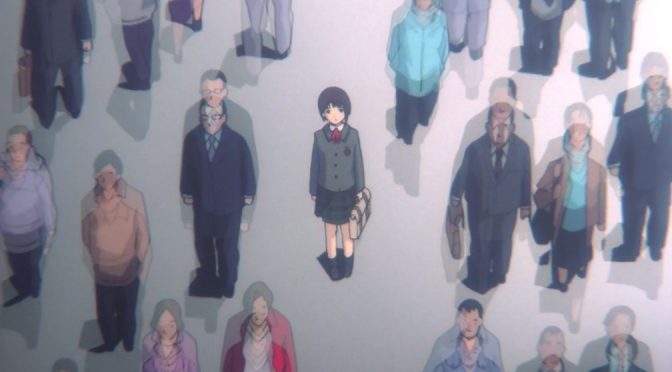
Serial Experiments Lain is a 1998 cyberpunk anime which follows a girl called Lain in a world where the boundary between the physical realm and the Wired – a fictionalized version of what we know as the Internet – progressively becomes more blurred. Lain grapples with confronting her digital alter egos and trying to make sense of her ever-shifting reality. While the series quickly spirals into surreality and confusion, the themes of memory, identity and mass media ring clear. The specific concept of prosthetic memories comes into view when it is revealed that the world’s chaos can be traced back to a digitally-omnipresent antagonist named Eiri, whose ability to manipulate collective memory can shape reality.  

Hence, I found that this series resonates heavily with Alison Landsberg’s 1995 paper Prosthetic Memories, in which she defines such memories as ones that are implanted instead of coming from lived experiences. While her discussion focuses on prosthetic memories as experienced through film and mass media, my blog post explores how Serial Experiments Lain extends her ideas to the modern age of the internet and social media. I go further to argue that the late-90s series prophetically illustrates how the internet is used as a powerful tool for systems of power to manipulate memory, alter reality and reshape history to the detriment of society. 

Prosthetic memories through social media

Landsberg explains that the mass media is a site for the production of prosthetic memories, with cinema in particular. As a medium that makes images available for mass consumption, it creates experiences and implants memories “which become experiences that film consumers both possess and feel possessed by” (176). Spectators witness memories depicted on screen that they have not actually lived through, prosthetically experiencing the histories of a collective past. Landsberg suggests that this complicates identity formation and results in the creation of “partial identities” (179).

Similarly, Lain is a figure whose identity is fragmented and shaped by prosthetic memories. Midway through the series, a mind-bending twist reveals that Lain is a digital entity entirely constructed by Eiri with the purpose of bridging the gap between the real world and the Wired. She grows to become a figure whose identity is shaped by the human collective unconscious present in the Wired, resulting in different “Lains” who are constructed by various people’s experiences and memories. While the Wired presents an exaggerated, more advanced version of how the Internet functions in real life, Lain’s experiences with partial identities is reflective of how our identities are shaped online. Beyond the images depicted in films as discussed by Landsberg, social media has made it so that users can easily upload documentations of their memories to the digital realm, readily accessible for others to prosthetically experience these histories and internalize them as their own.

Perception becomes reality

Landsberg explains that what is real and what is not becomes blurred when an individual’s identity is affected by prosthetic memories. She asks the question “What might it mean to say that those memories are ‘just’ from a movie?”, arguing against any attempt to distinguish between prosthetic memories and “real” ones, since anything that we experience to be real becomes our reality regardless of the source. Serial Experiments Lain echoes this point by positing that perception becomes reality, and extends this discussion to the realm of collective memories and the act of memory erasure.

“A memory is only a record. You just have to rewrite that record.” – Lain

While the series explores Landsberg’s ideas of experiencing additional memories outside of one’s own lived experience, it also explores what happens when memory is erased. As Lain becomes a powerful, God-like being that crosses between planes of reality, she grows to realize the detrimental impacts of her abilities, and uses memory manipulation as a positive force to remove herself from society’s collective memory. She continues to live on, but in a peaceful world where she was never remembered, and thus the impacts of her existence are no longer present. This bittersweet ending highlights a central idea that ripples throughout the episodes: that people only have substance within the memories of other people.

Memory as shaped by power

Following this idea that people only have substance within memories of others, could this also apply to global issues or events? Our collective memory and experience of reality is largely shaped by our engagement with social media and the images that we see online. If something is documented less or hidden from public view, society becomes prone to forgetting it, which essentially removes it from our perception, and thus our reality.

Adriaansen and Smit explain how platformization reshapes the act of remembering and forgetting through algorithmic curation. They define platformization as the way in which our pasts are actively and continuously reshaped by the infrastructures of digital platforms. They use the example of Facebook and Apple’s “Memory” features that algorithmically select old posts to surface as memories based on engagement metrics and positive content. These features strategically reconstructs individual’s memories into tailored narratives that highlight certain moments while erasing those deemed less desirable. Adriaansen and Smit also explain how, on a collective scale, algorithms aid in the dissemination of content throughout social networks, with algorithmic bias playing a part in determining which narratives gain visibility and credibility. This proliferates the spread of “fake news”, leading to collective yet false memories about public events that become part of our perceived reality and experiences (2).

Serial Experiments Lain extends Landsberg concept of prosthetic memories to the modern age of the Internet, and illustrates how social media is a prominent site for memory construction and the shaping of our collective reality. The power of memory manipulation that Eiri, and consequently Lain, hold, make them figures that are allegorical of these systems of power and regimes that enforce censorship in attempts to make us remember and forget. While there is no God-like entity that can literally extract and implant memories into the minds of individuals (hopefully), the erasure and fabrication of narratives happen all the time, subtly but surely. Hence, it remains important for us to look through the cracks and think critically about the information we engage with online so that we don’t fall into a perception of reality that blinds us from truth.

By: Adela Lynge


References

Adriaansen, Robbert-Jan, and Rik Smit. “Collective memory and social media.” Current Opinion in Psychology, vol. 65, Oct. 2025, pp. 1–4,

Landsberg, Alison. “Prosthetic Memory: Total Recall and Blade Runner.” Body & Society, 1995. pp. 175-189.


Oxford Word Of The Year In 2025 Is “Rage Bait” — And What?

By Micah Sébastien Zhang

Sometimes I think human thoughts and patterns are strange — sometimes even blatantly strange and intellectually-defunct. My mind often circles back to this wild statement after much observation as a new generation person breed by perpetual online content.

Quite recently, Oxford University Press has chosen the term "rage bait" as the Word of the Year of 2025. The term "rage bait" is "online content deliberately designed to elicit anger or outrage by being frustrating, provocative, or offensive, typically posted in order to increase traffic to or engagement with a particular web page or social media content" as defined by their given explanation. Their presented graphic showed that the usage of the term has been sharply rising since around June of 2024.

This wasn’t the first time that Oxford UP decided to bring in significant attention to rapidly developing internet jargons. Last year, the term "brain rot" was selected as the Word of the Year in 2024. A technical definition for this term would be about meaningless pieces of low-effort content circulating on the internet, yet a figurative definition would be an alarming symbolism that marks the downfall of communications and record-keeping of the humanity.

My growth as a 2005-born Millennial defined my intertwining love-hate relationship with the internet, and now my current identity as a media studies student is adding a touch of sour taste to recognizing the reality. My early days of internet exploration around 2016 opened myself up to the massive culmination of mankind knowledge (whether it’s good or bad); the sense of novelty was lingering among the majority of good-faith online communities (I missed the days watching DanTDM as a child). Yet now coming to the end of 2025 as a (questionable) self-functioning adult after learning three years of formal media jargons, this sense of novelty was eventually replaced with subtle nausea on overwhelming effects of emotions transmitting throughout the internet.

On a deeper reflective level, this feeling now feels more like a side effect of internet or mass communication as expected from media richness theory, which was developed by Richard L. Daft and Robert H. Lengel in the 1980s. The theory developed a framework to assess different means of communications depending on their "richness" — the ability to accurately convey information with as minimum misintepretations as possible.

A core of the internet relies on mass communication and digitization of traditional humanistic experiences, and the concepts within the media richness theory seem to alarm us of a possible outcome. Concepts mentioned in the media richness theory, such as paralanguage, social cues, and social presence — which are all heavily present in in-person communications — are mostly-to-always compressed and distorted during the transformation to digitized spaces. A simple "I love you" to a person could be reprinted and reproduced numerous times on language-prevalent platforms like Twitter and Facebook; the cues brought by tone, body languages, and facial expressions were, however, obliterated by the digital presence, despite the fact that they’re heavily influential on conveying deep meanings.

Rage bait could be pretty much interpreted as the direct result of phenomenon. The social media’s lessening capacity to hold long-form discussions is leading to a tendency of encouraging primal flirts to trigger simple emotions, yet ironically speaking, keeping content forms simple for social media seems like a popular solution for a social media platform to thrive. It might seems just easy for us to randomly post anything on Twitter within a 140-word limit, preferably with some pictures to spice up your content. The ultimate outcome we often hope for from posting would be engagement and acknowledgements, whether it could be simple as a like or retweet or as complex as a well-written and formatted reply. But the mediation of language itself is inevitable (and I would personally call it as the curse of language); it’s almost impossible to mirror a specific segment of your personal, in-real-life experience onto a short amount of text and expect other people can feel your same experience through the text. On topics such as debates over ideas and opinions that would often take an insurmountable effort form proper engagements and arguments, the text itself on those topics over social media doesn’t just represent a description, but rather a much dwindled tag of primal humanistic emotions.

What lies the real danger here is that the delivery format of social media is driving such engagements — exchanges of primal humanistic emotions. The root of conflicts inside mankind could be just coming from a small misunderstanding. If one day the boundaries between online and real-life interactions blurred, I must say that I’m not highly optimistic of what might be the outcome.

Sure, you can say it’s primal humanistic emotions again. ("We’re just humans, right?") Just don’t think that I’ll take all those norms in peace.

Works Consulted

Heaton, Benedict. “‘Brain Rot’ Named Oxford Word of the Year 2024.” Oxford University Press, 2 Dec. 2024, corp.oup.com/news/brain-rot-named-oxford-word-of-the-year-2024.

Heaton, Benedict. “The Oxford Word of the Year 2025 Is Rage Bait.” Oxford University Press, 1 Dec. 2025, corp.oup.com/news/the-oxford-word-of-the-year-2025-is-rage-bait.

“Media Richness Theory | Research Starters | EBSCO Research.” EBSCO, www.ebsco.com/research-starters/social-sciences-and-humanities/media-richness-theory#terms-&-concepts.

Copyright Acknowledgement

Cover feature image by Dmitry Vechorko on Unsplash.

What Can Image Gen-AI Models Teach Us About Image Perceptions?

A Critical Response Post to THE IMAGE: REPRESENTATION, REINCARNATION, REPRODUCTION by Matthias von Loebell, Danial Schatz, Django Mavis, and Sydney Wilkins.

By Micah Sébastien Zhang


A few days ago, I have stumbled across a work by some of my peers — Matthias von Loebell, Daniel Schatz, Django Mavis, and Sydney Wilkins — on the class blog, in which they talked about the significance of images in media, and how can the manipulation of images affect people’s perception. The blog article rolled out smoothly as it took us from the early and general form and definition of images at the start, then to the connections between theories, and it all falls back to the general summary of how is their whole thesis point playing out in the modern, contemporary field of world.

The article chose a sociological point of view when comes to the analysis of images and their effects, which is a proper move in my opinion. Similar perspectives and ways of research could never get old as the time and world are shifting forward. What I found particularly agreeing is their opinion on the essence of images, as they quote it as "a visual abstraction." Through this piece of thought, we can fairly arbitrate the concept of image falling within the classical frame of media mediation, in which images serve as a mediation to a summary of thought(s).

However, in this critical response post, I would like to take a step back and make my way to a summit that grants a holistic and figurative perspective on the conception of images, notably through a rather unusual example — text-to-image generative AI models.

How come? The reason why I’m proposing this peculiar perspective approach is that I personally found the technical process of text-to-image generative AI is similar to the humanistic experience of image perception. Yet before we can go into the comparable details of it, we should first understand how do text-to-image generative AI models usually work.

A research guide from the University of Toronto gave us a pretty comprehensive outlook of the technical process, yet for the sake of convenience, a summary will be also provided below. To be technically focused and more concise, I will only focus on the process for diffusion models.

Diffusion model is a common type among image generative AI models; both Stability AI’s Stable Diffusion and OpenAI’s DALL•E are categorized as diffusion models. Inspired from thermodynamic diffusion, the technical process of a diffusion model includes two methods. The first method — forward diffusion — will declutter and scatter (or "diffuse" according to the manual) the pixels of a normal image into random noises. The machine is learning to recreate the image by reconstructing a normal image from a randomized, noisy version. That is, for example, a normal image of an apple will be diffused into randomized noise and given with the "apple" tag, then from the tagged noisy images, the machine will recreate the normal images upon requests from prompts. Each creation of the image comes from the synthesis of noises, and this will result in different image outputs even with the same prompts.

Through this process, we can partly mirror this to a general humanistic perception of images if we consider images as a mediation to higher-level information. The creation of actual, in-real-life images comes from the diffusion of the higher-level knowledge in our brains; those pieces of higher-level knowledges are, in my opinion, properly stored as a culmination of humanistic experiences since one’s birth. Upon perceiving an image, we’re essentially transforming a two-dimensional plane of "diffused noise" (this could be any form of visual representation) as pieces of higher-level knowledges in our brain, yet they could be deviated from the original intention and meaning.

On this note, images are indeed better compared to pure texts. In this example, if I put the word "apple" here, my viewers could have different perceptions to the term: maybe it’s a red apple; maybe it’s a green one; maybe it’s even Apple Inc. that made iPhones. Images can provide a more directional rectification towards transmitting higher-level thoughts and concpets. Nevertheless, it is still incomparable to direct transmissions of higher-level thoughts as it falls within the constraints of diffusion of thoughts.

Going back to the article by my peers, one of their claims is that the values of images are diminishing along with the mass production of them. Quoting from the Frankfurt School thinker Walter Benjamin, their claim is reflecting on his claim that viewing artist labour "as the process by which art is imbued with meaning." Reflecting to my claim in this article, the mass production of images may symbolize technological advancements on means of media production and the media industry itself, yet considering this holistic overview, it may also make the transmission of information into a more chaotic stage where the mass produced images bear incomplete representations of higher-level informations.

As new media studies scholars, it is important to note down the challenges currently faced by our field of study, yet having new perspectives that challenge pre-constructed perceptions may provide us more beneficial insights to shape our field of study — and sometimes it could mean taking a step back and seeing things as a whole to find general patterns.

Works Consulted

“Research Guides: Artificial Intelligence for Image Research: How Generative AI Models Work.” University of Toronto Libraries, guides.library.utoronto.ca/image-gen-ai. Accessed 29 Nov. 2025.

Von Loebell, Matthias, et al. THE IMAGE: REPRESENTATION, REINCARNATION, REPRODUCTION | Approaches to Writing for Media Studies. 29 Sept. 2025, blogs.ubc.ca/mdia300/archives/115. Accessed 29 Nov. 2025.

Image Acknowledgement

The header image was produced by Jonathan Kemper on Unsplash.

Human-Technological Relations: An Exploration of McArthur and Van Den Eede

Emily McArthur and Yoni Van Den Eede, through an exploration of Siri via Walter Benjamin’s definition of the ‘aura’ and self-tracking technologies through Marshall McLuhan’s extension theory of media, explore the relationship between humans and technology and the ways in which interactions between the two shape the media ecology. In this post, I will be comparing the two texts in order to find common ground and points of difference between the two and point out the ways in which each author conceptualizes the boundaries between the human body and technological mediation.

McArthur

McArthur builds a case for the aura of technological devices and programs. Walter Benjamin’s definition of aura is ‘the sense of uniqueness’, which deteriorates due to forces of technological reproduction. However, he has a positivist attitude towards technological development, as the destruction of aura also destroys the mysticality inherent in it, and essentially leads to a democratization of art (McArthur 115). 

Originally, Benjamin’s definition of the aura had been applied to aesthetic works such as art and literature, with technology merely being the means of reproduction in this equation (McArthur 114). But what McArthur proposes is a reimagined view of the aura; a posthuman aura which allows technologies like Siri, which teeter on the edge of humanity and artifact, to gain a unique kind of authenticity (115). This new conception of aura, as proposed by McArthur, is based on the technology’s simultaneous proximity and distance from the user. It appropriates human mannerisms and functions well enough to lull the user into perceiving it to have a ‘quasi-human’ face, while also drawing a clear boundary through its robotic tone of voice, reminding the user that it is a technology created by man (117). It also performs a democratizing function, by making available a technology to everyday users, that had only been available to people working within the tech industry up until then (McArthur 117). All in all, McArthur presents a determinist approach to perceiving human-technological relationships. She raises concerns about such algorithms collecting data and surveilling users for corporate gain, fracturing human relationships as a result of excess proximity to technology, and encourages readers to critically engage with media.

Van Den Eede

On the other hand, Van Den Eede uses self-tracking health technologies as a case study to examine the extensionism theory, often championed by media theorists. He presents arguments for and against the extensionist perspective, specifically expanding upon Marshall McLuhan’s theory of extensionism and putting it into conversation with Kiran and Verbeek’s critique of the instrumentalist nature of the extension theory. Van Den Eede himself seems to take a stance against the extensionist theory, citing it as a useful way of examining media technologies but one that ultimately reduces human-technology interactions to a binary of complete ‘reliance’ or ‘suspicion’ (156). He instead ‘superposes’ McLuhan’s extensionism theory with Kiran and Verbeek’s argument that the relationship between humans and technologies should be one of trust, in which the user learns to critically engage with the technologies (168).

Translation and Linguistics

Both McArthur and Van Den Eede bring up translation as a crucial element of the human and technological relationship. McArthur talks about how natural language processors do not actually comprehend human speech; rather it goes through a series of translations (116). From sound waves to code and then back to sound waves. The magic of the translation process, the fact that information is converted into multiple different forms before being reflected back to the user is part of what gives the technology its aura (117). She argues that this appropriation of human language simultaneously performs the function of ‘mystifying’ and ‘demystifying’ language. While technology’s ability to comprehend and respond to humans in a language they understand grants it an exalted status, human speech is wrested out of human hands, causing them to lose the unique connection they had with the language (116). 

On the other hand, Van Den Eede argues that McLuhan’s media theory is deeply rooted in linguistics, citing McLuhan’s idea that media are translations of human organisms and functions into material forms (159). He refers to media as metaphors, suggesting that these media constitute a language through which humans make sense of the world around them. Van Den Eede contends that analysing media through a linguistic framework allows us to understand them by linguistic means. He examines the etymology of media and finds that it originates from the human, which, he argues, lends weight to McLuhan’s extensionist claim that the body from which media originates should hold significance (160).

Reciprocity and Control

McArthur cites Benjamin to explore technology’s ability to ‘gaze back’ at us, noting how, in the case of traditional art, this gaze once afforded value to bourgeois works. Essentially, she argues that this returned gaze grants the object a form of social control over the human (119). While it constructs a hierarchy that gives users the illusion of mastery over a human-like apparatus, there remains an imbalance, as the data collected by these corporations is used to refine algorithms and exercise corporate control over users (McArthus 125). Moreover, just like the aura of bourgeois art, the aura of Apple’s products gain control over the masses through the strengthening and construction of social hierarchies, with Siri adding onto its exclusivity. Though McArthur claims the aura has been ‘democratized’ by the value of it being available to the common people, Apple is still a brand whose products can only be acquired by a certain class of privileged individuals. Rather than democratizing aura, it furthers commodity fetishism and the aura of technology simply becomes another part of the equation of corporate profitmaking endeavours (120). 

Van Den Eede also addresses similar concerns, drawing on McLuhan’s theory of the environment’s reciprocal relationship with human extensions. He comments on a transformative process in which humans and media continuously reshape one another. By translating ourselves into media, ‘we reach out into the environment, but this also makes it possible for the environment to reach back into us’(160). He claims that the extensionist theory creates an illusion of  one-way traffic between humans and media, leaving humans unable to notice the effects media have on them. He advocates for a ‘two-way traffic’ approach towards technologies, arguing that they shape us just as much as we shape them (166). In this sense, Van Den Eede champions a co-shaping relationship between humans and technology, in which technology and humans exist within the same environment, on equal footing.

Posthumanism

McArthur describes the aura of technologies as posthuman, meaning a type of aura that is not inherent, but is instead imbued in a device through the painstaking efforts of engineers (120). In line with her technological determinist view she seems to be skeptical towards posthumanism. She claims that the posthuman aura of Siri is broken when it fails to process spoken instructions, which happens quite frequently. It reminds the user that Siri is not actually an autonomous entity, but rather a program developed by engineers which is liable to fail (124). 

McArthur’s view on the posthumanism of technology is in line with the McLuhanian extension theory and the concept of Narcissus narcosis, the idea that humans are unaware of the fact that these technologies originate from us. Van Den Eede seems to be critical of the anthropocentric implications of the extension theory, claiming that the idea of becoming aware of the ‘origin’ of technologies from the human still prioritizes human body over technology (160). He does admit, however, that Kiran and Verbeek’s idea of ‘trusting’ oneself to technology is also based in a certain negotiation of the boundaries between the two, which has a hint of a humanist character as well (168). All in all, while he does support a posthuman approach towards technology, he also encourages readers to critically engage with technologies.

Conclusion

McArthur appears to be more skeptical of human-technology relations, raising concerns about surveillance, data collection, algorithmic control, and the varied ways in which the capitalist system harnesses technology to exercise social control over the masses. She adopts a more humanist stance, echoing the McLuhanian notion of the human body assuming a superior position in  human-technology relations by value of it being the source of technology.

In contrast, Van Den Eede adopts a more optimistic stance toward technology. He only briefly touches upon surveillance and data collection, primarily using it to support his argument for a ‘trust’ approach to human-technology interactions (165). Though he ends up finding a middle ground between extensionism and Kiran and Verbeek’s alternative ideas of human-technology interaction, it is clear that he values the posthumanist notion of a two-way relationship between humans and technologies. Despite these differences, both authors share confidence in the user’s capacity to critically engage with media, emphasizing the importance of reflection and awareness in navigating technological environments.

Works Cited

  1. Van Den Eede, Yoni. ‘Extending “Extension”.’ Design, Mediation, and the Posthuman, 151-172.  https://doi.org/10.5040/9781666993851.ch-008. 
  2. McArthur, Emily. “The Iphone Erfahrung.” Design, Mediation, and the Posthuman, 2014, 113–28. https://doi.org/10.5040/9781666993851.ch-006.

What Alison Landsberg and Van Den Eede Teach Us About Technology

Nowadays, we are seeing emerging technologies like the Apple Vision Pro, Fitbits, and Oura Rings, which are making our senses increasingly extended and reshaped by digital media. This begs the question as to whether or not our senses are being strengthened or even manipulated due to technology. Alison Landsberg, in “Prosthetic Memory” (1995) and Yoni Van Den Eede in “Extending Extension” (2014), question how we understand the relationship between humans and media. Landsberg sees media as a “prosthetic”, technology that inserts itself into ourselves, affecting our mind and body (Landsberg 175). On the other hand, Van Den Eede sees media as an extension that expands and redefines what it means for us to be “human” (Van Den Eede, 151). Though their ideas are slightly different, each reveals how media and technology may not be neutral tools, presenting media as the active players in shaping us as modern humans. In an increasingly mediated world, their discussions depict how representation and interface influence our identity, control, and perception in an increasingly mediated world.

Landsberg: Prosthetic Memory

In “Prosthetic Memory,” Allison Landsberg begins by presenting the idea that cinema and mass media can implant memories in audience members and viewers, reshaping their identity, even though these recollections never truly occurred to them in real life. Landsberg defines these as “memories which do not come from a person’s lived experience in any strict sense”, but are still real nonetheless (175). The media we consume, including film, television, and social media content, can make us feel as if we are living in someone else’s experiences rather than just following their narrative. As Landsberg explains, cinema is “aware of its ability to generate experiences and to install memories of them ― memories which become experiences that film consumers both possess and feel possessed by” (176). Landsberg explained this idea using the film The Thieving Hand (1908), a story that follows a one-armed man who is given an artificial limb that causes him to steal from people against his will (175). Just like how technology can create and amplify our experiences, oftentimes, it is extended too far, where there is a loss of control. In this case, media can write images, feelings, and experiences into our minds that were never ours. Now, our screens can edit our sense of who we are, rewritten by the cultural technologies we consume, whether we like it or not. Especially where the algorithm feeds AI content, Landsberg’s argument that media “implants” memories is a cautionary tale that every image or video we encounter, real or fake, has the possibility to rewire who we think we are. 

Eede: Critical Awareness towards “Extension”

In Extending “Extension”, Eede mainly discusses the relationship between technology and the human being by applying the idea proposed by Marshall McLuhan – technology is the extension of the human being – and uses this as a way to call on the public to perceive technology in a more critical way. 

Eede points out that modern researchers often look at technology under an “external” context: “technologies and humans are seen here as independent entities, and the relation between them—the extension—as an external supplement to both.”(Eede, 156) This approach only leads to two extreme directions in which one side relies on technology blindly while the other side completely rejects it. 

To look at technology in a more practical sense one needs to accept that technology is not only “simple intermediaries” or a tool for humans to use but also acts as a source of influence that co-shapes human beings. To internally approach technology, one has to accept that we have already intertwined with technology, though one should remember to trust their own thinking rather than technology, despite its convenience in many aspects. At the same time, according to Eede, technology is also self-tracking and constantly shifting its position in the human-technological relationship and the boundaries between it and humans. This goes back to Eede’s promotion in critical thinking in a time when everyone needs to have awareness when it comes to treating technology.

Common ground and relations

Eede and Landsburg both made similar statements along with their main ideas when it comes to human-media relations. Eede emphasized on the fact that technology and media can influence and co-shape human beings, and that technology today should be seen as an internal element for humans since they can reflect and intervene with what people think they originally thought. The idea similar, or even can be considered an continual to “extending the mind through technology” can be found in Landsburg’s works, in which he describes how human memories can be influenced by what they watch on different media outlets and so “tricking” the mind to accept them as part of reality – consciously or subconsciously. In both works, the authors try to raise the awareness amongst the public to see media and technology in a more critical way. 

Main differences

While both thinkers see media as a force that is entangled with human experiences, they approach these ideas from different perspectives. Landsberg’s concept of prosthetic memory depicts media entering our bodies and creating emotional memories that are not ours. On the other hand, Eede focuses on media as an entity that is “an extension of ourselves” (151), rather than media being inserted into us. His perspective is loyal to McLuhan’s thinking about media as “technology is an extension of the human being, of human organs, body parts, senses, capabilities, and so on. ” (153). For Eede, media stretches and reshapes our sensory boundaries; it changes the way we move, see, and act in the world.

Landsberg emphasizes how media implants memories and emotions, while Eede is concerned in how media transforms our abilities in perception and our abilities as humans. Lansberg approaches media with more regard for its ability to emotionally penetrate ourselves with new memories, producing empathy and identity through what she calls the “unsettled boundaries between real and simulated ones” (174). In contrast, Eede’s priority in his thinking is not about emotional manipulation but about our loss of understanding of how media shape us while we use them, which is becoming increasingly unclear. Eede mentions technology itself creates a “fog to distort our sight; a blindness we are victim to or, even more precisely, an inability to assess the “why” and the ‘how’ of technologies in an immediate and direct way, at a glance so to speak.” (168). 

Contextualizing in Media Theory

Landsberg and Eede remind us that media are not just things that we consume, because it is a heavy influence on how we think, feel, and behave. We’ve often returned to McLuhan’s idea that “the medium is the message.” Van Den Eede explicitly extends this saying, while Landsberg adds by presenting the implantation of memories and emotion. This shows that modern media can impact us from many directions, both outward and inward.

Even further, Ingold’s mention of correspondence in Making or Gibson’s “education of attention” also applies here. According to Ingold, our perception arises through actively interacting with materials. Then, for Gibson, we observe affordances that invite us to act. Landsberg’s ideas similarly lean toward feeling through film’s affordances, while Van Den Eede’s extensions demand continual adaptation to technology.

Conclusion

Both of the readings emphasized on the importance of critical thinking with media and technology, and in a society filled with advertisements, new technology and implementations of various ideas from billions of people, critical awareness and consideration to accepting these information are indeed of vital importance. Meanwhile, not easily accepting the provided ideas also extends to the researching grounds – taking in the ideas and reminders from Eede and Landsburg, implementing them as an “extension” to our own thoughts and memories entirely without critical consideration is probably not what the authors would like to see, either. Indeed, our knowledge should come from our own interactions with materials, and this should be kept in mind in both interactions with the passages by Eede and Landsburg as well as with media and technology in our daily lives. 

References

Landsberg, Alison. “Prosthetic Memory: Total Recall and Blade Runner.” Cyberspace/Cyberbodies/Cyberpunk: Cultures of Technological Embodiment, edited by Mike Featherstone and Roger Burrows, SAGE Publications, 1995, pp. 175–186.

Van Den Eede, Yoni. “Extending ‘Extension’: A Reappraisal of the Technology-as-Extension Idea through the Case of Self-Tracking Technologies.” Design, Mediation, and the Posthuman, edited by Pieter Vermaas et al., Lexington Books, 2014, pp. 151–164.

Image: Pierznik, Christopher. “Our Brains Can’t Handle Technology.” Medium, 5 June 2019, https://medium.com/the-passion-of-christopher-pierznik-books-rhymes/our-brains-cant-handle-technology-8dfabe90505d

Contributers:

Siming Liao, Aubrey Ventura

Scrolling: The Regression of the Hand and the Decline of Material Correspondence

‘Scroll’ in its most literal sense refers to a rolled up sheet of paper or, more commonly, parchment, which was used for documentation. However, the word ‘scroll’ is now more commonly used as a verb rather than a noun, referring to the action of moving the display of a screen up and down. Moreover, apart from the gesture of moving one’s hand up and down a screen, the range of movement that can take place on the tiny phone screen is limited, yet it can still produce significant effects. The process of drumming one’s fingers seems to be completely unrelated to the forms that appear on the screen in the form of text or image. The physical movement of the hand on the screen does not directly translate into the form that is produced on the screen. This phenomenon relates to what Ingold refers to as the ‘regression of the hand’—the decline of the tactility and relations between manual movement and the material traces it yields.

I would like to explore the ways in which the actions involved in being on the phone lead to processes of creation and, most importantly, communication. Furthermore, I am interested in how modern electronic devices, particularly those with touch screen interfaces, challenge or even defy André Leroi-Gourhan’s idea of graphism. Leroi-Gourhan defines graphism as “relatively durable traces of dextrous manual gestures”(Ingold 116). In simpler terms, this refers to the marks that serve as a record of actions.

Heidegger, in commenting on the typewriter, expresses distaste for it and discusses how this device transformed the nature of writing (122). The transition from typewriter to computer keyboard intensified this separation. Unlike the typewriter, which immediately imprinted letters onto paper, the computer displays words on a screen separate from the physical act of typing. If the text displayed on a computer screen is eventually printed, the act of inscribing it onto a material medium is credited not to the one who typed but to the machinge, the printer. 

With cell phones, this separation becomes even more complex. The keyboard itself is no longer a an individual, physical machine but one of many virtual functions of the device. Ingold argues that the act of typing leads to a disruption in the process of transduction, wherein the ‘ductus—the actual kinaesthetic action does not directly correspond with the form that appears on the screen (Ingold 122). Ingold’s transduction refers to the process through which gestural action produces a transformation in material form (102). In the case of touch screen devices, this relationship is fractured. The physical action required is minimal, and the materiality of the medium being operated upon is ambiguous. The material that the hand comes into contact with is the surface of the phone, yet the change that takes place is in the code that exists in a virtual realm. This change in code is then represented by images and icons displayed on screen, giving the user an illusion of interacting with the material within the digital realm. 

Grip and Gestures

While using a phone, a person typically grips the device between the pinky finger and the thumb, with the back of the phone resting against the other fingers and balanced on the pinky. The thumb, which helps to secure the phone, also performs most of the navigational movements on the screen. Though the position of the hands often changes depending on the activity being performed, the actions being done on the screen are all done by the fingers. In particular, the tips of the fingers. This is in line with Ingold’s idea that the progress of technology is characterized by the shift from use of hands to fingers (123). In using a cell phone the tasks of typing, editing, clicking pictures are carried out as the fingers move across the surface of the screen. But the actual content being produced through these actions exists within the screen. The fingers make contact with the surface, yet the resultant forms remain entirely virtual. When you pinch to zoom in, the visual content on the screen enlarges, but the physical scale of the screen itself does not change. 

Ingold discusses how repetitive manual actions during the process of creation physically affect the hand in ways that contribute to or even enhance the process of making (117). He gives the example of string makers and cello players: their hands become coarser and develop calluses. The hardened skin protects the fingers from pain, allowing the musician to play longer and the craftsperson to produce better strings. Thusm these injuries, far from being a hindrance, actually facilitate the craft. In such cases, the deformation of the hand becomes integral to the process of creation. 

In the case of operating touch-screen devices such as phones, however, this relationship between bodily transformation and creative process becomes disrupted. The body still undergoes change; users experience repetitive strain injuries like carpal tunnel syndrome, the so-called ‘iPhone pinky,’ where the pinky finger becomes bent from supporting the device, and even soreness in the thumbs from constant scrolling or typing. However, unlike the callused hands of the craftsman or musician, this alteration in the hand of the phone user does not affect the process of making in any way.

This is because the gestures required by touch-screen devices are minimal and effortless. On a touch-screen interface, the physical gestures enacted by hands such as toggling, swiping, or pinching, are reduced to nothing more than pre-programmed features. Though these features are derived from bodily gestures, when incorporated into digital devices they become standardized features designed to trigger certain responses on the screen. This is in line with Ingold’s analysis that such actions have become metaphorical rather than genuinely physical or material (124). The gestures no longer result in real manipulation of substance but instead, represent symbolic actions whose effects are purely virtual.

This transformation creates a kind of simulacrum, in which gestures acquire meaning only through their digital consequences rather than through any tangible engagement with the material. The hand’s action ceases to produce traces in the Leroi-Gourhanian sense of graphism, instead reducing manual gesture into a sort of abstraction.

Human and Posthuman Writing

Heidegger suggests that the typed word lacks the humanity of handwriting. Ingold argues that the perfect, mechanical typescript robs the writing of any traces of being produced by a human, and  reduces it to a mere means of communication rather than a way of telling (Ingold 122). In this light, the movement of the hand is what imbues the produced handwriting with its humanistic dimension.

Ingold, drawing on Leroi-Gourhan, argues that while machines can extend human capacities and enhance certain forms of production, they also subtract something essential (122). The integration of mechanical devices into human action pushes us toward what he describes as a ‘posthuman‘ condition. He argues that even the simple act of pressing a button removes part of the humanity from the process, reducing it to an interaction with an intermediary rather a correspondence with material. Leroi-Gourhan’s argument raises the question: what happens when the entire process consists of nothing but pressing buttons? And those buttons are not even physical? On touch screens, the buttons are mere visual representations of electronic codes designed to simulate real-life, tactile surfaces. The gestures we perform do not affect real objects; they activate digital representations that mimic the appearance of materiality. The result is a detachment between human movement and material change.

Moreover, the rise and incorporation of Generative Artificial Intelligence into many applications has further flattened the process of creation. The art of inquiry, the ‘thinking through the making’, that Ingold propogates in ‘Making’ ceases to occur, as creation is increasingly reduced to typing short prompts for AI systems that generate text, images, or designs automatically (6). The hand’s role shifts from making to merely initiating a command.

All that remains now is scrolling. Most app interfaces are designed for endless scrolling, condensing all human interaction into a single repetitive gesture. Earlier in the essay, we discussed how effortlessness has become the priority in technological design. Yet it is precisely in effort that the humanism of creation lies. By removing friction between the hand and the material, we move further and further away from genuine making. As Ingold says, “It is precisely where the reach of the imagination meets the friction of materials, or where the forces of ambition rub up against the rough edges of the world, that human life is lived” (Ingold 73).

Ingold, T. (2013). Making: Anthropology, Archaeology, Art and Architecture (1st ed.). Routledge. https://doi.org/10.4324/9780203559055

Silence in the Age of Noise: Eco’s Library of Meaning 

“The Internet gives us everything and forces us to filter it not by the workings of culture, but with our own brains. This risks creating six billion separate encyclopedias, which would prevent any common understanding whatsoever.”
– Umberto Eco

Umberto Eco was many things, an Italian medievalist, philosopher, novelist, semiotician, cultural critic, and above all, a lifelong lover of knowledge. In Umberto Eco: La biblioteca del mondo film, we see him as a scholar surrounded by books, someone whose entire being seems shaped by them. From the outside, Eco appears calm, curious, and quietly humorous, and a man who treats his library as if it were a living mind.

As a cultural critic, Eco spent his life examining how meaning is made, distorted, and forgotten in the age of mass media. Long before the rise of social networks and the internet, he warned about the danger of information overload, of a world where knowledge could be reduced to noise. The film captures that concern through the physicality of his library, where every book is resistance against digital amnesia. Unlike the virtual world, Eco’s shelves preserve the weight of memory and resist the illusion that everything should be fast, accessible, and infinite.

A central theme that emerges from the film, and that we try to explicate here, is media and memory.

The Living Library: Memory as Being & the Foundation of Knowledge

Eco describes his library as a living organism. It is more than just a collection of written archives. Rather, the library is a being that holds memory and transforms as collections are added or moved around. The film opens with Eco speaking about memory, referring to the library as a “symbol and reality of universal memory” (2:01). He categorizes memory into three forms: vegetal, organic, and mineral. The library represents vegetal memory, full of physical books that originate from trees, knowledge rooted in nature. Organic memory lives within us; it is the memory we carry in our minds. When humans say “I,” Eco explains, it is our memory speaking. Stories that are written or passed forward, imagination, fiction, all of that is memory taking the shape of culture, entertainment, conversation, etc. Finally, mineral memory is what the digital world represents, vast collections of knowledge stored as data on the silicon of computer chips. Eco emphasizes that memory is imperative to building a future. Having knowledge about what came before us and reflecting on the past, is what gives us enough insight to build a future that is worthwhile. 

“We are beings living in time. Without memory, it’s impossible to build a future.” (11:08).

In Critical Terms for Media Studies, Bernard Stiegler discusses how humans have always relied on external tools to anchor memory or “exteriorize” it through language, writing, and technology. With the digital age we currently live in, and the extensive reach of information through the internet, this only gets amplified to an unfathomable magnitude, where millions of people have the ability to not only consume, but also to produce content abundantly. Stiegler elaborates on how humans have a retentional finitude. “It is because our memories are finite that we require artificial memory aids” (p.65).

These ideas align closely with Eco’s reflections in the film. He talks about how, though it is important to preserve knowledge, one needs to be selective about what they consume in order to make sense of it. An example he shares is that of a character who has the ability to remember all that he sees, and yet he is an “idiot” because all of that input is too much for a mind to conceive. Such is the state of the internet. The vastness of it is overwhelming and is, in fact, counterproductive to gaining knowledge. Eco says,

“The moment we think we have limitless knowledge, we lose it.” (26:40)

Individual organic memory, on the other hand, is selective. It acts as a limiter and rejects what is unnecessary or too complicated to perceive. This is favourable as it separates value from noise.

Knowledge, Noise, and the Loss of Meaning

We noticed that, for Eco, knowledge is not something that can be separated from the medium that holds it. He resists the idea that information should be instantly accessible, clickable, and endlessly reproduced. In the film, he says,

“Information can damage knowledge, like nowadays, with mass media and internet, because it’s too much. Too many things together produce noise, and noise is not a tool of knowledge.”(31:30)

We thought this reflects Bill Brown’s idea of the dematerialization hypothesis, the fear that digital media, by turning everything into data, threatens our “engagement with the material world” where physical objects once held meaning (p. 51). Eco resists this by grounding knowledge in material form, books that can be touched, smelled, and remembered. His library shows that thought itself has a materiality, what Brown calls “the process of thinking as having a materiality of its own” (p. 49). 

It caught our attention that Eco uses the term noise to describe how the overflow of digital information harms knowledge. Bruce Clarke, in his chapter on Information, uses the very same word to describe the way excess information disrupts meaning. “Information theory translates the ratios or improbable order to probable disorder in physical systems into a distinction between signal and noise, or ‘useful’ and ‘waste’ information, in communication systems” (p. 162). He explains that information and knowledge are not the same. Information is “a virtual structure dependent upon distributed coding and decoding regimes” and can exist only when interpreted by a mind (p. 157).

Like Eco, Clarke shows that while the digital world allows infinite copies and speed, it also breeds instability and forgetfulness: “what the virtuality of information loses in place and permanence, it gains in velocity and transformativity” (p. 158). In this sense, Eco’s silence-filled library resists the entropy of digital culture. Where Clarke sees noise as both inevitable and revealing, Eco insists that too much of it actually corrupts knowledge. We think that both of them agree that without slowness, form, and material grounding, meaning dissolves into static. Noise. Meaningless.

Authenticity in the Age of Digital Reproduction

Eco’s phone is always off, and that’s exactly the point.

“It’s always out. People believe they can reach me and they cannot… I don’t want to receive messages and I don’t want to send messages!” (21:59)

He might seem quirky, but this is resistance. He’s resisting a world flooded with messages that “each of them says nothing” (22:37). It’s a world overloaded with information where meaning gets drowned in noise, a point he also makes when warning that “the risk is losing our memory on account of an overload of artificial memory.” Instead of reading and remembering, we click a button and generate a list of tens of thousands of sources we’ll never look at. “A bibliography like that is worthless,” he warns, “you can just throw it away” (26:10).

John Durham Peters, in the Mass Media chapter, critiques this same media logic. He describes mass media as a system of “one-way traffic” where the sender and receiver are separated and messages become generic and impersonal (p. 273). In contrast, Eco really values slowness, intentionality, and presence. He seems to refuse to play along with a digital, information-saturated world obsessed with sending and reacting. In that refusal, we feel he makes a statement that not replying can be its own form of meaning. 

Connecting this to Walter Benjamin, we see a shared concern with how technological ease erodes authenticity. Benjamin warns that “that which withers in the age of mechanical reproduction is the aura of the work of art” (Section II/p. 221). The aura, for Benjamin, is about presence, time, and uniqueness, which are all qualities destroyed by endless replication. Eco’s fear of artificial memory speaks to this same loss. When we can generate a list of 10,000 sources in a second, the search itself becomes meaningless. Nothing is earned, and so nothing is remembered. Meaningless.

Both thinkers push back against the fantasy of instant access. The idea that more access equals more knowledge is an illusion. They urge us to resist, to slow down, and to remember that real meaning is not something you download or scroll through, it’s something you cultivate.

Reclaiming Presence & Silence in the Age of Noise

In today’s digital world, we’re constantly connected yet barely present. We scroll, click, react, and call it communication. But Eco reminds us that just because something is sent doesn’t mean it’s meaningful. All the things that he warned about, the web being an unnecessarily huge record that “causes memory to blackout,” are even more true in today’s world, where social media is an endless scroll full of options and irrelevant information, accessible at any place, right in the palm of your hands.

Eco’s refusal to be always reachable, his love for slow reading, and his quiet library all push against a world obsessed with speed and saturation. We’re taught that more information is better, but at what cost? Eco shows us the cost is lost memory, lost presence, lost meaning.

Maybe the lesson here isn’t how to keep up but how to pause. How to be intentional. How to let silence speak louder than noise. If we want to hold onto meaning in a world that drowns us in messages, maybe it’s time to stop replying and start actually listening.

Written by Kenisha Sukhwal & Maryam Abusamak

Works Cited

Benjamin, Walter. The Work of Art in the Age of Mechanical Reproduction. Translated by Harry Zohn, edited by Hannah Arendt, Schocken Books, 1969.

Brown, Bill. “Materiality.” In Critical Terms for Media Studies, edited by W. J. T. Mitchell and Mark B. N. Hansen, University of Chicago Press, 2010, pp. 49–54.

Clarke, Bruce. “Information.” In Critical Terms for Media Studies, edited by W. J. T. Mitchell and Mark B. N. Hansen, University of Chicago Press, 2010, pp. 155–170.

Peters, John Durham. “Mass Media.” In Critical Terms for Media Studies, edited by W. J. T. Mitchell and Mark B. N. Hansen, University of Chicago Press, 2010, pp. 263–276.

Umberto Eco: La biblioteca del mondo. Directed by Davide Ferrario, produced by Rosamont and Rai Cinema, 2021.

Screenshot from the film (31:51).

Cover image by Kenisha Sukhwal.

Shaping the World & Letting It Shape Us

Shaping the World & Letting It Shape Us

In the Making

Oftentimes, we may think that making starts with an idea in our head that turns into a physical form in the real world. However, every time we make something, sketch an idea, or fix something broken, we are also learning along the way. Tim Ingold’s Making: Anthropology, Archaeology, Art and Architecture (2013) reconsiders what it means to create. Instead of viewing the act of making as simply turning concepts into objects, Ingold describes it as a process of growth and interaction with materials. Amongst many theorists and scholars, his thinking builds on the psychologist James Jerome Gibson, who argued that we experience the world through an “education of attention,” gaining knowledge by simply noticing the environment around us. As we live and learn amid the world around us, we continuously pick up creativity through exploring and responding to the interactions that shape our experiences.

About James Jerome Gibson

James Jerome Gibson was an American psychologist known for his influence in the field of ecological psychology, the study of the relationship between organisms and their environments, where an organism’s behaviour is shaped by “affordances”. Born in McConnelsville, Ohio, in 1904, Gibson earned his Ph.D. in psychology from Princeton University in 1928 then taught at Smith College and Cornell University, where he began his pioneering research. 

https://monoskop.org/James_J._Gibson

Gibson explains in his most influential work, The Ecological Approach to Visual Perception (1979), that affordances are the possibilities for specific actions that the environment provides and the perceiver’s abilities. (Gibson 119). For instance, how a chair invites us to sit and a path invites us to walk on it .

Gibson’s theory rejects the notion that the mind and body are independent from one another and emphasizes that our perception and actions work hand in hand to understand our world through our bodies as we move and interact with it. This is what Gibson refers to as the “education of attention,” which is the process of learning by noticing information through participating experience and movement, rather than by solely passive observation (Ingold 2).

The Art of Paying Attention

Ingold draws from James Gibson’s concept of the education of attention to explain how people learn by doing. Through every move we make in our bodies, we learn to perceive by being active participants in our environment. Ingold draws Gibson’s concept of the education of attention to argue that making works the same way, as the maker learns through attentive participation while being attentive to materials, developing sensitivity to their textures, resistance, and potential.

In Making, Ingold writes that learning occurs through “what the ecological psychologist James Gibson calls an education of attention” (Ingold 3). The maker learns by feeling, sensing, and responding to the materials, not just by following a set plan in their head. Ingold also says that we “learn by doing, in the course of carrying out the tasks of life” (Ingold, 13), explaining that creativity is an ongoing journey between the maker, their bdy, and then the materials that they interact with.

Affordance in Materials

Ingold provides an example in chapter 3 of Making, “On Making a Handaxe”Ingold describes the Acheulean handaxe, which was made from flint over more than a million years ago. The origin of this axe came about when knappers paid attention to how the stone reacted when struck, noticing how the sharp edge and shape of the axe formed naturally (Ingold 34–38). This example proves that  Ingold extends this idea into materials themselves when making, where they also “join forces” in possibilities for action (Ingold 21). For example, clay affords shaping, wood affords carving, and yarn affords knitting. Thus, the maker’s creative process is shaped by both their intention and by the affordances that materials and tools display through use.

I want to think of making, instead, as a process of growth. This is to place the maker from the outset as a participant in amongst a world of active materials. These materials are what he has to work with, and in the process of making he ‘joins forces’ with them, bringing them together or splitting them apart, synthesising and distilling, in anticipation of what might emerge.” (Ingold 21)

Ingold’s approach to affordances indicates that materials and textures are not just passive tools because they indirectly participate in the creative process. Our duty is to respond to these affordances through attention so that making becomes a partnership between us and the world, rather than a one-sided action of control by humans.

Applying Gibson and Ingold to Our Media Environment

In terms of media studies, Gibson’s theory about affordances as well as the notion of “education of attention,” are relevant. Though Gibson’s ideas are connected to ecological affordances, we can use them to discuss media landscapes and what they provide us with. Ingold and Gibson’s theories surrounding anthropology, ecology, and psychology, when translated to understanding digital media, provide valuable insight about how we interact with, and use technology. 

A current example of Ingold’s application of Gibson’s theory can be seen in our digital habits, where we feel confused and overwhelmed with the features of emerging technologies. However, through continuous engagement, experimenting with new technological tools rather than repressing them, we slowly develop a system’s flow. Understanding the environment remains relevant now, beyond building axes and houses, as we are now experiencing a new type of environment, the media environment. Our perception and creative abilities evolve faster as media itself becomes a space of exploration between human attention and technological affordance.

By drawing on Gibson’s concept of “the education of attention,” Ingold shows that learning, creating, and perceiving all arrive from active engagement and participation with the environment. Though Gibson was mentioned only once throughout the entire book, the concept of the education of attention helps lay the groundwork for his later arguments on correspondence and material growth, where Ingold explains that perception, movement, and creation are all essential and related processes. Hereafter, making is a way of paying closer attention to the environment and being in touch with the world as it takes shape through our hands.

Contributors:

Kenisha Sukhwal, Aubrey Ventura

References:

Gibson, James J. The Ecological Approach to Visual Perception. Houghton Mifflin, 1979.

Ingold, Tim. Making: Anthropology, Archaeology, Art and Architecture. Routledge, 2013.

“James J. Gibson.” Monoskop, https://monoskop.org/James_J._Gibson. Accessed 18 Oct. 2025.

Noise versus Knowledge: Umberto Eco on the Internet

Throughout his time on earth, Umberto Eco was renowned for his great ideas, works, and qualities — he was an Italian semiotician, novelist, media theorist, philosopher, and, perhaps above all, a critic of the internet. As the internet and digital media rose rapidly in development and public use in the late 90s and early 2000s, Eco addressed this upsurge with the statement that “information can damage knowledge, because it is too much… noise, and that noise is not knowledge” (Umberto Eco: La biblioteca del mondo). Eco vocalized criticism of the way in which information is overly-accessible online, and its detriment to materiality and genuine knowledge. Using Eco’s thoughts to think about digital media nowadays is especially relevant, as we suffer from a paradox: we have never had more access to information with the internet, yet we struggle to turn it into understanding. Amid misinformation, algorithmic feeds, and social media noise, Eco’s ideas feel urgent today. His reflections on digital media reveal that information abundance without critical literacy leads to collective amnesia. His work pushes us to see media as objects that shape, and sometimes distort, how we learn, remember, and communicate.

I recognize myself and my own habits in Eco’s warnings. Everyday, I scroll through my phone and I consume a littany of posts that I forget moments later. It’s as though my attention is on shuffle. Eco might say I am lost in “semiotic overfeeding,” a term he used to describe being bombarded by information without the ability to filter it (Kristo 55). He compared this to a kind of social Alzheimer’s, where the abundance of data infringes on our ability to remember meaningfully. I feel this when I can recall countless fragments, like a certain headline, tweet, or meme, but I still struggle to string them together into concrete knowledge. Still, I don’t see the internet as purely destructive. It connects me to art, ideas, and communities I would never have known otherwise. Eco himself understood this potential: even while critiquing digital excess, he created Encyclomedia, a multimedia platform designed to link history, literature, and culture through the web (Kristo 56). He was not anti-technology; he simply demanded we use it consciously, with care.

In 2000, Eco Umberto contributed a commentary piece on Project Syndicate’s website called “The Virtual Imagination”, which one must make an account to access. In his writing, Eco anticipated the world we live in now: anyone can be a writer, editor, or storyteller via the internet. He described how computers and hypertext were transforming the reading process, allowing users to “ask for all the cases in which the name of Napoleon is linked with Kant” instantly (Eco, “Virtual Imagination”). This, he wrote, would change literacy itself. But he also worried that such “boundless hypertextual structures” would dissolve the boundaries that give stories meaning. If every reader can rewrite War and Peace, he mused, “everyone is Tolstoy” (Eco, “Virtual Imagination”). His distinction between systems (language’s infinite possibilities) and texts (closed, crafted worlds) speaks to our current internet condition, as it is an endless system of signs where meaning is endlessly deferred and interpreted, never settled. In that sense, Eco saw digital media as both a marvel and a mirror. It can reflect the human urge to create while also carrying the chaos of infinite interpretation (Eco, “Virtual Imagination”).

Renata Martini Kristo’s essay Umberto Eco and Emotions in the Time of Internet helps contextualize Eco’s critique in the era of social media. Kristo reminds us that Eco’s famous “legions of idiots” comment — a jab towards the platforms that are now accessible to supposed idiots — was not elitist frustration, but rather a demand for education. Essentially, Eco argued that the real problem wasn’t speech itself, but the lack of filtering and critical thinking. If society lacks the ability or simply overlooks the importance of evaluating the information that is fed to them, society risks drowning in its own noise (Kristo 52-53). Kristo expands on Eco’s view that schools should teach students “how to filter the immense information found in the Internet,” since even teachers, Eco stated, often lack the skills to do so (57). This idea feels strikingly modern; today, our digital environments rely more on algorithmic curation than human criticality. Eco would likely view our For You Pages as dangerous precisely because they mimic discernment while erasing the effort of it. His solution was not disconnection but education, a “discipline of memory,” as Kristo calls it, one that reintroduces intentionality and consciousness to our engagement with and consumption of media.

The AHEH article “Umberto Eco on Culture, Media, and the Internet” extends this by situating Eco’s thought within his semiotic framework of open and closed texts. Open texts invite interpretation, dialogue, and multiplicity; closed texts fix meaning and manipulate perception. Eco admired open systems such as art, literature, or media that provoke critical engagement, but he feared how digital culture could turn open texts into closed circuits of misinformation. He saw mass media as a double-edged sword as it is capable of democratizing knowledge but equally prone to ideological control. In our digital world, both dynamics coexist. The internet can amplify marginalized voices and communities, yet it also fuels misinformation on the daily when its power is placed in the wrong hands. Eco’s cautious middle-ground position calls for media literacy as a form of semiotic resistance. To understand media as objects, in Eco’s sense, is to recognize that every platform, post, and interface is encoded with a certain view and message (AHEH).

Sherry Turkle’s Evocative Objects collection offers a lens through which to humanize Eco’s theories. In Annalee Newitz’s chapter “My Laptop,” the computer becomes a literal extension of the self, Newitz referring to it as “a brain prosthesis” (Newitz 88). She writes about the emotional intimacy people build with their machines, describing her laptop as both tool and companion, worn down by her hands and filled with her history. Reading Newitz alongside Eco reveals a paradox: where Eco warns that digital media externalize memory and fragment attention, Newitz embraces technology as a vessel of emotional and intellectual connection. Her computer is an “apparatus for the realization of inner-human possibilities,” echoing Vilém Flusser’s idea at the start of the chapter that technology helps us create alternative worlds. This emotional relationship to media complicates Eco’s cautionary stance. The internet may scatter our focus, but it also holds our loves, friendships, and creative selves.

When I think about my own laptop, it feels like both Eco’s nightmare and Newitz’s much happier dream. My laptop contains every essay I’ve written, photos I’ve taken, and countless conversations with friends who live thousands of kilometres away. However, it’s also the source of my distraction — I do love it, but it tires me. Eco might say that I’m caught in a hypertext of my own making, while Newitz would remind me that this machine is an “evocative object,” one that shapes who I am and how I remember. The key, perhaps, is not to reject the medium but to use it mindfully and to build a relationship with technology that honours its materiality rather than erases it. Just as Eco defended the tactile book for its “dog-ears and underlines,” we can reclaim the digital object by using it deliberately, slowing down our consumption to preserve meaning (Umberto Eco: La biblioteca del mondo).

Ultimately, Eco’s work teaches us that media, whether a book or a screen, are not neutral vessels. They embody choices, values, and modes of thought. The danger lies not in technology itself but in our passive use of it. So, when I enter the realm of social media each night, I will try to remember Eco’s message that information without human reflection is just noise. But, I will also keep in mind Newitz’s tenderness towards her laptop, and that our devices can hold love, memory, and imagination. Somewhere between the noise and the meaning, between Eco’s library and Newitz’s laptop, lies the task of our generation as we move forward: to learn how to think with our media without letting anyone else think for us.

Sources

Aheh. “Umberto Eco on Culture, Media, and the Internet.” AHEH, 27 Aug. 2025, www.artshumanitieshub.eu/news/umberto-eco-on-culture-media-internet/.

Eco, Umberto. “The Virtual Imagination.” Project Syndicate, 7 Nov. 2000, https://www.project-syndicate.org/commentary/the-virtual-imagination.

Kristo, Renata Martini. “Umberto Eco and Emotions in the Time of Internet.” International Journal of Social and Educational Innovation, vol. 4, no. 7, 2017, pp. 51–58.

Newitz, Annalee. “My Laptop.” Evocative Objects: Things We Think With, edited by Sherry Turkle, The MIT Press, 2007, pp. 87–91.

Umberto Eco: La biblioteca del mondo. Directed by Davide Ferrario, 2018.

The Test of Time: Media and Memory Through Eco and Ingold

Davide Ferrario’s film, Umberto Eco: A Library of the World memorializes many of Eco’s theories, particularly the relationship between media and memory, which works through its connection to history. Eco himself is staunchly committed to physical media, blatantly exhibited through his sprawling library which is featured in the film’s opening credits. These themes of media and memory pervade throughout the film and are evident through the glimpses Eco gives the viewer of his own personal philosophy and conduct. His emphasis on physical media and the unique qualities he attributes to it align with the philosophies that Tim Ingold describes in his book Making. Ingold’s propositions recommending a re-evaluation of how we approach the concepts of learning and making are complementary to Eco’s valuation of physical media. Both theorists approach media in the same way, just from two directions: Eco reflects on a ‘finished’ product, while Ingold proposes restructuring our understanding of media from its inception. 

Physical Media and Memory

Eco espouses the benefits of physical media’s permanence. There are books that are hundreds of years old which can still be read and observed, yet “today’s computers are unable to read what we recorded two decades ago”(Ferrario 21:00-21:20). This longevity sustains physical media’s connection to history–and subsequently memory–in a way that is impossible for digital media.

The immediacy of the digital, while convenient, is not conducive to creating longlasting media that is tied to memory. By lacking memory, digital media offers little learning opportunity in the way that Ingold defines it: the process of accruing knowledge by being taught by the world rather than simply intaking information about it (2). Though the easy discussion forums presented by online media appear to help the flow and interexchange of knowledge, they primarily orchestrate an excessive influx of information that is designed to be consumed quickly and easily, not to facilitate effective and educational discussion. These discussion forums then become performative opportunities for interaction that are dictated by algorithms designed to cater information based on its audience.

Physical media, like Eco’s books, is a published thing. The source information cannot be changed on the same whim as that online, yet it’s this stagnation that allows for further reflection and change of perception over time. This temporal aspect of physical media is what truly makes it a conduct of memory. By remaining the same, the information is the finished object within the dynamic thing of the book (Ingold 85). The book can be altered physically, and through correspondence, because its information is not adapting to the audience.

Physical Media vs. Digital Media

During an interview featured in the film, Umberto Eco is discussing his own digital media habits and how he recently downloaded a copy of Proust’s Recherche onto his iPad. He then expresses frustration that he “could not underline any passage, [he] could not make dog-ears, [he] didn’t smear the pages with [his] dirty thumb”(Ferrario12:18-12:37). Evidently, Eco wants to alter his books as he reads them. He wants to impart his own thoughts onto the already published media, which is a far more dynamic process than simply absorbing the information that the book’s words offer. In this desire, Eco aligns himself with both Ingold’s philosophies of learning, and his views on the treatment of art. Ingold deems the role of students–or in this case readers–is not to mindlessly consume the information offered by an established source, but to “collaborate in the shared pursuit of understanding”(13). Similarly, he encourages us to view art as things that give “direct correspondence [to] the creative processes that give rise to them” rather than simply as “works to be analyzed”(Ingold 7).

Books: An Object or a Thing?

A pillar of Making is Ingold’s discernment between objects and things. An object “is complete in itself” and we cannot “join with it in the process of its formation”(85). Conversely, things are “with us” and allow us to correspond with their materials (Ingold 85). This distinction mirrors that of Eco’s explanation of bibliophiles versus bibliomaniacs. A bibliomaniac reserves his books to himself “because he would fear thieves from all over the world would flock to steal it”, while a bibliophile would “share his wonder with everybody and they’d be proud they knew it was his”(Ferrario 16:52-17:00). 

By this definition, bibliomaniacs view books as prized assets of information, to be hoarded and kept away, effectively rendering them stagnant objects of observation and considering them complete, despite this state of futility. If no one is around to read the books, there is no further knowledge to be gained than that which is printed on their pages. Meanwhile, bibliophiles share the information in their collections, inviting discussion and utilizing books as vessels to obtain further knowledge. Eco’s definition of bibliophile is one that exists harmoniously within Ingold’s definition of learning.

Eco deems books as “irreplaceable”(Ferrario 12:45). Books, and any other physical media, are inherently unique. Walter Benjamin defines this uniqueness using the concept of aura, which is congruent to the memory instilled into a physical medium and is not present in its replications as it is “embedded in the fabric of tradition”(6). The physical process of making a book, and its distribution to its eventual owners, is entirely distinct to another printing of that same book. The initial individuality and aura of physical media again cooperates with Ingold’s definition of making. 

Per Ingold, the process of making does not end with its finished ‘product’, as other factors will continue to act upon it over time (22). In this way, making is “a process of correspondence: not the imposition of preconceived form on raw material substance, but the drawing out or bringing forth of potentials immanent in a world of becoming”(Ingold 31). These ideas readily translate to Eco’s beloved physical media. No two books are affected by the world around them in the same way, but a pdf of a text will remain generally unchanged no matter whose device it is on. Furthermore, Ingold defines making as a “process of growth” wherein artists and other forces–in this case, the books’ audiences–work in tandem with the materials they are manipulating/experiencing (21). This approach to making and artistry is synonymous to the way Eco creates a reciprocal relationship between his books and his thoughts.

Mass Media 

The concept of mass media provides an interesting nuance to these theories. It, like any other form of media, must be made. Ingold further defines making as a process of correspondence, where transducers allow interaction between the kinaesthesia and material flow until they become indistinguishable, parallelling John Durham Peters’ definition of media as “symbolic connectors” between messages, means, and agents (Ingold 102, Peters 266). By these definitions the means/transducer creates a bridge from the kinaesthesia/message to the material flow/agents, ultimately creating the media that is observed or discussed. However, a defining characteristic of mass media is the distance and distinction between the senders and receivers, rather than each party taking on an interchangeable role (Peters, 267).

This differentiation of author and audience intrinsically opposes Ingold’s aforementioned definition of learning. The purpose behind mass media is to communicate to the masses (Peters, 268). With this purpose, the process of making is centred around the dissemination of the final product and any discussion that this media spurs is generally between two receivers, not the sender. In this way, mass media features something consumable, not collaborative. 

Mass media as consumption is far more relevant when considering digital mass media versus physical mass media. With the sheer amount of content created and its potential for profit, digital media often becomes a transaction. It attempts to balance its message with enough ease of digestibility, often diluting or changing its message in the name of profit. Through this, digital media becomes a stagnant object because of its dynamic form. The message gradually changes for its audience so it is always meant to be consumed at face value, not discussed at length. In our modern digital media landscape, everything is meant to attract our attention instantly. This quickens the pace at which we consume digital media and the extent to which it is mechanically reproduced effectively removes any aura or memory that was once attached to it, reinforcing Benjamin’s relative disdain for mechanical reproduction (4). Finally, the ease of mechanical reproduction works against the integration of memory into digital media. Umberto Eco says it best: “when everything is recorded, we don’t feel the need to remember it”(Ferrario 22:49-22:53).

Conclusion

Umberto Eco loved his books and, considering Ingold’s theories on making and learning, the opposing affordances between physical and digital media, and Benjamin’s resolution in the plight that is mechanical reproduction, it’s easy to see why. 

Citations

Benjamin, Walter. “The Work of Art in the Age of Reproduction”, Illuminations, edited by Hannah Arendt, Schocken Books, 1969.

Ingold, Tim. Making. Routledge, 2013.

Peters, John Durham. “Mass Media”,  Critical Terms for Media Studies, edited by W.J.T Mitchell and Mark, B.N. Hansen, The University of Chicago Press, 2010, pp. 266-279.

Umberto Eco: A Library of the World. Directed by Davide Ferrario. Performance by Umberto Eco, Zoe Tavarelli, and Giuseppe Cederna. 2022.

Photo by Molly Kingsley

Written by Molly Kingsley