All posts by elachua

Can a Film Give You False Memories? Prosthetic Memory in Monster

I was about forty minutes into watching Hirokazu Kore-eda’s 2023 film, Monster, when my understanding of the film completely altered. The pieces seemed to fit together so seamlessly, so inevitably. I was certain I had a grasp of who the monster was in the film until the film restarted and the same scenes were depicted through different lenses. The feelings I felt while the tone of the narrative shifted encapsulate why this film is now one of my all-time favourites. The uncomfortable, almost physical sensation of a memory changing was beautifully illustrated once the first part of the film closed out and began again with a new perspective. Not just my understanding, but my actual recollection of what I had witnessed had completely changed—the scenes I had experienced as sinister now carried entirely different emotional weight.

This unsettling experience is precisely what media theorist Alison Landsberg describes as “prosthetic memory,” where the memories we acquire do not come from lived experiences, but rather through cinema and mass media while still feeling deeply personal and emotionally resonant with our physical bodies. Landsberg argues that prosthetic memories allow us experiential access to the lives and perspectives that we haven’t lived through cinema.

Cinema has the powerful capability of building empathy across social, cultural, and historical divides. Following Benjamin and Kracauer, Landsberg claims that the cinematic experience “has an individual, bodily component at the same time that it is circumscribed by its collectivity.” (Landsberg, 180) The publicity of cinema allows individual bodies to form new means of collectivity through prostheses and prosthetic memories. Oftentimes, what we witness on film actually becomes part of one’s “personal archive of experience,” (Landsberg, 179) and can alter our overall sentiments towards the film and the movie-watching experience altogether. Monster take advantage of our memory. It doesn’t just give access to unfamiliar experiences, but forces us in participating in the very stigmatization the film ultimately condemns. What if the real power of Kore-eda’s film lies not in revealing who the “monster” actually is, but in making us feel what it’s like to have named one?

Landsberg discusses the concept of ‘emotional possession,’ where an individual identifies with the plot so much that they are carried away from the usual trend of conduct (Landsberg, 179) to describe the potential cinema has in emotionally resonating with individuals. Monster’s three part structure reveals different perspectives of the same event, first from the perspective of mother, Saori, then from teacher, Mr. Hori, and finally from the perspective of her son and his friend, Minato and Yori. The film takes advantage of traditional film technique, the Rashomon Effect, to reveal different aspects of the truth as the film progresses. This technique takes advantage of the idea of the unreliable narrator, where notions of memory and the truth are blurred based on differing perspectives and subjective views of one central event (Prince). By following one character per act, each section allows audiences to emotionally connect with the section’s protagonist, investing their emotional possession on that one character as that is the narrative they are initially exposed to. It is easy for movie-watchers to immediately assume what they first watch is true, thanks to imaginative identification, where audiences often project themselves on to the film’s protagonist (Landsberg, 179). The initial emotional investment in the first character, Saori, in the first act weighs more as the movie progresses and more perspectives and truths unravel. Further more, it makes the tone switch as the perspectives change more impactful, as it brings tension and surprise when it is revealed that nothing is really what it seems. Each retelling of the event doesn’t just add information, but it overwrites our experiential memory of what truly happened. What we first see from the perspective of Saori now becomes completely different in the eyes of Mr. Hori. We don’t understand the truth until we follow the children’s lenses, which even ends ambiguously. Because of the realism in Monster’s narrative, it becomes even more difficult for audiences to distinguish between truth and fiction, between the cinematic world and our society. The film deals with topics of intimacy, self-discovery, and innocence through perspective and memories. Upon my first screening of this film, it was compelling to see how the initial mystery of a teacher hitting a schoolboy unravelled into an exploration of two young children’s relationship with themselves, each other, and their surroundings. It was something I could have anticipated, when looking through the narrative from only one set of memories. 

This form of prosthesis extends viewers’ relationship to the film itself, rather than just the content and the watcher. As Landsberg emphasises, the nature of cinema gives us access to experiential knowledge and perspectives that we would otherwise not have access to. Unlike traditional flashback scenes, Kore-eda forces us to relive these moments through multiple different characters. By forcing us to “remember” the same scenes with different emotional contexts, audiences are given a bodily, highly sensory experience of having the wrong assumption about someone. What we knew at the end of the first act is never the lasting impression we have once the film ends. Oftentimes, the ‘truth’ lies within adults, those who are mature and of sound mind and children’s perspectives are ignored or seen through a childish lens. Monster plays with the idea of children as the truth and as critics. As children are more capable of being influenced by the world around us, and have little to no filters at a young age, this critique comes from innocence and wonder. Kore-eda gives us prosthetic access to these children’s perspectives, which are the very perspectives that the past two acts have misinterpreted.
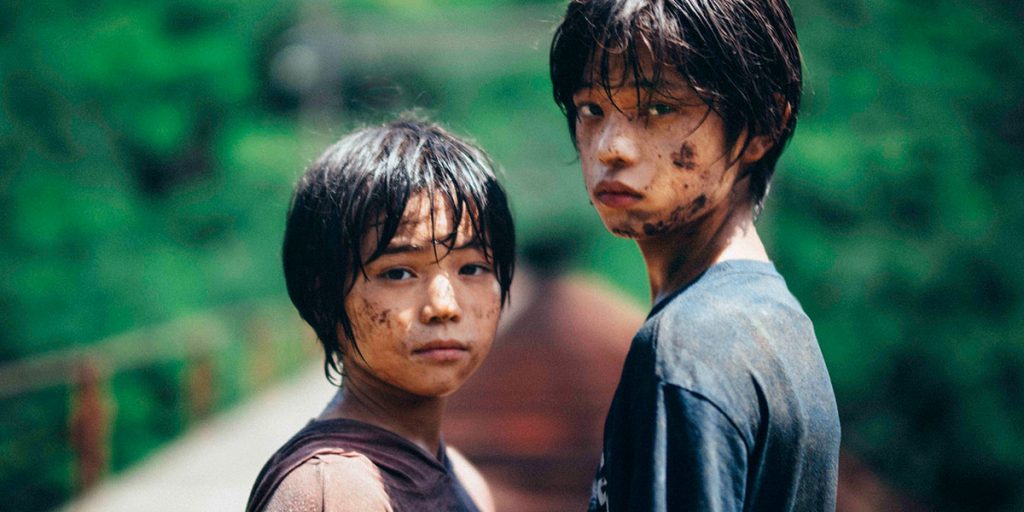
As director Kore-eda explains, the poster features the two children ‘looking our way and they’re evaluating us adults and they’re saying, “Hey you’re creating this world with monsters everywhere and that’s our world.”‘ (Fernandes) This is the political power of prosthetic memory that Landsberg describes: by literally making us experience what we’ve been missing. By witnessing the third and final act, we are able to feel the consequences of that exclusion. We carry the prosthetic memory of having participated in a world that creates monsters by refusing to see through children’s eyes.

The prosthetic memory that Monster implants in us is not just the children’s stories of what they witness, but the experiential knowledge of what we dismiss, damage, and mislabel as ‘monstrous.’ It forces us to use this movie and apply it to our own society and how we are so quick to critique others based on one perspective—but more than that, we now carry a memory of having done exactly that, of having gotten it wrong, that feels as real and uncomfortable as our own lived mistakes.

Sources

Fernandes, Marriska. “Monster’s Hirokazu Kore-Eda on the Two Entities in His Films: ‘Children and Dead People.’” Toronto Film Critics Association, 25 Sept. 2023, torontofilmcritics.com/features/monsters-hirokazu-kore-eda-on-the-two-entities-in-his-films-children-and-dead-people/.

Landsberg, Alison. Prosthetic Memory: Total Recall and Blade Runner.

Prince, Stephen. The Rashomon Effect | Current | The Criterion Collection, 6 Nov. 2012, www.criterion.com/current/posts/195-the-rashomon-effect.

Whose Land, Whose Image? Peasant Visibility in the Philippine Media Landscape

Every October, Filipino media celebrate Peasant Month by turning rice fields rich with harvests into a spectacle. Tourism to the Philippines heavily relies on natural wonders such as mountains, beaches, and, most importantly, rice fields, as attractions and must-see spectacles for the West. Yet behind these pastoral images, the real struggles of farmers, primarily landlessness, displacement, and state violence,  remain largely unseen. For context, the Philippines is the result of joint forces of colonialism, feudalism, and imperialism, and more often than not, the land we live on is either owned by these colonial forces or national figures who are infamously puppets to these higher powers. These forces have most impacted peasants, who make up over 75% of the population in the Philippines and constitute the poorest class in the nation (Canada-Philippines Solidarity Organization). Peasants include those in the agricultural sector, such as farmers and fisherfolk, and are widely regarded as the backbone of the agricultural and archipelagic country (Dela Pena). However, they have continuously struggled to reclaim this land, as they are currently only tenants of the land and farms they handle. A bigger surprise as well is that the Philippines is one of the world’s largest rice importers, importing rice from Thailand and Vietnam, rather than taking advantage of the rich agriculture internally (Lagare). Despite the efforts of peasants, they are not rewarded or aided by the government; rather, they are redtagged, refused their right to their land, and denied basic human rights (ICHRP). Therefore, I want to use the concept of media and making as a dynamic process in Tim Ingold’s book, Making, to explain how rice, and the process of making rice by peasant farmers in the Philippines, have played an active role in shaping the lives, movements, and knowledge systems of Filipinos.

Despite it being a staple in every meal, the majority of Filipino dishes are served and eaten with imported rice. Households make an effort to continue to buy these imported rice crops, even holding a stigma around locally produced rice by conspiring that the crops are combined with plastic grains, or that the taste is off or panis (spoiled). This exact perception of local grain is why our farmers are unable to sustain themselves with the cheaper rice imports and lack of attention to their livelihoods. While it may seem like a minuscule problem for those at home who are able to cook an abundance of fluffy rice easily, many overlook the cultural, historical, and economic impact rice has had on Filipinos and the country as a whole. Looking at rice through Ingold’s metaphysical framework, as a thing rather than an object, rice has been a vessel that holds other markers of Filipino culture through food and nature. Ingold adopts French philosopher Gilbert Simondon’s understanding of things being made as a dynamic process, where form and matter co-emerge (Ingold, 25). Through this framework of thinking of objects as things that we exist with and record their own process of formation (Ingold, 81), it is clear that rice has afforded Filipinos more than sustenance. I also want to refer to Ingold’s model corresponding to the person with air and kite to better explain the affordances and correspondences of rice. In my own diagram, I place rice as a central item that mediates a Filipino person (farmer or consumer) to the Filipino land and the Filipino culture. Firstly, rice has mediated the body with the land, where rice farmers directly engage with the soil, crops, and the surrounding environment. Eating the rice continues this correspondence; the grain grown by their labour becomes part of their bodies and the bodies of other Filipinos. The body, then, becomes a mirror of the landscape. However, because consumers often eat imported rice, this cycle often breaks after Filipino rice farmers produce local grain. Consumers of imported rice, therefore, lack awareness and understanding of the persistence and hard work that goes into agricultural production. 

While there is an aspect that lacks affordance in rice, it has also mediated Filipinos with their culture, as it was previously barely eaten in diets, and rather primarily used for spiritual rituals and cultural practises, as it often represents prosperity and good luck (National Nutrition Council). Every New Year’s, my family would display a large bowl of bigas, or milled rice, with coins placed on top of the rice to symbolise bringing in good luck and fortune. Besides eating it at meals, rice has evolved in Filipino culture to represent more than just a staple on the dining table. Rice has further mediated the Filipino identity through language, where there are over 10 different ways to refer to rice in Tagalog based on context and type of rice, such as palay (rice with husk), bigas (rice without the husk), and kanin (cooked rice). The word kanin can also be found at the root of the term to eat, kain. Tagalog, therefore, strengthens the relationship between rice and cultural identity, where its many versions to refer to it and the placement of rice as an origin in the term ‘to eat,’ reflect how deeply intertwined rice is with Filipino identity outside of its physical presence. Yet, in the media presenting the celebration of Peasants Month, this correspondence is often severed. Mainstream images view rice as an object, packed and ready for consumption, where the labour gone into its production is commodified and reduced to a mere spectacle and beautiful nature views. Ingold’s notion of making asks us to reject this way of thinking, offering us to follow the line of correspondences that tie rice, land, farmers, and what it means to be Filipino, and to see visibility as something made through these dynamic material relations.

Similarly to how Ingold discusses how mounds are living, shaped forms, rice paddies have long served the same purpose in the Philippines. To Ingold, the mounds we see today are ‘the cumulative by-product of all kinds of activities, carried on over long periods of time and not only by human beings.” (Ingold, 78) By continuing Simondon’s theoretical view of metaphysical ‘things,’ Ingold claims that mounds are growing and becoming earth, rather than existing on it (Ingold, 77) and are temporal in nature. Rice paddies in the Philippines especially embody this principle, as they are constantly changing due to human and non-human forces. These landforms are continually constructed and remade, and hold history and memory from each process. Ingold uses historian Mary Carruthers’ term ‘memory-work’ (Ingold, 80) to describe the traces of memory and history found at pilgrimage and event sites attributes the same characteristics to mounds. Through walking, cultivating rice, building nipa huts, and sustaining families on the land, rice fields store histories of agriculture, family, and ecology. Like the rice that is harvested from it, landscapes in the Philippines are cultivated with every gesture and care by their farmers and settlers. The lack of media visibility and acceptance for farmers’ struggles to reclaim their land resonates with Ingold’s reflection that “in the very process of trying to find things, or alternatively of trying to get rid of them, that mounds were formed.” (Ingold, 80) In the same way, Philippine rice fields are formed through many layers of cultivation and renewal; traces of lives that are continually refused and erased. Philippine landscapes become a mound of social, cultural, and historical memory, accumulating the unseen struggles of those who work the land yet remain invisible to the mainstream.

To see rice and the fields it grows in through Ingold’s framework of thinking, we can recognise that they are not merely backdrops and tourist destinations, but living gatherings of relations. Like Ingold’s mounds, rice paddies in the Philippines hold sediments of human interaction, representing and recording the past and present memories, histories that are consistently being erased by semi-feudalist and semi-imperialist powers. Bringing Ingold’s concept of making into dialogue with peasant visibility allows us to understand that visibility itself is a kind of making, since it is a growing process of attending to what has been buried, layered, or rendered unseen. To make peasants visible means engaging in the ongoing work of Ingold’s process of correspondence: to listen, to belong in, and to recognise the living mound of relations that sustains both body and nation. 

Works Cited

Canada-Philippines Solidarity Organization. “Commemorating Peasant Month.” CPSO, 20 Oct. 2023, cpso.pw/commemorating-peasant-month/. 

Dela Pena, Kurt. “When Those Who Feed the Nation Are the Poorest: Farmers, Fisherfolk in Deepest Poverty Pit | Inquirer News.” Inquirer, newsinfo.inquirer.net/1748786/when-those-who-feed-the-nation-are-the-poorest-farmers-fisherfolk-in-deepest-poverty-pit. Accessed 20 Oct. 2025. 

ICHRP Secretariat. “ICHRP Secretariat.” International Coalition for Human Rights in the Philippines, 20 Oct. 2024, ichrp.net/peasantprimer/. 

Ingold, T. (2013). Making: Anthropology, Archaeology, Art & Architecture. Routledge.

Lagare, Jordene  B. “When Those Who Feed the Nation Are the Poorest: Farmers, Fisherfolk in Deepest Poverty Pit | Inquirer News.” Inquirer, newsinfo.inquirer.net/1748786/when-those-who-feed-the-nation-are-the-poorest-farmers-fisherfolk-in-deepest-poverty-pit. Accessed 20 Oct. 2025.

The Importance of Rice to Filipinos’ Lives | National Nutrition Council (NNC), Republic of the Philippines, nnc.gov.ph/mindanao-region/the-importance-of-rice-to-filipinos-lives/. Accessed 20 Oct. 2025.

Cover image from https://philippinerevolution.nu/2023/10/21/peasant-month-commemorated/

From Material to Object: Weaving the In-Between

In Chapter 2 (The materials of life) in Making, Ingold describes the lifelike qualities of raw materials we use to create objects. He illustrates how we are accustomed to think of making as a project: we start with an idea of a goal, and with raw material to achieve it, and once we think the material has taken on intended form, we have produced an artefact. However, he argues that the entire process of making is actually one of growth, and the maker is a participant in a world of active materials. To support his position, Ingold references French philosopher Gilbert Simondon and his critique of the hylomorphic model of making. The Aristotelian word itself is a combination of Latin words hyle (matter) and morphe (form). This scheme posits each object and body as a combination of form and matter, and Simondon, through a detailed description of the creation process of a brick, argues that this model neglects a very important aspect of this process: the energy involved to transform the “formless” clay into a “finished” brick. Thus, rather than the maker imposing her designs on a world that is waiting to receive them, Ingold, supported by Simondon, argues that the maker is simply intervening in worldly processes that are already going on.

About Gilbert Simondon

Our focus is primarily extracted from the work of Gilbert Simondon of Saint-Étienne, France, born on October 2, 1924. From an early age, Simondon became interested in the act of questioning things, a habit that had transitioned into a lifelong passion for research and teaching. He had completed his secondary studies at the Lycée Fauriel in Saint-Étienne and went down the post secondary avenue of which he was most loyal to: philosophy at the École Normale Supérieure in Paris under the supervision of Martial Gueroult, a French philosopher preceding Simondon. It was during his studies in Paris when he had started expanding his palette within the sciences, exploring physics, mineralogy, and psychophysiology, and within the arts, developing interest in the cultures of literature, music, and surrealist art. Science, however, was where he found that his philosophical studies could be enlightened by the most, even branching out to obtain a degree in psychology at other institutions. After several years of teaching philosophy, psychology, languages, and 20th century literature at secondary and post secondary level, Simondon ventured back into academia to get a Master’s degree in philosophy at Sorbonne University. Simondon began studying the subject of individuation in 1952, when he reframed the individual being starting from the process of individuation rather than individuation starting from the individual.

I have chosen the notion of individuality and, for a year, I have been trying to make a reflexive theory of the criteria of individuality. (…) in fact, one must grasp the being before it has been analyzed into individual and environment: the individual-environment ensemble is not sufficient in itself; one can neither explain the individual by the environment nor the environment by the individual, and one cannot reduce one to the other. The individual and the environment are an analytical phase genetically and logically posterior to a syncretic phase constituted by the existence of a first mixture.” 

— Gilbert Simondon, January 1954 to Martial Gueroult.

https://gilbert.simondon.fr/content/biographie

Simondon on the Hylomorphic Model

Simondon’s thesis, Individuation in Light of Notions of Form and Information, invites a new perspective on remodelling frameworks in metaphysics. Rather than adhering to the hylomorphic model, which proposes that the results of making and production stem from the imposition of form onto matter, Simondon argues that products are formed through the simultaneous contraposition of form and matter (Simondon 2005, 41). Simondon believes that the preexisting model is too narrow and presupposes individuation, which itself is the process through which form and matter come into relation (Simondon 2005, 21). Therefore, Simondon argues that the hylomorphic model simplifies this complex process of making into the two innate ideas of ‘form’ imposed onto ‘matter,’ when in reality, the process of individuation is far more dynamic. More specifically, within the process of individuation, Simondon believes that form is ever emergent rather than fixed and given in advance. Therefore, Simondon argues that the hylomorphic model simplifies this complex process of making into the two innate ideas of ‘form’ imposed onto ‘matter,’ when in reality, the process of individuation is far more dynamic and grounded in information. He argues that information emerges in events, where form and matter coexist and coemerge in the process of individuation, rather than one forming the other (Simondon 2005, 36). Through shifting his perspective and rejecting the hylomorphic model, Simondon shifts his attention from being to becoming, where he explores what happens in between, rather than simply observing from the outside looking in. Through this perspective, he wants to approach organisms, objects, and even people as open, relational, incredibly dynamic things that are constantly in flux with their pre-individual fields.

How Ingold Uses the Quote

For Simondon, the creation of a brick illustrates how form emerges through interaction rather than from a predetermined design: the clay and mould converge in a “bringing together or unification of two ‘transformational half-chains’” (Ingold 2013, 25). This reflects the “first mixture”: the brick’s form emerges through the interaction of materials rather than from any pre-existing design. Simondon emphasizes that one cannot understand the individual in isolation from its environment: “one must grasp the being before it has been analyzed into individual and environment… one can neither explain the individual by the environment nor the environment by the individual”. This idea of the “first mixture” — that the individual and environment are inseparable in their formation — aligns closely with Ingold’s anthropology of making. Form emerges not from the imposition of a predetermined plan, but from the ongoing interaction between maker, materials, and environment. Making is a morphogenetic process — a dynamic flow of materials, forces, and energies in which the maker participates alongside the same forces that shape all living and nonliving things (Ingold 2013, 22). Both thinkers emphasize that materials are active participants in shaping outcomes rather than static matter. Ingold likens this idea to basket weaving, where shape arises from the interplay of willow branches, the weaver’s hands, wind, and bodily rhythm. All elements interact simultaneously from the start. Like the “first mixture,” the basket, maker, and environment emerge together, and only later can we consider the basket as a separate object or the maker as an individual agent. The maker follows the materials’ tendencies, contributing through movement, rhythm, and responsiveness. As Ingold notes, “in the field of forces, the form emerges as a more or less transitory equilibration” (Ingold 2013, 25), concluding, “perhaps bricks are not so different from baskets after all.” For Ingold, making is a longitudinal process, following materials as they grow and transform over time. The final form doesn’t exist independently of the materials or maker. Form arises through the continuous interaction of people, materials, and environment — a dynamic process in which individuals and their environments shape each other, reflecting Simondon’s insight.

Relevance to course

In our attached activity, we were able to roughly recreate Ingold’s students’ basket weaving experience through weaving yarn through handmade cardboard looms. We followed a tutorial on Instagram and immersed ourselves within the environment and process of tangibly making an object. We followed many of the same lessons Ingold described that his students did. Though we initially struggled with the set-up of our raw materials, the exceptionally separate pieces of yarn melded together naturally through the slow process of weaving and tightening – displaying the surprisingly recalcitrant properties of the material. We also ran into the problem of not knowing when to stop: despite the physical limitations of our loom, you could always tighten the previous stitches and make room for another row. Our deciding factor ended up being a lack of time, creating differences in our “finished” products. Throughout the making and reflection process, we discovered direct links between our activity, Ingold’s theories, and the critical term of body as defined by Wegenstein. Through expressing our learning in the tactile process of making an object with our hands, we were able to ground ourselves in nature and media creation more immersively than simply reading about it. By feeling the texture of the yarn and practicing the specific movements, we were able to connect our bodies to the bodies of the materials. Despite following the same tutorial, each of our final works depicted our own self-expression, and we were able to absorb knowledge through the medium of our body and learn from Ingold’s teaching through the experience of embodiment.

Citations:

Ingold, T. (2013). Making: Anthropology, Archaeology, Art & Architecture. Routledge.

Mitchell, W. J. T., & Hansen, M. B. N. (Eds.). (2010). Critical Terms for Media Studies. University of Chicago Press. 

Simondon, G. (2020). Individuation in Light of Notions of Form and Information (T. Adkins, Trans.). University of Minnesota Press.  (Original work published 1964)

Simondon, G. (2012, December 8). Form & Matter: Gilbert Simondon’s critique of the hylomorphic scheme (Part 1). The Funambulist Magazine. Retrieved from https://thefunambulist.net/editorials/philosophy-form-matter-gilbert-simondons-critique-of-the-hylomorphic-scheme-part-1

Wegenstein, B. (2010). Body. In W. J. T. Mitchell & M. B. N. Hansen (Eds.), Critical Terms for Media Studies (pp. 19–34). University of Chicago Press.

Ela, Lorainne, Dea, Victoria

Making in the Eco Chamber

“Those who buy only one book, read only that one and then get rid of it. They simply apply the consumer mentality to books, that is, they consider them a consumer product, a good. Those who love books know that a book is anything but a commodity.”

― Umberto Eco

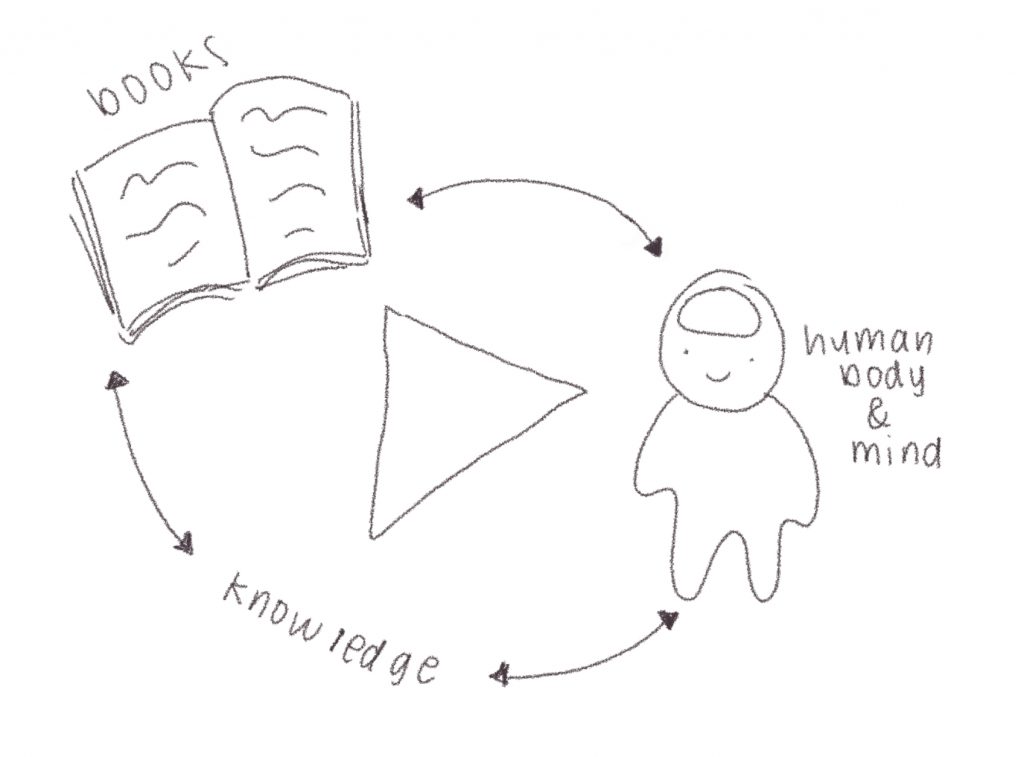
Umberto Eco: A Library of the World is a documentary that delves into Italian literary critic and semiotician Umberto Eco’s life and his personal library, which houses over 30,000 volumes of novels and 1,500 rare and ancient books. Director Davide Ferrario discusses with Eco, conducts interviews with his family and friends, and retrieves archival footage of Eco to beautifully encapsulate Eco’s life through his love and passion for books and the exploration of the truth. The 80-minute film presents Eco’s library as a living archive that mediates the relationship between media and memory, providing insights into how media shapes thought, culture, and history. Expanding to the scope of this course, the film explores the importance of the distinction between material and digital media, semiotics, and the body. I will connect these concepts to Tim Ingold’s novel Making, specifically, with Ingold’s claim that media as living matter and his distinction between ‘objects’ versus ‘things’. I argue that Eco’s approach to media and memory through books parallels Ingold’s concept of making as a continuous process between the conscious and material world.

The film’s themes of media and material knowledge emerge most vividly through Eco’s private library, which serves as both a physical living archive and a conceptual framework for understanding his worldview. The library, which is a growing personal collection of Eco’s books, then becomes a symbol of a living system of knowledge, rather than a static collection of objects. The film strengthens this idea by presenting Eco’s notion of vegetal memory, which mediates memory and knowledge through paper and books. Eco claims, in his paper on vegetal memory, that libraries are ‘the most important way of keeping our collective wisdom’ (Eco, 1). For him, books and their mass presence through the space of a library become a physical thing that mediates memory, linking memory to material forms. This idea parallels Ingold’s argument that material form is flowing, not fixed. He claims that the material world and human thought are mediated through correspondences, where the flow of materials and the flow of consciousness are intertwined, where making becomes a process of mediation (Ingold, 21). For Eco, making comes in the form of curating books for his personal archive, where he engages thought and memory with the physicality of books. Ingold proposes that making is an embodied interaction that occurs before and during meaning is made (Ingold, 96). Eco mirrors Ingold’s claims as he physically turns the page of each book, engaging with it at every turn. Beyond completing the reading, he continues to engage with the material by keeping a collection of books. Here, the meaning of books changes before, during, and after the activity of reading the actual contents of the object. With embodied interaction with its material, as Eco refuses to put on gloves to preserve its material, rather letting it decay, breathe, and live in its environment, the books transform from a commodity to a physical vessel of memory and knowledge.

To further explore the library as a metaphor for collective knowledge, Eco’s fascination with semiotics exhibits many parallels with Ingold’s distinction between objects and things and their affordances. Eco connects semiotics, the study of signs as a means of meaning-making, back to vegetal memory, where every book is a sign whose contents reference other signs and histories. Through these signs and the curation of other signs through books, humans can form frameworks to understand the world. Because of this, Eco’s library transforms into a semiotic system that not only houses these vessels of signs and knowledge but also creates a network that connects books through categories and cross-referencing. Furthermore, Ingold’s interpretation of seeing things as things, rather than as objects, is extremely relevant in exploring how Eco engages with books through a semiotic lens.

Ingold quotes philosopher Martin Heidegger’s claim that objects are complete in themselves, where correspondence does not occur because it does not interact with the world and its surroundings (Ingold, 85). On the other hand, Ingold claims that things are with us as opposed to objects being against us. Things can be experienced in a way that corresponds with their surroundings, rather than merely witnessing or existing alongside an object. A thing is a dynamic gathering of material matter that engages with other things, such as people or the environment (Ingold, 85). Ingold concludes his claim by stating that things exist and persist because they leak, where materials interact with each other physically across the different surfaces they encounter. Through these types of leakages and interactions, things can be living and dynamic and possess a sort of bodily agency that can die, decay, or transform over time (Ingold, 95). With this distinction between ‘objects’ and ‘things,’ it is clear that Eco’s books are not static or to be read and stored once completed. Rather, his consciousness corresponds with the book’s materiality, and even goes beyond his personal interpretations of his texts when he connects different texts and shares his understanding with the public. As mentioned in the quote at the start of this post, Eco’s passion for books goes beyond viewing them as a mere object or commodity; rather, it affords him knowledge and understanding of the world around him. Through this ongoing dialogue between mind and material, Eco transforms reading into a living practise, one that blurs the boundaries between individual memory and the collective intelligence stored within his library.

Ultimately, Umberto Eco: A Library of the World reveals that knowledge is never static but is continually made and remade through our material and intellectual engagements with media. Through the lens that books are dynamic ‘things’ rather than ‘objects,’ the film presents Eco’s books as a living, constantly growing system of knowledge. A point in the film that struck me the most was the intimate moments of Eco physically interacting with his books. Sensory actions such as touching the covers or each page, smelling the books, or rearranging books in categories became systems and processes of thinking. This reminded me that reading is not just an intellectual activity, but also a tactile and relational practise. Reflecting on our course discussions, I found parallels with the Critical Terms chapter I read for my presentation, “Writing,” where theorist Andre Leroy-Gourhan emphasises graphism in writing. Specifically, how literacy is not only used as a means of communication but as a tool that links mind, body, and material. The film offers a powerful reminder that media are not passive containers of knowledge but active participants in the making of knowledge itself.

Works Cited

​​Eco, Umberto. (2022). Umberto Eco: A Library of the World [Film]. Directed by Davide Ferrario.

Eco, Umberto. “Vegetal and Mineral Memory: The Future of Books.” Academia.Edu, 21 June 2015, www.academia.edu/13152692/Vegetal_and_Mineral_Memory_The_Future_of_Books_by_Umberto_Eco. 

Ingold, Tim. Making: Anthropology, Archaeology, Art and Architecture. Routledge, 2013.

Cover image from The Belcourt Theatre

Umberto Eco’s Books As Told Through Film

Davide Ferrario’s Umberto Eco: A Library of the World documents the life of Italian philosopher, semiotician, and novelist Umberto Eco through his private library, where he explores themes of media and memory, truth and fiction, and information and knowledge, using the library to represent pillars of human memory and knowledge.

Upon rewatching the documentary and doing extra research outside the documentary, this was an insightful film that connected to the course’s broader themes of media as mediators of perception and knowledge through semiotics and material media. Eco’s library is ultimately a lived example of the abstract practices of media theory and embodies how physical media shapes epistemology.

The film first introduced Eco’s library as a living archive of knowledge, a pillar that is paramount to what Eco describes as vegetal memory, referring to physical, memory on paper from trees. He emphasises that the conservation of material media, such as the books in his private library, sustains vegetal memory, and that this type of media that rots, decays, and changes over time makes written knowledge a material body. He uses vegetal memory as a metaphor for the tangiblity of the relationship between nature and human culture as mediated through books and literature. This exactly is what prompted Eco to start his huge archive of books that continues to grow and change over time. In the film, Eco says, “When we say ‘I’ we mean our memories,” to emphasise how tethered the body and self is to memory, and he uses his library as both a symbol and living embodiment of human’s universal memory, turning his library into ann intellectual map of the world through written texts.

Through his library, Eco also explores themes of truth and fiction. Eco collects scholarly articles and rare, antique novels for his library, but he was also keen on collecting fiction books and raunchy novels. For him, fiction was a way to organize truths. When facts and statistics can appear abstract, narratives in fictional pieces offer a new path to the truth, a new framework of understanding the world around us. This was a philosophy Eco stood by for a long time throughout his long-standing, arguably obsessive pursuit on truths and untruths, where he also strongly believed in semiotics and meaning coming from symbols, indexes, and signals. He claims that fictional texts with stories and narrative elements are ‘open books’ that encode cultural truths that facts and analysis often cannot reveal. This is because ‘open books’ allow for reader interpretation beyond authorial intent. In Eco’s library these two types of texts coexisted without any hierarchy, rather as a single intellectual ecosystem. The film itself also balances between elements of fiction and truth, going back and forth between archival footage and real interviews with dramatic readings of Eco’s essays from actors to present how both ways of presenting information is true and equal.

Lastly, the film discusses how Eco’s archive translates to the digital world, where his texts are translated and digitized into moving images. The film captures Eco’s ambivalence on this topic, especially on the topic of cellphones as a means of communication. He often criticized people who use their cellphone as a status symbol and “flaunt their private lives in the presence of all,” claiming they are exhibitionists rather than individuals seeking genuine connection and communication through their phones. He further claims that the world is becoming increasingly flooded with messages that say nothing, and that this information overload can damage knowledge. Tying back to the first theme, he also claims that the contemporary digital era is hurting the ability to preserve one’s organic brain and vegetal memory. 

Eco’s claims on digital communication are especially relevant to today, where access to information is incredibly convenient and instant. While this access is instant and convenient, it often is engaged with superficially and at a shallow level, where no discourse, discussion, or further reflection is ever really initiated. It is easy for students especially to stay in the constant comfort of digital instant messaging, where we end up neglecting physical means of gaining and retaining knowledge. However, film masterfully emphasises Eco’s passion for how the physicality of books mediates meaning differently from digital media and how it sustains vegetal memory through different genres of written work.

This film also ties back to the discussion of material media as important devices in corresponding the human body to knowledge of our environment. This reminds me a lot of the evocative objects we read about and discussed in class and Ingold’s Making. Rather than objects, they are now regarded as things because of our personal interpretation and mediation of the object. The meaning of a thing has transformed and evolved with us, and has afforded our bodies different things. For Eco, the physicality of books have transformed from objects to things, and has afforded him a personal living archive, where it maps memory and knowledge through material media that he engages with daily, not only in individual books, but in his created third-space of his private library.

The film additionally allows for a reflection through the digital moving image format as it tries to mediate Eco’s tactile, material world of books through the implementation of different sections and archival material. It also strengthens Eco’s passion for semiotics, where the form of film itself is semiotic and constantly reminds the viewers that meaning is constructed and ever-evolving, rather than constant. Again, the film’s back and forth between the realism of the documentary genre through archival footage and interviews and the poetic retelling of Eco’s essays further blurs the line between truth and fiction to emphasise how they are interdependent. While documentaries are conventionally associated with nonfiction and truth, this film’s adaptation of Eco’s material world into a digital medium remains an act of interpretation. Sort of like an open film, in which my own reflections and responses now become part of its meaning.

Works Referenced

Eco, Umberto. (2022). Umberto Eco: A Library of the World [Film]. Directed by Davide Ferrario.

Garner, Dwight. “Umberto Eco, Not a Cellphone Exhibitionist.” The New York Times, The New York Times, 6 Nov. 2007, archive.nytimes.com/artsbeat.blogs.nytimes.com/2007/11/06/umberto-eco-not-a-cell-phone-exhibitionist/#:~:text=The%20thousands%20of%20people%20we,in%20the%20presence%20of%20all.

The Hydrated Self: Care, Commodity, and Embodiment

My chosen object for this assignment is a water bottle. More specifically, it’s my large, 40-ounce insulated water bottle that I carry with me everywhere. I have always had these types of containers with me from middle school until now, and have only since retired one of them after it physically could not hold any more liquid. I noticed that I would finish at least 3 full containers of water daily – that’s over 3 litres of water a day. I found that I would sip on water when I have nothing to do, when I’m anxious and want a break, or, of course, when I feel tired and dehydrated. If I forget my bottle at home, sometimes I struggle to focus. Water and hydration was a constant thing I sought after, and my water bottle helped keep it by me at all times. Funnily enough, I would sleep with my water bottle by my side when I was younger, needing access to water as conveniently as possible at night. Ultimately, my water bottle is more than just a vessel for water. It is an object I interact with daily that affords me comfort and mediates the body with the rest of the environment through routine care. 

Similar to Marx’s table, my water bottle is an object that goes beyond materiality and the commodification of objects. Rather, it is a vessel for meaning and embodying the relationships with the self and the world around us. My personal interaction with my bottle is apparent through its appearance, with dents and scratches to reflect movement through space and time, and stickers that tell stories of who I am as an individual. The clear wear and tear of my bottle highlights how present the object has been in my lifestyle. The instances in which I use my water bottle the most emphasise how it has become a personal symbol of comfort and care, rather than a fetishised commodity. However, it is easy for capitalism to take over especially when consumer culture is as prevalent as ever and the idea of an ‘emotional support water bottle’ has become commodified, where brands such as Stanley or Owala have capitalised on lifestyle trends. Philosopher Jean Baudrillard best reflects this idea when describing a commodities’ ability to foster the desire that drives capitalism, ultimately making ideology invisible. Through this lens, a mass-produced, branded water bottle can easily disappear in the background of consumerism as just another everyday gadget. However, my bottle, with its scratches, dents, and stickers,  becomes Baudrillard’s wooden radio and resists object invisibility. It instead makes visible how objects can cease to be a fetishised commodity, and instead a personal archive of lived experiences and embodied routines.

Alongside its ability to reject fetishised commodification, my water bottle has mediated my embodiment and care for the self and body. Bernadette Wegenstein’s chapter on the body describes the body as the primordial medium, where experience is produced. My water bottle makes this concept visible. While consumer culture commercialises the need to stay hydrated, my bottle affords me more than functional utility; it mediates the act of pausing, routine, and caring for my body throughout the day. Taking a break to drink water amidst a transient lifestyle helps me reconnect with my body, framing hydration as a lived experience. Especially in contemporary life, Wegenstein claims the idea of ‘multiple selves’ where the digital age has fragmented the body and the self. The act of pausing, staying grounded, and keeping a routine through hydration and the constant of a water bottle with me mediates the idea of a single embodiment. It allows the self to return to being present and bodily care in a culture of distraction. In a way, the bottle rejects the idea of disembodiment, forcing awareness and mediation of Maurice Merleau-Ponty’s concept of the ‘flesh,’ where he claims that flesh is the bridge between the body and the world. Drinking water is not just a functional act but an embodied one. The taste and smell of the water and metal container, the sensation of swallowing, carrying the bottle, hearing the water move around the bottle. These tactile, sensory moments highlight how the body and the object are intertwined. It is through this entanglement that my water bottle evolves beyond being an object. It also mediates embodiment, highlighting how self-care is shaped through everyday practices of routine, identitiy, and relationality.

Ultimately, what first appears to be an everyday commodity can be transformed to mediate the self through personal sentiments and lived experiences. While there is no doubt that ideologies of capitalism and consumerism are present in branding and current online trends that turn insulated water bottles into a fad, my personal water bottle brings these once ‘invisible’ concepts in contemporary life to the forefront. In doing so, materiality is rejected, becoming instead a unique object that serves as a record of lived practises and routines.

Works Cited

Turkle, Sherry. “WHAT MAKES AN OBJECT EVOCATIVE? .” pp. 307–326.Wegenstein, Bernadette. “Body.” Critical Terms for Media Studies, pp. 19–34.

Writing Is Infrastructure: From Clay Tablets to Code

What would our world look like without writing? From establishing communities to the endless scrolls of texts on our phones, it is easy to overlook that writing has an insurmountable presence in our everyday lives. Media theorist Lydia H. Liu’s chapter, Writing, reminds us that writing is more than a writing tool for recording speech. It is a material technology and symbolic system, tracing its influence from the rise of civilisations to the digital age. In her discussion, Liu poses six central questions: the origins of writing, its role in governance, the relationship between scripts and systems, its evolution across different media, writing as a visual representation of speech, and its place in the digital age, to highlight how writing expands beyond being a tool for speech. The chapter ultimately demonstrates how deeply writing is intertwined with power, communication, and human imagination.

Origins of writing

Liu first focuses on the discourse on the ‘origins’ of writing to explain the first influences of writing in social systems and innovation. The first traces of scripts were found to have been invented separately in four different parts of the world, where each was characterised by urbanisation, division of labour, and a surplus economy. It is clear that writing was not just a product of culture, but also a practical innovation that emerged out of increasingly complex societies.

Each script is tied to material media (such as clay tablets, petroglyphs, and papyrus), highlighting how writing is also deeply technological and evolving alongside infrastructures of communication. Before these early scriptures, however, emerged semasiographs, or the use of iconic signs as a means of writing and communication. These forms of communication were first disregarded as writing by German linguist Florian Coulmas, who argued that all forms of graphic meaning, such as visual movement, syntax-like patterns, or rhythm, were not considered as being tied to writing. However, this classification evolved through the widespread use of the rebus principle, where a picture can be used to represent the sound of its name, rather than the object itself, marking a conceptual progression to non-language instances of illustration as writing. The chapter thus argues that there is no exact origin point of writing.

However, it is clear through early scripture that writing has evolved out of broader conditions of labour and communication. French archaeologist Andrè Leroi-Gourhan’s palaeontology of writing best supports Liu’s argument. In Gesture and Speech, Leroi-Gourhan studies early human ancestors to understand how their behaviour may relate to language. Here, he emphasises the neurological connection that the same parts of the brain are involved in tactile activities and using tools and also in the face and language. He uses the term ‘graphism’ to highlight this tactile, non-verbal form of communication to conclude that tool-making and language evolve alongside each other within human social life, where gesture and speech are intertwined, rather than being mutually exclusive.  

Writing in Governance

Connecting to Liu’s previous argument, it is clear that the early development of writing enabled new forms of organisation beyond oral traditions, easily seen as a symbol of knowledge and power across civilisations. Even early forms of storytelling prove that early civilisations understood the significance of writing through myths, legends and religion. Stories would characterise it as a ‘magical power,’ which later came to fruition as those who were literate and had access to writing held a monopoly on religious and political power in the form of Priests of the church. With this power, writing often allowed for the creation of new spatial and temporal configurations, as empires could easily sustain large colonies across far distances through written communication. This type of mass media production, as mentioned previously also in Chapter 18, ‘Mass Media’, can be seen in the monarchies of Egypt, Persia, and the Roman Empire. China’s first emperor, Qin Shi Huang of the Qin Dynasty, first proclaimed power through writing and scripture, where he imposed a standard script, orthography, and bureaucratic procedures for centralised rule. This started China’s long imperial history, and clearly would not have been possible if standard written script systems had not supported imperial rulers. 

Writing & Mathematics 

The development of ancient writing had strong early ties to predate methods for accurate tracking of numerical notation and record keeping, including weights, measures, and currency. Within the means of predated numerical notation, the earliest recorded transactions, dating back thousands of years, used pebbles, tallies, tokens, and clay containers or “bullae” — used in ancient Mesopotamia to show the marks of sealings indicating ownership to anything that was attached to it. In turn, this has led theorists to consider mathematics as the earliest precursor to writing. 

Though the consensus remains that writing has gone from pictographic to syllabic, and then to phoneticization, there remains the possibility that writing systems may have come from more semiotic scenarios rather than solely to record human speech. The etymology of the Phoenician word “spr” traces back to the English word “scribe.” The early meaning of the Phoenician word meant “to count”, but only later did it adopt the meaning of “to write.” The mutual ancestry between these words suggests that the alphabet and alphanumerical systems were the same. The ancient Greeks’  alphabet was already made up on the foundation of mathematics with its 24-letter system plus 3 alphanumeric signs of “digamma, koppi, and sampi” as well. 

The Global Evolution of Writing

Throughout time, the concept of writing has undergone extraordinarily vast changes from what we knew of it then to now: going back from using natural materials such as bronze, shells, or papyrus to the invention of print or electronic chips. Examining the global evolution of writing can be divided into the various empires throughout history. For instance, Ancient Egypt’s hieroglyphs were chiselled decoratively onto stone monuments, whereas writing on papyrus allowed for cursive of hieratic forms for quicker writing — the latter writing medium causing a large change in manuscript culture that shifted the forms of political organisation in history. The Roman Empire’s tradition of using papyrus “supported an emphasis on centralised bureaucratic administration,” whereas parchment in medieval Europe “helped give the church a monopoly of knowledge through monasticism,” according to Harold A. Innis. 

In Ancient China, the spread of Buddhism in the nation also prompted the invention of woodblock printing in the eighth century, where the mass production of printed books assisted in global socioeconomic transformation. Around the eleventh century, movable type was invented, a technology adopted in the printing of the earliest paper currency, which was used to hold control over the early economy in Asia as a whole. Over in Europe, around the fourteenth century, block printing and paper manufacturing came about as a result of the Mongol Empire’s westward expansion. This breakthrough translated into a rise in universal literacy, newspapers, advertising, and new forms of politics. 

Marshall McLuhan had observed the grand impact of printing on life in Europe and beyond, writing in the Gutenberg Galaxy, “the invention of typography confirmed and extended the new visual stress of applied knowledge, providing the first uniformly repeatable commodity, the first assembly line, and the first mass-production.” Thus, writing, in a sense, was the catalyst for all industrial practices to come after it, from its process of repetition to create a product for mass distribution.

Counting, notation, procedure: the road to algorithms

A second origin runs through numbers. Place-value numerals and operator symbols compress messy realities into portable strings. That compression invites procedures, do-this-then-that recipes someone else can repeat. In Liu’s telling, counting and inscribing were never far apart; even the word histories of “scribe” and “to count” cross. The point isn’t romantic; it’s practical: notation is writing tuned for calculation, a crucial bridge from tablets to code.

Materials change the message: paper, print, silicon

Writing’s substrates, bone, clay, papyrus, parchment, paper, type, and chips, aren’t background scenery. They reset speed, cost, and sameness, and with them, institutions. Paper and printing (in different historical paths) widened access; movable type accelerated repeatable precision and the rise of news, advertising, and mass politics. In the digital turn, text becomes addressable strings: searchable, sortable, and automatable, governed by file schemas, encodings, and protocols rather than just by clerks and courts.

Code is written—with machine readers

Alphabets loosely map signs to sounds; code maps signs to exact machine actions. In digital systems, a letter like “A” is an encoded value that can be copied without drift, checked for error, and executed in logic. Liu shows how modern information theory recasts “writing” as a statistical alphabet (including “space”) that machines can transmit and transform. Once marks are standardised for machines, the politics of writing shifts toward standards and interfaces, which set the fields, defaults, and labels that shape what’s sayable and searchable.

Tensions & connections (what ties the theories together) 

Speech-first vs. writing’s autonomy. A familiar hierarchy puts speech above writing. Our line, following Liu, flips the emphasis: writing has its own powers, coordination, inscription, calculability, that don’t depend on sounding like talk. This helps explain why ledgers, forms, and code can rearrange life without saying a word aloud.

Meaning vs. transmission. Engineering models treat writing as signals under noise, so messages travel reliably. That’s perfect for networks but thin on meaning; the trade-off is that standards (encodings, protocols, moderation rules) become the new chokepoints. The connection: what keeps symbols moving also decides which symbols move.

Media materials vs. institutions. Tools and substrates (brush, type, chip) shape what can be stored and processed; institutions harden around those capacities (schools, archives, platforms). This links McLuhan/Kittler-style media arguments to Liu’s core claim: writing is a world-building technology, not a transparent mirror.

Why this matters now

Change the format and you change the world: a new field on a platform form, a new label in a database, a tweak to an encoding, all are tiny acts of infrastructural authorship that decide what appears, what counts, and who gets heard. That’s writing’s power, from clay to code.

Summary: 

  • No single origin. Writing didn’t just copy speech; it stabilised agreements and memories so complex societies could form.
  • Power needs paperwork. Standard scripts and formats make populations legible—and governable.
  • Notation –  procedure – algorithms. Compression invites repeatable methods; that’s the seed of software.
  • Media matters. Substrate shifts (paper, print, silicon) rewire institutions and publics.
  • Code extends writing. Machine-readable marks turn literacy into a fight over standards, schemas, and interfaces.