

“Those who buy only one book, read only that one and then get rid of it. They simply apply the consumer mentality to books, that is, they consider them a consumer product, a good. Those who love books know that a book is anything but a commodity.”
― Umberto Eco
Umberto Eco: A Library of the World is a documentary that delves into Italian literary critic and semiotician Umberto Eco’s life and his personal library, which houses over 30,000 volumes of novels and 1,500 rare and ancient books. Director Davide Ferrario discusses with Eco, conducts interviews with his family and friends, and retrieves archival footage of Eco to beautifully encapsulate Eco’s life through his love and passion for books and the exploration of the truth. The 80-minute film presents Eco’s library as a living archive that mediates the relationship between media and memory, providing insights into how media shapes thought, culture, and history. Expanding to the scope of this course, the film explores the importance of the distinction between material and digital media, semiotics, and the body. I will connect these concepts to Tim Ingold’s novel Making, specifically, with Ingold’s claim that media as living matter and his distinction between ‘objects’ versus ‘things’. I argue that Eco’s approach to media and memory through books parallels Ingold’s concept of making as a continuous process between the conscious and material world.
The film’s themes of media and material knowledge emerge most vividly through Eco’s private library, which serves as both a physical living archive and a conceptual framework for understanding his worldview. The library, which is a growing personal collection of Eco’s books, then becomes a symbol of a living system of knowledge, rather than a static collection of objects. The film strengthens this idea by presenting Eco’s notion of vegetal memory, which mediates memory and knowledge through paper and books. Eco claims, in his paper on vegetal memory, that libraries are ‘the most important way of keeping our collective wisdom’ (Eco, 1). For him, books and their mass presence through the space of a library become a physical thing that mediates memory, linking memory to material forms. This idea parallels Ingold’s argument that material form is flowing, not fixed. He claims that the material world and human thought are mediated through correspondences, where the flow of materials and the flow of consciousness are intertwined, where making becomes a process of mediation (Ingold, 21). For Eco, making comes in the form of curating books for his personal archive, where he engages thought and memory with the physicality of books. Ingold proposes that making is an embodied interaction that occurs before and during meaning is made (Ingold, 96). Eco mirrors Ingold’s claims as he physically turns the page of each book, engaging with it at every turn. Beyond completing the reading, he continues to engage with the material by keeping a collection of books. Here, the meaning of books changes before, during, and after the activity of reading the actual contents of the object. With embodied interaction with its material, as Eco refuses to put on gloves to preserve its material, rather letting it decay, breathe, and live in its environment, the books transform from a commodity to a physical vessel of memory and knowledge.
To further explore the library as a metaphor for collective knowledge, Eco’s fascination with semiotics exhibits many parallels with Ingold’s distinction between objects and things and their affordances. Eco connects semiotics, the study of signs as a means of meaning-making, back to vegetal memory, where every book is a sign whose contents reference other signs and histories. Through these signs and the curation of other signs through books, humans can form frameworks to understand the world. Because of this, Eco’s library transforms into a semiotic system that not only houses these vessels of signs and knowledge but also creates a network that connects books through categories and cross-referencing. Furthermore, Ingold’s interpretation of seeing things as things, rather than as objects, is extremely relevant in exploring how Eco engages with books through a semiotic lens.
Ingold quotes philosopher Martin Heidegger’s claim that objects are complete in themselves, where correspondence does not occur because it does not interact with the world and its surroundings (Ingold, 85). On the other hand, Ingold claims that things are with us as opposed to objects being against us. Things can be experienced in a way that corresponds with their surroundings, rather than merely witnessing or existing alongside an object. A thing is a dynamic gathering of material matter that engages with other things, such as people or the environment (Ingold, 85). Ingold concludes his claim by stating that things exist and persist because they leak, where materials interact with each other physically across the different surfaces they encounter. Through these types of leakages and interactions, things can be living and dynamic and possess a sort of bodily agency that can die, decay, or transform over time (Ingold, 95). With this distinction between ‘objects’ and ‘things,’ it is clear that Eco’s books are not static or to be read and stored once completed. Rather, his consciousness corresponds with the book’s materiality, and even goes beyond his personal interpretations of his texts when he connects different texts and shares his understanding with the public. As mentioned in the quote at the start of this post, Eco’s passion for books goes beyond viewing them as a mere object or commodity; rather, it affords him knowledge and understanding of the world around him. Through this ongoing dialogue between mind and material, Eco transforms reading into a living practise, one that blurs the boundaries between individual memory and the collective intelligence stored within his library.
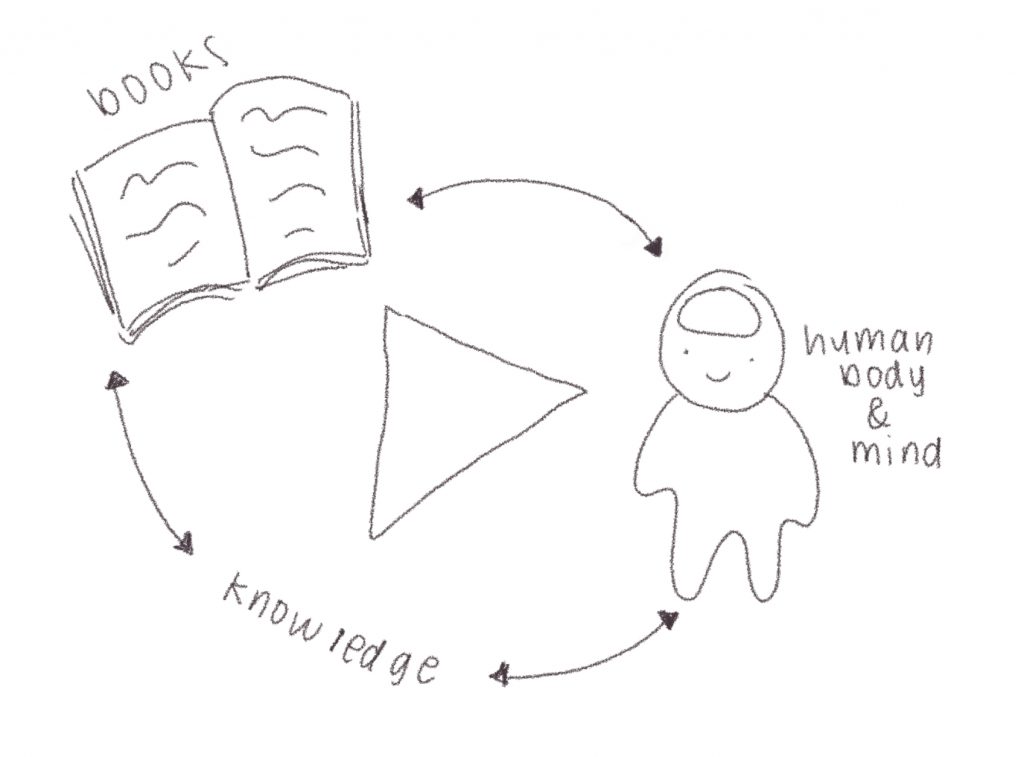
Ultimately, Umberto Eco: A Library of the World reveals that knowledge is never static but is continually made and remade through our material and intellectual engagements with media. Through the lens that books are dynamic ‘things’ rather than ‘objects,’ the film presents Eco’s books as a living, constantly growing system of knowledge. A point in the film that struck me the most was the intimate moments of Eco physically interacting with his books. Sensory actions such as touching the covers or each page, smelling the books, or rearranging books in categories became systems and processes of thinking. This reminded me that reading is not just an intellectual activity, but also a tactile and relational practise. Reflecting on our course discussions, I found parallels with the Critical Terms chapter I read for my presentation, “Writing,” where theorist Andre Leroy-Gourhan emphasises graphism in writing. Specifically, how literacy is not only used as a means of communication but as a tool that links mind, body, and material. The film offers a powerful reminder that media are not passive containers of knowledge but active participants in the making of knowledge itself.
Works Cited
Eco, Umberto. (2022). Umberto Eco: A Library of the World [Film]. Directed by Davide Ferrario.
Eco, Umberto. “Vegetal and Mineral Memory: The Future of Books.” Academia.Edu, 21 June 2015, www.academia.edu/13152692/Vegetal_and_Mineral_Memory_The_Future_of_Books_by_Umberto_Eco.
Ingold, Tim. Making: Anthropology, Archaeology, Art and Architecture. Routledge, 2013.
Cover image from The Belcourt Theatre