Category Archives: Assessment

Self- and Peer-Assessment in BC: Reflection as Learning

Austin’s Butterfly reminds us of the transformational power of descriptive feedback and how even young learners can provide effective peer-feedback.

In the BC Curriculum, assessment helps students understand where they are, where they are going, and what they might try next. This aligns closely with the Know–Do–Understand model, where assessment is connected to Big Ideas, Curricular Competencies, and Core Competencies rather than treated as an isolated end-point task focused mainly on content.

Self- and peer-assessment invite students to notice, name, and nurture their learning. BC’s K–12 Student Reporting Policy requires student self-reflection on Core Competencies and student goal setting as part of reporting; it also emphasizes descriptive feedback that identifies strengths and areas for growth. In practice, this means reflection should not be a one-time report-card activity. It should be embedded throughout inquiry, play, discussion, design, writing, problem-solving, and performance tasks.

Research supports this formative approach. Dr. Andrade’s review of student self-assessment argues that self-assessment is most useful when it generates feedback students can use to improve work and deepen learning. A 2022 meta-analysis also found that self-assessment and peer-assessment interventions had meaningful positive effects on academic performance across studies. This suggests that students need clear criteria, accessible language, examples of quality work, time to revise, and opportunities to review and select evidence of growth. Performance Assessment and Portfolio Assessment (digital or analogue) are two approaches that align well in BC contexts.

Below are some resources to support an exploration or self- and peer-assessment including links to some videos and examples from teachers.

View

Dr. Heidi Andrade reflects on self- and peer-assessment. Dr. Andrade shares some of the key components of self- and peer assessment and recognizes the need to teach students how to assess themselves and their peers in order to cultivate a culture of critique:

or listen to Dylan Wiliam review the benefits of self assessment and peer assessment as key components of effective learning, and hear about some of the associated strategies.

Peer assessment from the perspective of students and teachers:

Read

Connecting with Core Competencies: The BC Core Competencies are central to K–12 learning, and students are expected to grow in Communication, Thinking, and Personal and Social competencies through meaningful “doing” across subject areas. Self-assessment is a key component of core competency development. See the BC Ministry resource, Developing and Supporting Student Reflection and Self-assessment and the example shared on TeachBC, the BCTF open resource repository: Core Competencies Self-Assessment K-1

The responsiveclassroom.org offers some suggestions for how we might teach students to self-assess (PDF) effectively as well as some detailed prompts and approaches to engaging students in reflection. See their PDF, Self-assessment and Goal Setting go hand-in-hand.

Examples

Classroom examples (generated with assistance from ChatGPT)

  • Primary classrooms (see POPEY for primary related assessment resources)
    • Picture-based Core Competency reflection: “I listened,” “I tried a new idea,” “I helped someone.”
    • Partner share using sentence frames: “I noticed…” and “Next time you could…”
    • Learning story portfolio entry with a photo, teacher scribing, and student voice.
    • Play-based self-assessment after centres: “What did I build, solve, share, or wonder?”
  • Intermediate classrooms
    • Co-created “I can” criteria for an inquiry, writing, or ADST design task.
    • Two stars and a wish peer feedback before final submission.
    • Gallery walk with sticky-note feedback linked to Communication or Thinking competencies.
    • Portfolio reflection: “My evidence shows growth because…”
  • Middle years classrooms
    • Peer feedback protocol for drafts: clarify, value, question, suggest.
    • Group collaboration reflection using roles, evidence, and next-step goals.
    • Student-led conference artifact selection: one strength, one challenge, one goal.
    • Proficiency-scale reflection connected to a curricular competency and a Core Competency.
  • High school classrooms
    • Peer review of essays, labs, performances, or design projects using discipline-specific criteria.
    • Seminar self-assessment on listening, evidence use, questioning, and respectful disagreement.
    • Capstone or portfolio reflection connecting course evidence to student growth and Core Competencies.
    • Post-assessment goal setting: “What feedback will I act on before the next task?”

The key is to make assessment dialogic rather than merely evaluative. Students should not simply rate themselves; they should learn how to interpret criteria, compare evidence, give respectful feedback, revise work, and set purposeful goals. Engaging students in ongoing dialogues about learning offers important modeling in support of creating a classroom culture that is safe and welcomes constructive feedback. Digital portfolios, student-led conferences, performance tasks, and reflective prompts are all strong BC-aligned ways to make learning visible for students, teachers, and families.


References

Andrade HL (2019) A Critical Review of Research on Student Self-Assessment. Front. Educ. 4:87. doi: 10.3389/feduc.2019.00087 https://www.frontiersin.org/journals/education/articles/10.3389/feduc.2019.00087/full

Leave a Comment

by | May 15, 2026 · 12:13 pm

Performance Assessment: connecting teaching, learning, and assessment to support student

Performance Assessment is a way to integrate not only students’ knowledge and competencies but also the teaching and assessment process. By engaging in a more ‘real-world’ and authentic approach, students will learn in a more contextualized and deep way!

Performance Standards: The B.C. Performance Standards have been developed for voluntary use in B.C. schools. They describe the professional judgments of a significant number of B.C. educators about standards and expectations for the following key areas of learning: literacy, numeracy, social responsibility and healthy living. These came from work conducted by educators as part of the BC Network of Performance based schools.

What is a performance assessment?

This type of assessment evaluates students’ knowledge in a more complex way because students need to show what they know and are able to do through a practical and contextualized activity (Darling-Hammond & Adamson, 2010). In this sense, students produce something, such as an experiment, a performance, a report, research, etc that materialize what they have learned.

Moreover, performance assessment gives teachers the space to think about assessment beyond a way of measuring student learning. This type of assessment is also an opportunity for student learning since they may understand better a concept or develop a new skill during a performance assessment (Darling-Hammond & Adamson, 2014).

Performance standards helps students practice and understand their learning and how they can apply it.

Differences between performance task and performance assessment

The biggest difference between performance tasks and performance assessments is that the latter is designed for students to demonstrate a group of skills and knowledge acquired during a couple of performance tasks.

Teachers might design a series of three or four performance tasks (for example, one for each week of class). Each one of these performance tasks has the purpose of developing different skills and knowledge. Consequently, the final performance assessment of this course should give the opportunity to students to demonstrate all skills and knowledge developed during the four performance tasks.

One common way in which performance tasks  might be designed is through project-based learning where students are invited to develop a topic connecting classroom knowledge with some real world, community or contemporary topic (Lenz, Wells & Kingston, 2015).

Performance assessment has the purpose of helping teachers (and students) understand what students have (or have not) learned over a period by getting them to apply and practice in a contextualized situations.

How to design a performance assessment?

The National Science Teacher Association (NSTA) has an interesting article with steps to help you design a performance assessment. Below, we summarize these five steps:

Step 1: Unpack the performance expectation: Teachers should understand their expectations or in other words what they expect students to achieve at the end of the lesson/ classroom. Thus, teachers need to evaluate if the performance assessment is really accessing what they want. In this step, teachers can use curriculum standards to better align their expectations with the performance assessment.

Step 2: Identify a rich and authentic phenomenon: the richness of performance assessment is exactly its characteristic of being contextualized. Therefore, teachers should pay attention to choosing a phenomenon that allows students to apply their knowledge and skills in an authentic way.

Step 3: Develop prompts: teachers should develop prompts and questions that guide students throughout the process without taking them the opportunity to discover and test their hypotheses and assumption because these experiences are essential to produce deep learning.

Step 4: Create scoring guides: teachers should create rubrics or order types of scoring guides for students during the process. These guides help students to understand the different kinds of activities and levels of expectations teachers expect them to complete.

Step 5: Pilot, score, and revise: before putting performance assessments in practice, it would be important to test them to analyze if they attend what you want and identify possible problems.

Performance Assessment Tools and Resources

The Performance Assessment Bank, an open educational repository, includes resources for interdisciplinary studies and in several discrete subject areas including history/social studies, english language arts, science and math. In BC, a set of performance standards was developed to support teachers in designing assessments. Below are some additional resources:

References

Darling-Hammond, L., & Adamson, F. (2014). Beyond the bubble test: How performance assessments support 21st-century learning. John Wiley & Sons.

Darling-Hammond, L. & Adamson, F. (2010). Beyond basic skills: The role of performance assessment in achieving
21st century standards of learning. Stanford, CA: Stanford University.

Lenz, B., Wells, J., & Kingston, S. (2015). Transforming schools using project-based learning, performance assessment, and common core standards. John Wiley & Sons.


Guest post by Peer Tutor Ariane Faria dos Santos (Ph.D. EDCP), Dec. 2021

Leave a Comment

Filed under Active Learning, Assessment, Blog Posts, Curriculum, Language & Lit Learning, Lesson & Unit Planning, Math, Open Educational Resources, Planning, Resources, Science, Social Studies, STEAM

Lesson/Unit Planning: a guide for quick review of the essential points

This is a quick guide with questions you might ask yourself about your lesson/ unit plan to check that are considering the most essential points while planning.

1. Why do we teach..?

Let’s start with this video to help us understand why thinking about the goal of your lesson/ plan is the first step to achieving students’ learning. Please click to view.

Now it’s your turn:

  • Look at your lesson/unit plan and ask yourself:
    • Why do I teach? Is this reflected in my planning?
      • Who do I teach? Are my learners at the center of my planning?

2. Goal vs. Activities

One way to start planning is to select some activities you think your students will enjoy and then try to organize them together as a lesson or unit. The problem with this is that we can lose the focus, and move too far from what the goal of all these activities actually is. Moreover, choosing activities first rather than learning goals tends to not allow for differentiation, as these activities generally require all students to show their learning in the same way. See the difference between both processes:

comparing more backwards planning with more traditional approaches where backwards planning begins with outcomes in mind and moves to designing activities while former approaches might begin with a resource or activity idea.

Source: https://teaching.cambriancollege.ca/studio/backwards-planning/#1532372758719-5b1d9546-624f


In this example, a “backward design” process is recommended for planning because it allows more flexibility and focus and takes a more student-centred approach. The video below explains the step-by-step process of planning using backward design.

Personally, I like to do a brainstorm of all my resource and activity ideas around a central theme (because that’s often where my excitement and creativity lie!). Then, however, I set it aside and look to the curriculum for the specific content and competencies that are important for my students to learn/practice at a specific point in the year. Once I’ve established the learning goals, I’ll break them down into a progression of lessons and outcomes. Now I’m ready to get inspired again and look back at the resources I set aside to see if or where they might fit (or not!)

Do you want more examples? This Cult of Pedagogy blog post will be of interest. Dr. Shelley Moore offers examples of Inclusive design templates and frameworks that align with a backwards design model.

Now it’s your turn:

  • Look at your lesson/unit plan:
    • Did you start by choosing the activity or the learning goal? (if you started with the activity, look at it again and ask yourself “does this activity help students achieve the learning targets?”)
    • Can you identify pieces of evidence that your lesson/unit is focusing on learning goals rather than being merely a set of activities?

3. Write good learning goals (Part 1)

Defining learning goals is essential to a effective plan. The image below describes the features and examples of what a well-defined learning goal looks like:

Source: https://citl.illinois.edu/docs/default-source/online-course-in-a-box/good-vs-bad-learning-objectives.pdf?sfvrsn=2


Now it’s your turn:

  • Look at your lesson/unit plan:
    • Is your learning goal…
      1. Clear and specific?
      2. Measurable?
      3. Concise?
      4. Tied into course/curricular objectives?

4. Write good learning goals (Part 2)

When we are choosing our learning goals it is essential to pay attention to the ones that are similar to each other so that we can plan in a more focused way. Look at these three learning goals from the BC Math Curriculum (grade 3):

  • “Fractions are numbers that represent an amount or quantity”.
  • “Fractions can represent parts of a region, set, or linear model”.
  • “Fraction parts are equal shares or equal-sized portions of a whole or unit”.

Even though they are similar and these learning goals are all likely part of a unit of teaching, they likely aren’t part of a single lesson and teachers will want to plan different activities and assessments to achieve each one of them.

Now it’s your turn:

  • Look at your lesson/unit plan:
    • Are your learning goals related?
    • In what ways do the lessons/activities help students achieve these goals?
    • How do you know students have achieved the goals?

5. Connecting the why and what

In the BC Curriculum, we can interpret the Big Ideas as the “why” we teach and the content and competency as the “what” we teach, or in other words, the learning goals.

Now it’s your turn:

Look at your lesson/unit plan:

    • Do the curricular competencies and content work together to support learning around the big ideas?

6. Who are my students?

We do not plan for imaginary students but for the ones we have in our classes. Thus, it is essential to think about the student profiles and how to adapt your lessons to their needs and, potentially, their interests.

Tomlinson (2001) proposes a model to think about different student features we can consider while planning our lessons:

Source: Tomlinson, Carol A (2001). How to differentiate instruction in mixed-ability classrooms

Now it’s your turn:

7. Classroom setting

Our lessons happen in a space (physical or online). Thus it is important to think about how we will organize this space for each moment of the lesson. Tomlinson (2001) gives some ideas of how a teacher can organize that space:

Source: Tomlinson, Carol A (2001). How to differentiate instruction in mixed-ability classrooms

Now it’s your turn:

  • Look at your lesson/unit plan:
    • Have you planned the space for each moment of your class?
    • Behavioral expectations. How can different class instructional arrangements be used to deal with students’ behavior?
    • How can different classroom arrangements support your learning goals and students’ behavior?

8. Time

Our lessons also happen between some time frame. In this sense, it is not reasonable to plan the best lesson/ unit if they can not be implemented within the time limit you have.

Now it’s your turn:

  • Look at your lesson/unit plan:
    • Are your learning goals achievable within the time limit you have?
    • Do you have suggested times for each moment?
    • How many minutes are teacher-focused
    • How many minutes are student-focused?

9. What is next?

The last step in planning a lesson/ unit is to think about what is my next learning goal and how I can connect it to the current one. In other words, it is essential to think about the learning trajectory of my students and how I will support their progression.

It is important to understand how each learning goal is connected with the others. The BC Ministry of Education provides Learning Progressions to allow us to visualize and plan for curricular and cross-curricular learning.

Now it’s your turn:

  • Look at your lesson/unit plan:
    • Have you planned the progression of your learning goals?
    • Do you know your next goals and how they are connected to the current one?

10. Warm-up and end-up moments

Now that you have a good notion of your goals and the progression of you lesson/ unit, you can ensure the warm-up and end-up moments (opener/activating strategy and closure help to create coherence throughout your whole lesson/unit.

Now it’s your turn:

  • Look at your lesson/unit plan. Consider:
    • How you will start this class?
    • How will you provide closure?
      • Why did you make these choices?
      • How do they connect to the rest of the lesson?
      • Does your opening and closing help to start and complete a discreet cycle of learning? Are there opportunities to extend learning or signals of where you are headed?

More resources to support your lesson/unit plan


Guest post by Peer Mentor Ariane Faria dos Santos (Ph.D. EDCP), Aug. 2024.


Leave a Comment

Filed under Assessment, Blog Posts, Inclusive Practices, Lesson & Unit Planning, Planning

BC Curriculum: Core Competencies

Understanding the Core Competencies

Core competencies of Thinking, Personal and Social, Communication

from: https://curriculum.gov.bc.ca/competencies

According to the Ministry of Education, there are some essential understandings related to the Core Competencies and how they are connected with the other parts of the BC Curriculum:

  1. “The Core Competencies are sets of intellectual, personal, and social and emotional proficiencies that all students need in order to engage in deep, lifelong learning”
  2. “Along with literacy and numeracy foundations, they are central to British Columbia’s K-12 curriculum and assessment system and directly support students in their growth as educated citizens”
  3. “Students develop Core Competencies when they are engaged in the ‘doing’ – the Curricular Competencies – within a learning area” and, therefore, are an integral part of the curriculum.
  4. Even though the Core Competencies manifest in different ways, they are interconnected and are foundational to all learning.
  5. Core competencies are developed throughout the whole students’ life (before, during, and after school graduation, both inside and outside school settings). For these reasons, schools should not only value and integrate students’ knowledge acquired outside school but also give opportunities to students to learn and/or improve these competencies.

The BC Curriculum has three Core Competencies:

Communication

These are the competencies that students should develop to establish healthier relationships with others. In this sense, students should develop two groups of communication competencies:

    1. Communicating: BC curriculum identifies three facets (skills) that students should develop to active a good communication:
      • Connecting and engaging with others
      • Focusing on intent and purpose
      • Acquiring and presenting information.
    2.  Collaborating: BC curriculum identifies three facets (skills) that students should develop to be able to collaborate with others:
      • Working collectively
      • Supporting group interactions
      • Determining common purposes

Thinking

These are the competencies that students should develop to improve their intellectual development and produce new understandings:

    1. Creative Thinking: BC curriculum identifies three facets (skills) that students should develop:
      1. Creating and innovating
      2. Generating and incubating
      3. Evaluating and developing
    2. Critical Thinking and Reflective Thinking: BC curriculum identifies four facets (skills) that students should develop:
      • Analyzing and critiquing
      • Questioning and investigating
      • Designing and developing
      • Reflecting and assessing

Personal and Social

These are the competencies that students should develop to help them understand their own identity in the world. There are three facets within personal and social:

    1. Personal Awareness and Responsibility
    2. Positive Personal and Cultural Identity
    3. Social Awareness and Responsibility

The BC Curriculum recognizes that Core Competencies are developed inside and outside of school. Consequently, students, teachers, and parents/ guardians have different responsibilities and roles in the process of developing Core Competencies.

To guide students, teachers, and parents/ guardians in understanding how students develop proficiency in the Core Competency, the Ministry of Education has articulated profiles, or levels in the progression of development of each one of the Core Competencies. See an example on the BC government website

How to assess Core Competencies?

Assessment is another big challenge related to the Core Competencies but essential to guarantee that each student is developing them. BC Curriculum suggests that students should self-assess their own Core Competencies, but teachers have an essential role in developing strategies and tools to support students in this task.

Several school districts have published resources to help teachers engage in articulating and helping students self-assess the core competencies:

The Provincial Outreach Program for the Early Years (Popey) has some resources including PPTs with assessment examples  to support teachers implementation in  primary and pre-primary contexts.

Teacher Kerri Hutchinson from Surrey Schools explains and gives many examples of how she has developed and supported her students to self-assess Core Competencies:

Additional resources:

If you are looking for suggestions of how to develop the Core Competencies in your classroom, the UBC Education Library has a Core Competency booklist to support teachers in this work.

References:

Ministry of Education (2022, February 25). BC Curriculum Core Competencies. https://curriculum.gov.bc.ca/competencies


Guest post by Peer Tutor Ariane Faria dos Santos (Ph.D. EDCP), Feb. 2022.

Leave a Comment

Filed under Assessment, Core Competencies, Curriculum, Lesson & Unit Planning, Not Subject Specific, Planning

Digital Tools for Assessment

WHAT IS IT?

Digital assessment refers to the practice of having students demonstrate their understanding of objectives using technology and/or digital platforms and tools. Using digital technologies for formative assessment enables the teacher to hear from all students, rather than just the loudest, most eager ones. Digital tools can provide teachers with real-time results in terms of students’ understanding enabling them to modify/ adjust their lesson to better meet their students’ needs. Embedding digital technology makes assessment easier thanks to automation; it can ease the burden on staff while simultaneously improving student learning.

WHY IS IT RELEVANT?

Using educational technologies for students’ assessment saves time, offers immediate feedback, and is highly motivating for students. Using technology also enables teachers to better accommodate students of varying abilities and levels through built-in accessibility features (such as speech to text and text to speech).

HOW TO GET STARTED

Begin by diving into one or two different digital assessment platforms at a time and trying them out with your students- there is a lot out there and you don’t want to overwhelm yourself. The features available vary from tool to tool. Below are some examples and descriptions of digital assessment platforms available:

These digital quiz platforms are a great way to reinforce concepts and can be used as formative assessments.

Interactive learning games that engage students by immersing them in a live gaming environment. Students play the game while answering trivia/ review questions along the way.

Tools that transform lessons into active, collaborative learning experiences, by allowing the teacher to assess student understanding on the fly. Students are given a code to log into the lesson and participate live in polls, quizzes, and activities. Transforms lessons into interactive

Create online forms and surveys with multiple question types  in minutes, send to anyone, and see results in real time.

Boost students’ collaboration and engagement with these digital platforms. Students can add content to the shared sites (including images, audio, and video files).

A safe space for student expression and creativity, where students can express their ideas asynchronously in short video, text, and audio messages.

Students can demonstrate their understanding using Slides and use Docs to organize their learning through learning journals.

Slideshow Resource

August Workshops_Assessment_2023.pptx

References


Guest post by Peer Tutor Tamara Jabboour and Ariane Faria dos Santos, October 2023.


Leave a Comment

Filed under Assessment, Curriculum, Inclusive Practices, Not Subject Specific, Planning

Asking questions that promote students’ deep learning

Why does crafting good questions matter?

Creating/designing effective questions for students is one of the most common and powerful pedagogical strategies used by teachers during the process of teaching and learning. Good questions can benefit both teachers and students.

Reinhart (2000) states that questions can…

  • For teachers:
    • support teacher decisions.
    • encourage students’ participation.
    • communicate to students that their thinking is valued.
    • show students initial knowledge.
    • reveal students’ misconceptions.
    • make them learn a new thing about their students.
    • review previous topics.
    • access understanding and curriculum goals.
    • maintain the flow of the learning within the lesson.
    • foster speculation, hypothesis, and idea/opinion forming.
    • create a sense of shared learning and avoid the feel of a ‘lecture’.
    • model higher-order thinking using examples and building on the responses of students.
  • For students:
    • help students articulate their thinking.
    • generate critical thinking and inquiring behaviors.
    • teach students to develop metacognition about a topic.
    • develop students’ ability and repertory to formulate their own questions.
    • improve high-level thinking and deep learning.
    • promote insights and connections between areas.

What makes a question a “good” one?

According to Bloom’s Taxonomy, the process of teaching and learning can develop different levels of thinking in students. In this sense, teachers can incentivize students to use lower or higher cognitive levels of thinking based on the teacher’s pedagogical goals. Therefore, it does not mean that teachers can never use the low levels since a lot of times teachers need to scaffold students’ skills. However, it is essential teachers analyze when, how, and why to use each level.

Source: Vanderbilt University Center for Teaching.

In terms of making questions, while lower levels of questioning access only students’ memory, high-level questions demand that students make connections, bring evidence, and even infer new knowledge.

If you are looking for more examples of questions in different levels or how to use them in your classroom using Bloom’s Taxonomy, there are many resources that you can use:

You can also see in the following video how teacher Melanie Agnew develops higher-level understanding through effective questioning in her High School English classes:

A Sample Guide for planning classroom questioning

Teachers know how many things can happen during a lesson and that is the reason that planning each moment or intervention is essential to promoting students’ engagement and learning. Thinking about the challenges that are to using questions in the classroom, the Center for Innovation in Teaching & Learning of the University of Illinois discusses some steps to successfully make questions in the classroom.

Cotton (1988) also gives some guidelines for classroom questioning:

  • “Incorporate questioning into classroom teaching/learning practices.
  • Ask questions that focus on the salient elements in the lesson; avoid questioning students about extraneous matters.
  • When teaching students factual material, keep up a brisk instructional pace, frequently posing lower cognitive questions.
  • With older and higher ability students, ask questions before (as well as after) material is read and studied.
  • Question younger and lower ability students only after the material have been read and studied.
  • Ask a majority of lower cognitive questions when instructing younger and lower ability students. Structure these questions so that most of them will elicit correct responses.
  • Ask a majority of higher cognitive questions when instructing older and higher ability students.
  • In settings where higher cognitive questions are appropriate, teach students strategies for drawing inferences.
  • Keep wait time to about three seconds when conducting recitations involving a majority of lower cognitive questions.
  • Increase wait time beyond three seconds when asking higher cognitive questions.
  • Be particularly careful to allow generous amounts of wait-time to students perceived as having lower ability.
  • Use redirection and probing as part of classroom questioning and keep these focused on salient elements of students’ responses.
  • Avoid vague or critical responses to student answers during recitations.
  • During recitations, use praise sparingly and make certain it is sincere, credible, and directly connected to the students’ responses” (p.8-9).

What might questioning look like in content areas?

References:

Armstrong, P. (2010). Bloom’s Taxonomy. Vanderbilt University Center for Teaching. Retrieved May 5, 2022, from https://cft.vanderbilt.edu/guides-sub-pages/blooms-taxonomy/.

Cotton, K. (1988). Classroom questioning. School improvement research series5, 1-22.

Reinhart, S. C. (2000). Never say anything a kid can say!. Mathematics teaching in the middle school5(8), 478-483.


Guest post by Peer Tutor Ariane Faria dos Santos (Ph.D. EDCP), May. 2022.

Leave a Comment

Filed under Active Learning, Assessment, Blog Posts, Curriculum, Inclusive Practices, Inquiry, Language & Lit Learning, Math, Planning, Science, Social Studies, STEAM

Concept Maps for teaching and learning

What are concept maps?

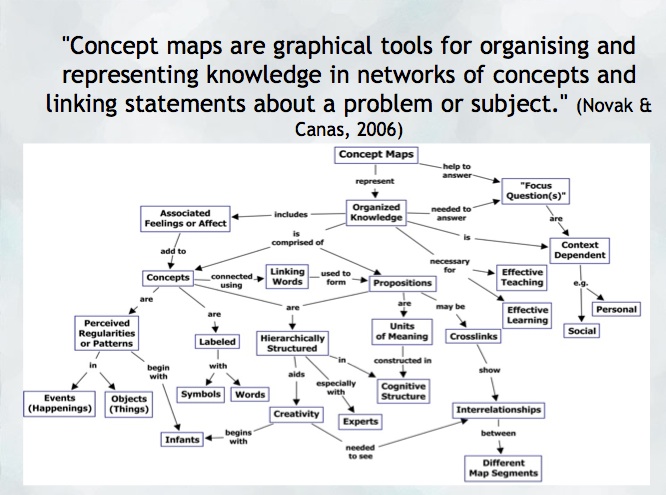
“A concept map is a type of graphic organizer used to represent knowledge of a topic, forge connections between ideas and create visual representations of one’s understandings. Concept maps begin with a main idea (or concept) and then branch out to show how that main idea can be broken down into specific topics” (Novak & Canas, 2006).  Visit the Concept Mapping resource post on this blog for a brief overview and links to resources.

Features of concept maps

There are four essential features represented differently in a concept map:

  1. Concepts: are words that try to represent a phenomenon, object, or idea. They may synthesize patterns in events or knowledge produced over time. In concept maps, these are depicted as shapes in the diagram.
  2. Linking words/phrases:  are used to connect two or more concepts and express some kind of relationship between them. They may indicate cause, consequences, conditions. In general, are written using a verb or few words.
  3. Focus concept or question: it is the main goal of a concept map.  It may be a question, an explanation, or a general idea that conducts your thought and organize all ideas around in the concept map. It is highlighted in the concept map, depending on the hierarchy chosen (top, center, etc.).
  4. Hierarchical and structure: it is how you will choose to organize the main concepts and their connections. It can be hierarchical (the main concept in the top), circle (the main concept in the middle), or other shapes appropriated to the idea you want to express.

Read more on  about the ‘concept’ of ‘concept mapping’ in this blog post on the “Inspiration” website and how teachers and their students might use concept maps, mind maps, or outlines to support writing, idea generation, and organization, planning and more. Inspiration is a software commonly found on school district devices.

You can also find a step-by-step construction of a concept map about the solar system in the Lucidchart or in the example below:

When to use concept maps in education?

Concept maps are powerful graphic organizers that can be used in many ways to illustrate and explore connections across ideas. In this sense, concept maps allow students to formulate their understanding in a non-linear way of thinking, showing their process of thinking during understanding a new idea or content.

Teachers can use concept maps to:

  1. Build new knowledge, deepen students’ understanding: designing a concept map provides students and teachers with an opportunity to construct and share their understanding of a topic, theme, concept, area of interest. This Edutopia article provides a good starting point for learning more about the power of concept maps and other strategies to support deeper thinking.
  2. Identify possible misconceptions: during the process of designing a concept map, teachers can understand better the logic used for students to build their knowledge and the origin of misconceptions. Curtis Chandler, a former Kansas teacher of the year shares how concept maps can be used to understand some students’ misconceptions or not use accurate language in a ‘middleweb’ blog post.
  3. Designing lessons: concept maps can even be used by teachers as a format for planning units or lessons of instruction, allowing teachers to visualize the logic used to connect several lessons into a unit plan or make cross-curricular connections.
  4. Assessment: concept maps can help students illustrate the connections between their ideas, concepts, or content in meaningful ways and can be used as formative and summative assessments. The University of Waterloo has some guides about what is important to consider when designing rubrics for assessing concepts maps.
  5. Create study habits: teachers can have students create concept maps summarizing the main ideas of a unit, creating the habit of continuum revision of the knowledge learned.
  6. Encourage collaboration and communication: a mind map might be collaboratively constructed in real time or asynchronously (using appropriate apps) allowing students to negotiate, think critically and communicate their ideas and understandings with others.

How to get started? mindmap

As mentioned, CMaps, concept maps can be analogue or digital. Teachers might consider providing students with a choice in developing their map using high tech or low/no-tech approaches depending on the objectives. If the objective is to widely share the map, then digital may be preferable (of course, students might also take a photo of a map ‘in process’ and one that is ‘completed’ in order to share as part of a portfolio or published work/project).

Some higher-tech options

  • Mindmaps: it is a tool that allows you to create concept maps without the need for an account. It also allows you to save your map in the cloud or download it to your computer.
  • Inspiration or Kidspiration as computer based or iPad apps Highly visual concept mapping software that allows the user to easily insert images from a large media folder. School districts commonly license these applications for use on their devices.
  • Bubbl.us is an online collaborative concept mapping software – each individual with an account can be invited to contribute to a given map being created in the cloud. With a paid educator account, a teacher can invite students using a link to either view or collaborate (students do not need to provide their information or sign up for an account). Paid app with Free trial options for Educator accounts.
  • For schools using ‘Google Classroom’   MindMup or Miro offer collaborative mindmapping (login required)
    • Teachers should always be aware of appropriate permissions in their context/school districts. These might include parental consent, student informed consent or it may not be permitted to have students sign up using gmail or other account information.

No/Low Tech Options

Collaborative or Individual drawing on chart paper or using sticky notes on a whiteboard or a table with a group of students are great options for kinesthetic or non-digital mind mapping. A primary teacher might even have students use kinesthetic, solid objects to create their mind map. Teachers might begin helping students develop their ability to connect ideas by providing a skeleton. This will help scaffold learning and introduce students to different ways to connect ideas.

Freeform Concept maps can be drawn by hand or using some of the available draw applications made for smartphones and tablets!


References:

Novak, J. and Cañas, A (2006): The Theory Underlying Concept Maps and How to Construct Them (Technical Report IHMC CMap Tools 2006-11). Florida Institute for Human and Machine Cognition.


Original post YD 2017 adapted by Peer Tutor Ariane Faria dos Santos (Ph.D. EDCP), Feb. 2022.

Leave a Comment

Filed under Active Learning, Assessment, Blog Posts, Curriculum, Digital Tools and Apps, Inclusive Practices, Inquiry, Not Subject Specific, Planning, Remote teaching & learning, Resources, STEAM