Category Archives: Interactivity

Literature Circles: An Introduction

What are Literature Circles?

Literature Circles are small groups of students reading and discussing the same book (AKA reading groups, book groups, or book clubs). One of the main goals of lit circles is for students to enjoy reading and engaging in “open, natural conversations about books” (Daniels, 2002, p. 18). During lit circles, the learning is student-centered, taking place during reading and conversation, and the teacher becomes a facilitator and coordinator.  Teachers can support lit circles by being open to learning from and with their students, and developing an expectation of reciprocity in teaching and learning.

Lit circles are adaptable and teachers can customize them for their students’ needs, which makes them a great strategy for Universal Design for Learning (UDL). Groups of 3-5 students seem to work best. The essential elements of literature circles include student voice and choice (Daniels, 2002). In a classroom, each group may be reading a different book or the whole class may be reading the same book. For online learning, lit circles can be held via breakout rooms and the teacher can pop into different rooms to facilitate. For more information, the UBC Education Library has compiled a list of resources for teachers wanting to try lit circles.

Voice and Choice

  • Students could choose their own reading materials (teachers can start with a book talk to introduce the selections, ex. topic, genre, level of difficulty – or teachers can spread out the books over several tables and allow students some quiet time to peruse)
  • If students are all reading the same book, students could choose the motif or theme they wish to focus on and those could be used to form the groups
  • Topics for discussion should come from students and discussions are peer-led; “personal connections, digressions, and open-ended questions are welcome” (Daniels, 2002, p. 18)
  • Students will meet on a predictable schedule – it can be helpful to provide students with a calendar (older students can choose how far to read before each scheduled discussion)
  • If groups are reading different books, they could have an opportunity to share about their book to others (perhaps you’ll have students choose new books, form new groups, and continue lit circles throughout the year)

Roles

Assigned roles can be a great way to help students learn how to participate in discussions and what they need to bring to a conversation to make it rich and engaging. Younger students may choose to draw notes, as opposed to write them. Roles are particularly useful in preparing for discussions because they help students to learn what elements can prompt meaningful conversation. However, the eventual goal is to remove the scaffolds (the roles) and allow students to have free-flowing conversations, which an over-reliance on role sheets can impede (Daniels, 2002).

Examples of Roles:

Updated Roles for the 21st Century (Herrera & Kidwell, 2018) retrieved from https://files.eric.ed.gov/fulltext/EJ1181553.pdf

  • Connector: finds connections between the book and the student(s)
  • Questioner: asks questions about the section being read or the book in general
  • Illustrator: creates images as they read
  • Word Wizard: highlights a few new or meaningful words for students to learn
  • Summarizer: creates a summary of the book section
  • Researcher: digs into and discovers background information related to the book
  • Literary Luminary: locates quotations or significant passages to generate discussion 

Older students will likely be able to prepare for lit circles without having specific roles assigned. However, having students choose a ‘Discussion Director’ (who manages the flow of conversation, encourages participation, and brings some topics/questions to get started) can help to keep conversations flowing and help students to practice facilitating a small group discussion. Students can rotate through this role so each has the opportunity to be discussion director.

Dialectical journals or reading logs can help students to think through their book as they read and can help to prepare students for discussions (a dialectical journal is a double-sided journal that students write in during their reading – on the left, they write questions, drawings, interesting quotations, anything that catches their attention, and on the right, they comment and jot down their thoughts relating to what they have written on the left).

Assessment

Generally, assessments during lit circles come from “teacher observation and student self-evaluation” (Daniels, 2002, p. 18). Offering students multiple self-assessment opportunities can help students to cycle through identifying an area for improvement, setting a goal, assessing if the goal has been met, then setting a new goal, and so on. Summative assessments could also include written assignments or presentations.

Interdisciplinary Learning

Novels naturally weave disciplines together in their stories and teachers can encourage students to research background information that will contribute to their knowledge of the book. For example, students can look into historical context, geography, scientific context (particularly useful for science fiction novels), and psychology – teachers can model interdisciplinarity and encourage students to bring these elements into their discussions. Although lit circles are most commonly incorporated into English, social studies, and humanities classes, they can be used effectively in other disciplines, such as science (Straits & Nichols, 2006).

Preparation

If students have never participated in lit circles before, teachers can model roles and expectations beforehand. For example, teachers could use a short story or poem to demonstrate how lit circles work and what productive participation may look like, as well as to introduce and practice the roles and responsibilities.

During lit circles, students will need time to read (silently or in small groups) and committing time for silent reading from the start of the year can help to establish expectations and routines for that time. It can also be a great way to calmly start the class and get students focused. Teachers can demonstrate they value reading by committing time to read in a way that is visible to students and share their enjoyment (as opposed to using silent reading time for other tasks).

Teachers should read all of the book club selections before starting lit circles and choose books that they also enjoy. It’s important to display passion for reading and enthusiasm for the book choices – students can be heavily influenced by a teacher’s attitude and mindset! Teachers can also think about how book selections cover and connect to big ideas/themes for the unit or year to promote integrated learning (ex. identity, sustainability, compassion, etc.). Adrienne Gear,  MEd UBC, Vancouver teacher and well-regarded literacy specialist, has assembled some thematic book lists for grades 3-6 and for grades 6-9 to help get you started.

How to Get Started

Daniels (2002, p. 55) explains that there 5 key steps for a successful start:

  • Explain – let kids hear why this activity is important
  • Demonstrate – provide live or videotaped examples, by kids or adults
  • Practice – help kids try out a variety of approaches (a fishbowl activity can be an effective way to practice and improve group discussions!)
  • Debrief – ask kids to notice and catalog effective procedures
  • Refine – provide ongoing training through mini-lessons and coaching


References

Daniels, H. (2002). Literature circles: Voice and choice in book clubs and reading groups. Stenhouse.

Herrera, L. J. P., & Kidwell, T. (2018). Literature circles 2.0: Updating a classic strategy for the 21st century. Multicultural Education (San Francisco, Calif.), 25(2), 17-17. https://files.eric.ed.gov/fulltext/EJ1181553.pdf

Straits, W., & Nichols, S. (2006). Literature circles for science. Science and Children, 44(3), 52- 55. https://www.proquest.com/scholarly-journals/literature-circles-science/docview/236904244/se-2?accountid=14656


Guest post by Peer Mentor Lindsay Cunningham (Ph.D. student, EDCP), July 2024.


Leave a Comment

by | August 31, 2024 · 4:58 pm

Embodied Learning: physical engagement and digital tech integration

“Movement, or physical activity, is thus an essential factor in intellectual growth, which depends upon the impressions received from outside. Through movement we come in contact with external reality, and it is through these contacts that we eventually acquire even abstract ideas.”

(Montessori, )

Physical movement in learning has been widely researched and written about. In the early 1930’s, Dr. Montessori understood that learning relied on how our physical bodies interacted with the environment. For her, the environment was physical. Today, we are able to consider the role of digital technologies, spaces, objects and experiences in the context of embodied learning.

Embodied, for our purposes, means that the learner has initiated a physical gesture or movement that is well-mapped or linked to the content to be learned. This might include place-based learning experiences, in-class hands-on engagement, learning labs, games and also includes the possibilities afforded through immersive technologies.

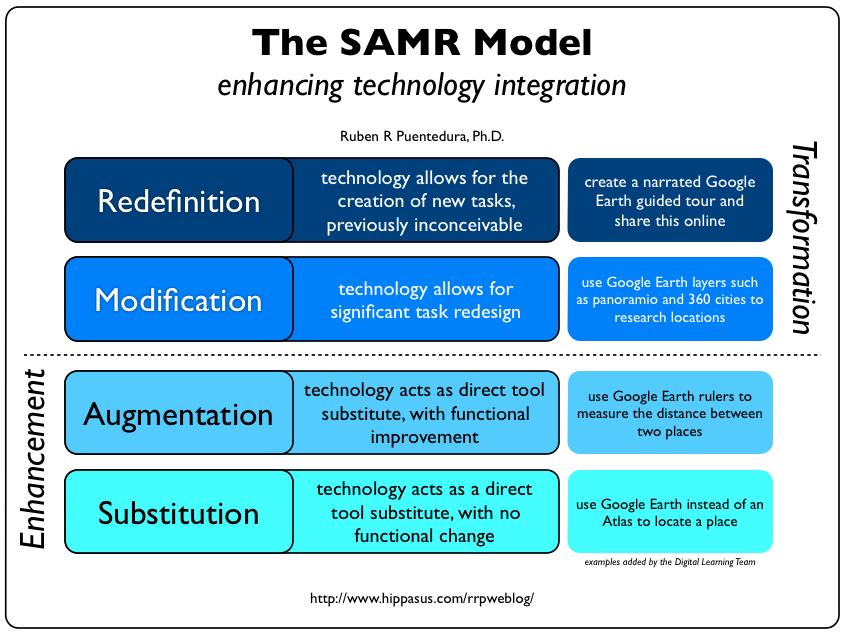
Immersive technologies, including Virtual Reality (VR) and Augmented Reality (AR), have the potential to enhance or even redefine learning (Puentedura, 2013). VR offers potentially emotionally charged, immersive experiences, where the user is ‘within’ the virtual environment, while AR overlays digital content on the real world. Research by Johnson-Glenberg MC (2018) emphasizes the levels of embodiment in education—ranging from basic gestures to full-body movement—to deepen learning experiences.

This emotional engagement, can lead to increased behavioural and, ultimately, cognitive engagement (Dubovi & Tabak, 2021). As teachers, integrating embodied learning means actively engaging students physically in the learning process. Digital and other technologies offer a spectrum of physical engagement levels for a more immersive and effective approach to teaching science. We can move from simple gesture to full body movement.

At the lower end of the embodiment spectrum would be the use of 360 video or other gesture based media (such as the Shakespeare folio we explored in our visit to UBC’s Emerging Media Lab – links to external UBC site). 360 video would be another good example. With equipment becoming less expensive and more accessible, you might try shooting your own video (or take still images using Google Streetview).

The following is an example 360 video a friend and I shot in Pacific Spirit Park. It shows my mentor, Lynn Pollard, a long-time Surrey teacher, environmental activities and naturalist educator. (Special thanks to Sharon Hu)

Now imagine the potential engagement and immersion if we could also smell the forest while learning about the carbon cycle! I actually tried this out using simple ‘scent boxes’ that students held while interacting with the video (one with moss, others with cedar, fir, leaves). While this video doesn’t allow for ‘smellivision’, it does allow a greater level of immersion than a static image or standard video. I have used this as ‘prep’ for heading outdoors with students and as a ‘replay’ to re-immerse ourselves upon return and before we do some art or writing activities related to our field experience. It could also be used as a replacement to an outdoor experience (depending on context, objectives).

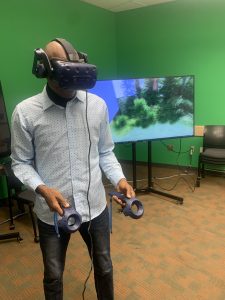
student wearing VR goggles and holding controllers in front of screen showing stanley park immersive experience

Student ‘immersed’ in VR

Levelling up a bit on the embodiment spectrum would be opportunities that allow for full body movement and gesture. This might include fully immersive VR of the kind explored on a recent visit to UBC’s Emerging Media Lab (EML).(links to external/UBC based site) Of course, while some schools have invested in this digital tech, access may not be possible in the average k12 school today. We were fortunate in our visit to the EML to try out a few different options (see table below for resource links).

Using the rather ubiquitous smartphone, we can view a variety of 3D images using a google search and engage with them as AR images in the environment.

Person gesturing towards a virtual AR image of a tiger in the classroom

Dr. Khan virtually pats a tiger!

Imagine our surprise when a tiger joined the class (or when the full circulatory system model wandered by!). In order to view these 3D images, we need to move around them physically and gesture to adjust size; allowing a somewhat ’embodied’ experience.

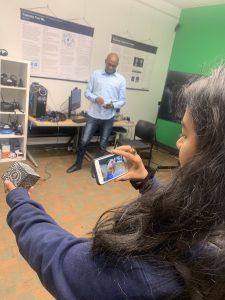
student holds merge smart phone in front of a merge cube AR block. Phone shows an AR beating heart.

Holding a beating heart in her hand!

We might also use a Merge Cube to view AR models. Again, not super high tech, but thought provoking when we think about the difference between a static model of the heart and a larger than life sized beating organ suspended in the room in front of us!


Embracing embodied learning empowers students to not just learn about science or the world around them, but to tangibly experience and internalize it. It’s about creating educational experiences that transcend the traditional confines of a classroom, fostering a deeper and, hopefully, more lasting connection between physical engagement and knowledge acquisition.

References:

Dubovi I, Tabak I. Interactions between emotional and cognitive engagement with science on YouTube. Public Underst Sci. 2021 Aug;30(6):759-776. doi: 10.1177/0963662521990848. Epub 2021 Feb 5. PMID: 33546572; PMCID: PMC8314998.

Johnson-Glenberg MC. Immersive VR and Education: Embodied Design Principles That Include Gesture and Hand Controls. Front Robot AI. 2018 Jul 24;5:81. doi: 10.3389/frobt.2018.00081. PMID: 33500960; PMCID: PMC7805662. Retrieved from https://www.ncbi.nlm.nih.gov/pmc/articles/PMC7805662/

Montessori, Maria. The Secret of Childhood. Orient Longman, 1966.

Puentedura, R. R. (2013, May 29). SAMR: Moving from enhancement to transformation [Web log post]. Retrieved from http://www.hippasus.com/rrpweblog/archives/000095.html


Resources from our Session (Oct 2023)

I recently had the opportunity to work with UBC Faculty, grad students and members of the team at the Emerging Media Lab on the Vancouver Campus on some interactive and ’embodied’ stations to allow students to experiment and consider the levels of embodiment afforded with Augmented and Virtual Reality tools. Below are some resources from our session. It is important to note that we did not offer these AR and VR options as alternatives to ‘real world embodied learning’ but as enhancements to the learning environment.

EML offers weekly drop-ins and opportunities to collaborate on projects, co-plan and co-teach! https://eml.ubc.ca/

Station/Activity Level of Embodiment  Resource notes/Links
VR immersive exploration (Stanley Park Simulation EML Project) immersive VR, interactive controllers, gesture, movement, sound https://eml.ubc.ca/projects/geography-vr/
Holo brain (using Hololens) gesture-based augmented reality https://eml.ubc.ca/projects/holobrain/
Smartphone Google Search AR gesture-based AR with some body movement Link to ios/android instructions and full list of available 3D images – Google link.
Star Walk AR gesture-based AR with some large body movement Requires smartphone, ipad, tablet. Star viewing apps allow you to view celestial objects/night sky in real time and across space and time. Link to Star Viewing Apps SS Blog post.
Merge Cube AR gesture-based AR Requires handheld/smart phone or ipad. Link to Merge Cube blog post in Scarfe Sandbox. 
Shakespeare XR Interactive gesture-based AR A table top virtual Shakespeare text, turn the pages with gesture. https://eml.ubc.ca/projects/shakespeare-xr/


Planning for ‘Tech-enhanced Embodied Learning’

I created the following ‘solution tree’ of considerations when electing to incorporate these tools (note this tree is a first draft… I’m hoping to make a more effective diagram for a future edit of this post – please comment on this post if you have feedback)

  • Is the experience you wish to offer POSSIBLE in the real world? Can you/your students visit the place or hold the object
  • if yes, then…
    • Consider incorporating the digitally enabled tools as supplement or enhancement to real world experiences and labs. For example, pre- or post- labs; allowing students to pre-play and re-play content or experiences using digital tools including 360 media can enhance their reflections on the experience, can supplement and even deepen connections to learning.
    • if yes, then:
      • Think about: your learning objectives and the ‘level of embodiment’ you’d like to offer your students as you choose the tools.
      • Ask:
        • are any students going to be excluded (due to health and safety or access issues?
        • if no, then… 
          • GO! Try to make it happen. Advocate for it!
        • if yes, then…
          • plan or consider alternative experiences. For example: if a student has vestibular or other health or safety concerns and may not be able to use a VR headset, is there an AR experience you can offer that is more comfortable for that student (Consider Universal Design for Learning (UDL) principles in your planning and you’ll see that having an alternative will likely be necessary for some and of benefit to many!)
  • Is the experience you wish to offer IMPOSSIBLE in the real world (perhaps unsafe or inaccessible to some/all of your students)
  • if yes, then…
    • consider incorporating the digitally enabled tools as the main/central experience in the lesson or unit or lab.
    • if yes, then:
      • Think about:
        • your learning objectives and the ‘level of embodiment’ you’d like to offer your students as you choose the tools.
        • how you will ensure access and engagement (if you have access to only one device, what will students do when it is not their ‘turn’? are there stations you can set up for students for more active engagement and to lessen ‘wait time’; what role do students have who are not ‘immersed’ in the activity?
        • how will students reflect upon their experience?
      • Ask: Are any of my students going to be left out of this experience?
      • if no, then… 
        • GO! Try to make it happen. Advocate for it!
      • if yes, then…
        • plan or consider alternative experiences. For example: if a student has vestibular or other health or safety concerns and may not be able to use a VR headset, is there an AR experience you can offer that is more comfortable for that student (Consider Universal Design for Learning (UDL) principles in your planning and you’ll see that having an alternative will likely be necessary for some and of benefit to many!)


Blog post by Yvonne Dawydiak, Learning Design Manager, Teacher Education Oct 2023

1 Comment

Filed under Activating Strategies, Active Learning, AR & VR, Assistive Technology, Blog Posts, Curriculum, Interactivity, Not Subject Specific, Planning, Resources

A brief history… Timelines

Global logistics concept with industry icons

I came across TimeToast awhile ago and was just reminded of it this morning as a tool for creating interactive digital timelines. There are many digital tools available for timeline creation – I’ve listed several in the ‘how to get started’ section below including a few open educational resources. There are also, many ways to create timelines as ‘no or low tech’ projects in a classroom using sticky notes, cards and string.

For Timetoast, a free account allows photos to be uploaded, annotations and live links. I love the ‘timespan’ option, allowing a span of time to be highlighted and annotated. This adds some depth and interest to the typical timeline.

Public timelines can be viewed and shared ‘as is’; your own Timelines can be saved and made private or public. When public, you can share via Facebook, Twitter or by grabbing embed code. Teachers can easily upload the timeline to the class website or blog for home viewing.

As I messed about with it again, I considered a variety of uses; both personal and professional. As a teaching tool, timelines have so many possibilities. Here are a few that come to mind:

  • A classroom calendar embedded on the class blog or website – the initial timeline can house calendared events over the year and can also be added to over time either by student request due to personal milestones (lost tooth chart anyone?!) or as the class wishes to share learning events and activities with the world.
  • Social Studies units could be greatly enhanced by students creating their own timelines of historic events, life and times of… or the class can co-create a timeline as they explore a specific person, place or time.
  • Tracking growth and change in a Science experiment using both photos and text is a unique way to share.
  • A unique way to create an  ‘About Me‘ or ‘About my Family‘ or ‘History of my Community‘. A recent teacher candidate created a beaded timeline with her students to help students learn more about the Indigenous presence in her school community!
  • Create a digital story – fiction or non-fiction
  • A way of sharing Inquiry learning; a timeline might help highlight the ‘process’

Timelines can be valuable in a second language classroom such as French Immersion, Core French, etc; allowing  students to creatively engage in language learning.

What uses come to your mind? Comment to share!


There are several free timeline programs (and plenty of ways to create timelines using other programs – PPT or Padlet or a mindmap come to mind). Here are a few programs with specific timeline features:


Leave a Comment

Filed under Curriculum, Inquiry, Interactivity, Not Subject Specific, Planning, Resources, Science, Social Studies, STEAM, Technology

Gaming & Storytelling

“What we can conceive of intellectually and what we’re able to speak about verbally,we may not have the print power for yet” – Angela Stockman

Bringing Stories to Life

Allow students to apply their understanding of story elements (characters, setting, problem, etc.) in a way that can better meet their interests and needs. Through the integration of coding with storytelling, using platforms such as MakeCode, Scratch, and Twine, students can program their stories to come to life, using text and their voice to help tell the story!

Why blend coding with storytelling?

Research conducted in the United States has shown that: (if we could find Canadian statistics, that would be more relevant)

  • Only 27% of 8th and 12th-grade students can write at a proficient level.
  • 40% of college applicants (grade 12) could not write at a college level.
  • Female students scored higher on writing than males at most grade levels.

(SOURCE: U.S. Department of Education, Institute of Education Sciences, National Center for Education Statistics, National Assessment of Educational Progress (NAEP), 2011 Writing Assessment).

Programming is a new form of literacy. Coding and gaming are part of this tradition of blending more traditional literacy practices (text, reading, and narrative) with new digital literacies (hypertext, coding, interaction).

Studies show various benefits:

  • Increased confidence and motivation to write.
  • Media literacy and creative production are necessary for learners to meaningfully engage in our culture today. Encourages students to become producers, rather than simply consumers of content.
  • Women are severely underrepresented in STEM fields. Using coding/ gaming platforms in the Language Arts classroom is a great way to promote engagement and interest among girls.

Getting Started

  1. The first step is to introduce students to the connection between games and stories through mentor texts and read-aloud. Discuss and bring awareness to students, of the story narratives behind the games they already play and are familiar with. Ask them to share the backstories of the video games they play.
  2. Use story mapping and storylines to help students plan their story to be told through video games. Using a storyline, story map, or graphic organizer can break up the writing into manageable steps and help students organize their ideas visually. The more you use story maps (or storylines) as a class, the more students will effectively use them independently. Practice using these organizers after a class read-aloud, showing and discussing the different parts of a story and how they come together. There are a variety of templates online to choose from: Example 1 & Example 2
  3. Choose the tool and introduce students to the coding/ gaming platform they will be using to create their story. There are a variety of free online platforms to choose from as well as the option to use codable robotics whereby students have the robots moving from ‘setting’ to ‘setting’ as they orally narrate the story.                            Examples include:

Some tips for teachers

  1. Allow students plenty of time to practice using the tool and getting used to the platform before they use it to tell their story. If students have a basic proficiency and familiarity with the platform, they will be more effectively able.
  2. Now comes the time for students to share and celebrate their stories! Have the class try out and play some of their peers’ games and/ or have them demonstrate their game to the class.

Slide Resource

Check out these slides for more information:

Gaming & Storytelling


Guest post by Peer Tutor Tamara Jabboour and Ariane Faria dos Santos, October 2023.


Leave a Comment

Filed under AppliedDesignSkillsTechnologies, Curriculum, Interactivity, Language & Lit Learning, multimedia creation, Not Subject Specific, Planning, Resources, STEAM, Technology, The Arts

Student Response Systems

A Student Response System is a wireless response system that allows individuals to request information and for students to respond by using a “clicker” or hand-held response pad to send his or her information to a receiver (University of Wisconsin-Milwaukee, n.d.). Some of these Student Response Systems include iClickers, Socrative, PollEverywhere, and Padlet.

One noteworthy SRS is Plickers. As described on their website, “Plickers is a powerfully simple tool that lets teachers collect real-time formative assessment data without the need for student devices”. All you simply have to do is download the free app on your iOS or Andriod device and print the cards on their website. This is a nice way of doing formative assessment using new technologies without the costs associated with introducing devices (such as iClickers).

To use Plickers, teachers would simply create the multiple choice questions on their free account. To use the Plicker cards in class, each student holds up their card. Each side of the card corresponds to A, B, C, and D. The teacher holds their phone up and scans it across the class.

Check out this YouTube video to see how it works:

For information about other Student Response Systems, check out the new Apps & Programs page.

Resources:

References:

University of Wisconson-Milwaukee (n.d.). Student FAQs. Learning Technology Center. Retrieved from http://www4.uwm.edu/ltc/srs/students/docs/StudentFAQs.pdf

Leave a Comment

by | December 19, 2014 · 9:45 am

Introduction to digital technologies commonly found in elementary schools

The elementary school experience today is vastly different from what it used to be like not too long ago. Thanks to the rapid development of various technologies, how they are used in classrooms has vastly evolved. Eight years ago in elementary school, I remember walking down to the computer lab with my classmates. We would impatiently wait for the teacher to unlock the door, then we would enter and choose our favourite computer. Typically, a portion of the time was spent typing away on All the Right Type or creating artwork on KidPix (does this ring a bell?). Other times, we would spend time in the computer labs working on research projects. After everything was done, we would be allowed free time on the computers.

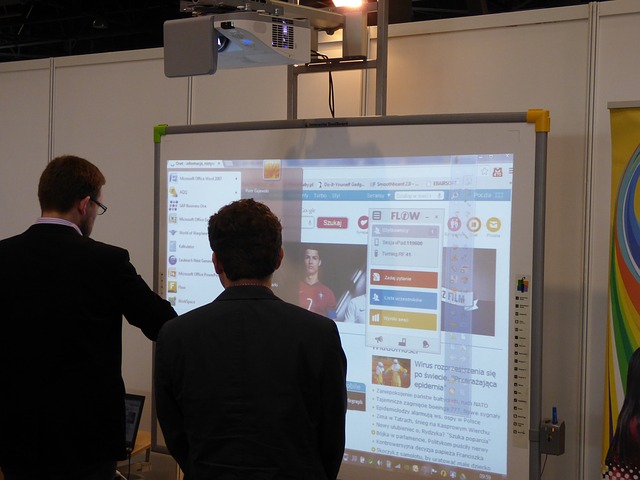
Nowadays, students don’t even have to leave the classroom to access technology anymore. Often times, they are already installed in the classrooms. One of the most recognizable technologies are SmartBoards, which is one type of Interactive Whiteboards (IWB). IWBs strive to increase student engagement by providing a focal point for instruction, interactivity, gaming, and animations. Gone are the days of overhead projectors!

interactive-whiteboard-332239_640

Other common technologies include iPads and laptops. Often, classrooms or school libraries will have carts of iPads and laptops available for loan during school hours. When using any device, encourage small group work so that students get the advantages of learning to use the technology while fostering social interactions.

Regardless of whatever technology you decide to utilize, remember:

“The mere introduction of the technology does not guarantee an enhanced learning environment. The role of the teacher, his or her knowledge of the technology and how to use it, will be the most important factors in determining if successful progress can be identified and supported” (Hockly, 2013). The view that any technology by itself will lead to “better” learning is misleading (Hocky, 2013).

Articles worth checking out:

References:

Hockly, N. (2013). Interactive whiteboards. ELT Journal, 67(3), 354-358. doi: 10.1093/elt/cct021

Leave a Comment

by | December 3, 2014 · 1:29 pm

Introduction to the SAMR Model

The SAMR Model was developed by Dr. Ruben Puentedura as a way for teachers to evaluate how they are incorporating technology into their practice. This video on Common Sense Media gives a good overview of the model. SAMR stands for substation, augmentation, modification, and redefinition.  If you attended the workshop but did not receive a handout, click here for a PDF of the wheel poster that incorporates the SAMR Model.
null

Resources:

In our session today, we looked at (and explored) several digital technologies through the SAMR lens. As you select digital technologies for use in your own classroom, remember to apply SAMR.

Apps we explored today:

  • Student Response Systems – we tried Kahoot and looked at polleverywhere (which allows text message response as well as online) and Socrative (allowing individual student accounts). Remember the ‘issues’ around anonymity – you can harness the value but need to be aware of the risks… The other system that incorporates student code cards that I mentioned is called Quiz Socket – I’ll be making a set of cards and testing this one out over the next couple of weeks (so please check back!)
  • Padlet.com a cloud based, cross-compatible space for brainstorming… you can even moderate student responses (using the settings wheel) and adjust the privacy of your wall. Valuable for group brainstorms where you’re asking students to consider the responses of others. Helps in co-constructing kn0wledge.
  • 32 Interesting Ways to use Padlet in the Classroom
  • Concept mapping is a valuable way for students to connect learning – co-construct visual CMaps using Popplet.

Here is a link to the promised google doc with ‘subject specific’ online applications, simulations, games etc to support learning – again, as you select, evaluate using SAMR! NB: I will be adding to this list in consideration of our discussion and the subject areas ‘identified’ in our workshop over the next few days!

As always, please feel free to leave a comment below if you have any questions, comments or requests!

Leave a Comment

by | November 18, 2014 · 11:49 am