Category Archives: Free speech

Equity, Governance, Economics and Critical University Studies #criticaled #edstudies #ubc #bced #yteubc

Workplace: A Journal for Academic Labor
Equity, Governance, Economics and Critical University Studies
No 23 (2014)

As we state in our Commentary, “This Issue marks a couple of milestones and crossroads for Workplace. We are celebrating fifteen years of dynamic, insightful, if not inciting, critical university studies (CUS). Perhaps more than anything, and perhaps closer to the ground than any CUS publication of this era, Workplace documents changes, crossroads, and the hard won struggles to maintain academic dignity, freedom, justice, and integrity in this volatile occupation we call higher education.” Workplace and Critical Education are published by the Institute for Critical Education Studies (ICES).

Commentary

  • Critical University Studies: Workplace, Milestones, Crossroads, Respect, Truth
    • Stephen Petrina & E. Wayne Ross

Articles

  • Differences in Black Faculty Rank in 4-Year Texas Public Universities: A Multi-Year Analysis
    • Brandolyn E Jones & John R Slate
  • Academic Work Revised: From Dichotomies to a Typology
    • Elias Pekkola
  • No Free Set of Steak Knives: One Long, Unfinished Struggle to Build Education College Faculty Governance
    • Ishmael Munene & Guy B Senese
  • Year One as an Education Activist
    • Shaun Johnson
  • Rethinking Economics Education: Challenges and Opportunities
    • Sandra Ximena Delgado-Betancourth
  • Review of Abundance: The Future is Better Than You Think
    • C. A. Bowers

January 28 National Day of Teach-ins focused on First Nations Education Act #idlenomore #ubc #bced #bcploi #occupyeducation #edstudies

IDLE NO MORE + DEFENDERS OF THE LAND
TEACH-INS
JANUARY 28, 2014

Idle No More— As we begin a new year, we invite Idle No More groups to organize local teach-ins on January 28th based around the First Nation Education Act and the broader Termination Plan that it represents.  We recognize that every Nation and community has their own unique stories, struggles, and practices and we hope that every teach-in is rooted in the on-the-ground realities that are the heart of the movement. When we include our local allies and supporters to attend, help, and promote local teach-ins we believe this adds strength to the bundle of arrows we continue to build through education.

As a support to teach-in organizers we are developing educational tools to use at local teach-ins that will focus on the  First Nation Education Act and the broader Termination Plan of the Canadian government.  Please feel free to use these tools, or to develop your own!  We are also hoping that each teach-in will create a quick list of local struggles or issues and that we can share these lists to help guide the Idle No More movement.

We need to support one another as we continue to fight for our lands, water, sovereignty, and our future generations.  We hope that these teach-ins help to deepen and strengthen our roots and prepare us for the work that lies ahead.

Read More: Idle No More

#IdleNoMore “Got Land? Thank An Indian” truth-telling protest Jan 28 #ubc #ubced #bced #bcpoli #criticaled

Idle No More + Defenders of the Land
Day of Action
January 28, 2014

Idle No More, For Immediate Release– Idle No More and Indigenous teen who wore “Got Land? Thank an Indian” shirt call on people everywhere to wear it as act of truth-telling protest

Tenelle Starr will appear as honorary guest at Neil Young concert in Regina on Friday

(Turtle Island/Canada ) – A 13 year old Indigenous teenager, Tenelle Starr, prevented initially from wearing a sweatshirt at her school in Balcarres near Regina that read “Got Land? Thank an Indian” is now calling, along with the Idle No More movement, for people everywhere to don the shirt as an act of truth-telling and protest.

Now and up to a January 28 Day of Action, Tenelle and Idle No More and Defenders of the Land are encouraging people across the country to make the shirt and wear them to their schools, workplaces, or neighbourhoods to spark conversations about Canada’s true record on Indigenous rights. They have created a website (http://www.idlenomore.ca/got_land) where people can get stencils to make a shirt, to buy it, and upload photos of themselves wearing it.

“Everyone can wear the shirt.  I think of it as a teaching tool that can help bring awareness to our treaty and land rights. The truth about Canada’s bad treatment of First Nations may make some people uncomfortable, but understanding it is the only way Canada will change and start respecting First Nations,” says Tenelle, an Idle No More supporter who has participated in many Idle No More rallies with her mother.

Tenelle will also be appearing as an honorary guest at the Neil Young Honour The Treaties concert in Regina on Friday night. Chief Allan Adam and the Athabasca Chipewyan First Nation have gifted her and her mom with tickets to pay respect to her courage.

Since the media started reporting on Tenelle’s acts, she has has been attacked on her facebook page by an online hate group that has threatened her safety, forcing her to disable her facebook account.

The January 28 National Day of Action is also a day of Teach-ins to raise awareness about the federal Harper government’s attack on native education through the First Nations Education Act and his continuing agenda to “terminate” or abolish Indigenous peoples rights, sovereignty and status as Nations and dispossess them of their lands and resources.

Read More: Idle No More

Canadian universities sacrifice principles in pursuing collaborations #bced #bcpoli #education

CAUT, November 20, 2013– In their drive to attract new revenues by collaborating with corporations, donors, and governments, Canadian universities are entering into agreements that place unacceptable limits on academic freedom and sacrifice fundamental academic principles, according to a report released today by the Canadian Association of University Teachers (CAUT).

Open for Business: On What Terms examines twelve research and program collaboration agreements between universities, corporations, donors and governments to determine if universities have protected their academic integrity.

“Our findings should raise alarm bells on campuses across the country,” said CAUT executive director James Turk. “In the majority of the agreements we reviewed, universities have agreed to terms that violate basic academic values.”

According to Turk, seven of the twelve agreements provide no specific protection for academic freedom, and only one requires the disclosure of conflicts of interest. Only five of the agreements give academic staff the unrestricted right to publish their research findings and just half provide that the university maintains control over academic matters affecting staff and students.

“Universities have allowed private donor and corporate partners to take on roles that should be played by academic staff,” stated Turk. “They have signed agreements that side-step traditional university decision-making processes and undermine academic freedom.”

The report concludes by recommending a set of guiding principles for university collaborations to better protect academic integrity and the public interest.

“Collaborations can be beneficial to faculty, students, institutions, and the public, but only if they are set up properly,” Turk added.  “Universities owe it to the academic community and to the public to do more to safeguard the independence and integrity of teaching and research.”

The research and program collaborations examined in the report were:

  • Alberta Ingenuity Centre for In-Situ Energy (AICISE)
  • Centre for Oil Sands Innovation (COSI)
  • Consortium for Heavy Oil Research by University Scientists (CHORUS)
  • Consortium for Research and Innovation in Aerospace in Quebec (CRIAQ)
  • Enbridge Centre for Corporate Sustainability
  • Mineral Deposit Research Unit (MDRU)
  • Vancouver Prostate Centre
  • Balsillie School of International Affairs
  • Munk School of Global Affairs
  • Partnership: University of Ontario Institute of Technology/Durham College/Ontario Power Generation
  • Partnership: University of Toronto/Pierre Lassonde—Goldcorp Inc.
  • Partnership: Western University/Cassels Brock & Blackwell LLP

Copies of the report are available on-line.

The Canadian Association of University Teachers is the national voice of more than 68,000 academic and general staff at over 120 universities and colleges across the country.

– See more at: CAUT

Edmonton students’ views on symbols of #IdleNoMore, Occupy expressed in artwork

Heather McIntyre, Metro Edmonton, April 18, 2013 — The use of symbols in relation to movements, such as Idle No More and Occupy, have become pieces to admire at the Art Gallery of Alberta. The AGA Ledcor Theatre Foyer currently holds art from students in the Modern Languages and Cultural Studies department at the University of Alberta.

The students’ assignment initially was to focus on Occupy – hence the exhibit being called Occupy The Gallery! – but as the Idle No More movement grew, many students turned to it, including Erin Hunt and Mohamad Mahfouz.

“It’s just taking a movement and what we were learning as symbolism and symbolic interaction, and looking in our own community and engaging with things that were happening in our own community,” said Hunt. Hunt’s piece is four photographs of nature within a sanded wood frame.

“The part of the Idle No More movement that I identified with the most was environmental protection,” said Hunt. “I’m giving people the opportunity to identify with nature through the pieces I chose through the photographs I took, and to almost challenge them to take on the same kind of declaration that I did.”

Mahfouz focused on land, but chose to do so through a video, which consists of a woman wandering through the woods, “appreciating it while also lost.”

“Then a feather magically falls from the sky and she picks it up… and then eventually she finds her way, and reaches the downtown view and holds the feather up saying ‘This is where I belong,’” he said. “Then the feather lands on the ground firmly, to symbolize roots.”

The exhibit opened earlier this month, and will remain at the gallery until April 28.

Read More: Metro Edmonton

David Suzuki: Government not protecting wild salmon, scientists censored

David Suzuki, CBC Radio, April 18, 2013– David Suzuki gave an extended interview on CBC’s On the Coast, profiling Alexandra Morton’s new film “Salmon Confidential” and elaborating on the Canadian government’s censorship of scientists.

Listen to CBC’s On the Coast Interview with David Suzuki

Muzzling scientists is an assault on democracy

David Suzuki, Rabble.ca, April 9, 2013–

Access to information is a basic foundation of democracy. Canada’s Charter of Rights and Freedoms also gives us “freedom of thought, belief, opinion and expression, including freedom of the press and other media of communication.”

We must protect these rights. As we alter the chemical, physical and biological properties of the biosphere, we face an increasingly uncertain future, and the best information we have to guide us comes from science. That scientists – and even librarians – are speaking out against what appear to be increasing efforts to suppress information shows we have cause for concern. The situation has become so alarming that Canada’s Information Commissioner is investigating seven government departments in response to a complaint that they’re “muzzling” scientists.

The submission from the University of Victoria’s Environmental Law Centre and Democracy Watch alleges that “the federal government is preventing the media and the Canadian public from speaking to government scientists for news stories – especially when the scientists’ research or point of view runs counter to current Government policies on matters such as environmental protection, oil sands development, and climate change” and that this “impoverishes the public debate on issues of significant national concern.”

The complaint and investigation follow numerous similar charges from scientists and organizations such as the Canadian Science Writers’ Association and the World Federation of Science Journalists, and publications such as the science journal Nature. Hundreds of scientists marched on Parliament Hill last July to mark “the death of evidence”.

The list of actions prompting these grievances is long. It includes shutting the world-renownedExperimental Lakes Area, axing the National Round Table on the Environment and the Economy, eliminating funding for the Canadian Foundation for Climate and Atmospheric Sciences and prohibiting federal scientists from speaking about research on subjects ranging from ozone to climate change to salmon.

All of this has been taking place as the federal government guts environmental laws and cuts funding for environmental departments through its omnibus budget bills. It has justified those massive environmental policy changes in part by saying the review process was slow and inefficient, but research by scientists at the University of Toronto, published in the Canadian Journal of Fisheries and Aquatic Sciences, “found no evidence that regulatory review in Canada was inefficient, even when regulators had an ongoing load of over 600 projects for review at any given time.”…

Read More: Rabble.ca

Phil Fontaine speaks to University of Winnipeg students on #IdleNoMore

CBC News, March 13, 2013— It has been weeks since Idle No More protests have made headlines, and now a former national chief is saying the movement needs to change direction to get things moving again.

Phil Fontaine, the former chief of the Assembly of First Nations in Canada, spoke to University of Winnipeg students alongside federal Liberal leader Bob Rae on Wednesday.

Fontaine lauded the efforts of the Idle No More movement while speaking to students but said those behind the grassroots movement should now try to align with chiefs to move forward.

“I think it would be a mistake to marginalize the chiefs in this very important process, and so the point I was making is, I think they have to work together,” said Fontaine.

The Idle No More movement was sparked by opposition to Bill C-45, an omnibus budget bill that had far-reaching implications for the Indian and Environmental Assessment Acts.

The grassroots movement said the bill endangered the environment and infringed on treaty rights.

But the movement was at times at odds with aboriginal leadership, pointing to quick progress made by Idle No More protests that took chiefs years to achieve.

Indigenous Studies students Carl Balan and Allan Cochrane attended Fontaine and Rae’s talk Wednesday but said they weren’t convinced the movement should change direction.

“I was extremely optimistic to hear some of these ways forward, but it was the same old talking about the past,” said Balan.

Cochrane said he wasn’t impressed with Rae’s suggestion the movement lacked focus.

“To close in on any one issue opens up the possibility for the federal government to come up with a quick fix,” said Cochrane.

He said what’s more important is a change to the status quo.

For now, Idle No More organizers are maintaining their focus on grassroots protests, with more events planned for next week.

UM Student union throws support behind #IdleNoMore

Winnipeg Free Press, February 14, 2013 — The University of Manitoba Students’ Union (UMSU) endorsed the Idle No More movement and pledged to provide resources and supports to local organizers, an UMSU news release said today following a teach-in at the U of M by the aboriginal student representative.

“Students recognize and understand that Indigenous people and communities continue to confront the systems of colonization and oppression established by successive Canadian governments,” UMSU president Bilan Arte said in the news release.

“As an organization committed to social justice and increasing access to higher education, it is natural for UMSU to support the Idle No More movement in its efforts to educate and inform the rest of the country on the issues facing Indigenous people in Canada.”

UMSU is the largest students’ association in Manitoba with more than 25,000 undergraduate student members.

Ryerson University professor Pam Palmater, key spokesperson for Idle No More, said in an interview with Postmedia News:. “We’re in this for the long haul. It was never meant to be a flashy one month, then go away. This is something that’s years in the making,”

U of Toronto Student Torbold Rollo on #IdleNoMore

Georgia Straight, Torbold Rollo, February 1, 2013 — IT IS SOMETIMES quipped that democracy is like two wolves and a lamb voting on dinner. This Darwinian image of vulnerable minorities falling prey to a “tyranny of the majority” is why few believe that democracy can be reduced to participation in elections. If democracy has value it is because it allows people to have a meaningful say in the rules that govern them. Anything that precludes or impairs this “voice” is anti-democratic by extension.

The Idle No More indigenous rights movement is a democratic movement par excellence. It seeks to challenge those mechanisms of Canadian governance that preside over the lives of indigenous peoples and in this sense their demand for self-government—what ancient Greek theorists called “autonomy”, from auto (self) andnomos (rule)—is a genuinely democratic aspiration. Canadians are coming to see this more clearly as the movement articulates its recommendations. (No surprise, then, that “Idle No More” was just voted “Best Democratic Moment of 2012” in a poll conducted by the research group on democracy, Samara.)

What exactly precludes and impairs the autonomy of indigenous peoples? The Indian Act stands out as the most glaringly anti-democratic impediment to self-government. Not simply because it shatters the 60 or so original indigenous nations along with their traditional governments and traditional territories into the 614 arbitrary “bands” now scattered across Canada on tiny “reserves”, but also because band leadership has no real say in political and legislative life on those reserves. Although they are elected, chief and council have no democratic authority to govern because they are constrained from above by the Indian Act rather than from below by their people. They are replaceable managers, in essence, not law-makers. Real authority resides in the enforcement of the Indian Act by Aboriginal Affairs and Northern Development Canada. The whole arrangement is insultingly arbitrary from a democratic perspective.

Read More: Straight.com

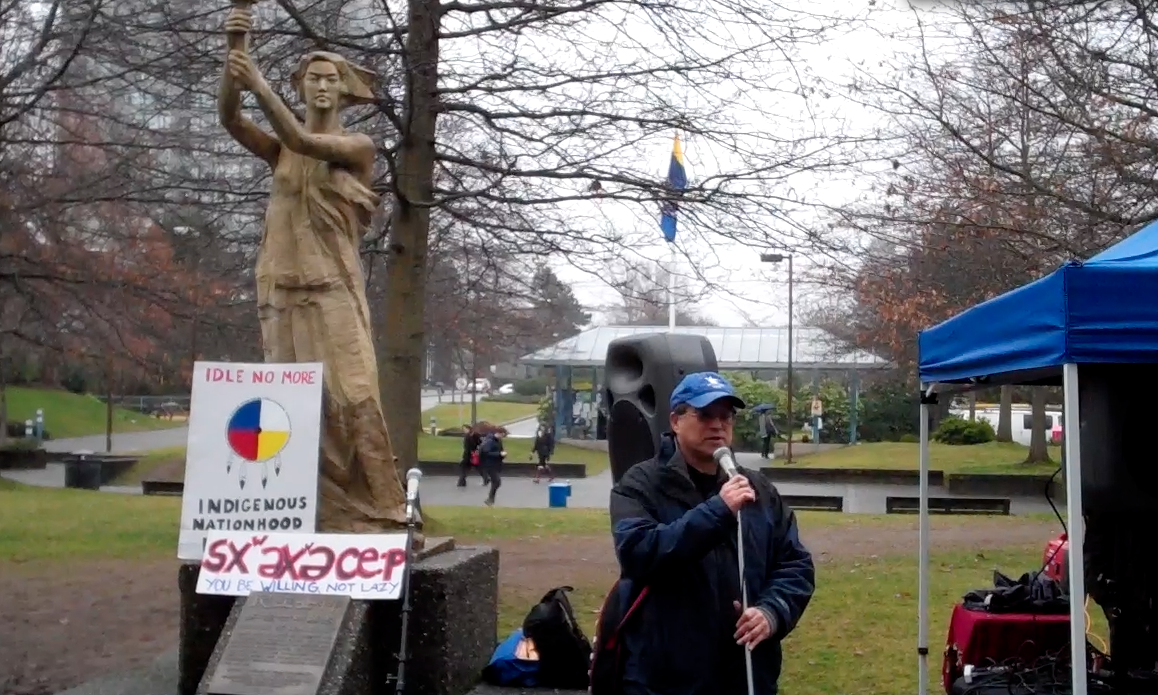
#IdleNoMore Teach-In and Demonstration at #UBC

Well over 300 gathered this afternoon for an Idle No More Teach-In at the University of British Columbia. This followed a late morning and afternoon INM demonstration yesterday with 100+ in attendance at any given moment. Today’s Teach-In at the First Nations House of Learning was broadcast by CITR (101.9 FM), the student run (since 1974) radio at UBC. If you were unable to attend, I encourage all to listen to the podcast for today and view videos from yesterday’s demonstration, as these were truly memorable and significant events at UBC. On a campus that has become renowned for apathy, Idle No More is a welcome and extremely promising change of both outlook and power dynamics. If you’re on the Board of Governors at UBC, you are likely proud and anxious at this point: Proud in that students are waking up and organizing demonstrations and teach-ins such as Idle No More and anxious in that none of this bodes well for business as usual and continuos expansion into unceded Musqueam territory and lands endowed in trust about 100 years ago (Musqueam home from time immemorial to “Crown Land” in late 1800s into “Endowment Lands” in 1910). Thank you to all who organized and participated these past two days in Idle No More at UBC!

#IdleNoMore Demonstration at UBC

Lee Brown Speaks wisdom to power at Idle No More Demonstration at UBC

Thank you to Idle No More student planners of the extremely important demonstration at the University of British Columbia yesterday (31 January). This was the first of many to come at a University that has grown irresponsible in its expansion throughout the unceded Musqueam territory on which it is settled. This was a refreshingly catalytic exploration of the varied and complex issues represented within the Idle No More movement for a campus waking up from a decade of messages from the University that an inactive and idle student body is the best student body.

The Idle No More Teach-In at UBC this afternoon at the First Nations Longhouse will work from yesterday’s demonstration to generate next steps for this decreasingly idyllic, but no longer idle, campus.

Most videos from the Idle No More Demonstration at UBC (31 January 2013) are accessible:

#IdleNoMore Teach-in at UBC on Friday (February 1)

Idle No More Teach-in
First Nations House of Learning
University of British Columbia

First Nations Longhouse
Friday, Feb. 1, 2013
1pm-3pm 

Distinguished Aboriginal faculty will provide a background to the movement, outline the aspects of Bills 38 and 45 that are seen as problematic and discuss ways that classroom dialogue around this issue can be incorporated in an informed and productive way.

Everyone is welcome including students, staff, faculty, TAs and community members.

#IdleNoMore Demonstration at UBC on Thursday (January 31)

Idle No More Demonstration at the University of British Columbia 
Thursday, January 31
10:30am – 5pm
meet in front of UBC’s Museum of Anthropology
for a march to the Student Union Building

The UBC Idle No More Demonstration is an educational campaign led by both First Nations and Non-Indigenous students.

We will meet in front of UBC’s Museum of Anthropology for a march to the Student Union Building for a day of music, dancing, guest speakers, and alliance building between the grassroots Idle No More Movement and the wider UBC community.

10:30 am Meeting at MOA for opening prayer with Musqueam community members and Doctor Lee Brown.  11:00 to 12:00 March around campus (route to be determined) lead by First Nations Studies students.

Drummers and Singers from the Coast Salish, Tsimshian, Nisga’a Tlingit, Haida, and Kwakwaka’wakw Nations will be sharing their songs and dances throughout the demonstration.

**We invite people from all Nations to come with their drums to join in on songs and share songs of your own**

12:00 to 4:30 Meeting in front of the SUB between Brock Hall and the Goddess of Democracy Statue

Order of Speakers

  • 1.) 12:00/12:30 to 1:00 Professor Glen Coulthard, Yellowknives Dene First Nation
  • 2.) 1:00 to 1:15 Karina Czyzewski (student)
  • 3.) 1:30 Shannon Hecker (student)
  • 4.) 1:45 Professor Charles Menzies
  • 5.) 2:00 Professor Coll Thrush
  • 6.) 2:30 Miles Richardson (Haida Gwaii, UBC Alumni, David Suzuki Foundation, British Columbia Treaty Commission)
  • 7.) 3:00 Angela Code (Sayisi Dene and UBC Alumni)
  • 8.) 3:30 Professor Bruce Miller.
  • 9.) 3:45 to 4:30 Open Mic and performances (weather permitting).
  • 10.) 4:30 to 5:00 Closing

#IdleNoMore World Day of Action

Today (January 28) is the first #IdleNoMore World Day of Action, with events and protests planned around the globe and in at least 30 Canadian cities.

This day of action will peacefully protest attacks on Democracy, Indigenous Sovereignty, Human Rights and Environmental Protections when Canadian MPs return to the House of Commons on January 28th. As a grassroots movement, clearly no political organization speaks for Idle No More. This movement is of the people …

INM urges the government of Canada to repeal all legislation; which violates Treaties, Indigenous Sovereignty and subsequently Environmental Protections of land and water.

INM is grateful to many leaders who have supported this vision and the movement of the grassroots people. “The Treaties are the last line of defense to protect water and lands from destruction,” stated Oren Lyons, Faithkeeper Turtle Clan, Onondaga Nation Council of Chiefs.

Here in Vancouver, the rally and Gathering of Nations will begin at 12:00 at the Aboriginal Affairs and Northern Development Canada Department office, near the intersection of Melville and Thurlow (1138 Melville st).

At the University of Mannitoba, Buffy Sainte-Marie will speak at the University of Manitoba Tuesday from noon to 2 p.m. about the momentum of the movement as part of the university student union’s annual Week of Celebration. Students and youth from First Nations in Manitoba are walking this weekend along Highway 59 to rally at the Manitoba Legislative Building on Monday at 5 p.m. Sainte-Marie is expected to join the rally and round dance at the Manitoba Legislative Building today. Read more: Winnipeg Free Press

Mi’kmaq students stage #IdleNoMore rally at CBU

Chris Hayes, Cape Breton Post, January 25, 2013 — Dancing a round dance of friendship and speaking out against legislation by the federal Conservative government, Mi’kmaq students at Cape Breton University held a rally on Wednesday in support of the national grassroots Idle No More movement.

The students, who are in a Mi’kmaq governance class, wanted to raise awareness about legislation by the federal Conservative government they describe as a threat to their treaty rights and, in a wider sense, to all Canadians.

Class member Janine Christmas said the legislation is being pushed ahead without consultation with First Nations.

“These are things that not only affect our treaty rights and communities but also all Canadians,” she said.

Students wearing Idle No More T-shirts passed out information sheets to a crowd of CBU students and faculty at the rally about federal omnibus legislation called Bill C45, which was described as the bill causing greatest concern to First Nations across Canada.

A definition of aboriginal fishery in Bill C45 doesn’t recognize a moderate livelihood fishery and the bill drops protections that were in the Navigable Waters Protection Act for a list of federally protected lakes and rivers, reducing it in Nova Scotia, for instance, to just the Bras d’Or Lake, Great Bras d’Or and the LeHave River, the handout said.

The omnibus bill, which is about to be proclaimed by the Governor General, also changes how the federal government does environmental assessments in a way that could limit the role of First Nations people and alters the Indian Act when it comes to how bands may lease reserve lands to third parties. The new way of leasing land will be by “simple majority” voting.

The handout at the rally said there was no consultation on the changes to the Indian Act and chiefs feel the way they came about calls into question the honour of the Crown.

Christmas suggested a lower threshold could ease the way for the development of pipelines and power lines that are a threat to the environment and health.

First Nations have concerns about other federal legislation, she said.

The rally began with a smudging ceremony and honour song by the Stoney Bear Singers.

Read More: The First Perspective


Sylvia McAdam @ U Regina on #IdleNoMore

Global News, 14 January 2013. At a presentation to University of Regina students on Monday, Idle No More co-founder Sylvia McAdam wasn’t afraid to air her own criticism of how some in the mass media have portrayed her grassroots movement.

“I have an issue with media. There is this automatic idea that indigenous people and leaders are misusing funds. That is not true,” McAdam told students, referring to allegations of mismanaged funds on Chief Theresa Spence’s Northern Ontario Attawapiskat reserve.

McAdam was also quick to point out that while they may share common goals, Chief Spence is separate from the Idle No More movement.  Her message to future journalists, besides making sure to get the facts straight was that more dialogue is needed.

Idle No More wasn’t present at the meeting on Friday between Stephen Harper and First Nations Chiefs. McAdam says they weren’t invited, but had they been, they would have probably not attended anyway because the government had made it clear Bill C-45 would not be repealed.

When asked if the movement will soon likely run out of steam, she replied, “Resistance is creative. It’s very creative. I don’t think it will slow down because on January 28th we’re having a worldwide Idle No more call to action, so it’s still growing.”

U of R professor Leonzo Barreno invited McAdam to speak to his Indigenous People and the Press class. He says it’s important for the students to hear all sides and to be able to sort out a very complicated and sensitive issue, but hesitates to liken Idle No More to other recent popular movements…

Read More Global News: Global News | Idle No More co-founder speaks of movement’s effectiveness

See video of Sylvia McAdam, Idle No More co-Founder, at the University of Regina (sponsored by The event was jointly sponsored by the School of Journalism, University of Regina, and the Indian Communication Arts program at the First Nations University of Canada).

Idle No More @ Universities

University administrators in Canada are bracing as Idle No More energizes students, staff, and faculty members dissatisfied with business as usual. Protests have been fluid, with flashmobs and scaled demonstrations moving from streets to campuses and back. Massive demonstrations across the country were held today in solidarity with Attawapiskat Chief Theresa Spence, now one month into a hunger strike, and other First Nations chiefs.

Carleton and Ottawa universities for the past week have seen a series of round dance flashmobs, and activism from the People’s Council of representatives of the movement, Indigenous students and communities, and the wider student movement. On 8 January, the Indigenous and Canadian Studies Students’ Association (ICSSA) of the University of Ottawa raised the following five demands for decolonization of the campus:

  1. That Omaniwininimowin (the Algonquin language) and Kanien’keha (the Mohawk language) be taught every semester, and that this leads to the creation of a minor in both these languages.
  2. A substantial increase in scholarships for Indigenous students by the administration of the University of Ottawa, in recognition of the treaty rights of Indigenous nations to higher education.
  3. An Indigenous portal on the University of Ottawa website, including a statement recognizing that our campus is built on non-ceded Algonquin nation territory.
  4. A commitment to the recognition of the Algonquin nation in the physical landscape of our campus, for example through the naming of buildings.
  5. The immediate and substantial increase in the allocation of resources to the Aboriginal Studies program in the Faculty of Arts, leading to the creation of an Institute of Indigenous Studies and Decolonization.

The Idle No More student movement is holding steadfast: “Higher education is a treaty right guaranteed to Indigenous nations that has been consistently violated by Canada. It is time for students and Indigenous nations to stand together and be IDLE NO MORE.”  The emphasis is on a “commitment to the struggle for justice in both higher education and the wider Indigenous and settler societies.”

Read more: Idle No More Community and Idle No More website

Legal battle ends, “larger struggle continues” for professor denied tenure because of her politics

Legal battle ends, “larger struggle continues” for professor denied tenure because of her politics

The North Carolina Supreme Court won’t consider a petition of discretionary review by professor Terri Ginsberg, who was denied tenure several years ago after her outspoken criticism of Israeli policies.

Ginsberg, a film scholar, has said that following her public criticism of Israeli policies, she endured immediate retaliation from the administration of North Carolina State University, where she was a professor of film studies. As I reported in January 2010, she was “punished with partial removal from — and interference in — duty, non-renewal of contract and rejection from a tenure-track position” in 2008.

Quebec Students Endure Despite Police State Repression

Photo by Peter McCabe, The Gazette

After 11 weeks of the student movement in Quebec, marked by 185,000 in protests and strikes, momentum is increasing as the Charest government is nervously clamping down. With all of the ingredients of a revolution, police state tactics are marring what would otherwise be forceful, yet peaceful, dissent in a mass movement for political change.  Joel Bergman reports that

The scope of the repression by the police is almost unheard of in Quebec — one would have to go back 40 years to see anything of this magnitude.  Over the course of one week alone, we saw upwards of 600 arrests at various campuses and demonstrations.  At the Université du Québec à Outaouais (UQO) on 19th April, the police broke the picket lines and locked the students out of the campus.  A few hundred students soon arrived on buses to demonstrate in solidarity with their brothers and sisters. Teachers soon joined, as well.  The police unleashed brutal repression on them with a few students and professors left bloody from baton hits to the head.  The demonstration of around 800 students then held a mass assembly and decided to march on the police lines and reclaim the university. They marched on the police, beating them back and they managed to reclaim the university for a short period of time before more police forces were called in and mass arrests commenced.  Approximately 300 ended up arrested at UQO.

Over the last 3 days, police have been especially brutal in clamping down on the protesters.  Yet despite the pattern of intimidation and arrests, the movement is growing in momentum and will.  High school students, looking at their future, are joining in with a presence in the movement that we’ve not seen in North America since the 1960s.

Read more In Defence of Marxism and Montreal Gazette