
With ICES
-
Recent Posts
- Newly translated Paulo Freire lecture featured in Critical Education 17(2)
- Call for Submissions: Teaching for EcoJustice in an Era of Polycrisis
- UBC Public Talk: An Empire of Unnatural Extinction
- New issue of Critical Education (Vol. 17, No. 1, 2026)
- Critical Education Special Issue Call for Papers — THE GREAT BEYOND: SURPASSING HISTORICAL DAMAGE AND PIVOTING TOWARDS PROTECTING BLACK BOYS
Recent Comments
- Anna Achen on Workplace: A Journal for Academic Labor
- Anna Achen on Call for Submissions: Teaching for EcoJustice in an Era of Polycrisis
- Anna Achen on New issue of Critical Education (Vol. 17, No. 1, 2026)
- Anna Achen on UBC Public Talk: An Empire of Unnatural Extinction
- iit coaching in noida sector 62 on Working toward tuition free post-secondary education in BC and Canada
ICES Calendar
October 2026 M T W T F S S 1 2 3 4 5 6 7 8 9 10 11 12 13 14 15 16 17 18 19 20 21 22 23 24 25 26 27 28 29 30 31 Archives
Categories
Meta
Blogroll
Trends
Academic freedom Adjuncts Administration BC education BC Liberals BCTF British Columbia Budgets & Funding call for manuscripts Canada CFP CFPs citizenship conferences Contingent labor Contracts Critical Education critical pedagogy curriculum studies education policy education reform Equity Ethics Faculty Free speech Government Idle No More journals K-12 issues Labor Legal issues neoliberalism Protests Research Strikes Strikes & Labor Disputes Student Movement Students talks Teachers Testing UBC unions Working conditions Workplace JournalAuthors
Author Archives: E Wayne Ross
How did Quebec Students Mobilize Hundreds of Thousands for Strike?
Posted in Strikes & Labor, Student Movement
StatsCan: Female university professors make less money than male
Female university professors make less money than males
University faculties have become more inclusive of women in recent decades, though their salaries still trail those of their male counterparts, new data shows.
Figures from Statistics Canada show the average salary of full-time faculty at Canadian universities was $115,513 in the 2010-11 school year. That was up 2.8 per cent from the previous year.
Among male teaching staff, the average pay was $120,378, and among females, $106,970 Ñ or 88.9 per cent of males’ pay.
Posted in Salary/Economic Benefits
Tagged Equity, Faculty, Salary/Economic Benefits, women
COCAL Updates
COCAL updates in brief and links from Joe Berry:
1. Faculty at U of OR get agreement on mixed bargaining unit recognition (it includes ALL contingents) joint AFT/AAUP affiliate
http://www.aaup.org/AAUP/newsroom/2012PRs/UOAgree.htm
2. Yet another article supports what most of us in the union movement have long said, as wealth goes up, empathy declines [or “the rich are different from you and me, they have more money…” and less empathy for others.]
http://www.scientificamerican.com/article.cfm?id=how-wealth-reduces-compassion
3. Ad for adjunct job specifies that the person not be teaching anywhere else and reactions.
http://www.insidehighered.com/news/2012/04/25/usc-job-ad-rankles-adjuncts
and http://www.nationalreview.com/phi-beta-cons/296957/adjuncts-alarmed-over-usc-job-posting-nathan-harden
and http://www.insidehighered.com/blogs/confessions-community-college-dean/mandatory-monogamy-adjuncts
4. More on union recognition at U of OR
http://www.insidehighered.com/quicktakes/2012/04/25/faculty-union-advances-u-oregon
5. Very interesting contrast in US press coverage between French and US elections. Are there lessons here for how the press frames our issues in higher ed? (such as making the extreme privatization and casualization trends of US seem normal here, but covering them differently, if at all, overseas.) The question, of course, is how to change or challenge this press frame.
http://www.beyondchron.org/news/index.php?itemid=10095
6. Student veterans group revokes charters of locals at over 20 for-profit colleges
http://www.insidehighered.com/quicktakes/2012/04/26/veterans-group-lists-profits-where-it-revoked-charters
7. Capella U (a for profit) to offer college credit (classes) online to higher school students for a fee. [Is there anything not for sale if one has enough money? Didn’t Marx say something about “All that is solid melts into the air?”]
http://www.insidehighered.com/quicktakes/2012/04/26/capella-posts-25000-free-tutorials-through-sophia
8. The for-profits’ war on philanthropy
http://www.insidehighered.com/views/2012/04/26/essay-profit-colleges-undermine-traditional-role-philanthropy
http://www.insidehighered.com/quicktakes/2012/04/26/capella-posts-25000-free-tutorials-through-sophia
9. Ten Ways for a non-tenure track faculty to get fired [some of these are good, some obvious and some just plain wrong IMHO, especially the one about not trusting (some) “help” (clerical staff). They can be our best allies, individually and collectively.]
http://chronicle.com/article/10-Ways-to-Get-Yourself-Fired/131630/
10. New memo reveals union suppression at Kaplan U in NYC
http://www.dailykos.com/story/2012/04/19/1084585/-BREAKING-Kaplan-University-Suppressing-Union-Organizing-In-NYC
11. Blog from union organizer at East-West U in Chicago
http://academeblog.org/2012/03/21/shooting-itself-in-the-foot-east-west-universitys-anti-union-campaign/
12. More on new play about for-profits
http://www.campusprogress.com/articles/theatre_of_the_absurd_former_for-profit_college_advisor_takes_his_stor/
13. Update on massive Quebec student strike agains huge tuition increases
http://www.marxist.com/quebec-revolt-analysis-april-2012.htm
14. Kaplan and other for-profits were part of ALEC and their ED task force
http://truth-out.org/news/item/8766-washington-posts-kaplan-and-other-for-profit-colleges-joined-alec
15. AAUP summer institute http://www.aaup.org/AAUP/about/events/si2012.htm
16. More on Gren River CC (WA) adjunct apartheid event and disposable teachers
http://dissidentvoice.org/2012/04/disposable-teachers/
The Biggest Student Uprising You’ve Never Heard Of
The Chronicle of Higher Education: The Biggest Student Uprising You’ve Never Heard Of
April 23, 2012, 5:32 am
 250,000 students pack the streets in largest demo in Quebec history
A guest post by Lilian Radovac. (BTW, SoCal readers may want to know that Marc is speaking at UC-Irvine a 4 p.m. 4/23 on New Media/New Protests.)
On an unseasonably warm day in late March, aquarter of a million postsecondary students and their supporters gathered in the streets of Montreal to protest against the Liberal government’s plan to raise tuition fees by 75% over five years. As the crowd marched in seemingly endless waves from Place du Canada, dotted with the carrés rouges, or red squares, that have become the symbol of the Quebec student movement, it was plainly obvious that this demonstration was the largest in Quebec’s, and perhaps Canadian, history.
The March 22nd Manifestation nationale was not the culmination but the midpoint of a 10-week-long student uprising that has seen, at its height, over 300,000 college and university students join an unlimited and superbly coordinated general strike. As of today, almost 180,000 students remain on picket lines in departments and faculties that have been shuttered since February, not only in university-dense Montreal but also insmaller communities throughout Quebec.
Aerial news footage of the March 22nd Manifestation nationale
Posted in Strikes & Labor, Student Movement, Students
Tagged media, Quebec, student strike
Manifesto for universities that live up to their missions
Manifesto for universities that live up to their missions (to sign click here)
Publicly subsidized universities ought to fulfil three missions – teaching, research, and service to the community – as defined by their objectives and their mutual implication.
For signatories of the present manifesto these missions have the following objectives:
- preserving knowledge as accumulated through history, producing new knowledge and passing on both old and new knowledge to as many students as possible along with the questions they have prompted;
- training students in research methodologies, in critical analysis of the social consequences of scientific issues, practices and findings, in the development of free thinking, avoiding any form of dogma, with the common good as an objective as well as the acquisition of competence for a responsible professional activity;
- contributing to the reflection of social systems on themselves, particularly on the kind of model they use for their own development.
Nowadays current modes of governance in universities run against the above definition of what a university ought to be. Their mantras are efficiency, profitability, competitiveness. Universities are invited to become the agents of maximum production in as little time as possible, to turn out scientists and professionals that are competitive, flexible and adapted to market demands – the improvement of humanity is then measured in terms of economic growth and technical breakthroughs, and the progress of universities in terms of ‘critical mass.’
Consequently, universities are subjected to more and more frequent international evaluations and audits that measure their respective productivity and contribute to their positions in various rankings.
Though they do not deny that university practices and their effects have to be assessed, the signatories note that current evaluations are based on narrow criteria, that are often formal and fashioned on standardized practices; that the competition they foster among universities leads to a race to publish, with the number of published papers sometimes prevailing on their interest; that procedures involve cumbersome red tape with recurrent reminders that the logic universities have to comply with is the logic of markets and globalization.
Beyond the minimum endowments granted to universities, the selection of research that can be financed is largely determined by calls for tenders and the size and reputation of the teams that apply. Such a situation distorts the purpose of university research, which ought to be open to projects carried by small, relatively unknown teams. Rather, it favours the submission of well presented projects rather than of projects that could further knowledge.
Subsidies granted to universities often depend on student populations. In the case of a closed envelope, this leads to ‘hunting for students,’ which in turn may entail a lesser quality teaching as well as the risk of doing away with important but small departments.
University teachers are expected to explain what profession-related forms of expertise they are to develop in students. While it is imperative to teach students the skills they will need in their professional activities, highlighting these skills might lead teachers to overly stress utilitarian and saleable knowledge at the expense of basic sciences and of reflexive and critical knowledge.
The involvement of university staff in domestic management and representation is more and more numerous and encroaches on services to society at large.
The above mentioned elements contribute to increase the strain to which university staff are subjected and may possibly destroy the ideals of once passionate teachers and researchers.
To support their vision of the university, the signatories of the present manifesto call for the following measures:
- making sure that university research is allowed the kind of freedom that is necessary to any finding, the right to waver and the right to fail;
- reaching a correct balance between critical and operational knowledge and between general and profession-related skills in the various study courses offered by the universities;
- promoting services to society;
- reining in the production of red-tape, the rat-race and other stress factors that prevent university staff from carrying out their duties properly;
- assessing university practices and their consequences in view of the specific objectives of universities and not of market expectations.
To meet these requirements they consider that it is necessary:
- to assert the objectives of the university as defined above;
- to provide global subsidies for higher education;
- to use criteria for awarding public money that promote diversity in research and that preserve the quality and plurality of study courses on offer.
They call upon:
Public authorities and academic bodies to recognize that universities ought to try and achieve objectives that are in tune with their identity and social function, and provide the means thereof;
University staff to oppose measures and practices that go against the positions defined in this manifesto; to promote an in-depth analysis of the growing unease among university staff, of its causes and of possible solutions; to participate in concrete actions – to be decided on depending on contexts – to put forward their positions and proposals wherever necessary; to support movements and actions outside the university that aim at the common good.
Anarchist scholar to speak at RF@AERA denied entry to Canada
Abraham P. DeLeon, assistant professor in the College of Education and Human Development at the University of Texas, San Antonio was refused entry to Canada today. He was scheduled to deliver a papers at the American Educational Research Association meeting and the pre-conference meeting of the Rouge Forum @ AERA, both which are being held in Vancouver, BC this weekend.
DeLeon, who holds a PhD from the University of Connecticut, does research in the areas of cultural studies, anarchist theory, post-colonialism, and animal studies in educational theory. His articles that have appeared in The Social Studies, The Journal for Critical Education Policy Studies, Educational Studies, Equity & Excellence in Education, and Theory and Research in Social Education. He is associate editor of Critical Education, which is based at the University of British Columbia. He has also co-edited two books: Contemporary Anarchist Studies: An Introductory Anthology of Anarchy in the Academy (Routledge, 2009) and Critical Theories, Radical Pedagogies, and Social Education: Towards New Perspectives for Social Studies Education (Sense Publishers, 2010).
DeLeon was scheduled to deliver an AERA paper titled: “Lured by the Animal: Rethinking Nonhuman Animals in Educational Discourses” and he was also scheduled to speak at the pre-conference Rouge Forum @ AERA on “What might happen when teachers and other academics connect reason to power and power to resistance?”
Canada Border Services Agency refused to give a reasons for denying DeLeon entry to Canada. CBSA has also repeatedly denied entry to American educator Bill Ayers, a Distinguished Professor at the University of Illinois, Chicago. The CBSA’s actions raise serious concerns for Canadians and Americans who value free speech, open debate and academic freedom.
Posted in Academic freedom, Free speech
Tagged Academic freedom, Free speech, Rouge Forum
CFP Rouge Forum 2012 (Deadline April 15)
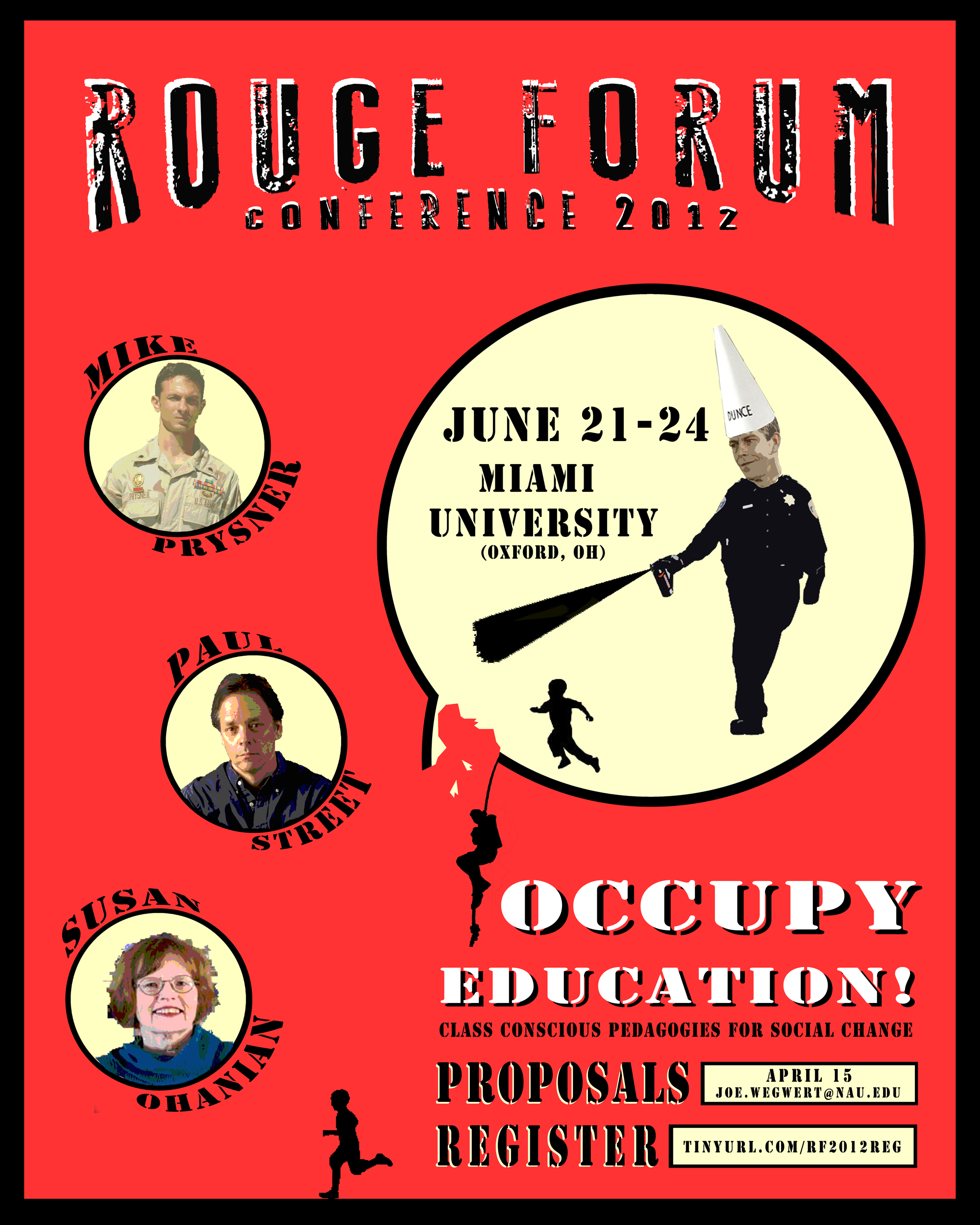
The Rouge Forum 2012 will be held at Miami University in Oxford, Ohio. The University’s picturesque campus is located 50 minutes northwest of Cincinnati. The conference will be held June 22-24, 2012.
Proposals for papers, panels, performances, workshops, and other multimedia presentations should include title(s) and names and contact information for presenter(s). The deadline for sending proposals is April 15. The Steering Committee will email acceptance notices by May 1.
Read the Call for Proposals.
Featured speakers this year include Mike Prysner, Paul Street, and Susan Ohanian.
Posted in CFPs, Students, Teachers, Unions, Working condition
Tagged CFP, conferences, Rouge Forum
Call for papers special issue of Workplace: A Journal for Academic Labor (Graduate Studies and the Academic Labor Market)
Call for Papers:
Graduate Studies and the Academic Labor Market
Special Issue of Workplace: A Journal for Academic Labor 2012
Guest Editors: Bradley J. Porfilio, Julie A. Gorlewski, and Shelley J. Jensen
Workplace invites and authors to submit papers for a special issue on Graduate Studies and the Academic Labor Market. What are the futures of the academic labor market for graduate students? Or more to the point, is there a future in academic labor for graduate students? Even a casual glance at The Chronicle of Higher Education and, in Canada, at the CAUT Bulletin and University Affairs, suggests a shrinking job market for PhDs. In some disciplines, academic careers have all but disappeared. Post-PhDs are increasingly tracked or streamed into adjunct and sessional appointments, most of which are dead-end and even on full time bases may amount to less than $25,000 per year. This “income” is oftten typically annulled by student loan payments; indeed, the income to debt ratio for post-PhDs adds to a heavy burden of anxiety. We readily romanticize the life of the intellectual, but – more and more – this life does not put food on the table. Food banks are becoming more and more common on university grounds and the lines are not limited to students.
- What is the nature of this phenomenon in higher education?
- What do these trends mean for the future of education and learning beyond mere technical training?
- How do economic hardships affect scholarly pursuits?
- How might graduate students reclaim their futures in the professoriate?
- What roles exist for the scholar activist – both novice and veteran?
- What other questions we should be asking?
The editors request abstracts for papers by September 15, 2012, with full drafts due by December 15, 2012.
For more information and due dates contact Brad Porfilio (porfilio16@aol.com)
Posted in Students, Working condition
Tagged academic labor market, CFP, graduate studies, Workplace Journal
Critical Education: “Water is a Right: A Critique of Curricular Materials and Learning Experiences in Schools Sponsored by the Transnational Water Utility Service Industry”
Critical Education has just released a new issue, featuring the article “Water is a Right: A Critique of Curricular Materials and Learning Experiences in Schools Sponsored by the Transnational Water Utility Service Industry” by J. Hall.
Critical Education 3(3), 2012
Water is a Right: A Critique of Curricular Materials and Learning Experiences in Schools Sponsored by the Transnational Water Utility Service Industryd
J. Hall
Abstract
There is no longer an infinite supply of fresh water on the planet. In large part, the global water crisis is a result of large-scale, destructive, industrial “innovations.” In just fifteen years, two-thirds of the people on the planet will feel the impact of the diminishment of safe drinking water. Given the global water crisis, the focus is this analysis is on the transnational water utility service industry as well as the larger shift from the notion of drinking water as a public right to a commodity to be privately owned and sold on the global marketplace. I discuss the very different ways these corporations are entering communities in the Southern compared to the Northern hemisphere, including attempts to re-brand their image after public failures. I then consider the particular strategies these conglomerates use to seep into cities and towns in the North. Emphasis is placed on how this sector of the water industry is becoming involved in schooling through sponsoring curricular materials and activities. I also provide initial analysis of the messages distributed in a sample of such materials and activities intended for K-12 students. While literature exists that explores curricular materials in schools provided by transnational corporations involved in direct control of natural resources, surprisingly, the privatization of the world’s fresh water supply receives little attention in both education-based scholarship and media.
Posted in Research
Tagged corporate capitalism, Critical Education, curriculum studies
Ross delivers keynote at International Conference on Research in Teaching of Social Sciences in Barcelona
Last month, E. Wayne Ross, Professor in the Department of Curriculum and Pedagogy and ICES member, gave the keynote address at the Ninth International Conference on Research in Teaching of Social Sciences at the Autonomous University of Barcelona (Spain). Organized by GREDICS (Research Group on the Teaching of Social Sciences) this year’s conference theme was “The Formation of Social Thought and the Construction of Democracy in the Teaching of Social Science, Geography, and History.”
Ross’ talk, titled “Social Control and the Pursuit of Dangerous Citizenship”, can be streamed online here (in Catalan).
The PowerPoint presentation of Ross’ talk is available in English, Spanish, and Catalan.
The abstract of his talk follows:
Social Control and the Pursuit of Dangerous Citizenship
Yes, citizenship—above all in a society like ours, of such authoritarian and racially, sexually, and class-based discriminatory traditions—is really an invention, a political production. In this sense, one who suffers any [or all] of the discriminations…does not enjoy the full exercise of citizenship as a peaceful and recognized right. On the contrary, it is a right to be reached and whose conquest makes democracy grow substantively. Citizenship implies freedom…Citizenship is not obtained by chance: It is a construction that, never finished, demands we fight for it. It demands commitment, political clarity, coherence, decision. For this reason a democratic education cannot be realized apart from an education of and for citizenship. (Paulo Freire, Teachers as Cultural Workers, p. 90)
The nature of citizenship and the meanings of citizenship education are complex, as are their multiple and contradictory implications for contemporary schooling and everyday life. The issues citizenship education presents are critical and inexorably linked to the present and future status of public schooling and the maintenance, strengthening, and expansion of individual and democratic rights.
In his classic book Democracy and Education (1916), John Dewey opens with a discussion of the way in which all societies use education as a means of social control. Dewey argues that education as a social process and function has no definite meaning until we define the kind of society we have in mind. In other words, there is no “objective” answer to questions about the means and ends of citizenship education, because those purposes are not things that can be discovered.
In Normative Discourse, Paul Taylor (1961) succinctly states a maxim that has the potential to transform our approach to the civics, citizenship education and the whole of the social studies curriculum: “We must decide what ought to be the case. We cannot discover what ought to be the case by investigating what is the case” (p. 278). We—educators and citizens—must decide what ought to be the purpose of citizenship education. That means asking what kind of society, what kind of and world we want to live in and then taking action to make it a reality. And, in particular, in what sense of democracy do we want this to be a democratic society? In order to construct meaning for civics and citizenship education, we must engage these questions not as merely abstract or rhetorical, but in relation to our lived experiences and our professional practice as educators.
Not surprisingly then civics and citizenship education—which is generally accepted as the primary purpose the social studies education—has always been a highly contested curricular area. The tapestry of topics, methods, and aims we know as social studies education has always contained threads of social reconstructionism. Social reconstructionists in the USA, such as George S. Counts, Harold Rugg, and later Theodore Brameld argued that teachers should work toward social change by teaching students to practice democratic principles, collective responsibility, and social and economic justice. Dewey advocated the democratic reconstruction of society and aspects of his philosophy inform the work of some aspects of citizenship education. The traditional patterns of social studies teaching, curriculum, and teacher education, however, reflect little of the social reconstructionist vision of the future, and current practices in these areas are more often focused on implementing standardized curriculum and responding to high-stakes tests than developing and working toward a vision of a socially just world. Indeed, the self-described social studies “contrarians” in the USA who advocate the “transmission” of “facts” and reject pluralism in favor of nationalism and monculturalism seem to be have the upper hand in most schools and classrooms, despite spirited resistance.
Undoubtedly, good intentions undergird citizenship education programs in North American. And yet, too often their oppressive possibilities overwhelm and subsume their potential for anti-oppression and anti-oppressive education, especially as states, the national government, and professional education associations continue their drive to standardize, to impose a singular theory and practice of curriculum, instruction, and assessment.
Social studies educators must pursue, as some already do, an agenda dedicated to the creation of a citizenship education that struggles against and disrupts inequalities and oppression. Classroom practice must work toward a citizenship education committed to exploring and affecting the contingencies of understanding and action and the possibilities of eradicating exploitation, marginalization, powerlessness, cultural imperialism, and violence in both schools and society. Freire, as illustrated in the above quotation, like Dewey, teaches us that citizenship education is essential to democratic education, and that democratic education is essential to a free and democratic society. Students must know that birth, nationality, documents, and platitudes are not enough. They must understand that the promises of citizenship (freedom), the fulfillment of its virtues, are unfinished, and that they remain an ongoing, dynamic struggle. And they must come to act in a variety of creative and ethical ways, for the expansion and realization of freedom and democracy, the root of contemporary notions of citizenship, is in their hands, and it demands of them no less than the ultimate in democratic and anti-oppressive human reflection and human activity.
Contemporary conditions demand an anti-oppressive citizenship education, one that takes seriously social and economic inequalities and oppression that result from neoliberal capitalism and that builds upon the anti-oppressive possibilities of established and officially sanctioned approaches. Some new and potentially exciting directions and alternatives exist, however, within the recent scholarship surrounding Freirean and neo-Freirean pedagogy, democratic education, and cultural studies.
The pedagogical power “dangerous citizenship”, which I explore in the balance of this paper, resides in its capacity to encourage students and educators to challenge the implications of their own education/instruction, to envision an education that is free and democratic to the core, and to interrogate and uncover their own well-intentioned complicity in the conditions within which various cultural texts and practices appear, especially to the extent that oppressive conditions create oppressive cultural practices, and vice versa.
Posted in Research
Tagged citizenship, conferences, Research, social studies education
