
Ingold’s “Making” describes the experiential process of creating things as a project. An inceptive idea translated into raw materials, birthing an intention in the form of an artefact. This is the basic structure that Ingold uses to introduce the concept of hylomorphism. A longitudinal interaction where forms created by the mind are imposed on material objects, creating things under Thomas’ description of ´material culture´, “rendered cultural” (qtd in Ingold, 20). Ingold is particularly critical about hylomorphism as he details that the creation of things should not be looked at as projects, but in his argument of the experiential, creating things should be considered as a process of growth. The maker in itself is part of a process, but their involvement can’t ignore the ever-moving activity of materials and materiality. Creating is not an imposition but a synergy of the animal with its environment that is not sedentary, as the hylomporphic model would suggest. Now, what I found most interesting about this argument is the involvement of materiality in the process of making.
In the second chapter, Ingold details the process and relationship between form and material, not only as a linear model by which a structure is followed in the same sense as a hylomorphic model, but as an interplay of the process of making as the creation of shifts in a material that already has matter-based movements. A modular dance, in Ingold’s terms, that disrupts predetermined material structures like grain or, in the case of iron, welding. Now moving towards the idea of materiality, Ingold divides theorists between the assumption of materiality as in the physical material and the potential interplay of the human, and the notion that materiality refers to the appropriation of physical material by human nature. Ingold connects this debate to the concept of human nature as a similar theoretical discussion. Human nature as a sort of brute, raw, instinctual material or that of adaptation and is placed on a higher level of being, more than natural. Ingold even states that “materiality, like humanity, is Janus-faced” (27).
Although Ingold argues that this debate does nothing to create a definition of materiality, the importance lies in the appeal of materiality in the actual process of becoming materials. That being said, I found the second argument to have a greater validity, both in what is considered to be materiality and in a slight psychological aspect if one thinks about the debate between nurture and nature.
To support his explication of materiality as an appropriation of materials by human nature, Ingold refers to Cornelius Holtorf and his text Notes on the Life History of a Pot Sherd. Holtorf is a German archaeologist and anthropologist working as a professor of archaeology at Linnaeus University in Kalmar, where he also serves as the UNESCO Chair on Heritage Futures. His main research focus has been in the areas of contemporary archaeology, heritage theory and futures.
Ingold refers to Holtorf’s text as a counterpoint in the debate of the definition of materiality against Geoff Bailey’s definition, which states that a material’s cultural materiality precedes several lives of an artefact or ‘thing’ as being an amalgamation of material traces, but in the end, its materiality lies in the process of outlasting moments in its formation. In a way, it signifies a hylomorphic scale of materiality where the human has an interplay in the material, but the thing itself is determined by its physical structure. Holtorf, in his example of Pot Sherds, sees materiality from a different viewpoint. As quoted by Ingold, a thing’s materiality is “no more no less than the ways in which, throughout its history, it was variably enrolled in human
life-projects” (Ingold.28). Ingold sees Holtorf’s definition as a switch between a definition based on the physicality of matter and social appropriations to its form. I would argue that, although Ingold, in a sense, criticises both arguments and theorises that the debate ultimately doesn’t give an understanding of materiality or material culture, Holtorf’s article, although inadvertently, connects to a lot of Ingold’s arguments, does in fact lay a structure by which material culture is defined by human interaction rather than the material by itself.
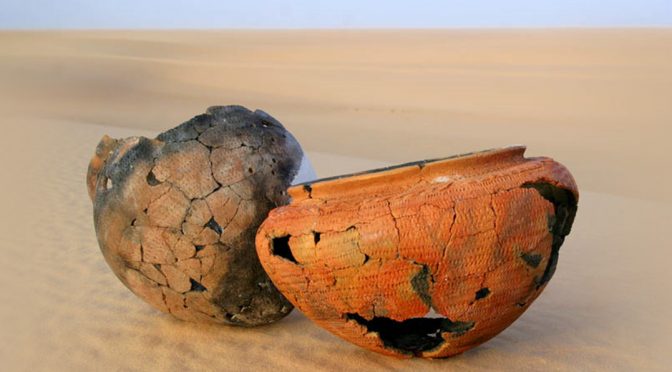
In Holtorf’s Notes on the Life History of a Pot Sherd, he recapitulates the process of finding a pot shard in the Monte Polizzo in Sicily. He goes deep into the process of seeing a piece of material, completely devoid of any context, being identified by one of the workers of the site as a pot shard. He describes the archaeological process of selecting what is potentially important and what is essentially garbage as a way of reflecting how materiality can depend on human perspective and categorisation. He then describes the process of analysing the shard through different layers of ethnographic research. In short, through the text, he details how the involvement of human identification and knowledge is the product of not the physical construction of matter, but as the material culture that identifies a ‘thing’s’ status as an artefact
In a sort of layman’s terms, Holtorf suggests that a piece of matter will remain an object, stripped of cultural materiality, until the human process of classification, analysis and knowledgeable assertions places it in its rightful status. For Holtorf, an artefact’s life cannot be assumed before its discovery. All the properties, including its material identity, are ascribed by the gradual process of research and exploration, creating a slow assembly of its form. He states that since the past lives of ‘things’ are a direct outcome of their present lives in discovery, material identity is attributed to elements not conjoined to their essential material properties but rather a product of the relationship between humans and things. If the pot shard was left hidden or discarded with the rest of the rubble, is it still an ancient artefact that can tell us about society? Or since it’s discarded, is it just trash? He states that “materiality is multiple and has a history” (Holtorf 64). This even connects to his idea of shifts in a thing’s materiality. If research is restricted to the tools and knowledge we have in the present, who is to say that a thing’s materiality won’t shift as these tools evolve?
I connect this idea if we contextualise it to the argument that Ingold brought up about the parallels to human nature. If one visualises humanity as the ‘thing’, it alone cannot evolve and progress. Yes, it may have a natural animal instinct in a sort of “raw material” form, but it is shaped by its environment and the environment in turn shapes it. It is an interconnection between the human and physical world that gives a sort of meaning to human life. It is looking at existential questions or navigations through human thought to be a product of the surrounding physical environment, as well as past experiences and knowledge we build. Holtorf quotes Thomas, a theorist also quoted in Making, when he describes how materials are identified as things depending on previous understanding, knowledge and prejudices. After the human process is done, if there is no interaction with a human or their understanding of a “thing”, then the thing is essentially reduced to the notion of an object. Something that just is.
Ingold, perhaps inadvertently, uses a source that actually connects thoroughly to the argument he places in the beginning and throughout the book. Holtorf signifies a process of research that, in its source, is ethnographic. A scientific explanation as to what a thing is, rather than what it would mean. It does not follow the anti-hylomorphic rhetoric of the Ingoll text, but in itself, the process reveals a sort of anthropological study of the epistemology of materiality. By creating these connections between the material element of a thing and the material culture imposed by human research, this understanding is in itself an experiential study of how we define materiality. It is ‘with’, not ‘about,’ as Ingoll describes in earlier chapters.
Sources Cited
Holtorf, Cornelius. “Notes on the life history of a pot sherd.” Journal of Material Culture, vol. 7, no. 1, Mar. 2002, pp. 49–71, https://doi.org/10.1177/1359183502007001305.
Ingold, Tim. Making: Anthropology, Archaeology, Art and Architecture. Routledge, 2013.