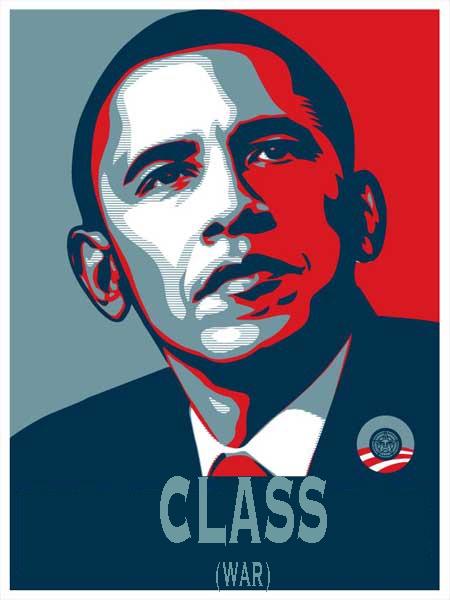
Tag Archives: class war

Rich Gibson: The Empire is Teetering! Why is There No General Strike?

The Empire is Teetering! Why is There No General Strike?

By Rich Gibson

January 4, 2025

Going downhill, like a Slinky on a staircase, the empire rolls down almost imperceptibly, until it reaches the floor and collapses in on itself.

But the empire isn’t a Slinky. It is busy with class and imperial warfare, the few attacking the many in ways more numerous than a short essay can outline.

Where is the resistance? Where are the unions?

Even conservative Catholic, David Brooks, has called for a general strike and mass civil disobedience. It only makes sense.

Let us consider our context:

Combine the vast transfer of wealth to the pecunious in the “Big Beautiful Bill,” the loss of Medicaid benefits for fourteen million people, the vast homeless crisis, climate and vaccine denial, a veritable war of the rich on the poor.

Now the hubris of a socio-pathic narcissist decapitates the head of Venezuela, kidnaps him and his wife using typically amphetamine addled Delta force based on Fort Bragg (see The Fort Bragg Cartel), flies them to New York in preparation for a trial about drugs (?).

Approximately forty people were killed in the operation: collateral damage.

Add this body count to the fast boat murders, about 100 dead, where the evidence was destroyed by guaranteeing the ship were sunk, along with two survivors who were blown up while they waved at the sky.

These were, most certainly boats full of drugs, even the one with eleven people on it—where was the room for the drugs?

Drugs– after pardoning the Honduran convicted of bringing metric tons of drugs into the US?

Consider this contradiction: Maduro is charged with enriching himself from the drug trade. Whether that is true or not, or if it is another Gulf of Tonkin tale, may take years to determine.

For his year in office, Trump and his family have enriched themselves from the ponzi scheme that is crypto (even Melania has a crypto), real estate deals, pay for play dinners with billionaires, ignoring the emoluments class.

It grew so egregious that the New York times is publishing pages of charts about the deals Trump and his allies have made, using his public office as cover for what amounts to electoral extortion.

Prattling about bringing democracy: the Constitution does not follow the flag.

Democracy talk ended on day two of the kidnapping. became, rule by proxy—likely Delcy Rodriguez, who should take a lesson from other allies and puppets, like Vietnam’s Diem (Johnson: “we killed the son of a bitch”), or Libya’s Gadaffi.

Rodriguez has been warned by the administration that if she doesn’t cooperate, “She will get something worse than Maduro.”

For her part, Rodriguez has demanded Maduro’s return.

Daughter of a guerrilla terrorist, Rodriguez, the Vice President, is also the oil minister and has been meeting with Americans for months. She is a prime candidate as the insider who made the abduction possible. And, she may well be able to cooperate. Under Maduro’s fake socialism, she was pursuing open market strategies.

Even so, democracy hasn’t ever ruled in the US.

What has ruled, and still rules, are capitalism and imperialism.

Whether we call the US a democracy (rule of the people) or a republic (somewhat distant rule of the people), they’re matched and overwhelmed by capital (rule of the few). It’s a two-sided contradiction and one side must and did win—capital.

There are answers in history, which ties the past, with the present, and organizes the future.

Founding Father, James Madison, wrote, “what if the poor vote not to pay their debts?” that would be too much democracy for any rich man.

Or, when the 1791 Whiskey Rebellion broke out after a revolution that promised equality and happiness, George Washington raised a militia of around fifteen thousand men, to attack tax protesters in Western Pennsylvania.

President Washington, who to his credit, was with the troops on battlefields during the revolution (unlike the five star hotel generals of today, parodied in the film “War Machine”) left the militia early to lower ranking officers.

They had problems: desertion, drunks, theft, but many of the ranks had no shoes and short rations.

So, how did the officers, including the gentleman Merriweather Lewis, live? The lived very well with plenty of whiskey, beef, sweets, and more.

Discipline, to enforce these inequities, was harsh—typically one hundred lashes laid on hard.

Inequality, ah, trumped, equality, fast—despite the real radicalism of the American Revolution embodied in the Declaration of Independence.

That summons to action for equality and revolution inspired radicals in France, Haiti, and Ho Chi Minh of Vietnam who wrote his declaration almost word for word from Jefferson’s.

Jefferson, per historian Stephen Ambrose, “wanted empire.” He was a slaveholder and land speculator, like Washington, two of the richest men in the country.

He and other landowner/speculators, needed more and more land to serve the soil destroyer, tobacco. It was, as always with empire, expand or die. In this case, internally, but in most cases, expand or die because another empire; now soft-economic power China, is coming.

(The US has at least 750 bases around the world. China has one. The soft power is money and people).

The US government, before and with Trump, is nothing but an executive committee and armed weapon of the ruling class, the exploiters. It is inequality, within the US and the world, not “affordability,” the Democrats mantra.

Now, back to the kidnapping.

Sun Tzu, the Chinese philosopher of war, wrote, about two thousand years ago, “know yourself, know your enemy, know the terrain, and you will win one thousand battles.”

Socio-pathic narcissists can’t know themselves, and their sycophants who trail along, all blinded by “we leader,” only know he’s a genius, that is, for public consumption, otherwise they know they are kidnapped by him.

Venezuela is a huge country, thirty million people, twice the size of Iraq. There a competing militias all over Venezuela, and two Colombian guerrilla forces. The people are armed, and were in training before the abductions. Fifteen thousand troops on ships west of Venezuela won’t be nearly enough to quell a rebellion.

Congressman Gil Cisneros says Trump wants the oil so he can process it and bring it to the US to drive down gas prices. If he is right, it’s a classic example of the US leaders not knowing the terrain, as in Vietnam, Afghanistan, and Iraq.

Venezuela’s oil processing plants are dilapidated. Over twenty years of decay means only oil rigs owned by Chevron are anywhere near full capacity. According to oil industry insiders, it will take years to bring the rigs up to capacity. Others within Trump’s orbit, promise the oil companies will be reimbursed for their efforts.

And who will reimburse them? Taxpayers from an unjust tax system where billionaires like Trump, pay little or no taxes.

Is this a diversion as a former Democratic Party presidential candidate suggests?

Yes, Trump’s popularity ratings have plummeted, and the Democrats did do will in recent elections. In New York, the voters chose a socialist, who probably won’t be able to keep his promises, like Obama’s “hope and change” demagoguery, but billionaires spent millions for Cuomo, and they lost. All true.

Then there are the Epstein files (demand the videos!) which cling to Trump like his orange makeup and wig. They were forgotten for a day.

But this military attack is part and parcel of US imperialism. It is what empire’s MUST do: join in the relentless struggle for cheap labor, raw materials (oil), regional control and markets. Empire sent the US into Vietnam (rice, tin, rubber, strategic location), Afghanistan (strategic location going back to the Great Game) and Iraq (oil again).

Rosa Luxemberg outlined empire long ago.

“In detail, capital in its struggle against societies with a natural economy pursues the following ends:

  1. To gain immediate possession of important sources of productive forces such as land, game in primeval forests, minerals, precious stones and ores, products of exotic flora such as rubber, etc.

  2. To ‘liberate’ labour power and to coerce it into service. 

  3. To introduce a commodity economy.

  4. To separate trade and agriculture.”

The 2025 National Security Strategy, straight from Project 2025, expands on the 1823 Monroe Doctrine, now dubbed the Don-doctrine, declaring all of the Americas the property of the US. Trump, before the kidnapping, declared Venezuelas’ oil, “ours.”

The many-titled Marco Rubio threatened Cuba, Columbia, and Mexico, with the Venezuela treatment. Clearly, Greenland and Canada have reason to worry about the once-peacenik candidate Trump.

My “No Blood for Oil,” buttons and stickers, created in 2001, will be good for the rest of our lives.

Moments after the kidnappings were announced, lawyers leaped forward to declare the actions illegal, under so many laws that I lost count: the UN Charter, no involvement of congress, the War Powers Act, and more. But the law is merely a reflection of political and economic reality. US law is PROPERTY law. There is no right to have a job, home, health care—it’s not about human rights, it is about power, and usually money.

And so, it’s only illegal if you get caught, and sure they are caught, after all they caught themselves by announcing the kidnapping.

No law is going to stop them. Trump has immunity. He can pardon the other co-conspirators in murder and kidnapping, and that will be that.

And, immediately after I heard the big news, I got an email from the Democratic Party Front, Move-on, urging donations and plans to petition congress, and let’s vote in the mid-terms.

Nobody ever voted their way out of fascism, and that is what this modern tyranny is. It will take a mass, activist, anti-racist, class conscious movement with experience in direct action, on the job and off.

General Strike?

Let us wrap up with why there will be no general strike.

I have never been able to get off the merry-go-round of the bogus US unions. I have been writing about them for nearly 20 years, often on Counterpunch.

A sidelight of imperialism is that the core empire loots enough goods and money to bribe certain sections of the working class. Lenin demonstrated this more than 100 years ago. It’s still true.

The upshot of this is that the union bosses who, as above, believe and benefit from, Partners in Production, sell the pacified labor of the union members to the Big Bosses, in exchange for dues income, off of which the labors bosses live very well.

Foe example, a past president of the National Education Union, where I once worked as an organizer, when NEA was actually a union on the early ’80s, made $686, 949 in his last year in office—this in a union where many school workers live in trailers.

It follows that a general strike led by rank and file activists, would upend that sweet deal. They’d realize the union bosses would become worse than irrelevant—enemies. The union bosses know they are corrupt, and they are going to protect their corruption at all costs.

A United Auto Workers president threatened to kill a dissenter in his inner circle.

In the unlikely event that some accelerator, like the Tunisian fruit vendor who self-immolated to set off the disastrous “Arab Spring,” should create a series of rolling strike that coalesce as a General Strike, expect a violent response.

ICE, Border Patrol, and Trump’s own SS, the Proud Boys, the Oath Keepers, unmarked masked men, and others will certainly mobilize and, as in past strikes, like the railroad strike of 1877, people will begin to be “shot back to work.”

Simply withdrawing labor may not be enough.

All the forces of the state, the police, the courts, almost all of congress, the mainstream media, and most cultural institutions would be arrayed against strikers and their allies.

And, then, in the even unlikelier event that class consciousness sees the state itself as a target, the planning gets beyond my pay grade, and my crystal ball becomes opaque. While I like the Declaration’s call for the necessity of revolution, and I have already laid out plenty of similar grievances, a 21st century revolution is difficult for me to imagine.

This is the best I can do. I’ve been thinking and acting like this for more than six decades. The youngers will have to pick up where parts of my generation left off (so many mistakes, sad to say) and carry on the fight for equality and justice.

One last thing.

Justice demands organization. A critical examination of past parties, and the contradictions of democratic centralism, must push forward our battle,

Rich Gibson is professor emeritus of history from San Diego State University. He, with Wayne Ross, is the founder of the Rouge Forum. He can be contacted at: RG@Richgibson.com
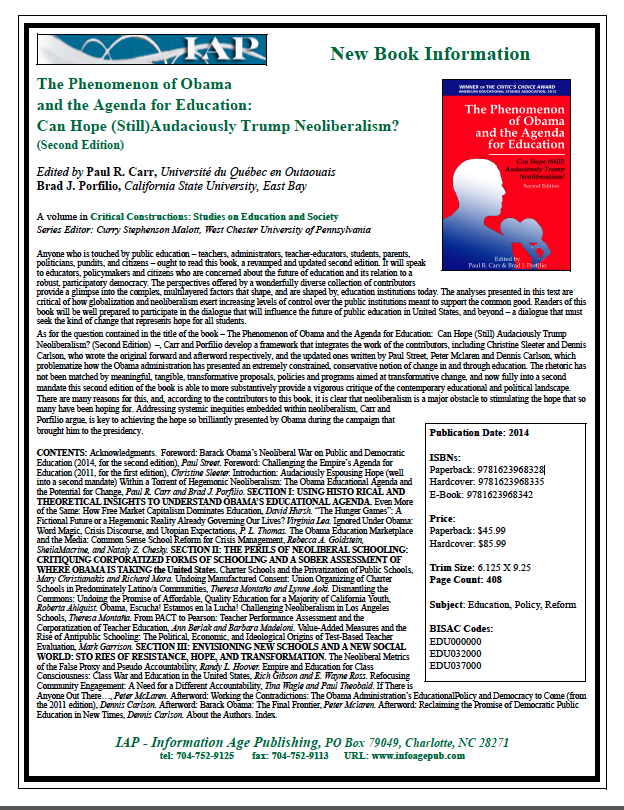
New book: The Phenomenon of Obama and the Agenda for Education – 2nd Edition

The Phenomenon of Obama and the Agenda for Education – 2nd Edition
Can Hope (Still) Audaciously Trump Neoliberalism?

Edited by:
Paul R. Carr, Université du Québec en Outaouais
Brad J. Porfilio, CSU, East Bay

A volume in the series: Critical Constructions: Studies on Education and Society. Editor(s): Curry Stephenson Malott, West Chester University of Pennsylvania, Brad J. Porfilio, California State University, East Bay, Marc Pruyn, Monash University, Derek R. Ford, Syracuse University.

Published 2015

Anyone who is touched by public education – teachers, administrators, teacher-educators, students, parents, politicians, pundits, and citizens – ought to read this book, a revamped and updated second edition. It will speak to educators, policymakers and citizens who are concerned about the future of education and its relation to a robust, participatory democracy. The perspectives offered by a wonderfully diverse collection of contributors provide a glimpse into the complex, multilayered factors that shape, and are shaped by, education institutions today. The analyses presented in this text are critical of how globalization and neoliberalism exert increasing levels of control over the public institutions meant to support the common good. Readers of this book will be well prepared to participate in the dialogue that will influence the future of public education in United States, and beyond – a dialogue that must seek the kind of change that represents hope for all students.

As for the question contained in the title of the book – The Phenomenon of Obama and the Agenda for Education: Can Hope (Still) Audaciously Trump Neoliberalism? (Second Edition) –, Carr and Porfilio develop a framework that integrates the work of the contributors, including Christine Sleeter and Dennis Carlson, who wrote the original forward and afterword respectively, and the updated ones written by Paul Street, Peter Mclaren and Dennis Carlson, which problematize how the Obama administration has presented an extremely constrained, conservative notion of change in and through education. The rhetoric has not been matched by meaningful, tangible, transformative proposals, policies and programs aimed at transformative change, and now fully into a second mandate this second edition of the book is able to more substantively provide a vigorous critique of the contemporary educational and political landscape. There are many reasons for this, and, according to the contributors to this book, it is clear that neoliberalism is a major obstacle to stimulating the hope that so many have been hoping for. Addressing systemic inequities embedded within neoliberalism, Carr and Porfilio argue, is key to achieving the hope so brilliantly presented by Obama during the campaign that brought him to the presidency.

CONTENTS
Acknowledgments. Foreword: Barack Obama’s Neoliberal War on Public and Democratic Education (2014, for the second edition), Paul Street. Foreword: Challenging the Empire’s Agenda for Education (2011, for the first edition), Christine Sleeter. Introduction: Audaciously Espousing Hope (well into a second mandate) Within a Torrent of Hegemonic Neoliberalism: The Obama Educational Agenda and the Potential for Change, Paul R. Carr and Brad J. Porfilio.

SECTION I: USING HISTO RICAL AND THEORETICAL INSIGHTS TO UNDERSTAND OBAMA’S EDUCATIONAL AGENDA. Even More of the Same: How Free Market Capitalism Dominates Education, David Hursh. “The Hunger Games”: A Fictional Future or a Hegemonic Reality Already Governing Our Lives?Virginia Lea. Ignored Under Obama: Word Magic, Crisis Discourse, and Utopian Expectations, P. L. Thomas. The Obama Education Marketplace and the Media: Common Sense School Reform for Crisis Management, Rebecca A. Goldstein, SheilaMacrine, and Nataly Z. Chesky.

SECTION II: THE PERILS OF NEOLIBERAL SCHOOLING: CRITIQUING CORPORATIZED FORMS OF SCHOOLING AND A SOBER ASSESSMENT OF WHERE OBAMA IS TAKING THE UNITED STATES. Charter Schools and the Privatization of Public Schools, Mary Christianakis and Richard Mora. Undoing Manufactured Consent: Union Organizing of Charter Schools in Predominately Latino/a Communities, Theresa Montaño and Lynne Aoki. Dismantling the Commons: Undoing the Promise of Affordable, Quality Education for a Majority of California Youth, Roberta Ahlquist. Obama, Escucha! Estamos en la Lucha! Challenging Neoliberalism in Los Angeles Schools,Theresa Montaña. From PACT to Pearson: Teacher Performance Assessment and the Corporatization of Teacher Education, Ann Berlak and Barbara Madeloni. Value-Added Measures and the Rise of Antipublic Schooling: The Political, Economic, and Ideological Origins of Test-Based Teacher Evaluation, Mark Garrison.

SECTION III: ENVISIONING NEW SCHOOLS AND A NEW SOCIAL WORLD: STO RIES OF RESISTANCE, HOPE, AND TRANSFORMATION. The Neoliberal Metrics of the False Proxy and Pseudo Accountability, Randy L. Hoover. Empire and Education for Class Consciousness: Class War and Education in the United States, Rich Gibson and E. Wayne Ross. Refocusing Community Engagement: A Need for a Different Accountability, Tina Wagle and Paul Theobald. If There is Anyone Out There…, Peter McLaren. Afterword: Working the Contradictions: The Obama Administration’s EducationalPolicy and Democracy to Come (from the 2011 edition), Dennis Carlson. Afterword: Barack Obama: The Final Frontier, Peter Mclaren. Afterword: Reclaiming the Promise of Democratic Public Education in New Times, Dennis Carlson.About the Authors. Index.

Phenomenon of Obama 2 ed

Education for Dangerous Citizenship

I’ll be at the University of Texas at San Antonio in November giving a talk as part of the Educational Leadership & Policy Studies Distinguished Lecture Series.

The talk, titled “Education for Dangerous Citizenship”, will draw from some of my recent work with Rich Gibson (e.g., “The Education Agenda is a War Agenda” and “No Child Left Behind and the Imperial Project”) and Kevin D. Vinson (“The Concrete Inversion of Life””: Guy Debord, the Spectacle, and Critical Social Studies Education” [pdf]). The UTSA talk will cover some of the foundational ideas for a book Kevin and I are currently writing titled Dangerous Citizenship: A Theory and Practice of Contemporary Critical Pedagogy.

Thanks to Abraham DeLeon for organizing things at UTSA.

Here’s the blurb:

Education for Dangerous Citizenship: War, Surveillance, Spectacle, and the Education Agenda

We live in an era in which leaders have delivered on the promise of perpetual war and where the primary role of “public” schooling is social control. In the contemporary milieu of advanced capitalism, the fusion of surveillance and spectacle produces, maintains, and propagates controlling images that enforce prevailing societal norms by disciplining the thoughts and behaviors of individuals and groups. How might educators respond to the mechanisms of the state used to ensure direct and ideological social control? How might we resist increasingly color-coded social and economic inequality? And might we subvert an education agenda that is a (class) war agenda?

Rouge Forum Update: Happy Holidays To Us, Every One! And Remember March 4th!

Obey-Obama-CLASS

Dear Friends, Here’s to the 4468 of us on the Rouge Forum list who have, in one way or another, sought to fashion reason and connect that to power. Here’s to a decade that lays the foundation for a just and equitable society—fun too!

On the Education Front is a Class War Front This Week:

The Rouge Forum Newslatest edition is now available

National Call for March 4 Strike and Day of Action To Defend Public Education:

California has recently seen a massive movement erupt in defense of public education — but layoffs, fee hikes, cuts, and the re-segregation of public education are attacks taking place throughout the country. A nationwide resistance movement is needed.

We call on all students, workers, teachers, parents, and their organizations and communities across the country to massively mobilize for a Strike and Day of Action in Defense of Public Education on March 4, 2010. Education cuts are attacks against all of us, particularly in working-class communities and communities of color.

The politicians and administrators say there is no money for education and social services. They say that “there is no alternative” to the cuts. But if there’s money for wars, bank bailouts, and prisons, why is there no money for public education?

We can beat back the cuts if we unite students, workers, and teachers across all sectors of public education — Pre K-12, adult education, community colleges, and state-funded universities. We appeal to the leaders of the trade union movement to support and organize strikes and/or mass actions on March 4. The weight of workers and students united in strikes and mobilizations would shift the balance of forces entirely against the current agenda of cuts and make victory possible.

Building a powerful movement to defend public education will, in turn, advance the struggle in defense of all public-sector workers and services and will be an inspiration to all those fighting against the wars, for immigrants rights, in defense of jobs, for single-payer health care, and other progressive causes.

Why March 4? On October 24, 2009 more than 800 students, workers, and teachers converged at UC Berkeley at the Mobilizing Conference to Save Public Education. This massive meeting brought together representatives from over 100 different schools, unions, and organizations from all across California and from all sectors of public education. After hours of open collective discussion, the participants voted democratically, as their main decision, to call for a Strike and Day of Action on March 4, 2010. All schools, unions and organizations are free to choose their specific demands and tactics — such as strikes, rallies, walkouts, occupations, sit-ins, teach-ins, etc. — as well as the duration of such actions.

Let’s make March 4 an historic turning point in the struggle against the cuts, layoffs, fee hikes, and the re-segregation of public education.

– The California Coordinating Committee

(To endorse this call and to receive more information contact: march4strikeanddayofaction@gmail.com and check out www.defendcapubliceducation.wordpress.com )

Read the full Rouge Forum Update here.

Finance oligarchy captures US government; US government preps for civil unrest

The conventional wisdom, to this point, has been that current economic crisis cannot be as bad as The Great Depression. Conventional wisdom is apparently changing.

Last week, renowned investor George Soros said the world financial system has effectively disintegrated, adding that there is yet no prospect of a near-term resolution to the crisis.

Soros believes the current economic crisis has created more severe turbulence than the Great Depression and former Fed chairman Paul Volker, speaking at the same conference at Columbia University, agrees: “I don’t remember any time, maybe even in the Great Depression, when things went down quite so fast, quite so uniformly around the world,” Volcker said.

Referring to events in Septmeber 2008, when Lehman Brothers went under, Soros said, “We witnessed the collapse of the financial system. It was placed on life support, and it’s still on life support. There’s no sign that we are anywhere near a bottom.”

The bailout money is being abused in a number of ways, all of which recycle bailout cash back to corporate elites and the political class:

  • Former New York Governor Eliot Spitzer has criticize AIG, not for using bailout cash to give huge bonuses to its executives, but for repaying, in full, its investment banking partners—steering additional federal dollars to Goldman Sachs, Bank of America, Merrill Lynch, JPMorgan Chase and others when they already were already being propped up by Washington.

“Bank of America (which got $15 billion in bailout money) sent out $24,500 in the first two months of 2009, including $1,500 to House Majority Leader Steny Hoyer and another $15,000 to members of the House and Senate banking panels. Citigroup ($25 billion) dished out $29,620, including $2,500 to House GOP Whip Eric Cantor, who also got $10,000 from UBS which, while not a TARP recipient, got $5 billion in bailout funds as an AIG “counterparty.”

But Spitzer and Newsweek are talking small potatoes compared to the Simon Johnson’s assessment of the current economic crisis. In “The Quite Coup” (The Atlantic, March 2009),  Johnson, a professor at MIT’s Sloan School of Management and former chief economist at the International Monetary Fund, says that that the finance industry has “effectively captured our government” not through violence or bribes (Abramoff and K Street notwithstanding), but

Instead, the American financial industry gained political power by amassing a kind of cultural capital—a belief system. Once, perhaps, what was good for General Motors was good for the country. Over the past decade, the attitude took hold that what was good for Wall Street was good for the country. The banking-and-securities industry has become one of the top contributors to political campaigns, but at the peak of its influence, it did not have to buy favors the way, for example, the tobacco companies or military contractors might have to. Instead, it benefited from the fact that Washington insiders already believed that large financial institutions and free-flowing capital markets were crucial to America’s position in the world.

What we have is an ideological coup. The government quite clearly acting as the executive committee of the rich. Johnson explains why we have been been denied the pleasure of of seeing fat cats jumping out of Wall Street skyscrapers—the financial oligarchy remains in control, blocking essential reforms and continuing to push us toward the Greatest Depression.

Johnson’s article is the most clearly reasoned, knowledgeable, and accessible piece I’ve read on root causes of the current crisis and he presents a “tried and true” strategy for solving it too—IMF shock therapy. He likens the U.S. economic and financial crisis to what has been seen in emerging markets (and only in emerging markets) like South Korea (1997), Malaysia (1998), Russia and Argentina (time and again).

In each of those cases, global investors, afraid that the country or its financial sector wouldn’t be able to pay off mountainous debt, suddenly stopped lending. And in each case, that fear became self-fulfilling, as banks that couldn’t roll over their debt did, in fact, become unable to pay. This is precisely what drove Lehman Brothers into bankruptcy on September 15, causing all sources of funding to the U.S. financial sector to dry up overnight. Just as in emerging-market crises, the weakness in the banking system has quickly rippled out into the rest of the economy, causing a severe economic contraction and hardship for millions of people.

The financiers who created the crisis with the able assistance of Wall Street alumni in government (particularly ex-Goldman Sachs executives who have been ensconced at the Treasury Department for multiple administrations) are now, according to Johnson, “using their influence to prevent precisely the sorts of reforms that are needed, and fast, to pull the economy out of its nosedive. The government seems helpless, or unwilling, to act against them.” Well, the financiers are the government.

For Johnson the two major, interrelated problems are the banking sector “that threatens to choke off any incipient recovery that the fiscal stimulus might generate” and  “a political balance of power that gives the financial sector a veto over public policy, even as that sector loses popular support.” On the former, he suggests the IMF’s nationalization approach. On the latter, Johnson suggests replacing our current elites, with a new batch. Hmm.

While Johnson’s analysis is compelling, his solutions, unsurprisingly, aren’t—two scenarios: IMF approach solves the problem or catastrophic global depression smartens up the elites).

Meanwhile the US government moves forward to on plans to use the military to control civil unrest as a result of the collapsing economy, as legislation to establish internment camps on US military bases has been introduced into the House of Representatives.

Doesn’t look to me like the finance oligarchy is planning to step down any time soon.

As the economic crisis sparks upheaval globally, analysts fear possibility of class war in the USA

As global capitalism implodes there is has been a marked uptick in social upheaval worldwide and now establishment analysts are expressing their concerns about “class conflict” and “civil war” in the USA.

The Economic Meltdown Sparks Global Unrest

The financial crisis has sparked unrest globally and particularly across Europe, with demonstrations, strikes, and protests in 16 European countries. Here are a just a few examples:

  • Tens of thousands of workers marched in Lisbon, Portugal on March 13 against the policies of the Socialist government, which unions say are increasing unemployment and favoring the rich at a time of crisis;
  • Hundreds of workers at Bulgaria’s Kremikovtzi steel mill protested on March 9 over planned lay-offs and unpaid salaries, demanding the Socialist-led government find a buyer for the insolvent plant; thousands of police officers marched in Sofia on Sunday to demand a 50 percent wage rise and better working conditions;
  • In Greece, the fatal police shooting of a 15-year old in December sparked the country’s worst riots in decades, fueled by anger at economic hardships and youth unemployment. Anarchists and left wing guerrilla groups have followed up with a wave of attacks against banks and police; Greek unions, representing about 2.5 million workers, have also staged repeated protests against the government saying its measures to tackle the global crisis only burden the poor;
  • Last month over 100,000 people marched against cutbacks in Ireland.

High unemployment rates have led to protests in Latvia, Chile, Greece, Bulgaria and Iceland and contributed to strikes in Britain and France.

Last month, a half-million Mexican truckers shut down the countries highways to protest high fuel prices.

In December, Russian riot police busted up protests in Vladivostok against new taxes intended to “help prop up Russia’s domestic car industry and prevent people buying cheaper, imported products.” BBC reports that the protests were fuelled by the severe impact of the global economic crisis on Russia. According to Newsweek, “the Russian Interior Ministry set up a special command center in Moscow, packed with surveillance equipment designed to deal with street unrest. The Duma, on Kremlin instructions, added seven new articles to the criminal code including a law that makes “participating in mass disorders” such as the one in Vladivostok a ‘crime against the state.'” 800,000 Russians lost their jobs in December and January, making the total number of unemployed more than 6 million or 8.1 percent. Gennady Gudkov, former KGB colonel and current chair of the Duma’s security committee, said, “We are expecting mass unemployment and mass riots. There will be not enough police to stop people’s protests by force.”

There a have been massive general strikes in the French territories of Guadeloupe, Martinique, and Réunion. The general strike in Guadeloupe prompted the French government to fly in riot police (Guadeloupe is a French “overseas department” in the Caribbean). And while the general strike lasted 6 weeks—it ended on March 4 with an agreement among the strike collective, the employers federation and local and French governments, which granted 20 of the strikers primary demands and set out negotiations on a long list of remaining issues—strikes and protests continue, involving tens of thousands of workers.

The agreement to end the Gaudeloupe strike , called the “Jacques Bino Accord”, identifies the underlying cause of discord as “the present economic and social situation existing in Guadeloupe [that] results from the perpetuation of the model of the plantation economy”. An economy “based on monopoly privileges and abuses of dominant positions that generate injustices.” The accord calls for an end to these obstacles “by establishing a new economic order enhancing the status of everyone and promoting new social relationships”.

Just as the general strike ended in Guadeloupe, social unrest over economic conditions spread to Réunion (a French “overseas department” in the Indian Ocean).

There is a definite pattern developing world wide. And now, US elites are starting to worry about what might happen if the American workers take action as a result of their frustrations with massive economic inequalities.

USA Prepares for Class War

YouTube Preview Image

In his latest monthly commentary (Mar. 15, 2009, Commentary No. 253), sociologist and world-systems analyst Immanuel Wallerstein discusses the breakdown of taboos as the world’s economy continues to disintegrate.

He notes, for example, that “nationalization” of banks and industry is now being seriously discussed by establishment intellectuals and analysts such as Alan Greenspan, Senator Lindsay Graham, and economist Alan Blinder.

But Wallerstein’s most dramatic example of the breakdown of taboos is the open discussion of the possibility of class war breaking out in the USA. Wallerstein says that “after hearing nationalization proposals by arch-conservative notables, we are now hearing serious discussions about the possibilities of civil war in the United States. Zbigniew Brzezinski, apostle of anti-Communist ideology and President Carter’s National Security Advisor, appeared on a morning television talk show on February 17, and was asked to discuss his previous mention of the possibility of class conflict in the United States in the wake of the worldwide economic collapse.”

In Brzezinski’s interview with Joe Scarborough on MSNBC about his recently published book—America and the World: Conversations on the Future of American Foreign Policy, co-authored with another former National Security Advisor (to Gerald Ford and George H. W. Bush) Brent Scowcroft—Brezenzki was straightforward about the belief that class war in America is real possibility:

JOE SCARBOROUGH: You also talked about the possibility of class conflict.

ZBIGNIEW BRZEZINSKI: I was worrying about it because we’re going to have millions and millions of unemployed, people really facing dire straits.  And we’re going to be having that for some period of time before things hopefully improve. And at the same time there is public awareness of this extraordinary wealth that was transferred to a few individuals at levels without historical precedent in America…And you sort of say to yourself: what’s going to happen in this society when these people are without jobs, when their families hurt, when they lose their homes, and so forth?

We have the government trying to repair: repair the banking system, to bail the housing out.  But what about the rich guys? Where is it?  [What are they] doing?

Brzezinski went on to compare the current economic meltdown to the “Panic of 1907”:

It sort of struck me, that in 1907, when we had a massive banking crisis, when banks were beginning to collapse, there were going to be riots in the streets. Some financiers, led by J.P. Morgan, got together.  He locked them in his library at one point. He wouldn’t let them out until 4:45 AM, until they all kicked in and gave some money to stabilize the banks: there was no Federal Reserve at the time.

Where is the monied class today? Why aren’t they doing something: the people who made billions, millions.  I’m sort of thinking of Paulson, of Rubin [former treasury secretaries]. Why don’t they get together, and why don’t they organize a National Solidarity Fund in which they call on all of those who made these extraordinary amounts of money to kick some back in to [a] National Solidarity Fund?

Brzezinski continued saying,

“And if we don’t get some sort of voluntary National Solidarity Fund, at some point there’ll be such political pressure that Congress will start getting in the act, there’s going to be growing conflict between the classes and if people are unemployed and really hurting, hell, there could be even riots!

Wallerstein points out that “almost simultaneously” LEAP/Europe a European agency that issues monthly confidential bulletins for its clients—politicians, public servants, businessmen, and investors—devoted its February issue to global geopolitical dislocation, discussing the possibility of civil war in Europe, in the United States, and Japan; and foreseeing a “generalized stampede” that will lead to clashes, semi-civil wars.

Wallerstein quotes the Global Europe Anticipation Bulletin as saying:

“If your country or region is a zone in which there is a massive availability of guns, the best thing you can do…is to leave the region, if that’s possible.”

And Wallerstein also points out that, “the only one of these countries which meets the description of massively available guns is the United States. The head of LEAP/Europe, Franck Biancheri, noted that ‘there are 200 million guns in circulation in the United States, and social violence is already manifest via gangs.’ The experts who wrote the report asserted that there is already an ongoing emigration of Americans to Europe, because that is ‘where physical danger will remain marginal.'”

Wallerstein emphases that “these analyses are not coming from left intellectuals or radical social movements.…Verbal taboos are broken only when such people are truly fearful. The point of breaking the taboos is to try to bring about major rapid action – the equivalent of J.P. Morgan locking the financiers in his home in 1907.”

And US elites are obviously fearful enough to start planning for military responses to potential social upheaval as a result of the collapsing economy.

Last November, the US War College’s Strategic Studies Institute posited a number of  “strategic surprises” that the country should be prepared for, including potential for disruption and violence caused by the economy’s failure. The report Known Unknowns: Unconventional ‘Strategic Shocks’ in Defense Strategy Development, says “widespread civil violence inside the US would force the defense establishment to reorient priorities in extremis to defend basic domestic order and human security.”

And now, for the first time ever, US military units are staged and are training inside the country to address civil unrest rising from inequality. The Army Times has reported on the US Northern Command’s (NORTHCOM) deployment of the 3rd Infantry Division’s 1st Combat Brigade Team (BCT) on U.S. soil for “civil unrest” and “crowd control” duties. The 5,000-member force was one of first units deployed in Baghdad.