U. of Iowa Lists 14 Graduate Programs at Risk for Cuts or Elimination

The Chronicle: U. of Iowa Lists 14 Graduate Programs at Risk for Cuts or Elimination

Worried faculty members at the University of Iowa now have a report from a provost-appointed task force that names 14 graduate programs — half in the humanities — that could be restructured or eliminated as the university seeks to save money.

In a process that began last spring and triggered some angst among faculty members, the task force categorized the institution’s 111 graduate programs into five groups. The 14 programs are in a category called “additional evaluation required” and have “significant problems,” with no “viable plans for improvement,” the report says.

The programs the group said needed to be evaluated further are: American studies, M.A. and Ph.D.; Asian civilizations, M.A.; comparative literature, M.A. and Ph.D.; comparative literature (translation), M.A. and Ph.D.; film studies, M.A. and Ph.D.; German, M.A. and Ph.D.; linguistics, M.A. and Ph.D.; educational policy and leadership studies (educational administration), M.A., Ed.S., and Ph.D.; educational policy and leadership studies (social foundations of education), M.A. and Ph.D.; health and sport studies, M.A. and Ph.D.; teach and learn (elementary education), M.A. and Ph.D.; stomatology, M.S.; integrative physiology, Ph.D.; and exercise science, M.S.

U of A faculty accepts six unpaid days

Edmonton Journal: U of A faculty accepts six unpaid days

EDMONTON – University of Alberta faculty have agreed to take six unpaid days of vacation next year in exchange for the chance to review and critique previously confidential financial planning documents.

“It’s not a matter of having any sort of veto power,” said Walter Dixon, president of the academic staff association. “If we think it’s the wrong decision, we can actually say so before that decision is made so that there may be some sober second thought.”

Ohio U Faculty Challenge Tenure Denial

Inside Higher Ed: Faculty Challenge Tenure Denial

In denying a qualified Ohio University journalism professor tenure, university administrators violated principles of due process and failed to produce sufficient evidence to justify their opposition, a faculty committee has found.

An ad hoc committee of Ohio’s Faculty Senate on Sunday issued a report recommending that Bill Reader be granted tenure status and labeling the process up to this point as “tainted” and “compromised” by a variety of administrative missteps.

Is Heckling a Right?

Inside Higher Ed: Is Heckling a Right?

Every few minutes during a talk last week at the University of California at Irvine, the same thing happened. A student would get up, shout something critical of Israel, be applauded by some in the audience, and be led away by police.

The speaker — Michael Oren, Israel’s ambassador to the United States — was repeatedly forced to stop his talk. He pleaded for the right to continue, and continued. University administrators lectured the students and asked them to let Oren speak. In the end, 11 students were arrested and they may also face charges of violating university rules. (Video of the event, distributed by a pro-Israel group, can be found here.)

Jury Finds Oregon Professor Suffered Bias for Not Being Fully Japanese

Register-Guard: Bias verdict is hollow victory
A former professor who won damages from the UO says she would rather have her job back

The Register-Guard
Appeared in print: Tuesday, Feb 16, 2010

A former professor who last week won a reverse race discrimination lawsuit against the University of Oregon said Monday that she feels vindicated by the federal jury’s verdict but is still paying a high price for the unfair treatment.

A U.S. District Court jury awarded Paula Rogers more than $164,000 after finding that she suffered adverse treatment and a hostile work environment in the UO’s East Asian Languages and Literatures department because she is only half Japanese. Jurors also found that Rogers suffered departmental retaliation for filing a grievance over the discrimination.

Obama’s Efforts to Improve Teachers’ Training Stir Old Debates

The Chronicle: Obama’s Efforts to Improve Teachers’ Training Stir Old Debates

At Arizona State University, education majors are studying less education than they used to.

Students in the college of education are taking more courses in the subjects they intend to teach. The law-school dean is writing a civics curriculum for aspiring elementary-school teachers; university scientists have created a science program. It’s a universitywide effort to make teacher training more rigorous and effective, one financed in part by a new $33.8-million grant

New Journals, Free Online, Let Scholars Speak Out

The Chronicle: New Journals, Free Online, Let Scholars Speak Out

He seems genial, but John Willinsky is a dangerous man.

As a leader in the development and spread of “open access” scholarly journals, which are published online and offered free, the Stanford University education professor is not just helping to transform academic publishing. He is also equipping scholars around the world with a tool to foment revolution.

Principles for ‘One Faculty’

Inside Higher Ed: Principles for ‘One Faculty’

A coalition of academic associations is today issuing a joint statement calling on colleges to recognize that they have “one faculty” and to treat those off the tenure track as professionals, with pay, benefits, professional development and participation in governance.

The joint statement, “One Faculty Serving All Students,” calls for colleges to adopt a series of policies that would significantly improve the treatment of adjunct faculty members at many institutions. The statement was organized by the Coalition on the Academic Workforce, and has been signed by 14 disciplinary associations as well as by the American Federation of Teachers. The disciplines involved represent such major fields as anthropology, art, composition, English, foreign languages, philosophy and religion.

11 students arrested after disrupting Israeli ambassador’s speech at UC Irvine

Los Angeles Times: 11 students arrested after disrupting Israeli ambassador’s speech at UC Irvine

Soon after Israeli ambassador to the United States Michael Oren began his speech Monday night at UC Irvine, the first student rose.

“Michael Oren, propagating murder is not an expression of free speech,” the student in a gray hoodie yelled.

The remainder of his words were drowned out by an uproar of cheering and clapping from students sitting around him before he was led away by university police. It was the first of 10 interruptions throughout the speech, and by the end of the night, 11 UC Irvine and Riverside students were arrested and cited for disturbing a public event.

UK: Thousands to lose jobs as universities prepare to cope with cuts

The Guardian: Thousands to lose jobs as universities prepare to cope with cuts

• Post-graduates to replace professors
• Staff poised to strike over proposals of cuts

Universities across the country are preparing to axe thousands of teaching jobs, close campuses and ditch courses to cope with government funding cuts, the Guardian has learned.

Other plans include using post-graduates rather than professors for teaching and the delay of major building projects. The proposals have already provoked ballots for industrial action at a number of universities in the past week raising fears of strike action which could severely disrupt lectures and examinations.

THE NETHERLANDS: Students protest against grant cuts

World University News: THE NETHERLANDS: Students protest against grant cuts

Dutch Education Minister Ronald Plasterk has proposed substituting the monthly student grant of EUR266 (US$367) with a loan system. More than 1,000 students protested at the move, occupying lecture halls and university buildings in Amsterdam, Nijmegen, Utrecht and Rotterdam.

Educators, students under increasing attack

World University News; GLOBAL: Education under increasing attack

Around the world, schools and universities have faced brutal military and political attacks in an increasing number of countries over the past three years, according to a new report published by Unesco. Since 2007 there have been thousands of reported cases of students, teachers, academics and other education staff being kidnapped, imprisoned, beaten, tortured, burned alive, shot or blown up by rebels, armies and repressive regimes.

Tenure and the Workplace Avenger

The Chronicle: Tenure and the Workplace Avenger

For millions of Americans, last Friday’s mass shooting at the University of Alabama at Huntsville, in which three faculty members were killed and two others and one staff member were injured, has conjured up frightful memories of massacres at Virginia Tech and Northern Illinois University. And in its wake, concerns are being raised yet again about campus safety and emergency response.

American academics to meet in Uganada?

Inside Higher Ed: Dilemma Over Meeting in Uganda

The American Political Science Association is among several disciplinary associations that have found themselves caught in debates over whether to hold meetings in locales that some want to boycott. In 2008, the association rejected calls by some to move the 2012 meeting out of New Orleans because Louisiana has adopted one of the most stringent bans on gay marriage, applying the ban also to any proposed legal relationships, such as civil unions, that could be seen as resembling marriage. The decision led to a call by some political scientists to boycott the meeting.

RPI Prez No. 8 in Corporate Board Pay

Bloomberg: Sarbanes-Oxley Lifts Some Directors’ Pay Higher Than $1 Million

Feb. 12 (Bloomberg) — The Great Recession hasn’t stopped pay increases for company boards. According to compensation consultants Pearl Meyer & Partners, the typical director of a large corporation made $216,000 last year, up from $129,667 in 2003…

Shirley Ann Jackson 2008 board pay: $1,346,648 (Public Service Enterprise Group, $213,110; NYSE Euronext, $225,016; Medtronic, $193,275; FedEx, $210,548; IBM, $229,699; Marathon Oil, $275,000) Jackson’s day job is pretty lucrative, too. As president of Rensselaer Polytechnic Institute, she was paid $1.6 million in 2008. She was unavailable for comment.

Alberta’s 2002 Teacher Strike: The Political Economy of Labor Relations in Education

Education Policy Analysis Archives has just published its latest issue at
http://epaa.asu.edu/ojs/article/view/697

Estimados/as lectores/as
Archivos Analíticos de Políticas Educativas acaba de publicar su último
artículo en http://epaa.asu.edu/ojs/article/view/697

Prezados/as leitores/as
Arquivos Analíticos de Políticas Educativas acaba de publicar o último
artigo en http://epaa.asu.edu/ojs/article/view/697

———————————————————–
Alberta’s 2002 Teacher Strike: The Political Economy of Labor Relations
in Education

Bob Barnetson
Athabasca University Canada

Citation: Barnetson, B. (2010). Alberta’s 2002 teacher strike: The
political economy of labor relations in education. Education Policy Analysis
Archives, 18(3). Retrieved [date] from http://epaa.asu.edu/epaa/v18n3/.

Abstract
In 2002, approximately two thirds of school teachers in the Canadian
province of Alberta went on strike. Drawing on media, government and union
documents, this case study reveals some contours of the political economy of
labor relations in education that are normally hidden from view. Among these
features are that the state can react to worker resistance by legally
pressuring trade unions and justifying this action as in the public
interest. This justification seeks to divide the working class and pit
segments of it against each other. The state may also seek to limit
discussion and settlements to monetary matters to avoid constraining its
ability to manage the workplace or the educational system. This analysis
provides a basis for developing a broader theory of the political economy of
labor relations in education. It also provides trade unionists in education
with information useful in formulating a strike strategy. Keywords: teachers
unions; labor relations; Canada; regional government; politics of education.

Education Policy Analysis Archives is a refereed open-access journal
published by the Mary Lou Fulton Institute and Graduate School of Education
at Arizona State University

More information about becoming a reviewer or submitting manuscripts is
available at http://epaa.asu.edu/

U. of Sussex students start occupation to protest budget cuts

U. of Sussex students start occupation to protest budget cuts

Occupation Statement 1
We have occupied the top floor of Bramber House, University of Sussex, Brighton. There are 106 of us.

The decision to occupy has been taken after weeks of concerted campaigning during which the university management have repeatedly failed to take away the threat of compulsory redundancies and course cuts.

We recognise that an attack on education workers is an attack on us.

The room we have occupied is not a lecture theatre but a conference centre. As such, we are not disrupting the education of our fellow students; rather, we are disrupting a key part of management’s strategy to run the university as a profitable business.

They’re occupying everywhere in waves across California, New York, Greece, Croatia, Germany and Austria and elsewhere – and not only in the universities. We send greetings of solidarity and cheerful grins to all those occupation movements and everyone else fighting the pay cuts, cuts in services and jobs which will multiply everywhere as bosses and states try and pull out of the crisis.

But we are the crisis.

Profitability means nothing against the livelihoods destroyed, lost homes, austerity measures, green or otherwise. We just heard we’ve increased ‘operational costs’ – they’d set out the building for a meeting and now they’ll have to do it again

We’ll show them “operational costs.”

Occupy again and again and again.

NO CUTS ANYWHERE.

THE UNIVERSITY IS A FACTORY. STRIKE. OCCUPY.

-All the occupiers of the 8th of February.

University worker accused of extorting student file sharers

RockRap.com: University worker accused of extorting student file sharers

by Greg Sandoval CNet News

If you thought the Recording Industry Association of America was hard on illegal file sharing, consider Dorin Dehelean.
Dehelean, an Internet security analyst, was in charge of tracking illegal file sharing at the University of Georgia until he tried to shake down the student downloaders he caught.

Last week, police arrested the 37-year-old Dehelean on a felony extortion charge, according to a report published by the Web site of the Athens Banner-Herald. Police allege that Dehelean contacted a female student two weeks ago to tell her that he’d caught her violating school policy by illegally downloading copyright materials.

He also told her he could make the “situation go away in exchange for money,” Jimmy Williamson, chief of campus police at the university, told the Banner-Herald. “All he was doing was (offering) to keep the information from going to Judicial Programs.”

The student, who apparently could have faced disciplinary action for the downloading, told Dehelean that she didn’t have the money and then informed a school official about the conversation. The police were contacted and they sent a plainclothes officer to meet with Dehelean posing as the student. After Dehelean accepted a payment of an undisclosed amount, he was arrested and the school immediately fired him.

Police believe Dehelean tried to extort other students and may have been paid off by at least one student. No word yet on whether the female student was disciplined for the downloading.

www.rockrap.com

Universities, Corporatization and Resistance

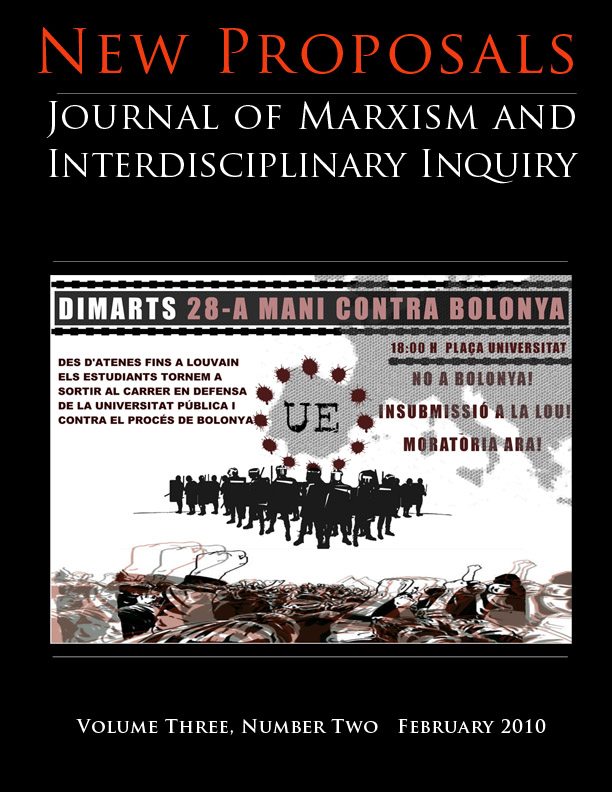
Cover Page

The latest issue of New Proposals: Journal of Marxism and Interdisciplinary Inquiry examines the corporatization of the university and resistance to it.

I’m pleased to be the co-author, along with John F. Welsh and Kevin D. Vinson, of one of the articles in the issue:

To Discipline and Enforce: Surveillance and Spectacle in State Reform of Higher Education
John F. Welsh, E. Wayne Ross, Kevin D. Vinson

Abstract

Drawing from concepts developed by the social theorists Michel Foucault and Guy Debord on the exertion of political power in contemporary society, this paper analyzes the restructuring of public higher education systems initiated by governors, legislatures and state higher education boards. The paper argues that the primary features of restructuring are (1) increased surveillance of the behaviors and attitudes of the constituents within colleges and universities by the state and (2) the spectacularization of reform by state governments. Surveillance and spectacle aim at the disciplining of individuals and enforcement of state policy and are forms of direct and ideological social control. They imply a transformation of relations between institutions and the state, particularly the subordination of the higher learning to state policy objectives.

Here’s the full table of contents:

New Proposals
Vol 3, No 2 (2010)
Universities, Corporatization and Resistance

Introduction
New Perspectives on the Business University
Sharon Roseman

Comments and Arguments
An analytical proposal for the understanding of the Higher Education European Space. A view from the University of Barcelona
Edurne Bagué, Núria Comerma, Ignasi Terradas

Resistance One-On-One: An Undergraduate Peer Tutor’s Perspective
Andrew J. Rihn

Articles
To Discipline and Enforce: Surveillance and Spectacle in State Reform of Higher Education
John F. Welsh, E. Wayne Ross, Kevin D. Vinson

Reviews and Reflections
Reflections on work and activism in the ‘university of excellence.’
Charles R. Menzies

Review of Peter Worsley, An Academic Skating on Thin Ice (Berghahn Books, 2008)
Sharon Roseman

The Exchange University: Corporatization of Academic Culture
Dianne West

A Return to Educational Apartheid? Critical Examinations of Race, Schools, and Segregation

A Return to Educational Apartheid? Critical Examinations of Race, Schools, and Segregation

A Critical Education Series

The editors of Critical Education are pleased to announce our second editorial series. This current series will focus on the articulation of race, schools, and segregation, and will analyze the extent to which schooling may or may not be returning to a state of educational apartheid.

On June 28, 2007, the Supreme Court of the US by a 5-4 margin voted to overturn Jefferson County’s four decade old desegregation plan. The Meredith case from Jefferson County was conjoined with the Parents Involved in Community Schools case from Seattle, WA, for which a group comprised primarily of white parents from two neighborhoods alleged some 200 students were not admitted to schools of their choice, based on “integration tie-breakers,” which prevented many from attending facilities nearest to their homes.

In Justice Roberts plurality opinion, he argued, “The parties and their amici debate which side is more faithful to the heritage of Brown [v. Board of Education, 1954] , but the position of the plaintiffs in Brown was spelled out in their brief and could not have been clearer: ‘The Fourteenth Amendment prevents states from according differential treatment to American children on the basis of their color or race’. What do racial classifications at issue here do, if not accord differential treatment on the basis of race?” And, later, “The way to stop discrimination based on race is to stop discrimination on the basis of race.”

Aside from the fact that the plaintiff in the Louisville case ultimately won her appeal in the Jefferson County system, placing her white child into precisely the school she wanted based on her appeal to the district, demonstrating that the system worked, it is the goal of this series to investigate the extent to which Justice Roberts and the other concurring justices have taken steps to erode the civil rights of the racially marginalized in order to serve the interests of the dominant racial group. It took just a little over 50 years (of monumental effort) to get a case to the Supreme Court to overturn Plessy v. Ferguson. Now, has it taken just a little over 50 years to scale that decision back with the overturning of voluntary desegregation plans in Jefferson County and Seattle School District 1?

In 2003, with a different make-up, the Supreme Court foreshadowed this 2007 verdict by rendering a ‘split decision’ regarding the University of Michigan admission policies. In the Gratz v. Bollinger case, the Supreme Court decided 6-3 that the University of Michigan needed to modify their admission criteria, which assigned points based on race. However, in the Grutter v. Bollinger case, the Supreme Court decided 5-4 to uphold the University of Michigan Law School’s ruling that race could be one of several factors when selecting students because it furthers “a compelling interest in obtaining the educational benefits that flow from a diverse student body.”

In Jonathan Kozol’s 2005 sobering profile of American education, Shame of the Nation: The Restoration of Apartheid Schooling in America, a lamenting follow-up to his earlier work, Savage Inequalities, he already began to illustrate the retrograde process many public school systems have undergone related to racial balance. His critique of these pre-Brown-like-segregation systems was balanced, ironically, by rather effusive praise of the Jefferson County system, which attempted to keep this balance in check. Does the 2007 decision remove this one shining example?

Though the course toward educational apartheid may not be pre-destined, what is the likelihood that the “path of least resistance” will lead toward racial separation? How does the lingering legacy of residential segregation complicate this issue? What connections can we draw to and/or how might further racial segregation exacerbate issues of poverty or unemployment? Further, where do race and class collide? And, where is a more distinct analysis necessary? Finally, what can we surmise about the ongoing achievement gap if, in fact, apartheid schooling is afoot?

Undoubtedly, at worst, this decision could prove to be a harbinger for the death of a waning democracy. Without a compelling public education that helps all our children become critical consumers and citizens, what kind of society might we imagine for ourselves? At best, though, this decision could marshal the sensibilities of a critical cadre of educators, social workers, health care workers, activists, attorneys, business leaders, etc. to stand in resistance to the injustice that is becoming our nation’s public school system.

In an LA Times opinion piece a few days before this 2007 decision, Edward Lazarus argued, “Although they may have disagreed about Brown’s parameters, most Americans coalesced around the decision as a national symbol for our belated rejection of racism and bigotry. Using Brown as a sword to outlaw affirmative action of any kind would destroy that worthy consensus and transform it into just another mirror reflecting a legal and political culture still deeply fractured over race.” As Allan Johnson (2006), in Privilege, Power, and Difference, claims, there can be no healing until the wounding stops. Likewise, paraphrasing Malcolm X’s provocation about so-called progress, he reminded us that although the knife in the back of African-Americans may once have been nine inches deep, that it has only been removed a few inches does not indicate progress. Will this decision plunge the knife further?

Series editors Adam Renner (from Louisville, KY) and Doug Selwyn (formerly of Seattle, WA) invite essays that treat any of the above questions and/or other questions that seek clarity regarding race, education, schooling, and social justice. We seek essays that explore the history of segregation, desegregation, and affirmative action in the US and abroad. While we certainly invite empirical/quantitative research regarding these issues, we also welcome more qualitative studies, as well as philosophical/theoretical work, which provide deep explorations of these phenomena. We especially invite narratives from parents or students who have front line experience of segregation and/or educational apartheid. Additionally, and importantly, we seek essays of resistance, which document the struggle for racial justice in particular locales and/or suggestions for how we might wrestle toward more equitable schooling for all children.

Please visit Critical Education for information on submitting manuscripts.

Also feel free to contact the series editors, Adam Renner (arenner@bellarmine.edu) or Doug Selwyn (dselw001@plattsburgh.edu) with any questions.