Category Archives: Labor

The Rouge Forum 2011: Call for Papers

The Rouge Forum 2011: Call for Papers

Education and the State: A Critical Antidote to the Commercialized, Racist, and Militaristic Social Order

The Rouge Forum 2011 will be held at Lewis University. The University’s main campus is located in Romeoville, IL, which is 30 minutes southwest of Chicago, IL. The conference will be held May 19-22.

Proposals for papers, panels, performances, workshops, and other multimedia presentations should include title(s) and names and contact information for presenter(s). The deadline for sending proposals is March 22. The Steering Committee will email acceptance or rejection notices by April 1. The proposal formats available to the presenters are as follows:

Bringing together academic presentations and performances (from some of the most prominent voices for democratic, critical, and/or revolutionary pedagogy), panel discussions, community-building, and cultural events, this action-oriented conference will center on questions such as:

  • Transforming the notion of “saving public education” to one of creating education in the public interest, what does teaching and learning for a democratic society look like?
  • How do we educate the public and our youth to understand the implications of “saving public education” through corporate and militaristic practices, such as standardized examinations, zero-tolerance policies, charter schools, and corporate donations?
  • How will educational initiatives supported by the Obama Administration and many other politicians impact teachers, students, and communities across the US?
  • What does education for liberation look like compared to the more socially reproductive/dominating education we see in many of our nation’s schools?
  • What debts will future generations, including the students we may teach, carry because our financial, governmental, and military endeavors have not been concerned with public goods?

SUBMISSIONS
Proposal Formats

Individual Proposal: (45 minutes)
The Rouge Forum welcomes individual paper proposals, with the understanding that those accepted will be grouped together around common or overlapping themes, Presenters will have approximately 45 minutes to present or summarize their individual papers. Individual paper submissions will be considered for panels with the same topic/theme. If you would prefer to present your paper/research individually you should consider the alternative format proposal. A 300-500 word abstract of the paper will be peer reviewed for acceptance to the conference.

Symposium Proposal: (90 minutes)
Presenters are also welcomed to submit proposals for a symposium. A symposium is typically composed of a chair and discussant and three to five participants who present or summarize their papers. Each symposium is organized around a common theme. Each participant will have between 15 and 45 minutes to present their papers, depending upon the number of participants involved in the symposium. A 300-500 word abstract of the symposium will be peer reviewed for acceptance to the conference.

Panel Proposal: (90 minutes)
A panel discussion is another venue available presenters. A panel discussion is typically composed of three to six participants who discuss their scholarly work within the context of a dialogue or conversation on a topic or theme related to the conference theme. Typically, each panelist is given 10-15 minutes to discuss the topic, present theoretical ideas, and/or point to relevant research. A chair should be identified who introduces the panel and frames the issues and questions being addressed. In addition to the chair, we encourage (but do not require) organizers of panels to include a discussant who responds to the comments of the panelists. Individual proposal submissions will be combined into panels with the same theme/topic. A 300-500 word abstract of the panel discussion will be peer reviewed for acceptance to the conference.

Alternative Format and Special Interest Groups (90 minutes)
Alternative proposals that do not fit into the above categories, such as workshops, performances, video and multimedia presentations, and round-table dialogues, are encouraged. We also welcome proposals for the organization of special interest groups. A 150-250 word abstract of the panel discussion will be peer reviewed for acceptance to the conference.

Email proposals to conference coordinator Brad Porfilio porfilio16@aol.com, by March 22, 2011.

Additional information on Rouge Forum 2011 is available at rougeforumconference.org

Update to issue 17 of Workplace: A Journal for Academic Labor

The current issue of Workplace: A Journal for Academic Labor has been updated with two new field reports.

Issue No. 17 of Workplace “Working In, and Against, the Neo-Liberal State: Global Perspectives on K-12 Teacher Unions” is guest edited by Howard Stevenson of Lincoln University (UK).

The new field reports include:

The NEA Representative Assembly of 2010: A Longer View of Crisis and Consciousness
Rich Gibson

Abstract
Following the 2009 National Education Association (NEA) Representative Assembly (RA) in San Diego, new NEA president Dennis Van Roekel was hugging Arne Duncan, fawning over new President Obama, and hustling the slogan, “Hope Starts Here!” At the very close of the 2009 RA, delegates were treated to a video of themselves chanting, “Hope starts Here!” and “Hope Starts with Obama and Duncan!” The NEA poured untold millions of dollars, and hundreds of thousands of volunteer hours, into the Obama campaign. In 2009, Van Roekel promised to tighten NEA-Obama ties, despite the President’s educational policies and investment in war. What happened in the year’s interim? What was the social context of the 2010 RA?

Resisting the Common-nonsense of Neoliberalism: A Report from British Columbia
E. Wayne Ross

Abstract
Faced with a $16 million budget shortfall, the Vancouver school trustees, who have a mandate to meet the needs of their students, have lobbied for more provincial funding to avoid draconian service cuts. The government has refused the request, and its special advisor to the Vancouver School Board criticizes trustees for engaging in “advocacy” rather than making “cost containment” first priority. The clash between Vancouver trustees and the ministry of education is not “just politics.” Rather, education policy in BC reflects the key features of neoliberal globalization, not the least of which is the principle that more and more of our collective wealth is devoted to maximizing private profits rather than serving public needs. British Columbia is home to one of the most politically successful neoliberal governments in the world, but fortunately it is also a place to look for models of mass resistance to the neoliberal agenda. One of the most important examples of resistance to the common-nonsense of neoliberalism in the past decade is the British Columbia teachers’ 2005 strike, which united student, parent, and educator interests in resisting the neoliberal onslaught on education in the public interest.

France on strike

France on Strike

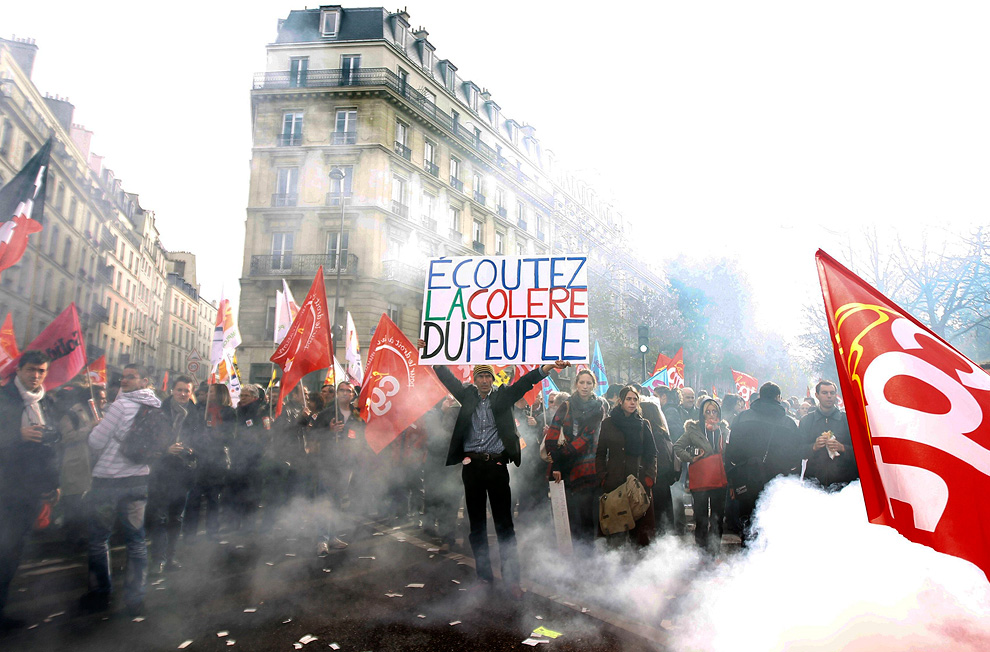
Weeks of strikes, protests and demonstrations have brought much of France to a standstill as workers, students and others voice their strong opposition to a government proposal to raise the age for a minimum pension from 60 to 62. A quarter of the nation’s gas stations were out of fuel, hundreds of flights were canceled, long lines formed at gas stations and train services in many regions were cut in half. Protesters blockaded Marseille’s airport, Lady Gaga canceled concerts in Paris and rioting youths attacked police in Lyon. The unpopular bill is edging closer to becoming law as the French Senate is preparing to vote on it today. Collected here are recent images of the unrest around France. Update: Pension reform bill just now passed by French senate. (40 photos total)


A man holds a placard which reads “Listen to the public’s rage” during a demonstration in front of the French Senate in Paris October 20, 2010. French trade unions kept up their resistance on Wednesday to an unpopular pension reform due for a final vote in the Senate this week. (REUTERS/Charles Platiau)

View more photos here.

“The Wobblies” (1979 documentary)

The 1979 documentary, The Wobblies, directed by Deborah Shaffer and Stewart Bird, is now available on line at google video (1:28:39). Highly recommended.

Related links:
“Remember the Industrial Workers of the World?”
By Michael Aktinson (Village Voice) June 20, 2006

This 1979 documentary established a new, primary-research modus for historical nonfiction—no narrator, no authorial perspective, just original documents and witnesses—but its subject matter was, and still is, its most radical characteristic. By the ’70s American culture had been made to forget that the Industrial Workers of the World had ever existed, just as in the century’s first decades the segregated union utopia was condemned, brutalized, legislated against, campaigned against, and demonized. Today, things haven’t changed much—Deborah Shaffer and Stewart Bird’s film stands among a scant handful of books detailing the labor movement’s astonishing power and growth, its newspapers and songs and sheer membership, as well as the sickening history of suppression, murder, and criminal injustice that was brought to bear upon it. (Don’t forget Warren Beatty’s Reds, shot around the same time and with several of the same elderly survivors.) American high schoolers should have to see it to graduate, but then so much of what they’re taught would evaporate as a consequence. Released with new interviews and old anthems, and alongside nine other classic docs in the “Docurama Film Festival I.”

Documents, Essays and Analysis for a History of the I.W.W. at marxist.org

Jim Crutchfield’s I.W.W. Page

Industrial Workers of the World (IWW) web site

Call for Proposals: Rouge Forum Conference 2010: Education in the Public Interest: Teaching and Learning for a Democratic Society

ROUGE FORUM CONFERENCE, 2010: CALL FOR PROPOSALS

Education in the Public Interest: Teaching and Learning for a Democratic Society

Rouge Forum 2010 will be hosted at George Williams College on the scenic banks of Geneva Lake. Located in Williams Bay, Wisconsin, the college is nestled between the major metropolitan areas of Milwaukee, Wisconsin and Chicago, Illinois. The conference will be held August 2-5.

Bringing together academic presentations and performances (from some of the most prominent voices for democratic, critical, and/or revolutionary pedagogy), panel discussions, community-building, and cultural events, this action-oriented conference will center on questions such as:

  1. Transforming the notion of “saving public education” to one of creating education in the public interest, what does teaching and learning for a democratic society look like?
  2. What does education for liberation look like compared to the more socially reproductive/dominating education we see in many of our nation’s schools?
  3. Are the current crises in the economy as well as educationally in such states as California or cities like Detroit indicative of a turning point in history? Has the rightward shift ebbed or will the economic crisis push the ruling class towards fascism?
  4. What is a public good? Is education a public good? Why is it treated as a private good?
  5. Is climate change a matter to be debated by governments and industry leaders? Has the public participated in the debate on climate change? What roles do educators have in making students aware of the implications of that debate?
  6. Are multi-trillion dollar deficits public ‘bads’?
  7. What debts will future generations, including the students we may teach, carry because our financial, governmental, and military endeavors have not been concerned with public goods?
  8. What are the educational implications of the recent Supreme Court decision to endow corporations with the right of free speech?
  9. How do we learn and teach to get from where we are to where we need to be?
  10. How do we stand up for the correctness of our ideas?
  11. How does change happen (individually, within a school, within a district)?
  12. Can the current system be reformed in order to better serve children, families, and citizens?
  13. If not, what would a new system look like? How would it be implemented? What past models exist on which to work and build?

To learn more about the conference, please contact any of our conference organizers:

Faith Wilson (fwilson@aurora.edu)
Adam Renner (arenner@bellarmine.edu)
Wayne Ross (wayne.ross@ubc.ca)
Rich Gibson (rgibson@pipeline.com)
Gina Stiens (stiensg@yahoo.com)
Doug Selwyn (dselw001@plattsburgh.edu)
Joe Cronin (jcronin@antioch.edu)

Or visit the conference website at: www.rougeforumconference.org.

Submissions
Proposals for papers, panels, or performances should include title(s), no more than a 500 word description, and names and contact information for presenter(s). Presenters should plan on 45 minute time slots to deliver papers. Panels and performances will be awarded 90 minutes.

Review of Paper and Panel Proposals treating any of the above questions will begin April 15, 2010. Please send your proposals to Faith Wilson (fwilson@aurora.edu). As we expect a number of proposals for a limited number of slots please forward your proposal as soon as possible.

Performance Proposals should also be forwarded to Faith Wilson (fwilson@aurora.edu) by April 15, 2010. Please describe your art/performance and how it may relate to the conference topic/questions.

Texas state school board continues assualt on reason

The right-wing wing assault on reason in schools has intensified with the appointment Gail Lowe as the chair of the Texas State Board of Education. Lowe recently criticized the inclusion of US Supreme Court Justice Thurgood Marshall and legendary labor leader Cesar Chavez in the social studies curriculum because, according to Lowe, Marshall and Chavez are are “not particularly known for their citizenship.”

Governor Rick Perry appointed Lowe to the position after the Texas state senate rejected Perry’s attempt to have Don McLeroy appointed for a second term as board chairman. In his role as chair of the Texas State Board of Education, McLeroy championed creationism and lobbied to have Texas science curriculum focus on the “weaknesses” of evolutionary theory. In a January 2009 editorial, The New York Times described the McLeroy’s board as “scientifically illiterate” for their efforts to create a science curriculum that reflects conservative Christian beliefs about creation, rather than  scientific evidence.

Under Lowe, the Texas Board is not likely change its tune. According to the Houston Chronicle, Lowe, a small town newspaper publisher,  is “unapologetic about her conservative Christian views.” In an interview with the Associated Press, Lowe said “This country was founded on Judeo Christian principles and to say otherwise is to deny what is very unique about our country,” and she believes that believes students should be taught “biblical motives of the country’s founding fathers.”

Lowe has been a member of the Texas board since 2002 and has consistently voted with the panel’s ultra conservative faction—opposing inclusion of contraception information in health textbooks, attacking evolutionary biology as part of the science curriculum, and rejecting the inclusion of two of the most towering civil rights figures of the 2oth century in the social studies curriculum,  Marshall and Chavez .

Lowe’s comments on Marshall and Chavez were in response to comments from members of  board appointed advisory-panel who have argued that Marshall—who argued the Brown v. Board racial desegregation case in the 1950s and who later became the first African American US Supreme Court Justice—and Chavez—the Mexican American farm worker, labor leader,  and civil rights activist—should be deemphasized in the social studies curriculum because they lack “the stature, impact and overall contributions of so many others.”

Marshall and Chavez are “not particularly known for their citizenship,” Lowe told the Houston Chronicle. “Figures we use to represent those character ideals (citizenship, patriotism and community involvement) and the type of persons we want your students to emulate should be politically neutral.”

Hmmm, what kind of logic is that? Well, it’s racist logic of course. Can you even find one figure in a US history textbook who is “politically neutral”? Even a white person?

Thanks to Tony’s Curricublog for the heads up on this (and many other stories).

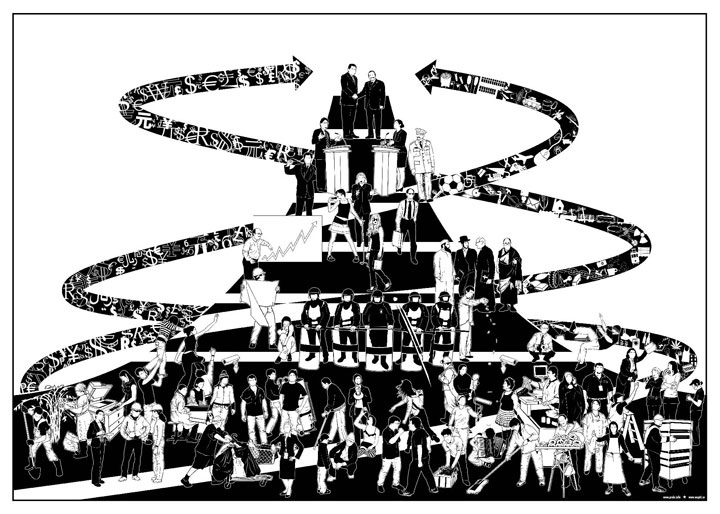
The new pyramid of the capitalist system

pyramid-1

Inspired by the old I.W.W. “PYRAMID of CAPITALIST SYSTEM”, this poster is a portrayal of class society as it appears to us today. The whirlwind of market forces encircle and shape society, operating through our activity, yet behind our backs. People at different levels of the modern capitalist pyramid enjoy it or defend it or cope with it or fight it or get drunk to forget about their place in it. This poster was designed in collaboration by wapiti.se and prole.info.

Download a print quality PDF of the new pyramid of the capitalist system here.

Order the Rouge Forum version of the original IWW pyramid of the capitalist system here.