Fourth International Conference on Education, Labor and Emancipation

Fourth International Conference on Education, Labor and Emancipation

This year’s Theme: Manifesto for New Social Movements: Equity, Access, and Empowerment

It will be help in Salvador, Bahia, Brazil on June 16th – 19th 2009.

Scholars, teachers, students and activists from various fields and countries will convene in Salvador, Bahia (Brazil) to compare theoretical perspectives, share pedagogical experiences, and work toward developing a global movement for social justice in and through education. We invite proposals from the following perspectives: indigenous, feminist, postcolonial, Marxist/neomarxist, queer theory, critiques of neoliberalism/globalization, CRT, liberation theology, anthropology, comparative/international education, etc. Visit our website for more information. http://academics.utep.edu/confele

We appreciate if you can forward this invitation to others who may be interested.

Please do send in your proposals, here are the guidelines:

CALL FOR PROPOSALS
We are currently witnessing the emergence of a new context for education, labor, and emancipatory social movements. Global flows of people, capital, and energy increasingly define the world we live in. The multinational corporation, with its pursuit of ever-cheaper sources of labor and materials and its disregard for human life, is replacing the nation-state as the dominant form of economic organization. Faced with intensifying environmental pressures and depletion of essential resources, economic elites have responded with increased militarism and restriction of civil liberties.
At the same time, masses of displaced workers, peasants, and indigenous peoples are situating their struggles in a global context. Labor activists can no longer ignore the concomitant struggles of Indigenous peoples, African diasporic populations, other marginalized ethnic groups, immigrants, women, GLBT people, children and youth. Concern for democracy and human rights is moving in from the margins to challenge capitalist priorities of “efficiency” and exploitation. In some places, the representatives of popular movements are actually taking the reins of state power. Everywhere we look, new progressive movements are emerging to bridge national identities and boundaries, in solidarity with transnational class, gender, and ethnic struggles.

At this juncture, educators have a key role to play. The ideology of market competition has become more entrenched in schools, even as opportunities for skilled employment diminish. We must rethink the relationship between schooling and the labor market, developing transnational pedagogies that draw upon the myriad social struggles shaping students’ lives and communities. Critical educators need to connect with other social movements to put a radically democratic agenda, based on principles of equity, access, and emancipation, at the center of a transnational pedagogical praxis.
Distinguished scholars from numerous fields and various countries will convene in Salvador, Bahia (Brazil) to compare and contribute to theoretical perspectives, share pedagogical experiences, and work toward developing a global movement of enlightening activism. Issues related to education, labor, and emancipation will be addressed from a range of theoretical perspectives, including but not limited to the following:

Critical Pedagogy

  • Critical Race Theory
  • Postcolonial Studies
  • Marxist and Neo-Marxist Perspectives
  • Social Constructivism
  • Comparative/International Education
  • Postmodernism
  • Indigenous Perspectives
  • Feminist Theory
  • Queer Theory
  • Poststructuralism
  • Critical Environmental Studies
  • Critiques of Globalization and Neoliberalism
  • Liberation Theology

Proposals may be offered as panel presentations or individual papers. Please indicate type of proposal with the submission.

Individual paper proposals should contain a cover sheet with the paper title, contact information (e-mail, address, telephone number, and affiliation), a brief bio, for each presenter, and an abstract of no more than 250 words (not including references). Please indicate whether you will present in Portuguese, Spanish or English. Presenters who wish to present in Portuguese should nevertheless include an English or Spanish translation of the abstract with their submission.

Panel proposals must include a cover sheet with the panel title and organizers’ contact information (e-mail, address, telephone number, affiliation), as well as an abstract of the overall panel theme (no more than 400 words, not including references) and abstracts/bios for each paper included in the panel. Please indicate whether panel members will present in Portuguese, Spanish or English. Proposals submitted in Portuguese should include translations (either English or Spanish) of the panel theme with each individual abstract.

Please submit proposals by E-mail only to: confele@utep.edu . THE DEADLINE FOR PROPOSALS IS March 1st, 2009. Proposals must be accompanied by your conference registration in order to be considered.

Following the tradition of the last three conferences, a book will be produced comprising the most engaging papers from CONFELE 2009, as selected by an editorial board. Presenters wishing to be considered for this volume should submit full papers (in APA style) for review by August 1st, 2009.
CFP: Academic Labor and Law

CFP: Academic Labor and Law
Special Section of Workplace: A Journal for Academic Labor

Guest Editor: Jennifer Wingard, University of Houston

The historical connections between legislation, the courts, and the academy have been complex and multi-layered. This has been evident from early federal economic policies, such as the Morell Act and the GI Bill, through national and state legislation that protected student and faculty rights, such as the First Amendment and affirmative action clauses. These connections continue into our current moment of state and national efforts to define the work of the university, such as The Academic Bill of Rights and court cases regarding distance learning. The question, then, becomes whether and to what extent the impact of legislation and litigation reveals or masks the shifting mission of the academy. Have these shifts been primarily economic, with scarcities of funding leading many to want to legislate what is considered a university education, how it should be financed, and who should benefit from it? Are the shifts primarily ideological, with political interests working to change access, funding, and the intellectual project of higher education? Or are the shifts a combination of both political and economic influences? One thing does become clear from these discussions: at their core, the legal battles surrounding higher education are about the changing nature of the university –the use of managerial/corporate language; the desire to professionalize students rather than liberally educate them; the need to create transparent structures of evaluation for both students and faculty; and the attempt to define the types of knowledge produced and disseminated in the classroom. These are changes for which faculty, students, administrators, as well as citizens who feel they have a stake in higher education, seek legal redress. This special section of Workplace aims to explore the ways in which legislation and court cases impact the work of students, professors, contingent faculty, and graduate students in the university. Potential topics include but are not limited to:

  • Academic Freedom for students and/or faculty
    • Horowitz’s Academic Bill of Rights
    • Missouri’s Emily Booker Intellectual Diversity Act
    • First Amendment court cases concerning faculty and student’s rights to freely express themselves in the classroom and on campuses
    • Facebook/Myspace/Blog court cases
    • Current legislative and budgetary “attacks” on area studies (i.e. Queer Studies in Georgia, Women’s Studies in Florida)
  • Affirmative Action
    • The implementation of state and university diversity initiatives in the 1970s
    • The current repeal of affirmative action law across the country
  • Benefits, including Health Benefits, Domestic Partner Benefits
    • How universities in states with same-sex marriage bans deal with domestic partner benefits
  • Collective Bargaining
    • The recent rulings at NYU and Brown about the status of graduate students as employees
    • State anti-unionization measures and how they impact contingent faculty
  • Copyright/Intellectual Property
    • In Distance Learning
    • In corporate sponsored science research
    • In government sponsored research
  • Disability Rights and Higher Education
    • How the ADA impacts the university
  • Sexual Harassment and Consensual Relationships
    • How diversity laws and sexual harassment policies impact the university
  • Tenure
    • The Bennington Case
    • Post 9/11 court cases

Contributions for Workplace should be 4000-6000 words in length and should conform to MLA style. If interested, please send an abstract via word attachment to Jennifer Wingard (jwingard@central.uh.edu) by Friday, May 22, 2009. Completed essays will be due via email by Monday, August 24, 2009.

A message from Staughton Lynd

I encourage you to get your library to purchase the new memoir by Staughton and Alice Lynd. EWR

Friends,
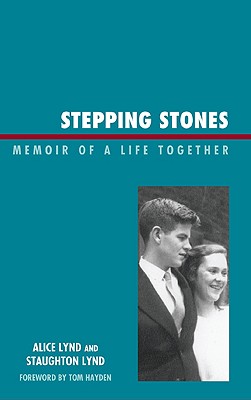
Greetings.  Alice and I have written a joint autobiography entitled Stepping Stones: Memoir of a Life Together.  We need your help in getting the book into the hands of the young people for whom it is most intended.

The book begins with a lovely Foreword by our longtime colleague, Tom Hayden.  Then come chapters, some written by us both, some by one of us, some by the other.  The chapters are grouped in the following sections:

Beginnings (our families, Staughton as a “premature New Leftist” and Alice on “Music and Dance and Discovering Childhood,” how we met and fell in love);

Community (our three years in the Macedonia Cooperative Community in the hills of Georgia);

The Sixties (among other matters, Mississippi Freedom Summer, a trip to Hanoi, Alice’s work in draft counseling and how it planted in our minds the idea of the “two experts” — the professionally trained person and the counselee, client or fellow struggler — who work together);

Accompaniment (how we found our way beyond the Sixties by doing oral history and then law together, with chapters on Nicaragua and Palestine);

The Worst of the Worst (representing and learning from prisoners);

Afterwords (a poem, retrospectives, Alice’s wishes for our daughter Martha’s marriage).

We had some difficulty finding a publisher.  At length we signed a contract with Lexington Books.  Lexington has produced an attractive hardback edition.  On the front cover there is a photograph of the two of us on the day we married (looking very young) and on the back cover a picture taken at our 50th wedding anniversary.

The problem is that this hardback edition is intended for academic libraries and costs $70.  Perhaps in part because of the current recession, we have been told that a paperback edition will be forthcoming only if orders from libraries are substantial.

This is where you can help.  It could make all the difference in getting this book into the hands of those who will carry on from all of us if you could:

* Ask whatever libraries you are connected with — law libraries, college or university libraries, public libraries — to acquire Stepping Stones.  The address of Lexington Books is:

Lexington Books
4501 Forbes Boulevard
Suite 200
Lanham MD 20706, www.lexingtonbooks.com.

There is a customer service number if desired:  800-462-6420.

* If you are told that the library would purchase a paperback edition but cannot afford an expensive hardback copy at this time, we hope you will write to Lexington Books and tell them that.

Let’s look at the bright side.  If your library orders a copy, you can read the durned book for free.  And if enough libraries order copies it will hopefully trigger paperback production, and together we can pass on to our successors what one Zapatista has called the hope of creating “another everything.”

With thanks, love, and comradeship,

Staughton Lynd for S&A

Rouge Forum Update: Staughton Lynd confirmed as Rouge Forum Conference keynoter

Dear Friends,

Great news! Staughton Lynd (http://en.wikipedia.org/wiki/Staughton_Lynd) has agreed to be a keynote speaker at the Rouge Forum Conference in Ypsilanti, Michigan, May 15 to 17:
Next week, more good news on the keynote topic.

Kathy Emery, expert on the Freedom Schools and, with Susan Ohanian, author of Why Is Corporate America Bashing Our Public Schools?, will be presenting in Los Angeles at the UTLA Human Rights Conference, 3303 Wilshire Blvd, March 27 and 28.

You can find a review at Book TV on CSPAN of Jeff Perry’s new book Hubert Harrison, The Voice of Harlem Radicalism.

Ravi Kumar has a fine interview with Peter Mclaren linked to Radical Notes online.

Resistance to inequality and injustice grows each week. From February 18th to 20th, NYU students occupied a building. They were removed and subsequently expelled. Each struggle brings its own lesson on how to better prepare. Details are here.

There is a lengthy struggle, a strike and civil uprising on Martinique.

A bus strike may lead to a general strike in Ireland.

Two big Marches in March.
Most of the anti-war movement will be on the streets on March 21 to condemn the invasion of Iraq (next week a report on the decisions made by the Historians Against the War regarding Afghanistan and other imperial adventures). And there is a call nationwide to March Forth on March 4th, against the homophobia inherent in the vote on California’s Prop 8.

Tougher News: George Soros agrees the sky is falling.

While the auto bailout/UAW sellout amounts to what looks to be the coming end of auto-worker health benefits.

Joel Kovel was fired at Bard. You can review the background and offer help here.

Thanks to Bonnie M, Paul, Joe B and C, Adam, Amber, Candace, Sally, Julie, Jill, Sandy, Laurel, EWR, Ravi, Don A, Ginger H, Kim B, Perry and Steve, Shelly, Kelly, Gina, Ludden, Carlson, Riley, Tommie, Bob, Dave and Sharon, Elaine H, Penny Brown, Sue, Greg and Katie, Bill B, Kevin, Paul and Mary.

All the best,
r

Another example of Marx’s relevance today: The real barrier of capitalist production is capital itself

Capital, Volume 3, Chapter 15

“The real barrier of capitalist production is capital itself. It is that capital and its self-expansion appear as the starting and the closing point, the motive and the purpose of production; that production is only production for capital and not vice versa, the means of production are not mere means for a constant expansion of the living process of the society of producers. The limits within which the preservation and self-expansion of the value of capital resting on the expropriation and pauperisation of the great mass of producers can alone move  these limits come continually into conflict with the methods of production employed by capital for its purposes, which drive towards unlimited extension of production, towards production as an end in itself, towards unconditional development of the social productivity of labour. The means  unconditional development of the productive forces of society  comes continually into conflict with the limited purpose, the self-expansion of the existing capital. The capitalist mode of production is, for this reason, a historical means of developing the material forces of production and creating an appropriate world-market and is, at the same time, a continual conflict between this its historical task and its own corresponding relations of social production. “

Rouge Forum Update: Sky Falling and More!

[Illustration from Z Magazine]

Dear Friends,

The sky is falling. The good thing, and the bad thing, is we were right about that.

Below is a short synopsis of our current context and reasons why you should plan to be at the Rouge Forum Conference in Ypsilanti, Michigan, May 15 to 17. Bring friends and submit a proposal.

The core issues remain inequality on the one hand and organized resistance on the other hand.

Inequality booms world-wide. In the US productivity went up on a near 90 degree vertical line. But wages remained stagnant, creating classic forms of overproduction (in sum, workers unable to buy products their class produces). Simultaneously, finance capital came to dominate and almost split away from productive capital, allowing the working class to maintain a standard of living by offering endless debt and falsely inflated home values. This is the video, Capitalism Hits the Fan.

Finance companies began to buy on margin inside a massive Ponzi scheme of mortgage securities. Fraud leaped in: Maddoff. Finance capital, became a barrier to itself, as Marx wrote years ago, and now we have real stagnation, banks awash in capital they will not loan, huge companies unable to sell goods, and workers losing jobs by the hundreds of thousands; a downward spiral that appears to have no bottom. GM just announced another 47,000 layoffs; demanded–with Chrysler–a total of about $39 billion from US taxpayers.

The aged millionaire Lady Astor complained bitterly about how finance capital operated. She commented on her 100th birthday, “Everyone became obsessed with money in the 1990’s and went higgledy-piggledy scampering after their fortunes,” she said. “People with money used to often care about the people who had no money. Not always, but often. Now, it is rare to find people with money who care at all about people with no money” (New York Times, March 30, 2002).

We witness the corporate state coming into being, the merger of government, business, and the military. Nearly $3 trillion will go to the banks, another $1-2 trillion to the military soon.

This is, as Foster and Magdoff make clear in their recent Monthly Review book, the Great Financial Crisis, a predicament that cannot be solved for working people within the system of capital. If reforms are to be won, they can only be won by linking immediate reform to profound social change. Every reform will be unsustainable.

Containing populations suffering from inequality will become the prime project of ruling classes everywhere, in schools and out. We have  seen massive demonstrations and strikes in Europe already, often initiated by students and teachers.

The large existing organizations that claim to defend working people and students, like the unions, are absolutely unprepared and unfit to meet this crisis. The UAW agreed to the 47,000 layoffs (having already lost a million members) and more concessions still–when concessions never save jobs, other than bosses’ jobs.

In schools, we can foresee a sharpened effort to eliminate freedom, to sharpen the regimentation of curricula, to impose more sophisticated testing, and more militarization as well (perpetual war is real).

Here is AFT’s President Randy Weingarten demanding more national education standards which will invariably tied to high-stakes exams and married to the Obama project of privatized charters.

Criticism of the anti- war coalition United For Peace and Justice continues to flash around the net. Here is one of the latest if not the most troubling, attacking UFPJ’s leadership for abandoning the fight to prosecute war crimes:

Here are two pieces from Rouge Forum members regarding UFPJ:

http://www.richgibson.com/wheremovement.htm
http://www.richgibson.com/icing.htm

The latest Obama Bailout remains mostly a mystery, a secret. But here is a the simple rough outline that we have seen so far, though it makes little sense as a jobs or people stimulus.

And the quick upshot: White recession, black depression.

It is no stretch to see that we are watching the emergence of fascism, which has never solved the problems it claims to solve. Here is Chris Hedges on Inverted Totalitarianism.

Only the Rouge Forum in the US has, in organized fashion, taken up these issues for a decade and translated research into action. We also forged a culture of friendship and mutual respect, among many differing viewpoints, that many people see as the highlight of the conference. Join us!

And for a moment’s relief—Calvin and Hobbes got it a long time ago.

Thanks to Faith, Wayne, Amber, Wendy, Victoria, Tommie, Bob, Gina, Adam, Candace, Sharon Ag…., Della, Kathy Young, Bill, Greg, Emily, Don A., Jim B, Dave S, Gil G, Peter M, Vanessa, Molly, Dave S, SL, Bonnie Macintosh, Nancy S, Steve R and Ricky C, Kelly, Beau, and the Old Mole.

All the best and good luck to us, every one.
R

Your Education Matters: Testing and the purposes of education

From the Public Education Advocates network:

FSA testing has increased the discussion of the purposes and value of public education.  You will want to view this program.

Simon Fraser University Professor Paul Shaker hosts a cable program, Your Education Matters. The next program features Paul Shaker with guests, UBC Professor Charles Bingham, and Mike Zlotnik, President of the Charter For Public Education Network.

This program features the purposes and principles of public education and begins with a discussion of the Charter for Public Education principles. It also discusses the attempt to turn education into a market commodity and why that is a mistake. And it closes with a discussion of the FSAs and why that is a mistake.

Given that FSA testing is going on right now, the show is very timely.

It has already aired twice on Shaw TV Cable, which is Channel 4 in the Vancouver area. This same episode will be rebroadcast all through February.

The next four episodes are as follows on Shaw cable (Channel 4 here):

Sunday, February 15, 1:30 a.m. and 7:00 p.m.
Wednesday, February 18, 3:30 a.m. and 3:30 p.m.

Other episodes can be seen at http://www.youreducationmatters.ca/

Student Protests Sweep Italy

While Americans waste their time discussing what position they’ll be in as they continued to get screwed by the bank bailouts and/or tweaking the reactionary education reform mess of No Child Left Behind students in Italy are saying “NO” to the Berlusconi government’s plan to impose business models on public services such as schools and universities that will see the disappearance of nearly 100,000 teaching positions in the next three years:

This “euthanasia of the universities”, as Gaetano Azzariti, professor of constitutional law at Rome university, calls it, was a political decision, sacrificing teaching and research to sectors of the economy. It means that for a university to hire a new lecturer now, two others have to leave its payroll. And it means more private sector funding in universities and higher tuition fees, leading to increased levels of debt for the poorest students. And on August 28, education minister Mariastella Gelmini presented another executive order, setting out budget cuts and plans to return to single teachers in primary schools (each class is normally taught by several different teachers), meaning a shorter school day for children (and reducing parents’ ability to go out to work). Other measures aimed to revive old practices, such as marks for behavior up to secondary level.

Since the start of the school year in September 2008, a national movement of parents, teachers and students resisting the neoliberal reforms of the Berlusconi government formed under the banner of “Non rubateci il futuro” (Don’t steal our future) and have spawned huge demonstrations and university occupations and general strikes.

“What’s developing is the self-organization of university students and casual workers,” explained Aliocha, a literature student at La Sapienza university who is also a casual in a bank. “Some people combine being casual workers and students or researchers, others are just casual workers. Together with the rank and file unions, we started the October 17 strike, and organized it in workplaces where job insecurity is an everyday reality.”

See Serge Quadruppani’s article at CounterPunch.

NCSS continues to advocate for government mandated high-stakes testing

Despite the research illustrating deleterious effects of high-stakes testing on teaching and learning, the National Council for the Social Studies continues to be an advocate for it.

NCSS, the largest group of social studies education professionals in the world, and it’s state level affiliates, use the perverted logic that the only way to preserve social studies courses in the curriculum is for those courses to be included in mandated high-stakes testing schemes.

The latest example of this perversion of education is in Massachusetts, where the state plans to either eliminate or delay required history and social science exams for 10th graders.

In response, the Massachusetts Council for the Social Studies has started a campaign to the save the tests! And the NCSS Board of Directors has sent an letter to the Mass. Board of Education stressing the importance of implementing the proposed exams as scheduled.

The logic is apparently that state mandated high-stakes exams are a way for governments to show their commitment to social studies. But do we need social studies courses that narrow the curriculum to what is on the exam? That undermine teacher professionalism by turning teachers into clerks for the state, whose job it is to feed students exam answers?

The idea that NCSS’s raison d’être—the promotion of “democratic citizenship”—is advanced by students and teachers willingly participating in a scheme that reduces education to scores is absurd.